As we have indicated, the internet is not the first communication technology to have appeared, nor has it developed in a socio-political vacuum. In this section we are going to focus on the close relationship between communication and technology from a sociological perspective. In particular, we will introduce the most relevant ideas from diffusion theories, i.e. those theories that explain how technological innovations enter a community of people (1.1.1), what are the possible attitudes of people towards new technologies (1.1.2), and what is the process that leads a technology to be (or not to be) adopted and to spread within a community (1.1.3). Then we will focus on the appearance and diffusion of new communication technologies in particular, analysing their relationship to other pre-existing communication technologies, the phenomenon of so-called 'mediamorphosis' (1.1.4).
1.1.1 The diffusion of technological innovations
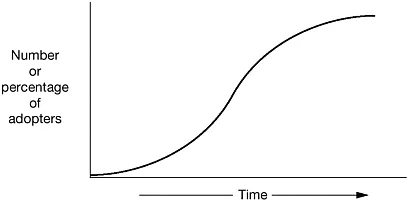
When a new technology becomes available on the market, the way by which it comes to be adopted within a social community usually does not follow a linear and continuous path (see Figure 1.1). The study of the impact of new technologies on social groups shows that the process of adoption (or refutation) of technologies can be very complex and manifold.
Two models can help us in explaining the diffusion of innovations: the model of linguistic change and that of ecological systems:
1 The model of linguistic change explains the phenomenon of innovations in human languages: that is, how a new element (a new word, a new syntactical construction, and so on) enters the language system and gets to be used by a given community. The introduction of a new element into the language follows three steps: the new element is created/ invented by someone who first coins it and uses it or a new sense is given to an existing element (innovation): 'everything in which the speech goes far from the existing models of the language in which the speech is established is an innovation' (Coseriu 1981: 55). The new element is then adopted and used by the hearer (adoption): 'the acceptance of an innovation by the hearer as a model for further expressions is adoption' (Coseriu 1981: 55). Finally, the new element spreads in the system; for instance, a word becomes part of the lexicon of a language, is inserted in the language dictionaries, and so on (change): 'linguistic change is the
diffusion or the generalization of an innovation, that is, necessarily, a series of subsequent adoptions' (Coseriu 1981: 56; see also Cantoni and Di Blas 2002: 30).
Technological innovations follow similar steps in their diffusion: a new technology is first invented; it is then adopted by a small community; it finally spreads in a society, partly overlapping with other existing technologies, partly overcoming old ones.
2 The impact of a technological innovation on the context in which it is inserted (a society, a community, an organization) can be well explained through the comparison with an ecological system. Ecological systems have two basic features:
a) They are high-interdependence systems, i.e. all the elements of the system are highly interdependent with one another. This means that a little change made in a part of a system, such as, for instance, the arrival of a new animal species in a part of the system – let us say a lake – has consequences on the whole system: all the other elements will be somehow affected by the change, some more directly, some less so. For instance, all the animal species that were already present in the system will have their space reduced, the food chain of the system will necessarily be modified, and so on.
b) Ecological systems are also characterized by the non-reversibility of their processes: once a process takes place, it is impossible to return to the status of the system before the process. If, for instance, a pollutant is spilled into the lake, it will have such an impact on the lake's flora and fauna that it will be impossible to completely eliminate the pollutant and, as if nothing had happened, let the lake return to the way it was before.
High interdependence and non-reversibility are important features of communication systems as well. When a new communication technology is adopted, for example, by an organization, the adoption will affect the whole organization, since the new element necessarily gives rise to a reorganization of the whole system. If one introduces e-mail in an organization, the new element will necessarily be used for some tasks that were before carried out by means of fax, phone, mail or express carrier; each one of the 'old' technologies will thus have to re-negotiate its field of action (its territory) with e-mail; and if one then decides, for unpredictable reasons, to eliminate e-mail from the organization, one will never be able to restore the situation as it exactly was before the adoption of e-mail.
Since the second half of the last century, diffusion theories have analysed the diffusion of innovations in given social contexts. Everett M. Rogers defines an innovation as 'an idea, practice or object that is perceived as new by an individual or other unit of adoption' (Rogers 1995: 11), and diffusion as 'the process by which an innovation is communicated through certain channels over time among the members of a social system. It is a special type of communication, in that the messages are concerned with new ideas' (Rogers 1995: 5). We notice here that the novelty of an innovation is defined on the basis of the perception that a unit of adoption has of it, and not of its intrinsic qualities, i.e. of its 'real' novelty. Let's introduce the subject through two well-known examples, taken from Rogers' book Diffusion of Innovations:
1 The first example has nothing to do with communication technologies, actually it refers to something that can be considered a technology in a very broad sense: water boiling.
After the Second War World, the Peruvian public health service tried to introduce boiling of drinking water in a little Peruvian village, Los Molinas. During the two-year campaign, the service sent a health worker, Nelida, to the village whose task was to persuade the housewives of the village to add water boiling to their pattern of daily behaviour. In two years, Nelida was able to persuade only 5 per cent – 11 families! – of Los Molinas population to adopt the innovation.
Why did the adoption of this important and healthy innovation fail? First of all, because of the cultural beliefs of the villagers: in her campaign Nelida did not take into account the hot–cold belief system (see Helman 2001), which is very common in most nations of Latin America, Asia and Africa. According to these beliefs, water is a 'cold' element, and boiling it would have made it 'hot', i.e. appropriate only for sick persons. Second, social reasons prevented the innovation from being adopted: Nelida worked with the wrong housewives of the village, because she ignored the importance of interpersonal relationships and social networks within that milieu; she did not work with the village opinion leaders, who could have activated local networks to spread the innovation; rather, she concentrated her efforts only on a few, socially excluded housewives. Furthermore, Nelida herself was perceived as an outsider by village housewives, in particular by lower-status ones (Rogers 1995: 1–5).
2 The second example deals more directly with ICTs: it is the case of the diffusion of the so-called 'QWERTY' typewriter (and computer) keyboard, named after the first six keys on the upper row of letters. The QWERTY keyboard is inefficient and awkward; it was invented in 1873 in order to slow down typists, since when they struck two adjoining keys too fast, often these jammed. The QWERTY keyboard, thus, allowed early typewriters to work satisfactorily by placing letters on the keyboard in such a way as to cut down on hasty jamming of two keys. In 1932, when the QWERTY design was no longer necessary, August Dvorak invented a much more efficient keyboard whose design was informed by the results of a series of time-and-motion studies. Nonetheless, the Dvorak keyboard did not spread at...