- 200 pages
- English
- ePUB (mobile friendly)
- Available on iOS & Android
eBook - ePub
About this book
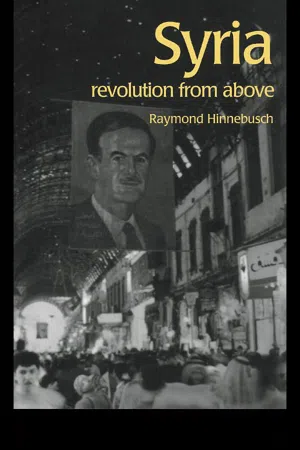
This study examines the development of the Syrian state as it has emerged under thirty-five years of military-Ba'thist rule and, particularly, under President Hafiz al-Asad. It analyzes the way in which the fragility of the post-independence state, unable to contain rising nationalist struggle and class conflict, opened the way to the Ba'th party's rise to power and examines how the Ba'th's 'revolution from above' transformed Syria's socio-political terrain.
Information
Chapter 1
INTRODUCTION:
CONCEPTUALISING THE SYRIAN BA’TH STATE
The theme of this study is the nature and development of the Syrian state, chiefly as it has emerged over nearly four decades of military- Ba’thist rule. The Ba’th party was by no means Syria’s only important political force but it left the most profound imprint on modern Syria. Indeed, the Ba’th’s half century history has paralleled the history of modern Syria itself. The Ba’th created a regime which proved remarkably enduring. It confounded observers who expected its collapse or transformation from the Nasserist opposition of the sixties, the Islamic uprising of the late seventies, from the economic stagnation of the eighties, from the end of the Cold War’s Soviet aid and protection, and from economic globalization and democratisation. Moreover, this regime is arguably strong: it carried out a substantial revolution from above in the 1960s and since the 1970s its economic and foreign policies have retained a remarkable consistency in spite of substantial changes in its domestic and international environments.
There is considerable controversy over how the Syrian Ba’th regime may best be conceptualised, perhaps reflective of its complex nature. The Ba’th came to power by a military coup and the army is a central pillar of the regime, but it is an “army-party symbiosis,” not mere military rule (Rabinovich 1972). The Alawi minority sect has dominated it, but it is not simply a minority regime and incorporates a cross-sectarian coalition (Van Dam 1981). At its centre is the personal dictatorship of Hafiz al-Asad, but his power rests on complex institutions (Perthes 1995). It has been described as a regime of the state bourgeoisie (Perthes 1995), but it also rose out of and incorporates a significant village base (Van Dusen 1975). Thus, no single one of the typical explanations of the regime—army, sect, class —adequately captures its complex multi-sided nature.
The Ba’th regime is, however, by no means wholly unique and indeed, it may best be Understood as a version of the dominant form of state in the Middle East, the prototypes of which were the region’s most successful and imitated state building experiments, Ataturk’s Turkey and Nasser’s Egypt. This regime type may perhaps best be labelled “populist authoritarianism” (Hinnebusch 1990:1–3; Ayubi 1992; Ayubi 1995:196–223). Populist authoritarian (PA) regimes embody a post-decolonization state-building strategy adopted by nationalist elites which face simultaneous external threat and internal instability. These regimes, artefacts of the early stages of state building, led and supported by elements of the small middle class, and initially based primarily on command of the military and bureaucracy, face the challenge of winning legitimation for their power among the mass public. New entrants to the international system at the bottom of the world power hierarchy and on the “periphery” of the world capitalist system, they also seek to consolidate independence through state led “defensive modernisation” based on import substitute industrialisation in the virtual absence of an industrial bourgeoisie (Hudson 1977; Ayoub 1995).
This state building project is seen to require, in Trimberger’s (1978) words, a “revolution from above.” Such a revolution effects a major transformation in elites, political institutions and social structure but is initiated from above by “reform coup” and without the mass violence and insurrection from below typical of great revolutions. Insofar as the PA regime uses its concentrated power chiefly to attack the old dominant classes while seeking legitimacy through egalitarian ideology and the political incorporation of middle and lower strata, it is arguably “populist,” that is, an “authoritarianism of the left” which challenges rather than defends the traditional, privileged status quo. But PA regimes neither necessarily remain popular or representative of popular interests; indeed they suffer from a built-in contradiction between their attempt to mobilize yet’control popular participation. Whatever their limitations, however, such revolutions from above have been the main vehicles of socio-political change in the Arab world where both mass revolution from below and evolutionary democratic reform have been rare.
I.
EXPLAINING THE RISE OF POPULIST AUTHORITARIAN ISM
What the Ba’th called its “Eighth of March Revolution” (thawrat aththamin min athar) is sometimes viewed as a mere military coup or sectarian power seizure, but it was substantially more than these. Indeed, the Ba’th’s rise to power had features of what Walton (1984) calls “national revolts” from below, that is, social movements which have many of the ingredients of “great revolutions,” albeit less explosively combined. In the Syrian case, a radical coup grew out of an anti-oligarchy alliance of a radicalised lower middle class,including strategic elements of the officer corps, with marginalized minorities and a significant proportion of the peasantry mobilised by agrarian conflict. Such an alliance depends on certain ingredients, adumbrated below, which arguably came together in the Syrian case.
1. International Context: Imperialism and nationalism: The rise of radical regimes in the Third world is a function of nationalist struggle against imperialism and the more damaging the impact of imperialism or prolonged the nationalist struggle, the more nationalism is radicalised, as was arguably so of Syria. The external imposition of state boundaries which fragmented historic Syria and corresponded to no popular identity, combined with the creation of Israel on a part of this territory, generated powerful supra-state irredentist ideologies— Pan-Arabism, Pan-Syrianism and Pan-Islam—with enduring revisionist claims. National and social conflict became inter-linked as the traditional elite’s association with imperialism destroyed its legitimacy. Moreover, as the national struggle mobilised and incorporated ever more plebeian elements, nationalist leaders proposed ever more radical social solutions to the national problem; in particular, it was their combination of nationalist ideology and struggle for land reform that nationally mobilised Syrian peasants which, in turn, ensured the national revolution would also be a social revolution.
2. The New Middle Class: The rise of authoritarian-populist states is an artefact of a particular, fairly early, stage of development and class formation. A landed oligarchy dominates the chiefly agrarian bases of national wealth while a small rising bourgeoisie has launched early capitalist development, sharpening the substantial existing class inequalities. Capitalist and bureaucratic growth, coming in cycles, creates a growing salaried and/or small-property-owning “new middle class” but, periodically faltering, frustrates its expectations; the oligarchy also obstructs its political ambitions. PA regimes are normally, first of all, vehicles of a “new middle class” radicalised by the perceived incompatibility between the oligarchic order and the satisfaction of its demands for modern careers and a share of power (Halpern 1963:51–78; Huntington 1968:39–59). This was so of Syria.
3. The military: Army officers are normally elitist and conservative, but may be radicalised if: a) radical reform is seen to be essential to the “defensive modernisation” needed to cope with external threats, and b) the military is autonomous of the dominant class, being recruited from the lower middle class and/or marginal ethnic groups, or from the rural hinterland. All of these conditions held in Syria (Wolpin 9–26, 114–116; 1963:251–280; Trimberger; Huntington 1962; 1968:192–237; Halpern 1963:251–280).
4. Minorities: Where, as in Syria, low class status is associated with certain deprived minorities, that is, where class and communal cleavages overlap, not only will conflict be particularly intense, but deprived communal groups may view class revolution as the solution to their particular deprivations. In addition, the unevenness of mobilisation of different communal groups due to such accidents as geographical location, population pressure and access to education, often results in the disproportionate representation of radicalised minorities in national or class-based populist movements. This was so of Syria, where the main peripheral minorities, the Druze, Isma’ilis and above all the Alawis, embraced the most radical versions of Arab nationalism as a way both of integrating into the national community on an equal basis and contesting the power of the dominant Sunni elite.
5. The Peasantry: Huntington (1968:292) points out that middle class radicalism merely produces instability and that it takes a middle class-peasant alliance to produce durable radical change. However, peasants are only available for political mobilisation when radicalised by intense land hunger and when the landlord class lacks a leadership role in the village (Moore 1966; Anderson 1974). Syria’s historically sharp gaps between urban-based landed magnates and the village, combined with the agrarian crisis arising from capitalist penetration and land concentration, radicalised important sections of the Syrian peasantry. Localised peasant movements, combined with the recruitment of peasant youth from the most mobilised regions into the Ba’th party and army, prepared the way for the Ba’th coup and thereafter the Ba’th’s mobilisation of a broader rural base from above.
II.
STATE FORMATION UNDER BA’THIST AUTHORITARIANISM
If populist revolt is to succeed, it must be institutionalised in a state. A paradigm for understanding how authority in PA regimes is established and evolves can be derived from various models in the literature. In Ibn Khaldun’s Middle East-specific paradigm a new state is founded by a movement from the periphery fired by a vision of radical change which seizes the “city”—i.e., existing bureaucratic chains of command. This corresponds to Max Weber’s authority type in which the charismatic leader of an ideological movement aims to launch revolutionary social change. Huntington (1968:140–47) disaggregates the rise of new authority into two phases, arguing that its success requires that the seizure and concentration of power at the centre be accompanied or followed by the expansion of power. This requires the revolutionary leaders create political organisations, notably an ideological party, to mobilize new participants whose activism expands the political energy at the regime’s disposal. Finally, the consolidation of new power requires, according to Weber, that it be “routinized” in stable institutions, but this may take two quite opposite forms. Power may be diffused through legal-rational institutions based on consent and the satisfaction of (largely economic) interests; alternatively, it may be routinized in personal patrimonial authority in which case state power capabilities actually contract (Weber 1964:363–373). The Syrian case largely replicates this “life cycle:” power was concentrated through an ideological movement and a revolution from above, expanded through party-building, and consolidated through patrimonialization, at the cost of a later contraction in power.
A.
Building new power
1. Power Concentration: Sect and the Regime Core: The attempt of the Ba’th regime to concentrate power in a new state centre based on ideology and collective party institutions (a mix of charismatic-ideological and legal-rational authority) was obstructed by the factionalism of the new elite, reflective of Syria’s fragmented society. Contenders in intra-regime power struggles, even when turning on ideological issues, made use of asabiya—kinship and sectarian solidarity—and Alawis, by virtue of their disproportionate recruitment, were best positioned to succeed. The centre was stabilised only when one faction finally won out and its leader, Hafiz al-Asad, established patrimonial authority. Although Asad forged a cross-sectarian coalition, at its core were loyal followers from his Alawi sect. This personal authority was then semi-institutionalised in an office—partly bureaucratic, partly patrimonial: a virtual “Presidential Monarchy.” Arguably, this outcome was compatible with the political culture transmitted from Syria’s patrimonial past.
2. Power concentration: the military pillar of power: The Ba’th regime used coercion to establish power against the resistance of the majority of the political class, not only the oligarchy but the urban middle class as well. This required reliable instruments of coercion, including the “mukhabarat” (secret police), but above all the transformation of the military into a reliable regime pillar.
In fragmented societies, the army is often the most organised, national-oriented social force with the largest stake in the state and the best equipped to impose order. But whether the military acts to concentrate power or, reflecting society’s fragmentation, dissipates it
through praetorian coups and counter-coups, depends on its incorporation into a system of authority. The Ba’th attempted to make the military an instrument of the ruling party through ideological Ba’thization (the Leninist model) but this only infected the army with the party’s ideological rivalries. It took the “Ataturk option,” the authority of a dominant military politician—Asad—to contain, albeit not eliminate, military praetorianism: a huge military establishment became the shield of the regime while personally loyal Alawi guard units became key power brokers.
3. Power expansion: the party: As a seminal volume on the Arab state (Dawisha and Zartman 1988) suggests, understanding the durability of Arab regimes requires that analysis go “Beyond Coercion” which alone is never enough to ensure stability: government can never directly coerce more than a minority; the ability to coerce depends on the always problematic loyalty of followers, and coercion can only concentrate, not expand power; the weak state captured by the Ba’th had so little power and urban centred opposition had such effective means of resistance that regime survival required power expansion, that is, bringing in new participants through regime institutions.
If the military is crucial to the concentration and defence of power in PA regimes, the single or dominant party is the key to the mass incorporation on which power expansion depends. According to Perlmutter (1981:2–5), such a political infrastructure is the chief feature distinguishing modern from traditional authoritarianism. Huntington argues that the Leninist party, with its core of ideological militants and mass auxiliaries penetrating society, is uniquely capable of both concentrating power and expanding it (Huntington 1968:334–343; 1974).
But is authoritarian single party rule compatible with political participation? It is certainly not compatible with fully inclusive participation but it can, arguably, accommodate limited participation. In fact, authoritarian regimes are normally a function of a split society in which one coalition of social forces imposes its rule on another: while the more common “bureaucratic-authoritarian” (BA) regimes of Latin America aimed to politically exclude the masses in order to impose capitalist development favouring the dominant classes, PA regimes invert this, excluding the dominant classes while seeking to mobilize and incorporate a counter-vailing mass constituency (Waterbury 1983:6–11; Ayubi 1992:98–101; Huntington 1968:344– 396).
This “mobilised participation” is crucial for the consolidation of PA regimes, but it may also make a difference for policy outcomes as well: arguably, the more the seizure of power is preceded, accompanied, or followed by social conflict and political mobilisation, the more the ruling revolutionary party will incorporate true activism, and the more enduring its populist orientation will be as its constituents become a constraint on dilution of the radical ideology and egalitarian policies initially used to mobilize them (Huntington 1974; Huntington and Nelson 1976:7–10; Nelson 1987; Skocpol 1979). In the Syrian case, the Ba’th came to power by coup, not mass mobilisation, but a prior decade of social crisis and anti-oligarchy party activism meant the coup was a delayed outcome of prior political mobilisation which the regime subsequently reactivated and incorporated through the party and its associated corporatist structures.
B.
The political economy of power consolidation
Weber argues that, as ideology inevitably declines, regimes must consolidate power through economic rewards to followers. PA regimes initially do so through re-stratification, the demolition of old distributions of wealth and the state creation of new ones (Apter 1965: 123–133). The state levels the dominant classes, the most independent social forces; control of the public sector and land reform allows it to redistribute resources and opportunity, and thereby foster upward mobility for its constituency while making mass society state-dependent.
The consolidation of PA regimes in the Middle East cannot, however, be detached from war, war preparation and the state’s position in the international system. In the Syrian case, the insecurity stimulated by the Arab-Israeli conflict, especially the defeat in 1967, legitimated the creation of an authoritarian national security state. On the other hand, the resources for this project partly derived from Syria’s exploitation of Cold War rivalries which allowed it to access Soviet protection, arms and development aid. Moreover, the oil price explosion in the seventies and Syria’s status as a “front line state” with Israel allowed it to extract oil rent from regional donors. This transformed Syria into a partial or indirect rentier state, with some of its new rent deployed as patronage needed to satisfy the regime’s constituency once redistribution was exhausted (Beblawi & Luciani 1987; Leca 1988).
The patrimonialization of the regime centre, combined with the fluidization of the social structure and the new rentierism permitted the consolidation of a “Bonapartist” regime—one led by a dominant patrimonial leader who uses the bureaucratic and distributory command posts of the state to balance and arbitrate between levelled old and rising new social forces. As the regime’s autonomy of society is thereby enhanced, its orientation alters: defence of state interests—its legitimacy, capabilities, and resource base—is p...
Table of contents
- COVER PAGE
- TITLE PAGE
- COPYRIGHT PAGE
- CHRONOLOGY
- FOREWORD
- GLOSSARY
- CHAPTER 1: INTRODUCTION: CONCEPTUALISING THE SYRIAN BA’TH STATE
- CHAPTER 2: THE FORMATION OF MODERN SYRIA
- CHAPTER 3: THE BA’TH REVOLUTION FROM ABOVE (1963–70)
- CHAPTER 4: POWER AND POLITICS UNDER ASAD
- CHAPTER 5: STATE-SOCIETY RELATIONS UNDER ASAD
- CHAPTER 6: THE POLITICAL ECONOMY OF DEVELOPMENT
- CHAPTER 7: SYRIAN FOREIGN POLICY
- AFTERWORD
- BIBLIOGRAPHY
Trusted by 375,005 students
Access to over 1.5 million titles for a fair monthly price.
Study more efficiently using our study tools.
Frequently asked questions
Yes, you can cancel anytime from the Subscription tab in your account settings on the Perlego website. Your subscription will stay active until the end of your current billing period. Learn how to cancel your subscription
No, books cannot be downloaded as external files, such as PDFs, for use outside of Perlego. However, you can download books within the Perlego app for offline reading on mobile or tablet. Learn how to download books offline
Perlego offers two plans: Essential and Complete
- Essential is ideal for learners and professionals who enjoy exploring a wide range of subjects. Access the Essential Library with 800,000+ trusted titles and best-sellers across business, personal growth, and the humanities. Includes unlimited reading time and Standard Read Aloud voice.
- Complete: Perfect for advanced learners and researchers needing full, unrestricted access. Unlock 1.5M+ books across hundreds of subjects, including academic and specialized titles. The Complete Plan also includes advanced features like Premium Read Aloud and Research Assistant.
We are an online textbook subscription service, where you can get access to an entire online library for less than the price of a single book per month. With over 1.5 million books across 990+ topics, we’ve got you covered! Learn about our mission
Look out for the read-aloud symbol on your next book to see if you can listen to it. The read-aloud tool reads text aloud for you, highlighting the text as it is being read. You can pause it, speed it up and slow it down. Learn more about Read Aloud
Yes! You can use the Perlego app on both iOS and Android devices to read anytime, anywhere — even offline. Perfect for commutes or when you’re on the go.
Please note we cannot support devices running on iOS 13 and Android 7 or earlier. Learn more about using the app
Please note we cannot support devices running on iOS 13 and Android 7 or earlier. Learn more about using the app
Yes, you can access Syria by Raymond Hinnebusch in PDF and/or ePUB format, as well as other popular books in Politics & International Relations & Political Economy. We have over 1.5 million books available in our catalogue for you to explore.