Designed for students with a basic knowledge of Russian, this book provides an accessible reference grammar and related exercises in a single volume.
Across more than forty grammar topics it introduces the student to Russian people and culture through the medium of the language used today, covering the core material which the student would expect to encounter in their first year of learning Russian.
Complete with a full key to exercises and glossary, Basic Russian is a user-friendly reference grammar suitable for both independent study and class use.
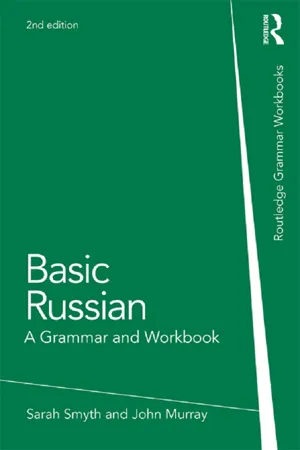
- 384 pages
- English
- ePUB (mobile friendly)
- Available on iOS & Android
eBook - ePub
About this book
Information
PART 1
Identifying and describing people, places and objects
UNIT 1
Identifying people
Gender
(i) Nouns are classified in Russian according to three genders: masculine, feminine and neuter. The grammatical gender of a noun, which is constant, can usually be identified by its ending in the nominative case, that is, the dictionary form of the noun. In this unit we concentrate on nouns that refer to people. These are usually masculine or feminine nouns. Masculine nouns refer to men, feminine nouns to women. (See Unit 3 for nouns referencing objects and places and for the introduction of neuter nouns.)
Masculine nouns end in a consonant, a consonant followed by a soft sign (-ь) or a vowel followed by the semi-consonant (-й).
hard | consonant | музыкант | Иван |
soft | consonant + -ь | писатель | Игорь |
soft | vowel + -й | герой | Николай |
Feminine nouns end in -a, -я, -ия or -ь. Note that the ending -ь may indicate either a masculine or feminine noun.
hard | consonant + -a | балерина | Анна |
soft | consonant + -я | Катя | |
soft | consonant + -ь | Любовь | |
soft | consonant + -ия | Анастасия |
(ii) Generally speaking males are designated by masculine nouns and females by feminine nouns.
Note: There are, however, some nouns ending in -a or -я which designate males. These nouns, though they look like feminine nouns, are grammatically speaking masculine, e.g., мужчина ‘man’, дядя ‘uncle’, дедушка ‘grandfather’; a number of first names, such as Илья, Никита, Фома; and many affectionate forms of names, such as Kоля(short for Николай), Ваня (short for Иван) and Петя(short for Пётр). These nouns are qualified by masculine adjectives, e.g. хороший мужчина ‘a good man’ (see Unit 4).
‘Hard’ and ‘soft’ endings
As can be seen from the tables above some nouns have what are called ‘hard’ endings and others ‘soft’ endings. The categories of ‘hard’ and ‘soft’ refer to the quality of the final consonant as realised in the vowel that follows it.
‘Hard’ endings are represented in the written language by a consonant followed by:
• a zero ending (no ending) which in some grammar books is represented as Ø
• or one of the following vowels: -а, -у, -ы or -o
‘Soft’ endings are represented in the written language by a consonant followed by:
• a soft sign: -ь
• or one of the following vowels: -я, -ю, -и, -ё or -е
This distinction is easy to remember once you realise that Russian has two renditions of every...
Table of contents
- Cover Page
- Half Title page
- Series Page
- Title Page
- Copyright Page
- Contents
- Preface
- Acknowledgements
- Sources
- Part 1 Identifying and describing people, places and objects
- Unit 1 Identifying people
- Unit 2 Meeting and greeting
- Unit 3 Identifying people and objects
- Unit 4 Describing people and objects (1)
- Unit 5 Describing people and objects (2)
- Unit 6 Revision
- Part 2 Saying who does or did what
- Unit 7 Expressing likes and dislikes
- Unit 8 Talking about oneself (1)
- Unit 9 Talking about oneself (2)
- Unit 10 Talking about the past
- Unit 11 Possession
- Unit 12 Revision
- Part 3 When, where and why we do things
- Unit 13 Where we do things
- Unit 14 When we do things
- Unit 15 Biographies
- Unit 16 How we do things
- Unit 17 Why we do things
- Unit 18 Revision
- Part 4 Talking about people
- Unit 19 Seeking information
- Unit 20 Identifying people's professions
- Unit 21 Absence
- Unit 22 Interests and leisure pursuits
- Unit 23 Interacting with people/social activities
- Unit 24 Revision
- Part 5 Going places
- Unit 25 Where we went
- Unit 26 Where are you going?
- Unit 27 Giving directions
- Unit 28 More likes and dislikes
- Unit 29 Revision
- Part 6 Responding to the world around us
- Unit 30 Seeking reactions and opinions
- Unit 31 Interacting with people
- Unit 32 Doing things for others
- Unit 33 Well-wishing
- Unit 34 Revision
- Appendix 1 Declension of nouns
- Appendix 2 Declension of adjectives
- Appendix 3 Declension of pronouns
- Appendix 4 Conjugation of some common verbs
- Appendix 5 Numerals
- Appendix 6 Spelling rules
- Appendix 7 Key to Exercises
- Glossary of Technical Terms
- Glossary of Proper Names
- Glossary of Acronyms and Abbreviations
- Vocabulary
- Abbreviations and codes
- Grammar Index
- Russian Index
Trusted by 375,005 students
Access to over 1.5 million titles for a fair monthly price.
Study more efficiently using our study tools.
Frequently asked questions
Yes, you can cancel anytime from the Subscription tab in your account settings on the Perlego website. Your subscription will stay active until the end of your current billing period. Learn how to cancel your subscription
No, books cannot be downloaded as external files, such as PDFs, for use outside of Perlego. However, you can download books within the Perlego app for offline reading on mobile or tablet. Learn how to download books offline
Perlego offers two plans: Essential and Complete
- Essential is ideal for learners and professionals who enjoy exploring a wide range of subjects. Access the Essential Library with 800,000+ trusted titles and best-sellers across business, personal growth, and the humanities. Includes unlimited reading time and Standard Read Aloud voice.
- Complete: Perfect for advanced learners and researchers needing full, unrestricted access. Unlock 1.5M+ books across hundreds of subjects, including academic and specialized titles. The Complete Plan also includes advanced features like Premium Read Aloud and Research Assistant.
We are an online textbook subscription service, where you can get access to an entire online library for less than the price of a single book per month. With over 1.5 million books across 990+ topics, we’ve got you covered! Learn about our mission
Look out for the read-aloud symbol on your next book to see if you can listen to it. The read-aloud tool reads text aloud for you, highlighting the text as it is being read. You can pause it, speed it up and slow it down. Learn more about Read Aloud
Yes! You can use the Perlego app on both iOS and Android devices to read anytime, anywhere — even offline. Perfect for commutes or when you’re on the go.
Please note we cannot support devices running on iOS 13 and Android 7 or earlier. Learn more about using the app
Please note we cannot support devices running on iOS 13 and Android 7 or earlier. Learn more about using the app
Yes, you can access Basic Russian by John Murray,Sarah Smyth in PDF and/or ePUB format, as well as other popular books in Languages & Linguistics & Languages. We have over 1.5 million books available in our catalogue for you to explore.