- 277 pages
- English
- ePUB (mobile friendly)
- Available on iOS & Android
eBook - ePub
Engineering Analysis of Fires and Explosions
About this book
Engineering Analysis of Fires and Explosions demonstrates how professional forensic engineers apply basic concepts and principles from engineering and scientific disciplines to analyze fires and explosions. It describes how forensic engineers use a "reverse design" process to determine the original cause of a fire or explosion. This guide incorporates practices and lessons learned from the first-hand experiences of the author and his colleagues. It is an exciting introduction to the multidisciplinary subject of fire and explosion analysis and its legal ramifications. The author's straightforward language and style make the concepts easy to understand.
Information
Chapter 1: Introduction
Fire
Ashes denote that fire was;
Respect the grayest pile
For the departed creature’s sake
That hovered there awhile.
Respect the grayest pile
For the departed creature’s sake
That hovered there awhile.
Fire exists the first in light,
And then consolidates, —
Only the chemist can disclose
Into what carbonates.
And then consolidates, —
Only the chemist can disclose
Into what carbonates.
Emily Dickinson from Poems, published 1890
A. General
This book is about forensic engineering as it applies to the analysis of fires and explosions.
The term forensic engineering is generally understood to mean the application of engineering principles and methodology to answer questions of fact. Often, the questions of fact have legal ramifications.
Regarding fires and explosions, the most frequently posed questions of fact are: where did the fire or explosion start; and what caused it? The terms of art for these questions are, respectively, the determination of the point of origin, and the determination of the cause. Sometimes the two inquiries are jointly referred to as the determination of the cause and origin, commonly abbreviated as “C/O” or “C&O.”
To establish a sound basis for analysis, a forensic engineer relies mostly upon the actual physical evidence found at the scene and verifiable facts related to the matter. The forensic engineer then applies accepted scientific methodologies and principles to interpret the physical evidence and facts. Often, the analysis of the physical evidence and facts requires the simultaneous application of more than just one scientific discipline: in this respect, the practice of forensic engineering is highly inter-disciplinary.
The disciplines primarily applied in the analysis of fires and explosions include inorganic and organic chemistry, materials and metallurgy, thermodynamics, physics, heat transfer, machine design, structural engineering, building systems design, electrical engineering, and ergonomics. A familiarity with codes and standards is also required. This includes building codes, mechanical equipment codes, fire safety codes, electrical codes, material storage specifications, product codes and specifications, installation methodologies, and various safety rules and regulations.
Because many of these subjects are normally a part of traditional mechanical and civil engineering curricula, graduates of these two engineering disciplines tend to dominate the forensic engineering field involved in the analysis of fires and explosions. However, there are also a small number of electrical, industrial, and safety engineering practitioners.
In essence what a forensic engineer does is this:
- he or she assesses what was there before the event and the condition it was in.
- he or she assesses what is present after the event, and the condition it is in.
- he or she hypothesizes plausible ways in which the pre-event conditions can have led to the post-event conditions.
- he or she searches for evidence which either denies or supports the hypotheses.
- he or she applies engineering knowledge and skill to relate the various facts and evidence into a cohesive scenario of how the event may have occurred.
Implicit in the above list of what a forensic engineer does is the application of logic: logic provides order and coherence to all the interdisciplinary facts, principles and methodologies which appear to bear on a particular case.
In the beginning of a case, the available facts and information are like pieces of a puzzle found scattered about the floor: a piece here, a piece there, and one perhaps which has mysteriously slid under the refrigerator. At first, the pieces are simply collected, gathered up, and placed in a ––heap on the table. Then, each piece is fitted to all the other pieces until a few pieces match up with one another. When several pieces match up, a part of the picture begins to emerge. Eventually, when the all the pieces have been fitted together, the puzzle is solved and the picture is plain to see.
It is for this reason that the scientific investigation and analysis of a fire or explosion should be structured like a pyramid. There should be a large foundation of facts and evidence at the bottom, which support a few conclusions at the top. Conclusions should be based directly upon facts, not upon other conclusions or hypotheses. If the facts are arranged logically and systematically, the conclusions should be almost self-evident. Conclusions based on other conclusions or hypotheses, which in turn are only based upon a few facts or upon very generalized principles, are a house of cards. When one point is proven wrong, they all fall down.
For example, consider the following case. It is true that propane gas systems are involved in some explosions and fires. A particular house that was equipped with a propane system sustained an explosion and subsequent fire. The epicenter of the explosion, the point of greatest explosive pressure, was located in a basement room which contained the propane furnace. From this information, the investigator concludes that the explosion and fire was caused by the propane system and in particular, the furnace.
However, the investigator’s conclusion is based on faulty logic. There is not sufficient information to firmly conclude that the propane system was the cause of the explosion, despite the fact that the basic facts and the generalized principle upon which the conclusion is based are all true.
Consider again the given facts and principles in the example.
Principle: | Some propane systems cause explosions and fires. |
Fact: | This house had a propane system. |
Fact: | This house sustained a fire and explosion. |
Fact: | The explosion originated in the same room as a piece of equipment that used propane, the furnace. |
Conclusion: | The explosion and fire was caused by the propane system. |
The principle upon which the whole conclusion depends asserts only that some propane systems cause explosions, not all of them. In point of fact, the majority of propane systems are reliable and work fine without causing an explosion or fire for the lifetime of the house. Arguing from a statistical standpoint, it is more likely that a given propane system will not cause an explosion and fire.
In our example, the investigator has not yet actually checked to see if this propane system was one of the some that work fine or one of the some that cause explosions and fires. Thus, a direct connection between the general premise and the specific case at hand has not been made; it has only been assumed. A verification step in the logic has been deleted.
Of course, not all explosions and fires are caused by propane systems; propane systems do not have a corner on the market in this category. There is a distinct possibility that the explosion may have been caused by something not related to the propane system which is unknown to the investigator at this point. The fact that the explosion originated in the same room as the furnace may be only a coincidence.
Using the same general principle and available facts then, it can equally be deduced (albeit also incorrectly) that the propane system did not cause the explosion. Why? Because it is equally true that some propane systems never cause explosions and fires. Since this house has a propane system, then it could be concluded that this propane system could not have been the cause of the explosion and fire.
As is plain, our impasse in the example is due to the application of a general principle for which there is insufficient information to provide a unique, logical conclusion. The conclusion that the propane system caused the explosion and fire is based implicitly on the conclusion that the location of the explosion epicenter and propane furnace is no coincidence. It is further based upon another conclusion that the propane system is one of the “some” that cause explosions and fires, and not one of the “some” that never cause explosions and fires. In short, in our example we have a conclusion, based upon a conclusion, based upon another conclusion.
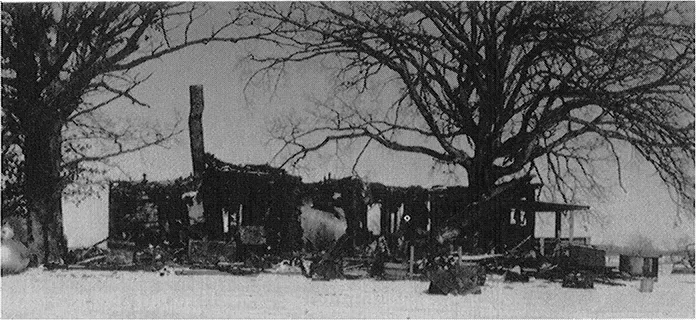
Figure 1.1. Remains of farm house after fire. Fire originated at propane water heater line.
The remedy to this dilemma is simple: additional information must be gathered to either uniquely confirm it was the propane system, or uniquely eliminate it as the cause of the explosion and fire.
Going back to our example, compressed air tests at the scene find that the propane piping found after the fire and explosion does not leak, despite all that it has been through. Since propane piping which leaks before an explosion will not heal itself so that it does not leak after the explosion, this test eliminates the piping as a potential cause.
Testing of the furnace and other appliances finds that they all are in good order. This now puts the propane equipment in the category of the “some” that do not cause explosions and fires. We have now confirmed that the conclusion which assumed a cause and effect relationship between the location of the epicenter and the location of the propane furnace was wrong. It was a coincidence that the explosion occurred in the same room as the furnace.
Further checks by the investigator even show that no propane was missing from the tank, as one would expect to be the case if the propane had been leaking. Thus, now there is an accumulation of facts showing that the propane system was not involved in the explosion and fire.
Finally, a thorough check of the debris in the epicenter area finds that within the furnace room there were several open one-gallon tins of paint thinner which the owner had assumed to be empty when he finished doing some painting. Closer inspection of the tins finds that some of them are expanded as if they had withstood an internal explosion of their vapors.
Upon further questioning, the owner recalls that the tins were placed only a few feet from a high-wattage light bulb, which was turned on just before the time of the explosion. A review of the safety labels finds that the tins contained solvents that would form explosive vapors at room temperature even when the tin was to all appearances empty. A back-of-the-envelope calculation finds that the amount of residual solvent in the tins taken together would be more than enough to provide a cloud of vapor in the room at a concentration exceeding the lower threshold of the solvent’s explosion limits.
The above example demonstrates the value of the “pyramid” method of investigation. When a large base of facts and information is gathered, the conclusion almost suggests itself. When only a few facts were gathered to back up a very generalized premise, the investigator can “steer” the conclusion to nearly anything he wants. Unfortunately, there are some fire investigators who do the latter very adroitly. This point is discussed again in Section I which is titled, “A Priori Biases.”
B. Eyewitness Information
Eyewitness accounts are important sources of information, but they must be carefully scrutinized and evaluated. Sometimes eyewitnesses form their own opinions and conclusions about what took place; they may then intertwine these conclusions and opinions into their account of what they say they observed. Skillful questioning of the eyewitness can sometimes separate the factual observations from the personal assumptions.
Consider the following example. An eyewitness initially reports seeing “Bill” leave the building just before the fire broke out. However, careful questioning reveals that the eyewitness did not actually see “Bill” leave the building at all; the witness simply saw someone drive away from the building in a car similar to Bill’s, and assumed it must have been Bill. Of course, the person driving the car could have been Bill, but it also could have been someone with a car like Bill’s, or someone who had borrowed Bill’s car.
Of course, some eyewitnesses are not impartial. They may be relatives, friends, or enemies of persons involved in the event. They may have a personal stake in the outcome of the investigation. For example, it is not unusual for the arsonist who set the fire to be interviewed as an eyewitness. Let us also not forget the eyewitnesses who are scalawags, psychotics, and blowhards. They may swear to anything to pursue their own agendas, or just to get attention.
What an honest and otherwise impartial eyewitness reports observing may also be a function of his location with respect to the event. His perceptions of the event may be colored by his education and training, his life experiences, his physical condition such as eyesight or hearing, and social or cultural biases. For example, the sound of a gas explosion might variously be reported as a sonic boom, cannon fire, blasting work, or an exploding sky rocket. Because of this, eyewitnesses to the same event will sometimes disagree on the most fundamental facts.
Further, the suggestibility of the eyewitness in response to questions is also an important factor. Consider the following two exchanges during “statementizlng.” This is a term of art which refers to interviewing a witness to find out what the witness knows about the incident. The interview is often recorded on tape and later transcribed to a written statement. Usually it is not done under oath, but it is often done in the presence of witnesses. It is important to “freeze” a witness’ account of the incident as soon as possible after the event. Time and subsequent conversations with others will often cause the witness’ account of the incident to change.
Exchange I
Interviewer: Did you hear a gas explosion last night at about 3 a.m.?
Witness: Yeah, that’s what I heard. I heard a gas explosion. It did happen at 3 a.m.
Exchange II
Interviewer: What happened last night?
Witness: Something loud woke me up.
Interviewer: What was it?
Witness: I don’t know. I was asleep at the time.
Interviewer: What time did you hear it?
Witness: I don’t know exactly. It was sometime in the middle of the night. I went right back to sleep afterwards.
In the first exchange, the interviewer suggested the answers to his question. Since the implied answers seem logical, and since the witness may assume that the interviewer knows more about the event than himself, the witness agrees to the suggested answers. In the second exchange, the interviewer provided no clues to what he was looking for; he allowed the witness to draw upon his own memories and did not suggest any.
C. Magnitude of Fire and Explosion Problem
The following fire loss statistics have been gathered from a number of sources, including the National Fire Protection Association, located in Quincy, Massachusetts; Accident Facts published yearly by the National Safety Council; the Information Please Almanac published yearly by the Houghton Mifflin Company, and the World Almanac published yearly by Pharos Books. They are presented to show the scope and breadth of fire and explosion losses in the U.S.
In 1990, about 7.8 billion dollars in property damage and 3,300 deaths were caused by fires in the U.S. Of this total, fires that damaged structures totaled about 6.7 billion dollars, or about 86% of the total. The loss to residential property was about 4.2 billion dollars. On a per capita basis, monetary losses from fire damages in 1990 were a litt...
Table of contents
- Cover Page
- Title Page
- Copyright Page
- Table of Contents
- Chapter 1 Introduction
- Chapter 2 Some Combustion Chemistry
- Chapter 3 Odorants and Leak Detection
- Chapter 4 Determining the Point of Origin of a Fire
- Chapter 5 Electrical Shorting
- Chapter 6 Explosions
- Chapter 7 Determining the Point of Ignition of an Explosion
- Chapter 8 Arson and Incendiary Fires
- Chapter 9 Automotive Fires
- Chapter 10 Fire and Explosion Case Study
- Chapter 11 Study Problems
- Bibliography
- Index
Trusted by 375,005 students
Access to over 1.5 million titles for a fair monthly price.
Study more efficiently using our study tools.
Frequently asked questions
Yes, you can cancel anytime from the Subscription tab in your account settings on the Perlego website. Your subscription will stay active until the end of your current billing period. Learn how to cancel your subscription
No, books cannot be downloaded as external files, such as PDFs, for use outside of Perlego. However, you can download books within the Perlego app for offline reading on mobile or tablet. Learn how to download books offline
Perlego offers two plans: Essential and Complete
- Essential is ideal for learners and professionals who enjoy exploring a wide range of subjects. Access the Essential Library with 800,000+ trusted titles and best-sellers across business, personal growth, and the humanities. Includes unlimited reading time and Standard Read Aloud voice.
- Complete: Perfect for advanced learners and researchers needing full, unrestricted access. Unlock 1.5M+ books across hundreds of subjects, including academic and specialized titles. The Complete Plan also includes advanced features like Premium Read Aloud and Research Assistant.
We are an online textbook subscription service, where you can get access to an entire online library for less than the price of a single book per month. With over 1.5 million books across 990+ topics, we’ve got you covered! Learn about our mission
Look out for the read-aloud symbol on your next book to see if you can listen to it. The read-aloud tool reads text aloud for you, highlighting the text as it is being read. You can pause it, speed it up and slow it down. Learn more about Read Aloud
Yes! You can use the Perlego app on both iOS and Android devices to read anytime, anywhere — even offline. Perfect for commutes or when you’re on the go.
Please note we cannot support devices running on iOS 13 and Android 7 or earlier. Learn more about using the app
Please note we cannot support devices running on iOS 13 and Android 7 or earlier. Learn more about using the app
Yes, you can access Engineering Analysis of Fires and Explosions by Randall K. Noon in PDF and/or ePUB format, as well as other popular books in Technology & Engineering & Forensic Science. We have over 1.5 million books available in our catalogue for you to explore.