- 264 pages
- English
- ePUB (mobile friendly)
- Available on iOS & Android
eBook - ePub
About this book
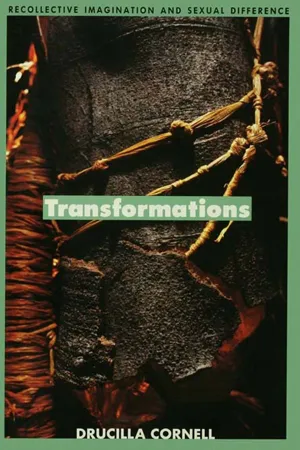
In a unique rethinking of political transformation, Drucilla Cornell argues for the crucial role of psychoanalysis in social theory in voicing connection between our constitution as gendered subjects and social and political change.
1
“Convention” and Critique
When we think of the world’s future, we always mean the destination it will reach if it keeps going in the direction we can see it going in now; it does not occur to us that its path is not a straight line but a curve, constantly changing direction.Ambition is the death of thought.It’s a good thing I don’t allow myself to be influenced!—Ludwig Wittgenstein1
There has been no more virulent antiprofessional than Ludwig Wittgenstein, nor a more searing and profound critic of the philosopher’s search for stable forms, unities, and essences to secure us against the contingency, the errancy of language. In his later work, Wittgenstein completely rejected the idea that the goal of the philosophical investigation of language was to identify the form of the identity of words with the form of the entity.2 The later Wittgenstein of Philosophical Investigations was in this sense “antiessentialist” to the core,3 and argued against the early Wittgenstein of Tractatus Logico-Philosophicus.4
Yet, if Stanley Fish is right that “anti-professionalism is indefensible because it imagines a form of life—free, independent, acontextual—that cannot be lived,”5 Wittgenstein’s antiprofessionalism would seem to contradict Wittgenstein’s own insight into the sittlich character of language and the situatedness of the individual subject in a pregiven language game or form of life. Was Wittgenstein actually espousing the ideology of professionalism in spite of his self-proclaimed distrust of it? The question, of course, becomes: Is Fish correct in his assertion that antiprofessionalism rests on a philosophically indefensible view of the subject, and of linguistic meaning?
I will argue, on the contrary, that in spite of Fish’s careful recasting of the insights of the later Wittgenstein, Fish makes two mistakes that Wittgenstein warned us against. First, by arguing that we are somehow enclosed in our form of life or professional context, Fish reintroduces the very idea of the determination of form that Wittgenstein rejected.6 Fish himself critiqued the idea of determination of form in his earlier debates with Ronald Dworkin7 and Owen Fiss.8 In those debates, Fish took his two opponents to task for attempting to predetermine the range of reactivation and redefinition of language.9 Fish did not deny constraint altogether, but only the attempt to render the constraints determinate, even if only through the metaphor of a “chain enterprise.”10 Unfortunately, as his essay “Anti-Professionalism” makes clear, Fish does not follow this insight to its conclusion. His suggestion that we are the prisoners of a rigidly bounded form of professional life reintroduces another version of the myth of the self-presence of form that Fish otherwise and persistently has urged us to reject.
Second, Fish slides from the recognition that linguistic meaning resides in a form of life to the mistaken conclusion that the preconscious acceptance of convention that makes discourse materially possible necessarily enters into the relevant language games and restricts it. Fish mistakenly concludes that the preconscious acceptance of convention that allows us to participate in our form of life forces an agreement among the participants as to the basic question of how to evaluate one’s profession and set the standards it sets for professional life. “Critique,” in the limited sense that Fish uses the word, is possible, precisely because we live in an open-ended language game in which disagreement is perfectly comprehensible.
The move, within a language game, “I think my colleagues are mistaken when they let their need for tenure influence their choice of research topics” is perfectly coherent. Critique, even as it rises to the level of antiprofessionalism, does not necessarily coincide with the belief in essences or a form of true meaning.
Ironically, to deny critique is to deny that there is a social reality, a horizon which encloses us and liberates us, enabling us to disagree as much as it enables us to agree. The very line between critique and convention is itself blurred. As Wittgenstein reminds us, when we appeal to communitarian standards in order to make sense, we cannot also delimit the entire repertoire of community standards.11 Fish implicitly recognizes the shifting values in English departments that now allow for the acceptance of doctoral theses on detective novels. He does not, however, appreciate the wider implications of his own insight: To conceptualize the constraints of professionalism is to once again render them determinate.
Both of these mistakes have implications for Fish’s critique of the subject. Fish argues that the very idea of the critique of professionalism demands a transcendental subject, “a self or knowing consciousness that is under the sway of no partial vision, and is therefore free (in a very strong sense) first to identify and then to embrace the truth to which a disinterested knowledge inescapably points.”12 I will argue, to the contrary, that the linguistic-philosophic critique of the constitutive subject does not erase the subject without a trace, but forces us to think about the subject, including the self-reflective subject, differently. It makes perfect sense within our form of life to say with Wittgenstein: “It’s a good thing I don’t allow myself to be influenced!”13
One caveat: When I speak of critique I am using the word in the very mundane sense—I am merely arguing that standards used to critique professional life need not replicate the ideology of professionalism. I am not, in this essay, addressing the fundamental question of whether it is possible to critique our philosophical cultural tradition: what Jacques Derrida has called phallogocentrism14 or Theodor Adorno calls identity-logical thinking.15 As we will see in the later essays included in this volume, I agree with both Derrida and Adorno that ultimately the practice of critique leads us to confront phallogocentrism. Wittgensteinian “therapy” cannot solve all of our problems precisely because Wittgenstein refused to recognize the full significance of the Other to established systems of meaning, such as the unconscious. However, such “therapy” can provide us with an answer to Fish. Therefore, I avoid the question of whether or how one can move beyond phallologocentrism or identity-logical thinking in this essay not because I think the question is ultimately irrelevant to the issues raised by Fish, but because Fish is not grappling with critique at that level. Fish would dismiss Adorno’s and Derrida’s insistence on the Other to established forms of life as more of the same bad metaphysics that both thinkers purportedly deconstruct.
Nihilism, for Fish, is another symptom of bad metaphysics; it is the flip side of the foundationalism he attacks in his essay. As I have already suggested, Fish’s contribution to the debates on objectivity in interpretation can best be understood as a recasting of the insight of the later Wittgenstein. Fish repeatedly emphasizes the sittlich character of linguistic meaning.16 When one grasps the sittlich character of language correctly, the very subjectivism that troubles Dworkin and Fiss vanishes as an illusion. As Fish explained,
The point is one that I have made before: it is neither the case that interpretation is constrained by what is obviously and unproblematically “there,” nor the case that interpreters, in the absence of such constraints, are free to read into a text whatever they like. … Interpreters are constrained by their tacit awareness of what is possible and not possible to do, what is and is not a reasonable thing to say, and what will and will not be heard as evidence, in a given enterprise; and it is within those same constraints that they see and bring others to see the shape of the documents to whose interpretation they are committed.17
Yet Fish also understands that the constraints that enable meaning cannot be made determinate, foreclosing the reactivation of definition. We cannot pin down the meaning of a word once and for all, precisely because of the sittlich character of language. Derrida has brilliantly shown how the iterability of language implies both sameness and difference. Words as signs are iterable or repeatable by any general user. Derrida accepts Wittgenstein’s demonstration of the self-contradictory nature of the idea of a private language. Language communicates because it is public—given meaning within the relevant group of inquirers. The repertoire of community standards is thus independent of any particular empirical subject. The very intersubjective character of language allows for both understanding and communication and for misunderstanding and reactivation of the range of definition.
Described in this way, the intersubjectivity of language—its capacity to function as a vehicle for the repetition of the same by different subjects—is, ironically, at the same time its capacity to be torn away by reader or hearer from what it meant to its issuer, so that it continues to mean something, but not identically what it meant to its writer or utterer. Thus, the very sittlich character of meaning keeps it from being fully saturated by any particular context. The boundaries of context are always shifting: There is no ideal self-sameness which guarantees exact repetition of meaning.
To deny this is not to reject the sittlich character of linguistic meaning nor to argue for unlimited freedom in interpretation. As Wittgenstein wrote, “The wall always has some determinate (Bestimmte) degree of elasticity—whether I know it or not.”18 Our immersion in a horizon of historical understanding does constrain us, but it cannot absolutely enforce agreement on the basic questions of life. The attempt to exhaustively determine the form of the constraints fails. The contextual nature of meaning requires that possible new meanings inhere in the very commonness of language. Wittgenstein’s (and Derrida’s) critique is aimed at the principle of identity, not at the possibility of contextual meaning. To quote Wittgenstein:
“A thing is identical with itself.”—There is no finer example of a useless proposition, which yet is connected with a certain play of the imagination. It is as if in imagination we put a thing into its own shape and saw that it fitted.We might also say: “Every think fits into itself.” … At the same time we look at a thing and imagine that there was a blank left for it, and that now it fits into it exactly.Does this spot [*] “fit” into its white surrounding?—But that is just how it would look if there had at first been a hole in its place and it then fitted into the hole….“Every coloured patch fits exactly into its surrounding” is a rather specialized form of the law of identity.19
Wittgenstein recognized the contextual nature of meaning but opposed the attempt to rigidly circumscribe it, to render any context a selfidentical form. In other words, meaning is revealed in context but not absolutely determined by it. Because meaning is not determined by context, disagreement, critique, and the generation of new meanings are always possible.
Fish seemingly understood this difference in his debate with Dworkin. Fish rejected Dworkin’s attempt to explicate the determination of the constraints on interpretation through the metaphor or example of a group novel.20 Fish’s central point was that each new writer in the chain can potentially reactivate the range of definition and by so doing shift the understanding of “what direction has already been taken.”21 Dworkin wanted to cement the boundaries and thereby delimit the enterprise as the later writers in the chain come to a project whose form has become ever more clearly delineated. Fish, in response, showed us that the boundaries of the form of the project need not necessarily hold and can always yield to a different interpretation. Context is not just there; it must be confirmed or disconfirmed, over and over again. The appeal to the context of the already-developed novel does not provide us with security against innovation and critique.
For all of his insight into Dworkin’s failed attempt to define boundaries, Fish himself now falls into the very trap he warns against. In his essay, professional practice becomes a bounded form of life from which escape can only be envisioned by a transcendental consciousness. Fish, of course, denies that such a consciousness exists. As Fish explains, anti-professionalism underwrites
a self that is able to see through the mystification of “rhetoric” and achieve an independent clarity of vision; a truth that is perspicuous independently of argument, and which argument tends only to obscure; and a society where pure merit is recognized and the invidious rankings imposed by institutional hierarchies are no more.22
And why, according to Fish, must antiprofessionalism appeal to a “transcendental subject” or an “essentialist” view of linguistic meaning? For Fish the inevitable immersion of the individual in her profession is “merely a recognition of the fact that needs and values do not exist independently of socially organized activities but emerge simultaneously with the institutional and conventional structures within which they are intelligible.23 But Fish’s conclusion does not follow from his premises: If our form of life, professional or otherwise, is inevitably unbounded, if ther...
Table of contents
- Cover
- Half Title
- Full Title
- Copyright
- Dedication
- Contents
- Preface
- Introduction: The Subject of Transformation
- 1 "Convention" and Critique
- 2 Pragmatism, Recollective Imagination, and Transformative Legal Interpretation
- 3 "Disastrologies"
- 4 The Doubly-Prized World: Myth, Allegory, and the Feminine
- 5 Sexual Difference, the Feminine, and Equivalency
- 6 Sex-Discrimination Law and Equivalent Rights
- 7 Gender Hierarchy, Equality, and the Possibility of Democracy
- 8 What Takes Place in the Dark
- Notes
- Bibliography
- Index
Trusted by 375,005 students
Access to over 1.5 million titles for a fair monthly price.
Study more efficiently using our study tools.
Frequently asked questions
Yes, you can cancel anytime from the Subscription tab in your account settings on the Perlego website. Your subscription will stay active until the end of your current billing period. Learn how to cancel your subscription
No, books cannot be downloaded as external files, such as PDFs, for use outside of Perlego. However, you can download books within the Perlego app for offline reading on mobile or tablet. Learn how to download books offline
Perlego offers two plans: Essential and Complete
- Essential is ideal for learners and professionals who enjoy exploring a wide range of subjects. Access the Essential Library with 800,000+ trusted titles and best-sellers across business, personal growth, and the humanities. Includes unlimited reading time and Standard Read Aloud voice.
- Complete: Perfect for advanced learners and researchers needing full, unrestricted access. Unlock 1.5M+ books across hundreds of subjects, including academic and specialized titles. The Complete Plan also includes advanced features like Premium Read Aloud and Research Assistant.
We are an online textbook subscription service, where you can get access to an entire online library for less than the price of a single book per month. With over 1.5 million books across 990+ topics, we’ve got you covered! Learn about our mission
Look out for the read-aloud symbol on your next book to see if you can listen to it. The read-aloud tool reads text aloud for you, highlighting the text as it is being read. You can pause it, speed it up and slow it down. Learn more about Read Aloud
Yes! You can use the Perlego app on both iOS and Android devices to read anytime, anywhere — even offline. Perfect for commutes or when you’re on the go.
Please note we cannot support devices running on iOS 13 and Android 7 or earlier. Learn more about using the app
Please note we cannot support devices running on iOS 13 and Android 7 or earlier. Learn more about using the app
Yes, you can access Transformations by Drucilla Cornell in PDF and/or ePUB format, as well as other popular books in Law & Gender & The Law. We have over 1.5 million books available in our catalogue for you to explore.