Within psychology, emotion is often treated as something private and personal. In contrast, this book tries to understand emotion from the 'outside,' by examining the everyday social settings in which it operates. Three levels of social influence are considered in decreasing order of inclusiveness, starting with the surrounding culture and subculture, moving on to the more delimited organization or group, and finally focusing on the interpersonal setting.
Think of the last time you experienced an emotion. Love, hate, fear, anger, embarrassment; it doesn’t matter which. Where were you and what were you doing? What was it that excited, pleased, or upset you? Chances are there was at least one other person around (even if only in your otherwise private thoughts), and that something that they did or didn’t do (or something that was done or not done to them) was part of what made you emotional. Now think about what happened next. Perhaps someone else reacted to your emotion, tried to calm you down, or responded with antagonism. Later still, maybe you discussed your feelings with someone close to you. Maybe, in some ways, the experience affected other people almost as much as it affected you.
What is it about people’s behavior that causes emotional effects? Why should some things they do matter to us whereas others do not? How do we tell what is emotionally important? This book proposes that one answer is that we make reference to others’ reactions to whatever is happening, especially when we share relationships or affiliations with those others. We know we should care about something at an emotional level if people close to us also seem to care. Further, to the extent that we are members of a common society, we have also learned to perceive, interpret, and act toward things in broadly similar ways, to recognize their conventional significance, and this too partly determines their emotional power. Those raised in different cultural contexts might not always share our emotional perspective on events.
Although emotions are often seen as intensely personal experiences, it also seems clear that most of them have an intimate relationship to other people’s thoughts, words, and deeds and bring direct consequences for how social life proceeds. Further, our position within groups, subcultures, and the broader society helps to determine our emotional outlook on the world. This chapter considers the range of ways in which emotions relate to social life, and explores how their personal and social aspects might be reconciled. The aim is to set the stage for the book’s more extensive consideration of how emotions are shaped by their social context.
Levels of Social Analysis
Social life involves a vast variety of processes that operate at a number of different levels (see also Doise, 1986; Keltner & Haidt, 1999). Three of these levels are of particular relevance to the present discussion. The first and most obvious level is the interpersonal level, which focuses on direct relations and interactions with other people, and on how their conduct influences and is influenced by our own. One person says something and another replies, a glance is acknowledged or ignored, and so on. Working at this level, we can start to understand what role emotions play in the course of unfolding encounters between people, and in the development of more articulated relationships.
Scaling up the analysis to a second level permits consideration of how individuals’ conduct is shaped by the fact that they belong to groups. Here, our focus will be on how collections of three or more people are implicated in emotional life. For example, what difference does it make if another person is “one of us” rather than “one of them”—a member of an in-group as opposed to an out-group? How does our sharing (or not) of a common social identity influence our emotional interactions? It seems that our membership of sports teams, work committees, fan clubs, gender categories, and so on can help to set the range of emotional options that are open to us. Groups segment the social world into the good and bad, the praiseworthy and blameworthy, the desirable and undesirable, with obvious consequences for our emotions.
As groups get larger over the course of history, they tend to subdivide and stratify. They develop traditions and rules, both formal and informal. Large-scale and relatively permanent groups with internal structures and established norms, values, and practices may be treated at a separate, cultural level. Because shared culture provides a constant backdrop for our emotional activities, its impact is often less obvious to us than that of our changing group and interpersonal allegiances. We become aware of cultural assumptions, rules, or practices only when brought into contact with direct alternatives. For example, for some English people, North Americans can seem effusive, upbeat, and relentlessly confident. Prolonged interaction with them can lead to the recognition of a contrasting implicit norm about understatement. We all grow up with emotional habits, some of which remain invisible to us until we are forced to acknowledge their cultural specificity.
Distinctions between interpersonal, group, and cultural factors often seem fuzzy. For example, when do three people who are talking stop engaging in interpersonal interaction and start operating as a group? When should groups be treated as cultures and when shouldn’t they? Indeed, what is a society, apart from a very large group? One of the reasons for maintaining these contestable distinctions is that research into social aspects of emotion has tended to treat them separately, however artificial this separation might sometimes seem. It therefore makes sense to review the evidence in these accepted categories. For most of this book, then, we will continue to divide social life into its interpersonal, group-level, and cultural aspects, but our ultimate aim will be to provide an integrative analysis of their interactive operation.
Pieces of the Emotional Jigsaw
Setting out what we mean by an emotion turns out to be even more problematic than demarcating social life. Although we all have an intuitive sense of what the word means, a surprising degree of disagreement exists about its precise definition (e.g., Fehr & Russell, 1984; Kleinginna & Kleinginna, 1981). Unfortunately, it is not possible to evade this issue entirely because definitions have important consequences for the interpretation of theory and research. For example, if we see emotion as a private experience, its relationship to the social world cannot be direct, but if we see emotion as communicative then it has a more obvious place in the social world (see following discussion). Because of the difficulty of the definitional issue and the significance of its implications, we will postpone detailed consideration of emotion’s meaning until we have identified some key landmarks in the relevant conceptual terrain. For now, it should suffice to say that the occurrence of an emotion is usually associated with a range of events and subcomponents that we can specify more easily than emotion itself. By setting out these different aspects of emotional processes, we get a better handle on the phenomenon in question.
The first thing to note is that emotions are related to events that happen in the world (objects and causes). We are therefore led to consider what it is about these events that make them emotional events. Second, emotion implies taking a particular perspective toward events, by liking or disliking what is happening, for example, or treating it as a cause for congratulation or condemnation (appraisal). Third, when we are emotional, our bodies usually react in some way: We break into a cold sweat or feel a warm glow, our pulse quickens or our heart stops, and so on (physiological change). Fourth, in addition to our sensations of bodily turmoil, we often feel strong impulses to act in certain ways when emotional (action tendencies). We may experience a desire to hurt or hug someone, for instance, or to run away, hide, or just stay very still. Fifth, particular emotions often seem to be associated with distinctive muscular movements that can express what we are feeling to others (expression or display). We smile or frown, lean forward or turn away, or clench our fists or open our arms, for example. Finally, we often try to do something about one or more of these different aspects of emotional episodes (regulation). We may seek to influence the course of events, change our perspective toward these events, work on our bodily reactions, or modify our gestures and expressions. For instance, imagine someone is being insulting in front of people whose opinions matter to you. You may try to silence her criticisms, wonder whether she really intends offense, take a deep breath to maintain your relaxation, or keep a tight lip to hide how upset you are.
Although we cannot yet say exactly what emotions are, then, we can at least agree that when we get emotional, some subset of the previously mentioned processes is probably also operating. Indeed, according to many definitions, emotion is constituted from the overall combination of these subprocesses. Alternatively, one or more component may be seen as more central to what emotion really is. In either case, separate consideration of these six different aspects of emotional function may bring us closer to understanding the nature of emotion and how it relates to social life.
Appraisal and Feedback Theories
Although the identification of component processes takes us a step closer to understanding what emotion is, we also need to say something about how those processes fit together. Indeed, the whole may be greater than the sum of its proverbial parts. Our ultimate aim, therefore, will be to reconstruct the bigger picture from the different pieces of the jigsaw. In the present section, we start to address this aim by considering which stages of the emotion process come first and how each stage influences what follows.
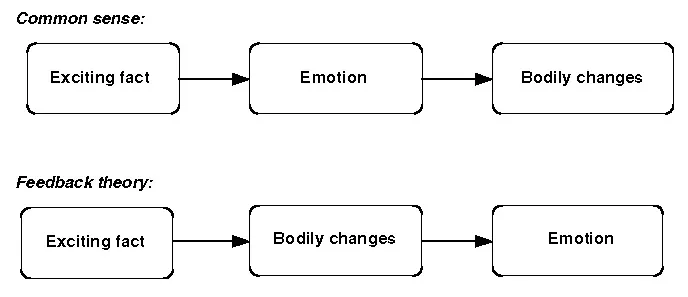
In William James’s (1884) classic paper “What is an emotion?” he contrasted a commonsense view of emotion causation with his own alternative, which has come to be known as “feedback theory”:
Our natural way of thinking is that the mental perception of some fact excites the mental affection called the emotion, and that this latter state of mind gives rise to the bodily expression. My thesis, on the contrary, is that the bodily changes follow directly the perception of the exciting fact, and that our feeling of the same changes as they occur IS the emotion . Common sense says, we lose our fortune, are sorry and weep; we meet a bear, are frightened and run; we are insulted by a rival, are angry and strike. The hypothesis here to be defended says that this order of sequence is incorrect … and that the more rational statement is that we feel sorry because we cry, angry because we strike, afraid because we tremble, and not that we cry, strike, or tremble because we are sorry, angry, or fearful, as the case may be. (pp. 189-190, emphasis in original)
According to feedback theory, then, the physiological changes, expressions, and actions come first, followed by the experience of the emotion, which is directly based on their perception (see Figure 1.1). Indeed, according to James, if these changes did not occur, the emotional quality would disappear from our experience:
Without the bodily states following on the perception, the latter would be purely cognitive in form: pale, colorless, destitute of emotional warmth. We might then see the bear, and judge it best to run, receive the insult, and deem it right to strike, but we could not actually feel afraid or angry. (p. 190)
FIGURE 1.1. James’s reversal of common sense
In other words, “A purely disembodied emotion is a non-entity” (p. 194).
For James, not only is bodily feedback what makes emotion emotional, it also defines what is different about different emotions. We know what we are feeling because the particular pattern of felt changes is thought to be distinctive in fear, anger, happiness, sadness, guilt, and so on:
The various permutations and combinations of which these organic activities are susceptible make it abstractly possible that no shade of emotion, however slight, should be without a bodily reverberation as unique, when taken in its totality, as is the mental mood itself. (p. 172)
The most popular alternative to feedback theory is appraisal theory (e.g., Arnold, 1960; Ellsworth, 1991; Lazarus, 1991a; Roseman, 1984; Scherer, 2001; Smith & Lazarus, 1993, inter alia), which in many ways is closer to what James claimed was “our natural way of thinking” about emotions. In this view, what makes emotion emotional is not the feeling of the various bodily responses, but rather what makes facts exciting in the first place—the realization that they matter to us personally:
Both perception and emotion have an object; but in emotion the object is known in a particular way. To perceive or apprehend something means that I know what it is like as a thing, apart from any effect on me. To like it or dislike it means that I know it not only objectively, as it is apart from me, but also that I estimate its relation to me, that I appraise it as desirable or undesirable, valuable or harmful for me, so that I am drawn to it or repelled by it. (Arnold, 1960, p. 171)
Both perception and emotion have an object; but in emotion the object is known in a particular way. To perceive or apprehend something means that I know what it is like as a thing, apart from any effect on me. To like it or dislike it means that I know it not only objectively, as it is apart from me, but also that I estimate its relation to me, that I appraise it as desirable or undesirable, valuable or harmful for me, so that I am drawn to it or repelled by it. (Arnold, 1960, p. 171)
The basic idea, then, is that our emotional reactions depend not on the specific characteristics of stimulus events, but rather on the way that we interpret and evaluate what is happening to us (appraisal). Furthermore, the particular character of our appraisal of events is what underlies the differences between different emotions. At the crudest level, this means that: “when we appraise something as good for us, we like it. When we appraise something as bad for us, we dislike it” (Arnold, 1960, p. 194).
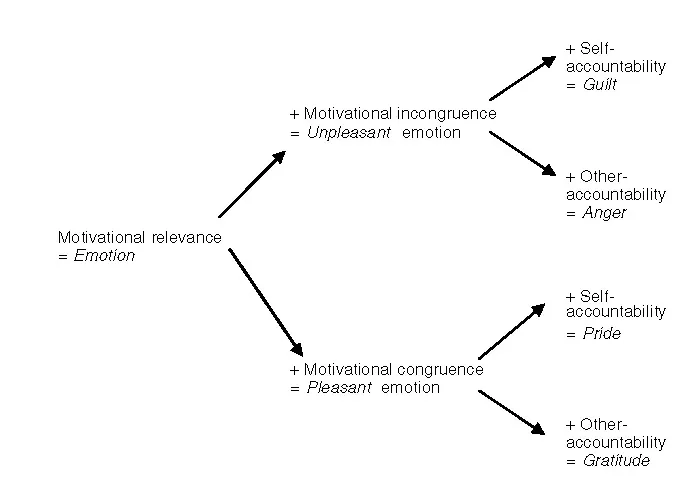
Some of the more specific relationships between appraisals and emotions according to Smith and Lazarus’s (1993) more recent version of appraisal theory are set out in Figure 1.2. The sine qua non for emotion according to this model is an appraisal of motivational relevance, meaning that unless what is happening has an impact on the goals or projects that the person is currently pursuing, there will be no emotion. In other words, we don’t care about things that don’t affect our lives (or those of other people we care about) in some way. Whether the resulting emotion is pleasant or unpleasant depends on appraisal of motivational congruence, which determines whether current developments help or hinder pursuit of our goals. The specific nature of the pleasant or unpleasant emotion in turn depends on further so-called “secondary” appraisals, which assess how the motivationally relevant event is to be explained (accountability) and what options are available for dealing with it (coping potential). For example, if someone insults us, this is usually a motivationally relevant and incongruent event and therefore leads to an unpleasant emotion. However, the kind of unpleasant emotion we experience depends on more specific appraisals relating to who is responsible (or accountable) for the insult. In particular, we will experience anger if we perceive the person doing the insulting as to blame for what they are doing, but guilt if we blame ourselves for doing something that led to the insult in the first place. In short, whether emotion occurs, and what form it takes, depends on our specific understanding of what is going on.
FIGURE 1.2. Appraisal components associated with selected emotions
Although the connections between appraisals and emotions specified by appraisal models of this kind mainly seem logical and rational...
Table of contents
Cover Page
Title Page
Copyright Page
About the Authors
Preface
Chapter 1 Emotion’s Place in the Social World
Chapter 2 Emotional Meaning Across Cultures
Chapter 3 Cultural Variation in Emotion
Chapter 4 Group Emotion
Chapter 5 Intergroup Emotion
Chapter 6 Moving Faces in Interpersonal Life
Chapter 7 Interpersonal Emotions
Chapter 8 Interconnecting Contexts
References
Trusted by 375,005 students
Access to over 1.5 million titles for a fair monthly price.
Study more efficiently using our study tools.
Frequently asked questions
Yes, you can cancel anytime from the Subscription tab in your account settings on the Perlego website. Your subscription will stay active until the end of your current billing period. Learn how to cancel your subscription
No, books cannot be downloaded as external files, such as PDFs, for use outside of Perlego. However, you can download books within the Perlego app for offline reading on mobile or tablet. Learn how to download books offline
Perlego offers two plans: Essential and Complete
Essential is ideal for learners and professionals who enjoy exploring a wide range of subjects. Access the Essential Library with 800,000+ trusted titles and best-sellers across business, personal growth, and the humanities. Includes unlimited reading time and Standard Read Aloud voice.
Complete: Perfect for advanced learners and researchers needing full, unrestricted access. Unlock 1.5M+ books across hundreds of subjects, including academic and specialized titles. The Complete Plan also includes advanced features like Premium Read Aloud and Research Assistant.
Both plans are available with monthly, semester, or annual billing cycles.
We are an online textbook subscription service, where you can get access to an entire online library for less than the price of a single book per month. With over 1.5 million books across 990+ topics, we’ve got you covered! Learn about our mission
Look out for the read-aloud symbol on your next book to see if you can listen to it. The read-aloud tool reads text aloud for you, highlighting the text as it is being read. You can pause it, speed it up and slow it down. Learn more about Read Aloud
Yes! You can use the Perlego app on both iOS and Android devices to read anytime, anywhere — even offline. Perfect for commutes or when you’re on the go. Please note we cannot support devices running on iOS 13 and Android 7 or earlier. Learn more about using the app
Yes, you can access Emotion in Social Relations by Brian Parkinson,Agneta H. Fischer,Antony S.R. Manstead in PDF and/or ePUB format, as well as other popular books in Psychology & History & Theory in Psychology. We have over 1.5 million books available in our catalogue for you to explore.