- 352 pages
- English
- ePUB (mobile friendly)
- Available on iOS & Android
eBook - ePub
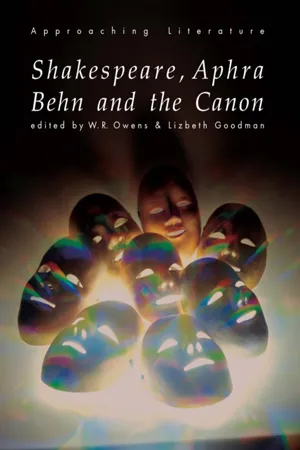
Shakespeare, Aphra Behn and the Canon
About this book
A clear introduction to the idea of the canon, exploring the process by which certain works, and not others, receive high cultural status. The work of Shakespeare and Aphra Behn is used to illustrate and challenge this process.
Information
The idea of the canon

by Lizbeth Goodman
(The canon' defined)
If you have already come across a definition of 'the canon', it may have been something like 'those works of literature that are considered especially worth studying'. But this seemingly straightforward definition immediately raises further questions. Which works? Who considers them worth studying? And so on. Such questions can only be answered ifwe move towards a more considered definition of 'the canon', and that is what we are aiming at in this book. We will use a variety of approaches: for example, we will look at a number of definitions and critical accounts - ranging from scriptural and historical ideas, to more contemporary approaches. But we will alsoexamine the term by looking at examples, by studying plays, literary scholarship and performance history in some detail. As you explore these definitions and examples, you will need to work in an active and questioning way so that you can put together your own defi nition of the canon.
In 1986 Graham Martin- then Head of the Literature Department at The Open University - outlined some thoughts on 'the canon' for debate among his colleagues as they were beginning to plan a new course, Literature in the Modern World. I'd like youto read his notes now, identifying the questions that he raises:
Dictionary definitions of 'canon' specify 'a body of sacred writings,accepted as inspired, which the Christian Church authorizes as the principal guide to faith andmorals'. There is also the narrower sense of 'the Shakespearean canon', or 'the Defoe canon', composed of those works held to be by the author, as distinct from those spuriously or merely conjecturally attributed to him. Itis the first sense that is in question in talk about 'the canon of English literature'.
Yet there is clearly a huge difference between a collection of sacred writingsheld to be of divine origin,and the long historical sequenceof humanly produced writing that we now call 'literature'. There is, for example, the question of authority.Who decides that certainsacred writings are 'canonical' and that others arenot? The leaders of therelevant religious institution. But in the case ofliterature? We may, perhaps, think of educational institutions (universities,schools, exam boards) as exercising a similar authority, but no more than a loose analogy can be claimed. For one thing, the distinction between canonized anduncanonized literary workshas never been binding; and for another,it is always imprecise. Then further, astime passes, opinions change.Since new novels/poems/plays continue to be published, there are alwaysnew candidatesfor whom 'canonicity' is claimed, and yetothers whose past achievement of 'canonicity' begins to be questioned - perhaps denied altogether. The very criteria by which 'the canon' is assembled can be seen to undergo a process of continual, sometimes striking, change, and those today who feel the need to 'challenge the canon' are taking part in a well-established cultural process. So, while institutional authority is crucial in setting up 'a canon of English literature', and in authorizing accredited members of the institution to make the canon an effective public presence, there is no question of its content being - however fiercely defended - 'fixed' or 'sacred', i.e. uniformly characterized by a common element.
Yet there is clearly a huge difference between a collection of sacred writingsheld to be of divine origin,and the long historical sequenceof humanly produced writing that we now call 'literature'. There is, for example, the question of authority.Who decides that certainsacred writings are 'canonical' and that others arenot? The leaders of therelevant religious institution. But in the case ofliterature? We may, perhaps, think of educational institutions (universities,schools, exam boards) as exercising a similar authority, but no more than a loose analogy can be claimed. For one thing, the distinction between canonized anduncanonized literary workshas never been binding; and for another,it is always imprecise. Then further, astime passes, opinions change.Since new novels/poems/plays continue to be published, there are alwaysnew candidatesfor whom 'canonicity' is claimed, and yetothers whose past achievement of 'canonicity' begins to be questioned - perhaps denied altogether. The very criteria by which 'the canon' is assembled can be seen to undergo a process of continual, sometimes striking, change, and those today who feel the need to 'challenge the canon' are taking part in a well-established cultural process. So, while institutional authority is crucial in setting up 'a canon of English literature', and in authorizing accredited members of the institution to make the canon an effective public presence, there is no question of its content being - however fiercely defended - 'fixed' or 'sacred', i.e. uniformly characterized by a common element.
This quotation defines the canon in an introductory way, but that's not the only reason why I chose it. Notice that it
- (a) refers to the scriptural background to the idea of the canon
- (b) refers to 'the canon of English literature'- an important term when we are studying William Shakespeare and Aphra Behn
- (c) addresses other key issues around the canon: for example, who decides what is to be included and excluded, and on what grounds?
In fact, these are the main issues in this chapter, and we will begin with the first point - about the scriptural background. How does the sacred status of scripture relate to the status of the literary canon?
Scripture and literature: defining canonicity
In Graham Martin's reference to sacred writings, he explained that certain books of the Bible are generally regarded as divinely inspired and are thus judged to be canonical.
I would like you now to think about the following question and to note down your answer: in what senses do you think scripture and literature are similar, and in what senses different? Consider,for example, who writes them.
Discussion
Both tend to take the form of written records of stories, myths and ideas (they are texts). But whereas authors of scripture are in many cases anonymous (and 'divinely inspired'), authors of literature are almost always identifiable people - even if we see them as inspired by 'genius'. There is a further difference between scripture and literature: the classification of certain works (and not others) as 'divine' is authorized by the Church, whereas with literature it is less easy to identify who decides which authors and texts are worthy of inclusion in the literary canon. •
That brief discussion emphasized the differences rather than the similarities. But at this point it is interesting to note that, recently, more and more literature courses have included the Talmud, the Koran, the Bhagavadgita and the Bible as texts that benefit from two kinds of literary analysis.
First, all of these texts can be studied as stories, as sets of narratives including mythic characters and events. The gospels in the Bible, for instance, can be studied as competing versions of the same story, told by different authors (or at least different narrative voices, for the 'authorship' of the Bible is an uncertain entity indeed). Secondly, all of these texts have been tremendously influential in the development of literature itself: all were used as models for the styles, characters and values of 'literary' texts that followed. For example, the medieval mystery plays are based on gospel accounts of Christ's birth, death and resurrection; John Milton's epic poem Paradise Lost (1667) deals with the events recounted inGenesis, and most of Shakespeare's plays are infused with Christian morality.
The interpretation of religious texts, from whatever culture, may seemto have little relevance to our discussion of the canon. But as many recent critics have argued, the very development of literature may berelated to the decline of religion in the modem world. Assecular life and ways of thinking have replaced the structures of morality and values previously enshrined in organized religions, a gap has opened; people have often filled this gap with literature, arguing that literature can convey some higher truth, someartistic and aesthetic ideal, some 'values'.
You may or may not agree about the role of religious writings in relation to the idea of 'the canon', but it is important that we consider a range of views if we are to undertake a serious investigation.
Loading the canon
When I was researching the background for this chapter, I found many and varied sources from which to choose: I found practical criticism of literature, and elegant arguments about the integrity of 'literary texts' (though that term is rarely defined). I also found all manner of reactions and challenges to that position, especially from cultural andfeminist critics. But whatI want to offerhere is not theory, but rather amore introductory, even common-sense, position. I have already found it useful to quote Graham Martin, and I also looked at the work of his predecessor as Head of Literature at The Open University - the late Arnold Kettle. In abook first published in 1951, Kettle attempted to explain the relevance of literature to life and I think that, in so doing, he got to the root of the 'canon question'. Referring to the English novel, he wrote:
Itis impossible toevaluate literature in the abstract; a book is neither produced nor read in a vacuum and the very word 'value' involves right away criteria which are not just 'literary'. Literature is a part of life and can be judged only in its relevance to life. Life is not static but moving and changing.
(Kettle, An Introduction to the English Novel, 1983 edn, p.l2)
Here Arnold Kettle getsto the heart of what makes literature interesting: it is not just its artisticmerit, or the status of its author, but the joy of reading and of engaging with ideas, characters and situations that conjure new ideas, suggest unexpected connections and open up fresh perceptions about life. And, as Kettle reminds us, life keeps changing. Sotoo does literature, and so too, it follows, should our ideas about what makes andkeeps literature valuable, relevant, 'canonical'. In his reference to life as 'moving and changing', Kettle also introduces a crucial element for this book: drama involves performance - movement, speech, changing scenes and sets and time-frames, allmade literal in three dimensions when a play is staged or recorded in visual media. And with new technologies, the forms of presentation of 'drama' keep changing and developing as well. So the idea that literature is alive and changing is one withparticular relevance to our study of plays.
In setting out the views of Martin and of Kettle, I have entered into a dialogue with them. I have selected them for reproductionand comment, and rejected others as less helpful. This is not to say that the definitions above are any less subjective or biased than any others, but rather to point out that to define terms is a tricky business, and one of the pitfalls of any field of study is an account that seems too 'objective'. While I don't want to suggest that there are no terms, or that deftning terms is too awkward or difficult, I do want to stress that defining terms always involves value judgements and choices. I have so far offered only two views, both quite complementary. Of course there aremany others, and of course you will question the ideas offered here and compare them with your own.
So, the defining of the term 'canon' is, to give in to the obvious pun, 'loaded'. What if we set aside the two views offered above and try to construct our own definition of 'the canon'? Could you write a sentence or two to define the term, and suggest a few of the authors who are usually included in the canon?
Discussion
Here's my best shotat it:
The term 'the canon', at a verybasic level, refers to the set of authors and literary texts that has been passed down from ageto age, generation to generation, with a stamp of approval - with areputation for being 'great'. So the canon, until recently, might wellhave included onlyHomer, Dante, Chaucer, Milton, Shakespeare, and also perhaps Wordsworth,Dickens... •
But as soon as I provide this list of 'canonical' authors, you can seequite plainly that it is partial, and that it depends on value-judgements.In fact, there are two major kinds of value-judgementimplicit in it - the 'official' and the 'personal'. My list is 'official' in that it is composed of the authors whom I would most expect to find listed as 'canonical'. Yet it is also personal: it includes only authors whose work I find inspiring and relevant.
We are all inevitably influenced by general cultural ideas of value when we set out to define tetms on our own. This is not limiting, but rather potentially exciting as it also means that we engage in a debate with our cultures when we offer our own definitions. Each time we discuss the canon, we allenter into the process of evaluating literature and its authors - and wedo so with the backing of a certain tradition oraccepted set ofideas behind us (the 'official version'), but also with our own personal preferences and objectives somewhere in the frame as well. Thus, as Martinpointed out above, we won't be engaging in some completely new and unheard of attack on the canon, but will rather join a distinguished list of thinkers who have long questioned the canon in its variousforms. Aswe explore the terrain, then, we can keep in mind the range of questions posed by contemporarycritics. For instance: why aremost ofthe canonicalauthors white men? Why is English the language in whichwe study most of this work, and whydo students in many countries study a canon of mostly English authors? These questions are crudely formulated, but no less interesting for all that: each will be explored in the pages of this book.
They are also a crucial part of the question that was raised a little earlier: how is it decided which works of literature - drama, novels or poems - will be accepted into the canon? Here we need to consider the concept of 'good writing' (and who determines what is 'good'?). We alsoneed to look atthe issue of 'textual integrity', or the idea that a work of literature should be judged for its artistic merit on aesthetic criteria, and deemed acceptably canonical if it meets those (subjective) criteria. The process seems to involve evaluating works of literature - but perhaps we need to explore this a little further, asking ourselves whether there might not be many kinds ofvalue or merit that anytext and author might possess.
The canon 'fired'
On several occasions so far, I've used the term 'literature' as though it is a straightforward term. But is it? We can, perhaps, all accept that 'literature' in the broadest sense is applied to three main 'literary' genres (prose fiction, poetry anddrama), but the two extreme viewsoutlined belowdemonstrate that the jury is still out on the question of what precisely makes literature 'literary', let alone 'canonical'.
The first, long-held view (so common that attribution to anyparticular critic would be misleading) is that literature is a particular kind of writing which is concerned with its own style, and which aims to inspire imagination and creativethought rather than merely to conveyinformation or express political orpersonal views. Of course it is easy to criticizethis definition: you might well argue that most 'literature' expresses the political and personal beliefs of its author, whether implicitly or explicitly. And indeed, what is valued as 'literature' by some willseem to be 'philosophy' or 'politics' or 'history' to others, depending on who reads it, when, and why/how it is read. Still, this first definition of 'literature' is as good a starting-point as any; we have no more precise term available to us and,besides, this view of 'literature' is the building block for the commonestidea of 'the literary canon'.
A very different view is offeredby Terry Eagleton, the Thomas Warton Professor of English Literature at Oxford University, who has famously questioned the very nature of 'the literary canon'. He argues that the term 'literature' is problematic. Even atrain timetable, Eagleton argues, may be read asliterature if the person reading it does so in order to think aboutphilosophical ideas oftime and travel, or as a structurefor considering the aesthetic placement of words and figures on the page as...
Table of contents
- Cover Page
- Title Page
- Copyright Page
- Contents
- Preface
- Part One
- Part Two
- Notes
- Bibliography
- Index
Trusted by 375,005 students
Access to over 1.5 million titles for a fair monthly price.
Study more efficiently using our study tools.
Frequently asked questions
Yes, you can cancel anytime from the Subscription tab in your account settings on the Perlego website. Your subscription will stay active until the end of your current billing period. Learn how to cancel your subscription
No, books cannot be downloaded as external files, such as PDFs, for use outside of Perlego. However, you can download books within the Perlego app for offline reading on mobile or tablet. Learn how to download books offline
Perlego offers two plans: Essential and Complete
- Essential is ideal for learners and professionals who enjoy exploring a wide range of subjects. Access the Essential Library with 800,000+ trusted titles and best-sellers across business, personal growth, and the humanities. Includes unlimited reading time and Standard Read Aloud voice.
- Complete: Perfect for advanced learners and researchers needing full, unrestricted access. Unlock 1.5M+ books across hundreds of subjects, including academic and specialized titles. The Complete Plan also includes advanced features like Premium Read Aloud and Research Assistant.
We are an online textbook subscription service, where you can get access to an entire online library for less than the price of a single book per month. With over 1.5 million books across 990+ topics, we’ve got you covered! Learn about our mission
Look out for the read-aloud symbol on your next book to see if you can listen to it. The read-aloud tool reads text aloud for you, highlighting the text as it is being read. You can pause it, speed it up and slow it down. Learn more about Read Aloud
Yes! You can use the Perlego app on both iOS and Android devices to read anytime, anywhere — even offline. Perfect for commutes or when you’re on the go.
Please note we cannot support devices running on iOS 13 and Android 7 or earlier. Learn more about using the app
Please note we cannot support devices running on iOS 13 and Android 7 or earlier. Learn more about using the app
Yes, you can access Shakespeare, Aphra Behn and the Canon by Lizbeth Goodman,W.R. Owens in PDF and/or ePUB format, as well as other popular books in Literature & Literary Criticism. We have over 1.5 million books available in our catalogue for you to explore.