eBook - ePub
Coordinating Science Across the Primary School
- 228 pages
- English
- ePUB (mobile friendly)
- Available on iOS & Android
eBook - ePub
Coordinating Science Across the Primary School
About this book
First Published in 2004. This book has been prepared for primary teachers charged with the responsibility of acting as science coordinators within their schools. It forms part of a series of new publications that set out to advise such teachers on the complex issues of improving teaching and learning through managing each element of the primary school curriculum.
Information
Topic
EducationSubtopic
Education GeneralPart one: The role of the science coordinator
- Chapter 1:The role of the science coordinator
- Chapter 2:Your own development as a science coordinator
- Chapter 3:Working with others
- Chapter 4:Contributing to school effectiveness
Chapter 1: The role of the science coordinator
Introduction
Prior to the introduction of the National Curriculum, science teaching in primary schools was variable in quantity and quality. Its inclusion in any significant way as part of the curriculum of primary schools is relatively recent, as is the notion of a teacher with a responsibility for coordinating science throughout the school. The first HMI report on Science in the National Curriculum indicated that although science was slowly becoming established in primary schools, there was still some way to go.
The main HMI findings were:
- [a] work at key stage one tended to be in topic areas familiar to infant teachers and ignored the physical and earth sciences;
- [b] science skill development was given a high priority but work was inadequately and insufficiently linked to subject knowledge;
- [c] time spent on science was often inadequate;
- [d] although schemes of work reflected National Curriculum requirements and teachers’ planning had improved, they were unsure about important issues like assessment;
- [e] almost half the schools visited had inadequate resources for science; and,
- [g] the quality of the work in science was adversely affected by the lack of suitably qualified teachers in up to 20% of schools.
(from DES, 1991, para. 45, p. 27)
Suggestion
- Before you read the rest of this chapter, jot down the things that you think will be expected of you in your role as science coordinator.
- Sort your list into an order of importance according to what you feel will be your priorities.
- Beside each item or cluster on your prioritised list, identify what you feel you would need to achieve this (e.g. time, money, outside help, and so on).
- Put the list to one side to review later when you have finished reading the chapter.
HMI concluded that a well-trained and knowledgeable science coordinator was essential for National Curriculum success. A similar conclusion had been reached by their colleagues over a decade earlier from the HMI survey of primary education:
…where a teacher with a special responsibility was able to exercise it through the planning and supervision of a programme of work, this was effective in raising the standards of work and the levels of expectation of what children were capable of doing.
(DES, 1978, para. 4.6)
Thus, an informed and effective science coordinator is crucial if primary schools are to lay sound foundations on which children’s science education is built.
So what is a science coordinator and what might be expected of you if you become one? This chapter provides a broad overview of the role of the science coordinator in a primary school. It could serve as a straightforward introduction for anyone thinking about or being interviewed for a post of responsibility for science. Subsequent chapters will provide more detailed information about various aspects of this role. Once you have been given the responsibility, they will provide support in translating ideas into practice.
Being a science coordinator
When you hold a post of responsibility for science, you may well find yourself being given one of several titles:
- the science specialist teacher:someone with some subject expertise in an aspect of science, probably with academic qualifications, and who may be asked to teach science to other classes;
- the science curriculum leader:someone who probably has a subject specialism in science and who can provide advice on the subject itself, guidance on how to teach it throughout the school, and who perhaps teaches science to some other classes as well;
- the science curriculum manager:someone who has administrative skills and perhaps some subject expertise, although not necessarily any academic qualifications in science, and who can take responsibility for the structure, form and direction of science throughout the school;
- the science curriculum coordinator:someone who is likely to have science expertise, and can coordinate the teaching and learning of science throughout the school and provide support and guidance to colleagues as needed.
In reality, as the school’s science coordinator, you are likely to be all of these and probably much more and it is with this broader coordinator’s role, rather than the science specialist teacher role, that this book is concerned.
If you are the science coordinator, it is important to remember that you may have colleagues who are also science specialists. You should use this to your advantage, since they are another source of support to both yourself and to the school, especially if their science specialism complements rather than mirrors your own. In addition, there will be other colleagues on the staff who are curriculum leaders, managers and specialists, and who are quite likely to have had to deal with many of the issues of leadership, management and coordination which you now face. Once again, see them as people to talk to who may be able to advise you about generic matters rather than subject specific ones. This will help you as you develop your role.
The dimensions of the science coordinator’s role
Haigh (1996) described effective primary subject coordinators as the rising stars of the staffroom, yet he noted that,
The primary co-ordinator’s position seems ill defined when compared with that of a secondary head of department—there is rarely a physical empire of rooms and resources nor the opportunity to recruit and lead a team of fellow-specialists. The title ‘co-ordinator’ seems to have been deliberately chosen for its slightly vague, non-authoritarian associations.
(p. 6)
In 1992, Bell reported that although the number of primary schools with a teacher responsible for developing and coordinating science throughout the school had increased significantly in the previous decade, they were not having the impact they should have on the quality of science in schools. Drawing on discussions he had with head teachers, class teachers and science coordinators, Bell concluded that this was partly due to a limited view of the role of the coordinator. He could find few descriptions of the role of such teachers. However, he reported the work of Morrison (1986), who produced a synthesis of all the various descriptions then available and ranked the characteristics of the role in order of perceived importance.
Aspects of the coordinator’s role (Morrison, 1986):
- communicate with the headteacher;
- exercise curriculum leadership;
- communicate with staff;
- organise resources;
- establish continuity throughout the school;
- organise in-service training;
- liaise between head and staff;
- establish record systems;
- motivate staff; and,
- promote curriculum development.
While Bell generally agreed with Morrison’s list of the characteristics of the role, he pointed out that:
…there are some specific demands made on individual coordinators which are closely related to the nature of their particular curriculum area. Science perhaps makes greater demands than other areas.
(Bell, 1992, p. 96)
Demands on the science coordinator can arise from:
- the essential practical nature of science education which requires resources and equipment;
- the safety considerations which practical activity in science necessitates;
- the need for the development by teachers of personal scientific knowledge and understanding;
- the fact that many teachers lack confidence and training in science work.
A useful starting point when thinking about your role is Science 5–16: A statement of policy(DES, 1985), in which the science coordinator’s role is described in the following terms:
They can act as science consultants or experts in the primary school, stimulate science teaching throughout the school and provide help and support for their colleagues. This support may take the form of assistance with the preparation of programmes of work, individual lessons or materials, and it may involve taking on part of the teaching of some classes, for example with older pupils. Encouragement and support from the headteacher and from the LEA are also essential.
(para. 21)
According to the discussion document, Primary Matters (OFSTED, 1994a), the official job description for a science coordinator would involve:
- developing a clear view of the nature of science and how it contributes to the wider curriculum;
- providing advice and documentation to help colleagues teach science and interrelate its constituent elements; and,
- playing a major part in organising the teaching of science and the resources available for science, so that the statutory requirements of the National Curriculum for Science are covered.
There are two central aspects to your role as a science coordinator to be considered. The first can be described as the static aspect of your role: supporting the current teaching of science in your school. The other is more dynamic: the proactive development of high quality, effective science education throughout the school. Figure 1.1 summarises these two aspects of the role which, in practice, interact.
The remainder of this chapter will outline what each of these involves.
Support: maintaining science teaching and keeping it going
The aim of a science coordinator in the support role is to maintain a school’s day-to-day science teaching. This requires a drop of oil to keep the machine running, a road map, provisions for the journey, the removal of obstacles en route, monitoring progress, encouraging, and, occasionally, politely pushing. Consequently, you will have three things to think about:
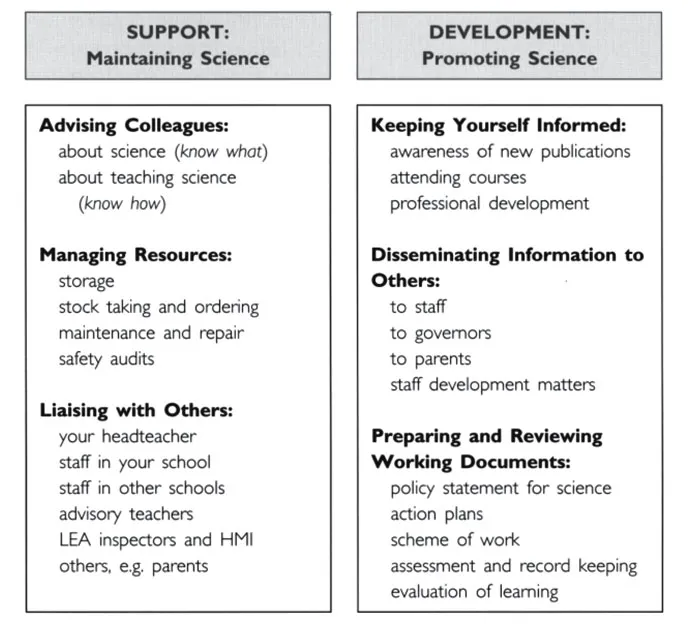
FIG 1.1 The role of the science coordinator
- advising and supporting colleagues;
- managing resources;
- liaising with others.
Advising and supporting colleagues
As the science coordinator, you will often have to respond to requests for science information (subject knowledge) and ideas for how to teach a topic (pedagogic knowledge). For example, questions range from, ‘Yes, but…what exactly is energy?’to ‘How do I teach my class about the flow of electric current?’This is not, however, the same as saying that you must be the fount of all science knowledge and understanding. Rather, what is needed is to know where to find the answers to such questions. In the first instance this may be from books so it is useful to have a small reference collection for basic information in a readily digestible form. However, guard against those old secondary school science textbooks which may serve as inappropriate models for primary practice.
Other questions likely to be asked of you relate to science education more broadly, such as, ‘One of my topics this term is “Festivals”. What can I do with my 6-year-olds in science that fits in with the National Curriculum?’Alternatively, the whole school programme might say ‘Chemical Changes’ and the teacher says, ‘There’s a good television series on festivals this term which I would like to use. How can I bring the two together?’The difficulty is apparent here. As the coordinator, you must be familiar with ideas and activities suitable for the full primary age range and ensure progression and continuity throughout the school, even though your personal experience may be limited to teaching one Key Stage. Textual resources can be supportive but so can other colleagues. It saves time and effort if successful ideas, a...
Table of contents
- Cover Page
- Title Page
- Copyright Page
- List of figures
- Series editor’s preface
- Introduction: Coordinating primary school science
- Part one: The role of the science coordinator
- Part two: What science coordinators need to know
- Part three: Whole school policies and schemes of work
- Part four: Monitoring for quality
- Part five: Resources for learning and support
- References
Trusted by 375,005 students
Access to over 1.5 million titles for a fair monthly price.
Study more efficiently using our study tools.
Frequently asked questions
Yes, you can cancel anytime from the Subscription tab in your account settings on the Perlego website. Your subscription will stay active until the end of your current billing period. Learn how to cancel your subscription
No, books cannot be downloaded as external files, such as PDFs, for use outside of Perlego. However, you can download books within the Perlego app for offline reading on mobile or tablet. Learn how to download books offline
Perlego offers two plans: Essential and Complete
- Essential is ideal for learners and professionals who enjoy exploring a wide range of subjects. Access the Essential Library with 800,000+ trusted titles and best-sellers across business, personal growth, and the humanities. Includes unlimited reading time and Standard Read Aloud voice.
- Complete: Perfect for advanced learners and researchers needing full, unrestricted access. Unlock 1.5M+ books across hundreds of subjects, including academic and specialized titles. The Complete Plan also includes advanced features like Premium Read Aloud and Research Assistant.
We are an online textbook subscription service, where you can get access to an entire online library for less than the price of a single book per month. With over 1.5 million books across 990+ topics, we’ve got you covered! Learn about our mission
Look out for the read-aloud symbol on your next book to see if you can listen to it. The read-aloud tool reads text aloud for you, highlighting the text as it is being read. You can pause it, speed it up and slow it down. Learn more about Read Aloud
Yes! You can use the Perlego app on both iOS and Android devices to read anytime, anywhere — even offline. Perfect for commutes or when you’re on the go.
Please note we cannot support devices running on iOS 13 and Android 7 or earlier. Learn more about using the app
Please note we cannot support devices running on iOS 13 and Android 7 or earlier. Learn more about using the app
Yes, you can access Coordinating Science Across the Primary School by Lynn D Newton,Douglas P Newton,Douglas P. Newton in PDF and/or ePUB format, as well as other popular books in Education & Education General. We have over 1.5 million books available in our catalogue for you to explore.