- 192 pages
- English
- ePUB (mobile friendly)
- Available on iOS & Android
eBook - ePub
About this book
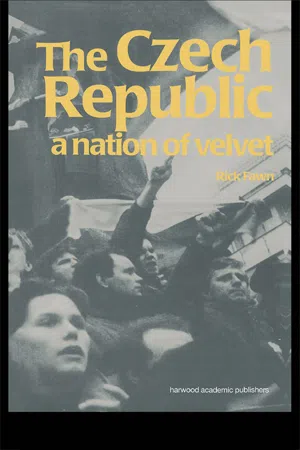
Czechoslovakia has captured the nation's imagination throughout the twentieth century. The Allied betrayal of the country to Nazi Germany in 1938 was to demonstrate the appalling consequences of naive appeasement of aggression. The wholesale reform of Soviet communism in the Prague Spring of 1968 won western support, and sympathy when it was crushed by Warsaw Pact tanks. The fierce communist regime thereafter was brought down almost magically in 1989. Czechoslovakia added to the international political vocabulary the term, 'Velvet Revolution', and the velvet metaphor has characterised much of the country's path-breaking postcommunist transformation and its peaceful break-up in 1993.
In separate chapters on history, politics, economics, foreign relations and the new Czech identity, this book not only applauds the successes of the Czech Republic since 1993, but also uncovers the frayed edges of the velvet nation.
Trusted by 375,005 students
Access to over 1.5 million titles for a fair monthly price.
Study more efficiently using our study tools.
Information
Chapter 1
THE LEGACIES OF HISTORY: FROM THE FOUNDATION TO THE VELVET REVOLUTION AND THE VELVET DIVORCE
In September 1938, British Prime Minister Neville Chamberlain expediently proclaimed Czechoslovakia to be a faraway country of which people knew nothing. Nevertheless, the history of Czechoslovakia is now well-travelled. Its history is very much the history of Europe, and, similarly, is replete with ambiguity and controversy. This chapter seeks to offer an outline of Czechoslovak and Czech history while also acknowledging the varying interpretations of that history and inviting the reader to further judgement.
CREATING CZECHOSLOVAKIA
The birth of Czechoslovakia in 1918 resulted from the skilful statesmanship of Czech and Slovak intellectuals, the mobilization of émigré communities in North America and the coincidence of their aims with that of the victorious Allies. This product, however, was less of a concert between Czech and Slovak populations themselves. Under the aegis of Tomáš G.Masaryk, an intellectual born in the southern Moravian town of Hodonín, the 30 May 1918 Pittsburgh Agreement called for the union of the Czechs and Slovaks in their own independent state. The Agreement intimated that the Slovaks would enjoy autonomy in the new state. The justifications for the creation of Czechoslovakia were ambiguous, and that ambiguity was a harbinger for the viability and durability of the country, particularly as it replicated the multiethnic nature of the Austro-Hungarian empire from which it had extricated itself.
Czechoslovakia moved towards reality when, on 28 October 1918, the National Committee that had campaigned for independence during the war announced the separation from Austria-Hungary of the Czech and Slovak lands. Key figures in the Czechoslovak independence movement, including Masaryk, Eduard Beneš and Milan Štefánik, were not even present in Prague when the pronouncement was made. A ‘bloodless revolution’ followed, in which Habsburg officials willingly ceded administrative control. The most audacious act of this peaceful revolution was the removal of public signs bearing the double-eagle emblem of the Habsburg empire.1
The formal Proclamation of the Republic of Czechoslovakia was made on 11 November. The creation of Czechoslovakia was foremost underwritten by pragmatism. For the Western Allies, the principle of national self-determination also justified the creation of a series of independent states forming a cordon sanitaire between defeated Germany and emasculated but revolutionary Russia. In addition, the proposed Czechoslovakia had what were considered natural frontiers, particularly a series of low mountains surrounding Bohemia and Moravia. Such topographical features added to the perceived defencibility of the country, which in turn increased the logic of Czechoslovakia as a country.
A nationality had to be created in order to fulfil the principle of national self-determination. The Czechs constituted barely half of the population while Germans constituted the second largest ethnic group, outnumbering the Slovaks. An ethnic fusion of the Czechs and Slovaks would generate an indisputable majority nation, thereby confirming its right to national self-determination. The higher Slovak birthrate was also expected over time to help reinforce the Slavic preponderance in the new country.
Linguistic and cultural reasons might have suggested that the Czechs and Slovaks were fraternal nations and their fusion was natural. But they had disparate historical experiences; the Czechs rose to cultural importance in Europe when Charles IV ascended the throne of the Holy Roman Empire. The Czechs lost their independence to the Austrians following the Battle of White Mountain of 1620 during which its nobility was destroyed, contributing to a national belief thereafter that the Czechs were an egalitarian people. By contrast, the Slovaks were under Hungarian tutelage for nearly a millennium. So absorbed into the Hungarian realm was Slovakia that St Martin’s Cathedral in Bratislava was the site of the enthronement of Hungarian kings. The development of a possible Slovak elite was pre-empted by intensive Magyarization and cooption. Religion also differentiated the Czechs and Slovaks. While Protestantism was important in Slovak culture and political life it was much more dominated by Catholicism than in the Czech Lands where the religious ethos was contoured by the Hussite-secular protest tradition. What similar heritage the two peoples shared did not make for a natural fusion. Rather, like many peoples around them, the Slovaks had undergone a national revival in the mid- and late-nineteenth century; and in 1918 they were asked to cede an identity that, while not fully enshrined as a popular ethos, was still strong enough to present an obstacle to the installation of a successor.
The fusion, then, was expedient, and expedience became an enduring feature of Czechoslovakia. As one commentator observed, the ‘full meaning of the political union of Slovaks and Czechs in 1918 was nebulous and difficult for the Czechs to grapple with or even understand. Prior to 1917 such a union had been given hardly any real consideration’.2 As another writer notes, ‘Czechoslovak unity was still a vessel to be filled with content and purpose in 1918’.3
Several features of the new country suggested that it would be strong and successful: its economic prowess, democratic credentials and accommodation of ethnic diversity. The country inherited a great economic legacy: Bohemia had been the industrial powerhouse of the Austro-Hungarian empire. The new Czechoslovakia constituted only a fifth of the territory of the defunct empire but held over half its industrial capacity, nearly half of its industrial workers and alone was responsible for 70 percent of its industrial production.4 Even with agrarian Slovakia, Czechoslovakia ranked as one of the world’s ten most industrialized countries.5
This industrial base was complemented by Czechoslovakia’s extensive arable land and forests. Agriculture was therefore an important economic sector and although its farming was not as technologically advanced as in Western Europe, productivity in many crops exceeded the European average. By Austrian calculations, per capita income in the Czech Lands between 1911 and 1913 exceeded that of Austria by 21 percent.6 Economically viable, the country also provided wide-ranging social insurance. While this was not thoroughly organized in the Republic’s initial years, it represented a general principle of Czechoslovak social life. The new republic introduced economic measures to ensure Czechoslovak control over the economy and also to insulate it from Austria’s post-war economic problems. Steps taken by the first half of 1919 included the launch of a separate Czechoslovak currency and the establishment of Czechoslovak banks and the Prague Stock Exchange. While its neighbours went through economic crisis and even socialist coups, Czechoslovakia enjoyed a relatively prompt economic recovery from the Great War. These successes inspired Czechoslovakia’s post-communist economic architects, and Václav Klaus and Tomáš Ježek referred in 1989 to the post-World War I era as part of a Czech liberal economic tradition.7
It was not only for its economic success but also for its multiethnic composition that Czechoslovakia earned the nickname of the Switzerland of the east. According to the first official census, conducted in 1921, 66 percent of the total Czechoslovak population was Czech and Slovak; 23.4 percent was German and a further 5.6 percent Hungarian, while the smaller minorities of East Slavs, Russians, Ukrainians and especially Ruthenians totalled 3.5 percent.
The laws of the fledgling country made provision for its ethnic diversity, with extensive legal and political provisions for its minorities, which were particularly enshrined in the Bill of Rights. In addition, a Supreme Administrative Court was established to hear cases of infringements of political rights. The education system was strong and also made provision for minority language education. Czech teachers were despatched to Slovakia to expand its education system. By 1930, 96 percent of Slovaks, as well as 97 percent of Germans and 93 percent of Hungarians, were receiving schooling in their native tongues.8 Major cities had parallel Czech and German universities or technical schools. The 1920 Constitution also entrenched equality among the country’s diverse ethnic groups and offered minority rights, including the use of minority languages in conducting government business in areas where they comprised at least a fifth of the population.
Both the Germans and Slovaks found grounds for dissatisfaction with the new country. The German minority, which had resided on the territory that had become Czechoslovakia for centuries, believed that its rights were curtailed and its interests underrepresented. The proposals of the Pittsburgh Agreement, including a Slovak assembly, were stalled after 1918 and then superseded by the Constitution of 1920, which created a highly centralized, unitary state.
Masaryk believed that as much as fifty years and certainly at least a generation was required for the Czechs and Slovaks to merge into a common nation.9 In the interim the young Czechoslovak state sought to strengthen the roots of Slovak identity and therein strengthened the Slovak sense of distinctiveness. Negligible industrial development was undertaken in Slovakia during the interwar period, save for modest military projects in the 1930s. What industry had been developed under the Austro-Hungarian empire (and it was the most industrial part of Hungary’s domain) was forced to compete, and generally unsuccessfully, against its Czech counterparts after 1918. At least the comprehensive education system in Slovakia, often run by Czechs sent to redress the region’s dearth of teachers, erased the effects of Magyarization. But the linguistic and cultural reinstatement of Slovak identity also had political consequences. Soon into the life of the young republic Slovaks began to believe that they were deprived of autonomy in the centralized state, particularly as they saw the central government, as well as their own local offices, overwhelmingly staffed by Czechs. Politically conscious Slovaks were divided between those who supported the idea of Czechoslovakia and those who classed themselves as Czecho-Slovaks, the latter most notably represented by the Slovak People’s Party of Andrej Hlinka. The Czecho-Slovaks approached the electoral strength of their competitors in Slovakia in only one of the four elections held in the First Republic.10
Nevertheless, the interwar parliamentary system was intended to include all ethnic and political interests. Proportional representation gave rise to a broadly based multiparty system that covered the political spectrum and the ethnic composition of society. A striking indication of the liberal, tolerant ethos of Czechoslovak politics was that, unlike elsewhere in the region, the Czechoslovak Communist Party (KSČ) was legally established in 1921 and allowed to operate openly throughout the interwar period. Party politics was a prevalent feature of political life. This was a result of the Constitution, which mandated proportional representation. Fifty parties ran in the interwar elections, with fifteen generally represented. Securing just eight percent of the popular vote allowed a party the possibility of entering a governing coalition. Because of the fragmentation of votes, at least five parties were needed to form a coalition,11 and this grouping became known as the Pìtka (The Five). As would be the case in post-communist Czechoslovakia and then in the Czech Republic, parties operated on the basis of a list of candidates, and those candidates sat in parliament.
The centrality of political parties to Czechoslovak politics was highlighted by the relative impotence of the President, who possessed limited power and was elected by Parliament. But Masaryk enhanced the powers of his post through his moral and intellectual prestige, as Havel would do seven decades later. Known as ‘Tatiček’, or Daddy, the scholarly Masaryk contrasted with other interwar Central European leaders, who tended to be military figures and inclined to centralized rule, such as Poland’s Marshall Pi³sudski or Hungary’s Admiral Horthy, or the autocratic monarchs of south-eastern Europe.
International circumstances would not favour interwar Czechoslovakia. The Depression of the late 1920s affected Czechoslovakia particularly badly. As a trading nation, protectionism crippled its exports. The economic downturn exacerbated ethnic relations. The Slovak economy, which trailed European standards of growth throughout the interwar period by forty years, suffered significantly and charges were levelled against Czech financial circles for manipulating the Slovak economy.
The efforts to accommodate Sudeten Germans in Czechoslovakia decreased as the Depression worsened. Invitations to the Sudeten Germans to participate in the government and the provision of education, and in the German language, that was superior to that received by their co-ethnics in Germany,12 failed to alleviate the effects of the economic crisis. The economic welfare of Czechoslovak Germans was already dented by the economic redistribution programmes of the post-1918 Czechoslovak government. But because of the extensive industry in the Sudetenland and its disproportionate employment of the Czechoslovak Germans, the fall in industrial production and exports affected their livelihoods especially profoundly. These circumstances offered fertile ground for the pro-Nazi National Front Party led by Konrad Heinlein. In May 1935 his party won almost two-thirds of the Sudeten German vote and he began advocating the federalization of Czechoslovakia. Thereafter, with backing from Hitler, he made increasing demands on Prague for German rights which ultimately meant secession and which were therefore incompatible with the integrity of the Czechoslovak state. The National Front Party also became increasingly totalitarian, seeking to mimic its successful fraternal party in Germany by commanding the full loyalty of its members, and that of all Sudeten Germans. Consequently it pressured, even with violence, moderate Czechoslovak-German political parties into joining with it. By 1938 it was effectively the only voice for Germans in Czechoslovakia.
CZECHOSLOVAKIA DISMEMBERED
Unlike its neighbours, democratic rule in Czechoslovakia was subverted not by developments from within but forces from without. While the Sudeten Germans carry some responsibility for the destruction of Czechoslovakia, they acted in an environment fashioned by Hitler, and Hitler had claims on Czechoslovakia. At his trial in 1924 Hitler inverted the concept of self-determination and proclaimed that the Germans were disenfranchised from regrouping their co-nationals and enjoying the right of self-government: ‘Self-determination, but self-determination for every negro tribe, and Germany does not count as a negro tribe’.13
As the international turbulence of the 1930s increased Czechoslovakia vigorously sought to secure itself through a combination of what can be called ‘good internationa...
Table of contents
- COVER PAGE
- TITLE PAGE
- COPYRIGHT PAGE
- POSTCOMMUNIST STATES AND NATIONS BOOKS IN THE SERIES
- PREFACE
- GLOSSARY OF ABBREVIATIONS
- CHAPTER 1: THE LEGACIES OF HISTORY: FROM THE FOUNDATION TO THE VELVET REVOLUTION AND THE VELVET DIVORCE
- CHAPTER 2: FRAMING VELVET: THE INSTITUTIONAL ARENA AND RULES OF THE GAME IN CZECH POLITICS
- CHAPTER 3: PATCHWORK VELVET: THE BURST BUBBLE OF THE CZECH ECONOMIC TRANSFORMATION
- CHAPTER 4: EXPORTING VELVET: THE CZECH REPUBLIC’S FOREIGN POLICY
- CHAPTER 5: A NATION OF VELVET? TOWARDS A NEW CZECH NATIONAL IDENTITY
- BIBLIOGRAPHY
Frequently asked questions
Yes, you can cancel anytime from the Subscription tab in your account settings on the Perlego website. Your subscription will stay active until the end of your current billing period. Learn how to cancel your subscription
No, books cannot be downloaded as external files, such as PDFs, for use outside of Perlego. However, you can download books within the Perlego app for offline reading on mobile or tablet. Learn how to download books offline
We are an online textbook subscription service, where you can get access to an entire online library for less than the price of a single book per month. With over 1.5 million books across 990+ topics, we’ve got you covered! Learn about our mission
Look out for the read-aloud symbol on your next book to see if you can listen to it. The read-aloud tool reads text aloud for you, highlighting the text as it is being read. You can pause it, speed it up and slow it down. Learn more about Read Aloud
Yes! You can use the Perlego app on both iOS and Android devices to read anytime, anywhere — even offline. Perfect for commutes or when you’re on the go.
Please note we cannot support devices running on iOS 13 and Android 7 or earlier. Learn more about using the app
Please note we cannot support devices running on iOS 13 and Android 7 or earlier. Learn more about using the app
Yes, you can access The Czech Republic by Rick Fawn in PDF and/or ePUB format, as well as other popular books in Politics & International Relations & 20th Century History. We have over 1.5 million books available in our catalogue for you to explore.