- 329 pages
- English
- ePUB (mobile friendly)
- Available on iOS & Android
eBook - ePub
About this book
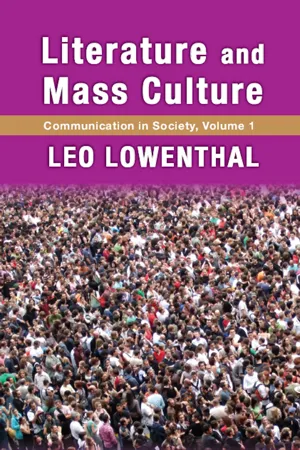
This first volume of the collected writings of sociologist Leo Lowenthal contains his classic theoretical and historical writings on the relationship of art to mass culture. This book series presents Lowenthal's contributions to a theory of the role of communication in modern society. This volume lays out the basis for a theory of mass culture. Lowenthal demonstrates that the juxtaposition of a "low"mass culture and a "high"esoteric culture did not originate in contemporary industrial, bourgeois society but can be traced back to the Middle Ages and antiquity.
Information
Part I
Historical and Empirical Studies
1
Historical Perspectives of Popular Culture
This chapter was written to be provocative, by one who has been engaged in empirical research for a considerable number of years and who has recently been charged with the administration of a large-scale research program. The author has taken it upon himself to act as the spokesman for an approach to popular culture which some will call “social theory” and others “obsolete, abstract criticism.” Specifically, this chapter deals with aspects of the historical and theoretical frame of reference which seem to me to be a basic requirement for the study of mass communications and yet a blind spot in contemporary social science. I know of no better statement with which to highlight this blind spot in contemporary analyses of mass phenomena than De Tocqueville’s remarks on the fact-finding obsession of the American mind a century ago:
The practice of Americans leads their minds to fixing the standard of their judgment in themselves alone. As they perceive that they succeed in resolving without assistance all the little difficulties which their practical life presents, they readily conclude that everything in the world may be explained, and that nothing in it transcends the limits of the understanding. Thus they fall to denying what they cannot comprehend; which leaves them but little faith for whatever is extraordinary and an almost insurmountable distaste for whatever is supernatural. As it is on their own testimony that they are accustomed to rely, they like to discern the object which engages their attention with extreme clearness; they therefore strip off as much as possible all that covers it; they rid themselves of whatever separates them from it, they remove whatever conceals it from sight, in order to view it more closely and in the broad light of day. This disposition of mind soon leads them to condemn forms, which they regard as useless and inconvenient veils placed between them and the truth.1
My plea on behalf of these “veils” takes the form of five rather unsystematic groups of observations: (1) I shall indicate that the discussion of popular culture has a century-old tradition in modern history; (2) the historical locus of popular culture today will be fixed; (3) an attempt will be made to evaluate the over-all approach of empirical research to the social function of contemporary popular culture; (4) the current philosophical, qualitative, nonresearch analysis of popular culture will be summarized briefly; and (5) some programmatic notes will be offered on the relationship between social criticism and social research.
Popular Culture—an old dilemma
In a survey recently undertaken of radio-listening habits in a foreign country, one of the respondents remarked:
Radio is the companion of the lonely. It has made gigantic strides for almost half a century. Women in particiular, especially those with small pensions and without other resources, who are completely isolated, are now in touch with the whole world thanks to the radio. They have undergone a regular transformation; they have found a kind of second youth. They are up-to-date and they know the stars of the headlines, of the theatre, the movies, the world of sports, etc. I have heard village people, discussing the merits of Mozart and Chopin, refer to what the radio had said.
In quite the opposite vein another woman revealed that she did not have a radio set in her home. Asked to explain why, she answered: “Because once there is a set in the house, one cannot resist. Everybody listens idiotically, the kids and the others too. When we stay with my friend G., my husband plays with the radio all the time.” Her view was supported by a male respondent, who also refuses to permit a radio in the house. He believes that studies, conversation, and activity around the house provide enough interest, that the indiscriminate outpouring of music and talk over the radio lowers everyone’s intellectual level.
These spontaneous remarks reveal two leitmotifs which have run continuously through the modern era: on the one hand, a positive attitude toward all instrumentalities for the socialization of the individual; on the other hand, a deep concern about the inner fate of the individual under the impact of the leveling powers of institutional and other organized forms of leisure activity. This basic dilemma concerning man’s existence beyond the requirements of biological and material survival, the vital question of how to live out that stretch of life which is neither sleep nor work, can be said to have found its classic intellectual expression in a philosophical dialogue that never took place. Montaigne in the sixteenth century took stock of the situation of the individual after the breakdown of medieval culture. He was particularly struck by the phenomenon of loneliness in a world without faith, in which tremendous pressures were being exerted on everyone under the conditions of a postfeudal society. To escape destruction by these pressures, to avoid becoming lost in the horrors of isolation, Montaigne suggested distraction as a way out:
Variety always solaces, dissolves, and scatters. If I cannot combat it, I run away from it; and in running away I double and change my direction. By changing place, occupation, company, I escape into the crowd of other thoughts and diversions, where it loses my trace, and leaves me safe.
Is it reasonable that even the arts should take advantage of and profit by our natural stupidity and feebleness of mind? The barrister, says Rhetoric, in that farce they call pleading, will be moved by the sound of his own voice and his feigned emotion, and will suffer himself to be cozened by the passion he is acting. He will affect a real and substantial grief in this mummery he is playing, to transmit it to the jury who are still less concerned in the matter than he. Like those men who are hired at funerals to assist in the ceremonial of mourning, who sell their tears and grief by weight and measure; for, although they are stirred by borrowed emotions, it is certain that, through the habit of settling their countenance to suit the occasion, they are often quite carried away and affected with genuine melancholy.2
It is significant that quite a few basic concepts which we have been accustomed to regard as very modern emerge as early as the sixteenth century: escape, distraction, entertainment, and, last but not least, vicarious living.
The reply to Montaigne came a century later. Commercial culture had developed in the meantime, and the waning influence of religion, pre- or post-Reformation, had made itself felt much more strongly in the average way of life. Restlessness, the search for relief everywhere and anywhere, had become a major social phenomenon. It was then that Pascal spoke up against the complete surrender of man to self-destroying restlessness:
Men are entrusted from infancy with the care of their honor, their property, their friends, and even with the property and the honor of their friends. They are overwhelmed with business, with the study of languages, and with physical exercise; and they are made to understand that they cannot be happy unless their health, their honor, their fortune and that of their good friends be in good condition, and that a single thing wanting will make them unhappy. Thus they are given cares and business which make them bustle about from break of day.—It is, you will exclaim, a strange way to make them happy! What more could be done to make them miserable?—Indeed! what could be done? We should only have to relieve them from all these cares; for then they would see themselves: they would reflect on what they are, whence they came, whither they go, and thus we cannot employ and divert them too much. And this is why, after having given them so much business, we advise them, if they have some time for relaxation, to employ it in amusement, in play, and to be always fully occupied.
How hollow and full of ribaldry is the heart of man!3
Again and again he warned against what he called “diversion” as a way of life which could lead only to permanent unhappiness:
When I have occasionally set myself to consider the different distractions of men, the pains and perils to which they expose themselves at court or in war, whence arise so many quarrels, passions, bold and often bad ventures, etc., I have discovered that all the unhappiness of men arises from one single fact, that they cannot stay quietly in their own chamber.
They have a secret instinct which impels them to seek amusement and occupation abroad, and which arises from the sense of their constant unhappiness.4
Thus the attitude toward leisure which, for Montaigne, guarantees survival means self-destruction to Pascal. And the controversy is still going on. Each side has its partisans on all intellectual levels in everyday life, as illustrated in the study on radio as well as in learned treatises. On one side there is the benevolent analyst of a mass medium who seems to say that, while everything is not yet wonderful, it is getting better every day:
For in the old days the artists and writers and craftsmen were not writing at the behest of the people, but to please small powerful groups, the kings and lords and chieftains, who drew the talent of the time inward towards them and kept it circumscribed within the bounds of their castles and baronies. Much of the fine art of today remains alive only through a similar connection.
Yet, taking civilization as a whole, this ancient process is now in reverse. There is an outward movement. Pictures, entertainment, fun, are beginning to be seen as the rightful possession of all, and the comics join in and reflect this spreading democratization. And if the people’s standards are at present lower than those which were set by workers around the seats of the mighty, the people’s artists will have the satisfaction of knowing that they are identified with a vast and forward movement, which is giving to everyday folks their right to laugh and flourish under the sun.5
On the other hand, we find the nonconformist social critic who connects the loneliness of modern man with his interest in mass media as a setup of utter frustration:
The conditions of earning one’s bread in this society create the lonely modern man.
Such conditions help explain the need, sometimes feverish, for an entertainment that so repetitively presents the same reveries, the same daydreams, the same childish fables of success and happiness. So much of the inner life of men is dried up that they tend to become filled with yearnings and to need the consolation of these reveries about people who are happy, healthy, and always successful.
Hence, parallel to the retrogression of consciousness in, say, the Hollywood writer, there is a more widespread and also more pernicious retrogression of consciousness in the motion-picture audience. Social and economic conditions have established the basis for this; the motion picture further enforces it.6
The differences in the verbalization of the dilemma are obvious. The language of the sixteenth and seventeenth century philosophers is still deeply steeped in religious terminology; that of the modern writers in sociological terms; that of the nonprofessional radio listeners or nonlisteners in the ordinary words of everyday life. But beneath these differences in nomenclature the dilemma remains the same: perhaps it could be called a conflict between the psychological and the moral approaches to popular culture.
The historical Locus of Popular Culture
This section of my discussion will be somewhat dogmatic in character, partly for the sake of brevity but also because it ought to be permissible to pause from time to time in our sociological routine and to speculate about the secular trend in which we, together with our objects of research, find ourselves.
The counterconcept to popular culture is art. Today artistic products are losing the character of spontaneity more and more and are being replaced by the phenomena of popular culture, w...
Table of contents
- Cover
- Half Title
- Title Page
- Copyright Page
- Table of Contents
- Acknowledgments
- Preface
- Part I: Historical and Empirical Studies
- 1 Historical Perspectives of Popular Culture
- 2 The Debate Over Art and Popular Culture: A Synopsis
- Excursus A: Notes on the Theater and the Sermon
- 3 Eighteenth Century England: A Case Study
- Excursus B: The Debate on Cultural Standards in Nineteenth Century England
- 4 The Reception of Dostoevski in Pre-World War I Germany
- 5 The Biographical Fashion
- 6 The Triumph of Mass Idols
- Excursus C: Some Thoughts on the 1937 Edition of International Who’s Who
- Part II: Contributions to the Philosophy of Communication
- 7 On Sociology of Literature (1932)
- 8 On Sociology of Literature (1948)
- 9 Humanistic Perspectives of David Riesman’s The Lonely Crowd
- 10 Popular Culture: A Humanistic and Sociological Concept
Trusted by 375,005 students
Access to over 1.5 million titles for a fair monthly price.
Study more efficiently using our study tools.
Frequently asked questions
Yes, you can cancel anytime from the Subscription tab in your account settings on the Perlego website. Your subscription will stay active until the end of your current billing period. Learn how to cancel your subscription
No, books cannot be downloaded as external files, such as PDFs, for use outside of Perlego. However, you can download books within the Perlego app for offline reading on mobile or tablet. Learn how to download books offline
Perlego offers two plans: Essential and Complete
- Essential is ideal for learners and professionals who enjoy exploring a wide range of subjects. Access the Essential Library with 800,000+ trusted titles and best-sellers across business, personal growth, and the humanities. Includes unlimited reading time and Standard Read Aloud voice.
- Complete: Perfect for advanced learners and researchers needing full, unrestricted access. Unlock 1.5M+ books across hundreds of subjects, including academic and specialized titles. The Complete Plan also includes advanced features like Premium Read Aloud and Research Assistant.
We are an online textbook subscription service, where you can get access to an entire online library for less than the price of a single book per month. With over 1.5 million books across 990+ topics, we’ve got you covered! Learn about our mission
Look out for the read-aloud symbol on your next book to see if you can listen to it. The read-aloud tool reads text aloud for you, highlighting the text as it is being read. You can pause it, speed it up and slow it down. Learn more about Read Aloud
Yes! You can use the Perlego app on both iOS and Android devices to read anytime, anywhere — even offline. Perfect for commutes or when you’re on the go.
Please note we cannot support devices running on iOS 13 and Android 7 or earlier. Learn more about using the app
Please note we cannot support devices running on iOS 13 and Android 7 or earlier. Learn more about using the app
Yes, you can access Literature and Mass Culture by Leo Lowenthal in PDF and/or ePUB format, as well as other popular books in Social Sciences & Media Studies. We have over 1.5 million books available in our catalogue for you to explore.