![]()
Part 1
The purpose of buildings
| |
| | INTRODUCTION, 7 | | |
| Chapter 1 | | ORIGINS, 9 | | |
| | | Houses, 9 | | |
| | | The settlement, 10 | | |
| | | Ritual sistes, 11 | | |
| | | Workplaces, 11 | | |
| | | Communications between settlements, 12 | | |
| | | Commerce and industry, 12 | | |
| | | Urban design, 12 | | |
| | | Defining space, 13 | | |
| | | Unnecessary space, 13 | | |
| | | Implicit limits, 14 | | |
| | | Privacy, 15 | | |
| | | Protection, 16 | | |
| Chapter 2 | | MODERATION OF THE ENVIRONMENT, 19 | | |
| | | Water, 19 | | |
| | | Temperature, 21 | | |
| | | Air flow, 22 | | |
| | | Sound, 22 | | |
| | | Natural disaster, 24 | | |
| Chapter 3 | | USE OF AVAILABLE TECHNOLOGY, 25 | | |
| | | Natural conditions, 26 | | |
| | | Local materials, 27 | | |
| | | Traditional technology, 28 | | |
| | | Available skills, 30 | | |
| | | Examples, 30 | | |
| | | Conclusion, 32 | | |
| Chapter 4 | | THE DEMANDS OF THE COMMUNITY, 33 | | |
| | | City and state 33 | | |
| | | Sustainable architecture, 36 | | |
| | | Law, 38 | | |
| | | Culture, 39 | | |
| | | Risk assessment, 40 | | |
| | | Tradition, 41 | | |
| | | Conclusion, 42 | | |
| | BIBLIOGRAPHY, 43 | | |
![]()
Part 1
Introduction
Before attempting to understand the mechanisms and techniques which are applied to the design of buildings, it is a prerequisite that the purposes for which buildings are created should be properly understood. These are not merely utilitarian, and are perceived differently by different parties. As technology has gained greater sophistication, so people have set higher targets in every area.
In Chapter 1 there is a brief survey of the development of buildings from primitive structures to the present.
The important role of the building envelope in modifying the external environment to produce acceptable internal conditions is discussed in Chapter 2.
Chapter 3 considers the means available to achieve such aims at different periods and today, and there is an overview of the materials and skills traditionally available to provide suitable structures, with a note of their relationship to climate and skill.
Finally, the cultural and legal requirements of the community are discussed, together with a note on sustainability and on risk assessment in Chapter 4.
![]()
Chapter 1
Origins
The most important part of a building is the space it defines. The other parts exist to define that space and to modify the environment experienced within it.
Houses
The earliest buildings created in all cultures are dwellings, not so dissimilar from the lairs or nests created by other animals, and intended to serve somewhat similar purposes. These are initially threefold:
• shelter, in terms of moderation of the climate;
• protection from predators; and
• privacy.
The shelter was made in the simplest possible way by the people who would occupy it, and the size of the home that could be created was severely limited by the materials available in the immediate vicinity and by the strength and skills of the people. It might well serve only on a seasonal basis, either because of its innate perishability or because the occupants were nomadic. These considerations apply to homes in climates as varied as the plains of Africa and the North American tundra.
Homes everywhere would be of somewhat similar size—just large enough to accommodate a sleeping nuclear family—and they were almost always circular because that is the easiest shape to build and has the most economical relation between perimeter and area.
The significant variations between the houses arise from two important factors:
• the climate from which shelter was required, which might include almost any combination of cold, wind, rain, snow or fog, or of heat, glare and sand storm; and
• the materials available—stone, wood, skins, grasses, ice blocks and so on.
So that the yurt, igloo, hut or tent were created from the most readily available materials to meet specific environmental conditions. From these very earliest beginnings, such considerations were intimately connected, and could not be considered in isolation.
Whereas most animals continue generation after generation to create similar shelters, humankind is adventurous, creative and ambitious. Once the notion of making them rectangular was appreciated, houses could become larger, and they were expandable. More than one cell could be created under a single roof. Even later, when the beam was invented, they could be broadened as well.
As skills developed, so did expectations, and homes have continued to become more sophisticated and so create even greater aspirations among potential owners.
A fourth purpose can, as a result, be added to the three mentioned above: statement. That is to say, from quite early times it came to be the case that dwellings told onlookers something about the people who lived in them. If they could afford to employ skilled specialists on the building, or to bring expensive materials from far away, this added to the occupants’ prestige.
In its simplest form, this can be seen in the Chief’s home being larger and more substantial than those of others because he could command the resources of materials and labour as a result of his position.
The settlement
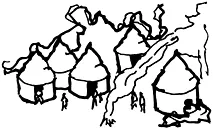
The small clusters of dwellings constructed by an extended family evolved into permanent settlements, as a hunter-gatherer society developed into a settled agricultural one. Such villages were carefully sited where a good supply of clean water was available, as well as suitable land. From a very early stage, care was taken to draw water from a higher point in its flow than the position where wastes were discharged into it.
Although there was no land hunger, the dwellings were built close to one another, largely for defensive reasons. In some regions they were sited contiguously, so that access was across roofs and downwards into individual dwellings.
Ritual sites
The second category of sites which appear to have been set apart for specific purposes consists of those that archaeologists loosely classify as ‘ritual sites’. Such constructions were of course fixed, and even in a nomadic society would be objectives of pilgrimage.
In these cases that fourth purpose, the statement of function, seems to have been paramount to those who made the spaces. Often, however, there is still doubt about the precise purpose. These might be spaces cleared and surrounded by defining structures, such as ditches or banks, or henges marked by stone or wood circles; in which case it seems most likely that they served for community meetings or for worship or the casting of oracles. It is reasonable to define them as monuments. The circle was still the preferred plan form.
Focal sites were generally chosen, and the monuments are often found on skylines or across valleys, where they can be readily seen from settlements even when these are at some distance from them.
A subsection of this category is the cemetery. The disposal of the dead seems always to have been treated with reverence by the great majority of cultures, and tombs and burial places...