Taking the pulse of current efforts to do—and, in some cases, undo—critical literacy, this volume explores and critiques its implementation in learning contexts around the globe. An impressive set of international authors offer examples of productive critical literacy practices in and out of schools, address the tensions and gaps between these practices and educational policies, and attempt to forecast the future for critical literacy as a movement in the changing global educational policy landscape. This collection is unique in presenting the recent work of luminaries such as Allan Luke and Hilary Janks alongside relative newcomers who use innovative approaches and arguments to reinvigorate and redefine critical practice. It is time for this cutting-edge inquiry into the state of critical literacy—not only because is it a complex and ever-evolving field, but perhaps more important, because it offers a reaction to, and powerful reworking of, standardization and high-stakes accountability measures in educational contexts around the globe.
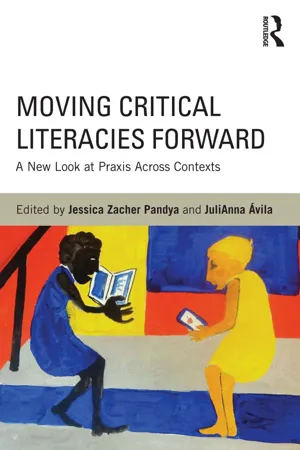
eBook - ePub
Moving Critical Literacies Forward
A New Look at Praxis Across Contexts
- 240 pages
- English
- ePUB (mobile friendly)
- Available on iOS & Android
eBook - ePub
Moving Critical Literacies Forward
A New Look at Praxis Across Contexts
About this book
Information
1
INTRODUCTION
Making the Road by Talking: Moving Critical Literacies Forward
In this introduction, we solidify in writing some of the conversations about key issues in critical literacy that we have been having over the past 10 years. We began this process in homage to Miles Horton and Paulo Freire's conversations in We Make the Road by Walking (1990), aiming to discuss and reflect on critical literacy's place in the world today. Like them, we have purposefully used dialogue as a framework through which to articulate the need to, as our title suggests, move critical literacies forward. We have brought the authors in this book together to show what critical literacy as a set of practices and stances can help us accomplish in classrooms and in our worlds. We—the participants in this edited volume—argue that critical literacies offer powerful ways of engaging with the opportunities and inequalities accelerated by globalization. New student populations and new technologies are combining to change what it means to be literate and to teach literacy.
These changing contexts are fraught for present and future teachers, whose hesitancy about undertaking critical literacy practices1 are reflective of larger societal tensions about turbulent economies and unstable job markets. Jobs are scarce, job retention is increasingly tied to assessments, and test preparation and curricular fidelity are often key job components. Critical literacies—whether seen as a way to cosmopolitanize youth (Hull & Stornaiuolo, 2010; Smith & Hull, 2012), a method through which to combat injustice (Janks, 2010; this volume), or a bricolage of these and other definitions—offer alternatives. They offer alternative ways to read and respond to some of the effects of globalization that are so visible in classrooms. To be useful in these ways, they need to be continuously retheorized and continually revisioned in practice. We think critical literacy has a fundamental role to play in the recruitment and retention of teachers who are able to not only withstand but also thrive in such exciting and challenging circumstances.
In the conversation we begin below, we use our own experiences to make some links between critical literacies in teacher education and in classroom and out-of-school contexts with children and youth. We begin with the issue of literacy vs. literacies, since its complexities illuminate crucial aspects of our subsequent critical literacy discussion. For instance, the multiple definitions of critical literacy and the looseness implied by the plural “literacies” provoke a certain degree of caution from those who want straightforward definitions and teachable skill sets. We then discuss the connections between critical literacy and multicultural education and education for social justice. We see them as interlinked movements, and think that critical literacy practices can, and do, move social justice itself forward. We also touch on some of the ways the global accountability movement has impacted critical literacies efforts in classrooms from preschool to college, as well as in teacher education. Critical literacies practices can offset the emotional, and cognitive, pressures of high-stakes assessment; they can also work as a set of methods through which teachers and students can make themselves heard in policy arenas. We have appreciated the chance to learn about and reflect on these topics as we make our own critical literacy journeys, and look forward to further conversation.
Our Conversation
JuliAnna: I find the trend of using “literacy” and “literacies” in seemingly interchangeable ways intriguing because it reflects, I would argue, some key frictions in literacy studies. Even as we have, in research and practice, shifted to a recognition that literacy is no longer a singular, agreed-upon entity, easily taught in linear and measurable ways (e.g., New London Group, 1996), habit and tradition seem to return us to the default: critical literacy. Does it even matter if it is singular or plural (except to an English teacher with idiosyncratic concerns)? I believe it does because, although perhaps benign in one sense, this choice represents the ways we're caught between one context, where mainstream education still treats literacy as singular in many ways (e.g., assessments) and the contexts we are working hard to create and share (e.g., plural contexts, where some elements might well transfer while others may not, leading again to unruliness I'll return to later). Critical literacies are hard to contain, in rows or boxes and even definitionally.
Another reason that we all move between “literacy” and “literacies” is that we want to reserve the right to move between the two forms as we see fit. This right is perhaps a claim made by those who traffic in language, with its affordances as well as its limitations. We know what both the reductive singular as well as the more expansive plural have meant and continue to mean as contested terms in the political struggle that can be literacy, or should I say literacies, education. I hope that we can teach our students that, at times in our lives, literacy is singular and must be coped with as a singular and monolothic entity to succeed in mainstream education, while at other times, there is more freedom and latitude, and hopefully self-definition, of what literacies encompass; and, ultimately, that our literacy identities can be expansive enough to deal with both forms.
Jessica: That may be one of the larger goals of critical literacy practitioners—to ensure that their own, and others', literacy identities are expansive. I think an expansive literacy identity is probably one of the most valuable assets in a globalizing world. Can we talk about our own literacy identities, to explain how we came to bring these authors together in this particular collection about critical literacy? My sense of self has long been tied up in being a good reader and writer, and my schooling experiences apprenticed me to a mix of what Patrick Finn (2009) would call middle-class and elite literacy practices. It wasn't until college, when I began tutoring children at a public school in Chicago's south side who did not share my privilege, or my positive associations with school literacies, that I got an inkling of what it might be like to be uncomfortable with the literacy practices that structure our lives. I spent my senior year volunteering in a local first-grade classroom, an experience that marked the beginning of my identity as a teacher in general, and as a teacher of urban children in particular.
I knew there were inequalities in the school system in which I worked, but I had not yet heard the term social justice, much less critical literacy; and I had even less sense of the idea that my students and I might attempt to make changes in our worlds. I suspect that this is where a lot of new teachers—from more and less privileged backgrounds—find themselves: knowing the world is unfair, but thinking that the only kind of positive change they can make is at the personal level, helping one student at a time. What about your own early experiences— did they lead you to a similar place?
JuliAnna: I felt that way starting out, although I've always wondered about the extent to which my experiences are typical. Since childhood I have always felt like I was in the borderlands; I grew up in southeast Los Angeles county in a mostly Latino neighborhood; as a girl who looked more White than Latina, although I am both, I was an outsider as long as I can recall. I ended up at an elite university but only for my last 2 years and after moving around, changing schools, and living a life that did not bode well for empowering anyone, least of all myself. I felt caught between cultures and social classes, and was not sure I deserved a university education since so many of my peers had not been able to attempt one, due primarily, I think, to not being raised to expect a post-secondary education or a social or economic station better than their parents'. I did not want my parents' life—or at least one of my parents: my father was a middle and secondary school teacher for 45 years, and I began college with the proclamation that I would not be an educator. Despite that, I had started volunteering as a teenager and became involved in a variety of social justice organizations. It would not be until I started teaching that I would connect education with social justice. As a college senior, I came to believe that those of us who achieve in literacy and English Education should be working with those who struggle with it and are outsiders in that particular sphere. Like you, I threw myself into the task of working with students who viewed literacy as an enemy and source of failure.
Jessica: So in both of our cases, I'd say the recognition of the centrality of literacy to individuals came first, and then that recognition expanded to the levels of social justice and community action. When I enrolled in the elementary teaching credential program at the New College of California, in San Francisco, I was immersed in the educational lingo for inequality, picking up terms like “social justice” and “multiculturalism.” I was also introduced to Freire, learning explicitly how literacy was implicated in social justice issues: how children intuitively construct understandings of their worlds, and how those understandings can be profitably used in the service of literacy acquisition. We hosted monthly Spanish—English family literacy nights, learned songs in Spanish, and practiced whole-language teaching methods (especially literacy experience approaches—those were my favorite activities). I began to learn Spanish at New College out of self-defense, since, at the time (and now) it seemed to me that everyone I came into contact with in California spoke Spanish, and I had better do so, too.
I got my first teaching job the next year at a school I'll call Gonzales (a pseudonym). It was a very diverse school—a mix of Latino, African-American, White, and Asian families and teachers. I was encouraged by my colleagues to address social justice issues with my students, but looking back, I'd describe our efforts as what Sleeter and Grant (2008) would call a “multicultural education” approach rather than a critical literacy approach. We did not move from study to questioning, much less to taking action to change existing power relations. My own inability to go further into critical pedagogical approaches—either further along the multicultural education spectrum towards social change, or towards critical literacy—shows me how I did connect education with social justice, but in rather specific, and not very expansive, ways. I think this is where a lot of teachers find themselves—wanting to bring inequalities to their students' attention, or to talk about inequalities their students bring up, but not having a sense of what to do next!2 Critical literacies approaches offer a bridge for those people—from awareness to action, via literacy activities that are (mostly) valued at school.3
JuliAnna: I know what you mean about operating at a certain level of awareness and assumption. I had been a “good” student and did well on standardized tests so when I started teaching high school and was working with students who tested several years behind their grade levels, I did not know enough to question either the validity of the assessments that pinned the label of “struggling” to these students or the structure of schooling that tracks students in unjust and unsupported ways, or to challenge the “mentor” teacher who told me that I should promptly abandon my plans to read the grade-level texts that the district recommended; instead, she strongly suggested that I equip myself with “skill” workbooks and then commandeer the copy machine so that I could have enough copies for all of the students. I did buy some of those remedial workbooks but also proceeded to read grade-level “real” texts with students (e.g., The Catcher in the Rye [Salinger, 1951]; I bet Holden Caulfield would have a thing to say about the scenario I just described). I also asked the principal to assign me another mentor. Despite my lack of awareness of critical literacy, and an inclination to be obedient that I credit to my Catholic childhood, I still believed it was a student's right to read the same texts that their “regular” peers were reading.
Jessica: You know, even with the institutional label of “struggling” placed on your students, you probably had more flexibility in that context than high school teachers of so-called “struggling” students do now. I had a similar flexibility, since I had only 20 students, lots of curricular resources, and, most importantly, the assessment pressures of No Child Left Behind (2001) were only distant clouds on the horizon. In fact, the only testing regime my students and I faced was administering the Brigance kindergarten readiness test in the few weeks allotted to me to get it done. Since then, I've made arguments about the injustice of overloading children with high-stakes testing regimes and highly structured curricula (Zacher Pandya, 2011), but at the time, I was unaware of these coming trends. I was, as many teachers are, busy enough just working with my students and happy to leave the larger world to its own devices. What about you? Did your awareness of social justice issues expand as you taught high school?
JuliAnna: I think my awareness of social justice found a different context since I had been aware of issues before due to volunteering with a range of organizations while in high school, as I mentioned before. The school that I taught at was diverse with Latino, African-American, and White students in, I would guess, roughly equal numbers (with a caveat about the tenuous nature of memory) and in a lower middle-class and working-class neighborhood. It was a scene I knew well, having attended this particular high school myself, a fact my students found amusing. I think they wondered if I had gotten out, why I had not stayed out. It was because I had done so well in English classes that I wanted to return to work with students who did not do well in English, still years away from understanding the complex and intricate landscape of “not doing well” in school. Although I had been enrolled in an Educating At-Risk Youth M.A. program immediately after earning a B.A., I felt that learning about education in the abstract was less useful to me at that time than making the abstract real by teaching full time. I continued to take graduate education classes at night, and despite the fact that I was learning, I did not yet have critical literacy tools—pragmatic ways to connect literacy with power, or lack of power—in hand.
Jessica: Looking back, I can see so many missed opportunities, for even small acts, small changes. I also draw on that experience to refute those who say that elementary-aged children are too young to “do” critical literacy, since they need to know “basic” skills first, and be older … I may not have engaged in critical literacy practices with th...
Table of contents
- Cover
- Half Title
- Title Page
- Copyright Page
- Dedication
- Table of Contents
- Foreword
- Acknowledgments
- 1. Introduction: Making the Road by Talking: Moving Critical Literacies Forward
- Section I Theoretical Frameworks and Arguments for Critical Literacy
- Section II Critiquing Critical Literacy in Practice
- Section III Revisions of Critical Literacy
- List of Contributors
- Index
Trusted by 375,005 students
Access to over 1.5 million titles for a fair monthly price.
Study more efficiently using our study tools.
Frequently asked questions
Yes, you can cancel anytime from the Subscription tab in your account settings on the Perlego website. Your subscription will stay active until the end of your current billing period. Learn how to cancel your subscription
No, books cannot be downloaded as external files, such as PDFs, for use outside of Perlego. However, you can download books within the Perlego app for offline reading on mobile or tablet. Learn how to download books offline
We are an online textbook subscription service, where you can get access to an entire online library for less than the price of a single book per month. With over 1.5 million books across 990+ topics, we’ve got you covered! Learn about our mission
Look out for the read-aloud symbol on your next book to see if you can listen to it. The read-aloud tool reads text aloud for you, highlighting the text as it is being read. You can pause it, speed it up and slow it down. Learn more about Read Aloud
Yes! You can use the Perlego app on both iOS and Android devices to read anytime, anywhere — even offline. Perfect for commutes or when you’re on the go.
Please note we cannot support devices running on iOS 13 and Android 7 or earlier. Learn more about using the app
Please note we cannot support devices running on iOS 13 and Android 7 or earlier. Learn more about using the app
Yes, you can access Moving Critical Literacies Forward by Jessica Pandya, JuliAnna Ávila, Jessica Pandya,JuliAnna Ávila in PDF and/or ePUB format, as well as other popular books in Langues et linguistique & Éducation générale. We have over 1.5 million books available in our catalogue for you to explore.