eBook - ePub
Forgotten Voices
The Expulsion of the Germans from Eastern Europe After World War II
- 356 pages
- English
- ePUB (mobile friendly)
- Available on iOS & Android
eBook - ePub
About this book
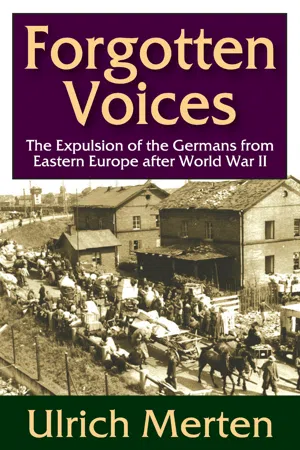
The news agency Reuters reported in 2009 that a mass grave containing 1,800 bodies was found in Malbork, Poland. Polish authorities suspected that they were German civilians that were killed by advancing Soviet forces. A Polish archeologist supervising the exhumation, said, "We are dealing with a mass grave of civilians, probably of German origin. The presence of children . . . suggests they were civilians."During World War II, the German Nazi regime committed great crimes against innocent civilian victims: Jews, Poles, Russians, Serbs, and other people of Central and Eastern Europe. At war's end, however, innocent German civilians in turn became victims of crimes against humanity. Forgotten Voices lets these victims of ethnic cleansing tell their story in their own words, so that they and what they endured are not forgotten. This volume is an important supplement to the voices of victims of totalitarianism and has been written in order to keep the historical record clear.The root cause of this tragedy was ultimately the Nazi German regime. As a leading German historian, Hans-Ulrich Wehler has noted, "Germany should avoid creating a cult of victimization, and thus forgetting Auschwitz and the mass killing of Russians." Ulrich Merten argues that applying collective punishment to an entire people is a crime against humanity. He concludes that this should also be recognized as a European catastrophe, not only a German one, because of its magnitude and the broad violation of human rights that occurred on European soil.Supplementary maps and pictures are available online at http://www.forgottenvoices.net
Trusted by 375,005 students
Access to over 1.5 million titles for a fair monthly price.
Study more efficiently using our study tools.
Information
Index
A
- Adenauer, Konrad (German Chancellor), 286, 288
- Alba Julia
- See Declaration of Karlsburg
- Allied Control Commission, 79, 191–192
- Allied Control Council, 76, 162–163
- Allied Zones of Occupation of Germany, xii, 10–11, 20, 162, 170
- Allies, xiii
- Chetniks and Tito, 214
- Curzon Line, 4
- and acceptance of refugees, 10–11
- effects of bombing, 30
- expulsion of inhabitants of Sudetenland, 112, 146
- Polish frontier, 83
- postwar political objective, 286
- Potsdam Conference, 64, 162
- Anti-Fascist Council for the Liberation of Yugoslavia
- See AVNOJ
- Antonescu, Ion (General, 1882–1946), 247–249, 253–254
- Äôs Courts
- See Czech Extraordinary People’s
- Courts
- Arrow Cross Party, 185
- Association of German Friendship Circles in Poland, 80
- Auschwitz-Birkenau, xiv, xx, 9, 65, 85–86, 138–139, 302, 307
- Aussig (Usti nad Labem), Czechoslovakia, 107, 125–128
- Austria, xii, 2–4
- assassination of Archduke Franz Ferdinand, 138
- cession of Burgenland to, 175
- expulsion of Germans from Hungary to, 199–200, 208
- German escapes to, 208
- German evacuation to, 102
- German expulsion to, 147, 152, 160– 170
- Habsburg, 87
- 1910 census, 95
- Austro-Hungarian Compromise of 1867, 210
- Austro-Hungarian Empire, 2, 95–98,
- Autochthonous peoples, 76, 80, 285
- See also Kashubians in West Prussia and Pomerania
- Masurians in East Prussia
- AVNOJ (Anti-Fascist Council for the Liberation of Yu...
Table of contents
- Cover
- Title Page
- Copyright
- Contents
- Preface
- Acknowledgments
- Foreword
- I Background
- II The Flight and Expulsion of the German Population from East of the Oder-Neisse Line (Poland)
- The Soviet Attack on East Germany and the Flight of the Civilian Population
- The Return of the German Population to Their Homes East of the Oder-Neisse Line
- Deportation of German Civilians as Forced Labor to the Soviet Union
- The Expulsion of the German Population from East of the Oder-Neisse Line
- The Polish Government’s Justification for the Expulsion of the German Population
- III The Expulsion of the Ethnic German Population from the Former Czechoslovakia
- IV The Expulsion of the Ethnic German Population from Hungary
- V The Flight, Incarceration, and Expulsion of Ethnic Germans from the Former Republic of Yugoslavia
- VI The Fate of the Ethnic German Minority in Romania
- VII Conclusion: Integration and Reconciliation
- Integration of Refugees and Expellees into German Society
- Reconciliation with East European Nations
- Relations with Romania and the Former Yugoslavia
- Concluding Remarks
- Appendix
- Bibliography
- Index
Frequently asked questions
Yes, you can cancel anytime from the Subscription tab in your account settings on the Perlego website. Your subscription will stay active until the end of your current billing period. Learn how to cancel your subscription
No, books cannot be downloaded as external files, such as PDFs, for use outside of Perlego. However, you can download books within the Perlego app for offline reading on mobile or tablet. Learn how to download books offline
Perlego offers two plans: Essential and Complete
- Essential is ideal for learners and professionals who enjoy exploring a wide range of subjects. Access the Essential Library with 800,000+ trusted titles and best-sellers across business, personal growth, and the humanities. Includes unlimited reading time and Standard Read Aloud voice.
- Complete: Perfect for advanced learners and researchers needing full, unrestricted access. Unlock 1.5M+ books across hundreds of subjects, including academic and specialized titles. The Complete Plan also includes advanced features like Premium Read Aloud and Research Assistant.
We are an online textbook subscription service, where you can get access to an entire online library for less than the price of a single book per month. With over 1.5 million books across 990+ topics, we’ve got you covered! Learn about our mission
Look out for the read-aloud symbol on your next book to see if you can listen to it. The read-aloud tool reads text aloud for you, highlighting the text as it is being read. You can pause it, speed it up and slow it down. Learn more about Read Aloud
Yes! You can use the Perlego app on both iOS and Android devices to read anytime, anywhere — even offline. Perfect for commutes or when you’re on the go.
Please note we cannot support devices running on iOS 13 and Android 7 or earlier. Learn more about using the app
Please note we cannot support devices running on iOS 13 and Android 7 or earlier. Learn more about using the app
Yes, you can access Forgotten Voices by Ulrich Merten in PDF and/or ePUB format, as well as other popular books in History & Eastern European History. We have over 1.5 million books available in our catalogue for you to explore.