- 249 pages
- English
- ePUB (mobile friendly)
- Available on iOS & Android
eBook - ePub
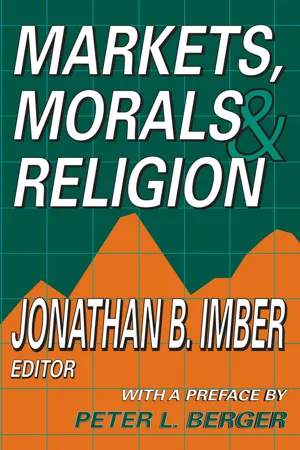
Markets, Morals, and Religion
About this book
The examination of the relationship of economic activity to other important aspects of human life and social behavior has inspired some of the most interesting and provocative social-scientific research in the past one hundred years. This book of original essays by leading thinkers across many disciplines offers new insights into enduring questions about how modern and modernizing market economies are both shaped by and shapers of morality, values, and religion.Part 1, "Markets and Morals," offers eight contributors who provide analyses of the various ways in which the market operates in relation to morality. An empirical presentation of moral values and market attitudes is given. Other essays take aim at how markets serve and disserve moral interests: Economic growth has moral consequences; the manipulation of markets exposes a moral underside; the nature of market failure has implications for understanding moral vulnerability; preference change has moral implications. In other chapters, a broad consideration of the positive moral effects of market economies is offered along with historical essays on the role that intellectuals have played in debates about the positive and negative effects of commercial life and on the ways in which the American idea of the pursuit of happiness reveals much about the morality of economic life.In Part 2, "Markets and Religion," nine contributors address both the historical and contemporary emergence of religious factors in the growth and transformation of global capitalism. Major religious traditions, including Judaism, Christianity, and Islam are examined for their contributions to answering questions about the nature and function of economic life in light of religious ideas and ideals. Several essays present original approaches to the importance of religious values to modern forms of consumption and to the political economy of reconciliation and forgiveness in nations coming to terms with past conflict. Finally, t
Part 1
Markets and Morals
1
Three Hundred Years of Positive Moral Effects of the Market
Jerry Z. Muller
In our society, defenses of the market come primarily from those concerned with economic and material well-being. Those who see themselves as the protectors of morality are more likely to be antipathetic to the market. But what about the positive moral effects of the market that tend to get overlooked in narrowly economistic discussions about production and distribution? To be sure, many of these benefits also have potential costs. But since these costs tend to receive the most attention from moralists, I will note them here without dilating upon them, not because they are less significant but because they are likely to be more familiar.
One perennial pitfall in thinking about the moral effects of capitalism is the issue of comparison. When philosophers ask about the morality of capitalism, they too rarely ask “compared to what”? Of course capitalism is morally inferior to many a philosophical utopia. And our comparative evaluation of capitalism is further skewed by the fact that when we compare capitalism to past regimes, it is often implicitly from the perspectives of those who profited most and suffered least in past systems—from the perspectives of lords rather than serfs, of masters rather than slaves, aristocrats rather than commoners.
With that caveat in mind, let me turn to the first argument about the positive moral effects of the market, namely the link between individual autonomy and self-support through legally free labor. Adam Smith famously wrote that: “It is not from the benevolence of the butcher, the brewer, or the baker, that we expect our dinner, but from their regard to their own interest. We address ourselves, not to their humanity but to their self-love, and never talk to them of our own necessities but of their advantages. Nobody but a beggar chooses to depend chiefly upon the benevolence of his fellow-citizens.”
This passage is most famous as a statement of the potential utility of self-interest. But notice its assertion that dependence upon the benevolence of others is morally degrading and hence something we should try to avoid if possible. Thomas Carlyle—and later Marx and Engels—would decry this system of mutual appeals to self-interest as “the cash nexus.” But the flip side of the cash nexus is first of all the freedom and self-determination that comes from having cash; and second, the fact that relations based on cash do not involve the total subordination of one individual to the will of another—the characteristic forms of human relations under slavery or serfdom. Nor does it involve the subordination of the individual to the will of the state and its officials, characteristic of socialism. That is why Hegel insisted that supporting oneself by earning a living is one of the most important ways in which men get a sense of themselves as autonomous individuals. What he called “the ethic of bourgeois society,” includes a commitment to “the activity of supporting oneself through reason and industriousness.”
All of this has dark sides, potential and real. It may lead us to a mindless commitment to work at the expense of other goods. It may lead to the belief that personal value comes only from paid labor, leading to a fear of dependence on others, or leading us to underinvest our time in vital but unpaid activity.
The second argument asserts that the moral quality of self-support derives in good part from the fact that it so often extends beyond the individual, to his or her family and descendants. This argument reminds us not to confuse self-interest with selfishness, for the “interests” we pursue in the marketplace often involve more than just ourselves. As Burke put it, “The power of perpetuating our property in our families is one of the most valuable and interesting circumstances belonging to it, and that which tends the most to the perpetuation of society itself. It makes our weakness subservient to our virtue; it grafts benevolence even upon avarice.”
Or, as Hegel explained, it is in the family that the self-interested actors of the market become members of a collectivity, to which they are emotionally and ethically attached. It is this collective interest that gives property and self-interest a very different meaning. It is the desire to form a family that often makes it necessary to acquire a continuous stream of income in the first place. And property is an integral part of family life. “The external and public reality of the family is its wealth,” Hegel writes, “its family fortune, which forms the basis for the survival of its members.” One way in which the love and deep obligation that characterize the family are expressed is by earning a living in the marketplace. In the search for familial wealth, Hegel says, self-interest and selfishness are transformed into an ethical concern for something shared.
The potential dark side here is that a commitment to the support of one’s family can overshadow our concern with the well-being of those beyond our family. It can thus serve as a motive for civic neglect, or even fraud.
The third argument is that the market leads to a self-interested concern for others, to what one might call non-altruistic reciprocity, or what Kant called “unsocial sociability.” This takes several forms. As Adam Smith pointed out, regular market relations are conducive to the development of honesty. This insight has been rediscovered by contemporary game-theorists. For reiterated multi-lateral exchange creates incentives to develop the trust of other players by scrupulous action. That is why merchants out to make a single sale to a customer are more likely to engage in fraud, while those who seek return business have reason to be honest. It is why successful companies have generous return policies and offer money-back guarantees. It is why companies that want to attract and retain investors strive for financial transparency. (Whereas executives out to make a single “killing” have no such incentive.)
Another form in which the market conduces to the development of a concern for others was explored by Hegel. Because we are dependent on others to meet our needs, and because we can only earn money by supplying their wants, we are forced to orient ourselves to other people, and take an interest in what they think and want. The link of self-interest to mutual concern is expressed in the sales clerk’s “Can I help you?” That phrase is often scorned—except by those who have lived in societies where sales clerks, for lack of institutional incentives, habitually ignore potential customers. Seen from the heights of moral rigorousness, such commercially motivated solicitude is evidence of the lack of true charity and altruism. Seen historically and comparatively, the market’s ability to create a self-interested regard for others is probably preferable to the indifference which most often characterize the relations of imperfect men and women toward one another.
Georg Simmel carried this argument an interesting step further, in his discussion of competition and its effects on entrepreneurs. Competition, he pointed out, is not only a relationship between those who compete: it is a struggle for the affection—or money—of a third party. To compete successfully, Simmel noted, the competitors must discover the wishes of that third party. Often, competition “achieves what usually only love can do: the divination of the innermost wishes of the other, even before he himself becomes aware of them.” And he was right: how many of us divined twenty years ago that we would need a computer on our desks? How many of us divined ten years ago that we could hardly live without a high-speed internet? This competition for customers and consumers had a highly democratic aspect as well. “Modern competition,” Simmel observed, “is often described as the fight of all against all, but at the same time it is the fight of all for all.” Competition, he wrote, forms “a web of a thousand social threads: through concentrating the consciousness on the will and feeling and thinking of fellowmen, through the adaptation of producers to consumers, through the discovery of ever more refined possibilities of gaining their favor and patronage.”
Each of these moral benefits has its potential dark side: self-interested solicitude can lead to complete inauthenticity, a sense of always selling oneself. That is why it has been so consistent a theme of social criticism from Rousseau’s critiques through “Death of a Salesman” and beyond. And the inculcation of ever- new needs by the market—when not bounded by a sense of priorities and of how new commodities fit into our life-plan—may put us on a treadmill of joyless consumption.
The fourth argument is that capitalism creates ever wider forms of human association. From Smith through Friedrich Hayek it has been pointed out that commerce connects us to foreign peoples who we come to regard not as barbarians but as potential suppliers and potential customers. Capitalism creates an awareness of their needs and wants, and to the extent that we view them as customers for our products and as producers of the goods we hope to consume, we become linked to them. One effect, as Marx and Engels put it, is that “National one-sidedness and narrow-mindedness become increasingly impossible, and from the numerous national and local literatures, there arises a world literature.” And, one might add, a world music, a more cosmopolitan cuisine, and an exchange of ideas such that there are more and more Buddhists in the United States and more and more classical musicians coming from places such as South Korea.
A related argument holds that capitalism leads to a diminution of religious and communal antagonism. Indeed one of great arguments in favor of capitalism is that it diffuses cultural and religious sources of conflict. It does so by creating incentives to cooperate with people of differing ultimate commitments, leading to a greater zone of indifference to the ultimate goals of others. We find this argument in Voltaire’s description of the London stock exchange in his Philosophical Letters: “Come into the London Exchange, a place more respectable than many a court. You will see assembled representatives of every nation for the benefit of mankind. Here the Jew, the Mohametan and the Christian deal with one another as if they were of the same religion, and reserve the name “infidel” for those who go bankrupt.”
It is their shared focus on a common means—money—that diffuses the religious antagonisms between the Jew, the Muslim, and the Christian. Taking this idea further, Georg Simmel claimed that money is the ultimate means. And minds ever more oriented to the weighing of means, Simmel tells us, become more tolerant, more conciliatory, because, focused on means, they are less concerned about to the ultimate ends of others. Spending less time thinking about ultimate salvation or perfection and more on obtaining means, they become more indifferent to the divergent ways in which others seek perfection or salvation. The market thus conduces to wider co-operation through a de-dramatization of social relations.
Of course this creation of wider forms of association is itself a source of moral complaint by those who champion cultural and religious particularism, and who rightly view trans-cultural contact as a threat to their inherited identity, at least in its traditional form. And the very de-dramatization of social relations may itself become a source of discontent by those who scorn such relations as mundane and trivial.
The last argument worth considering is that capitalism creates new and more complex forms of individuality. Simmel suggested that the limited-liability corporation was a model for many characteristic forms of association in an advanced capitalist society. Individuals cooperate with a limited portion of their lives for common but limited purposes. In previous societies, one’s status as a peasant, artisan or merchant often defined one totally. Being a member of a guild, for example, encompassed a complete set of social roles—economic, legal, political, and even religious. Modern market society, by contrast, is based upon looser, more temporary associations, founded to pursue specific economic, cultural, or political interests. Such associations demand only a small part of the individual, sometimes only a monetary contribution in the form of dues. As a result, the modern individual can belong to a greater range of groups, but groups that are looser and less all-encompassing. In contrast to earlier forms of association, modern associations allow for participation without absorption. They make it possible for the individual to develop a variety of interests and to become involved in a wider range of activities than would otherwise be possible, yet to do so without surrendering the totality of his or her time, income, or identity to any particular association, from the family to the state.
Under such circumstances, individual identity arises from the set of one’s interests and associations, a set different, in theory at least, for each individual and valued precisely because it is voluntarily chosen. I may be a husband and father, a Buddhist, a jazz aficionado, a molecular biologist, a marksman, and a reader of modernist fiction. What is remarkable, and historically new, is the possibility of being all of these things at the same time. Being any one of them does not entail the others, and so my identity, my sense of myself as an individual is constituted in large part by the choices I have made and the intersection of interests that come together in me. And that choice of possibilities is made possible in no small part by the market. It is the division of labor facilitated by the market that allows for this profusion of possibilities. It makes it possible for me to specialize in molecular biology, and to be sufficiently productive to make enough money so that I can buy commodities that allow me to develop my interests —musical instruments, recorded music, novels, and trips to the ashram.
The dark side of this argument is the danger of the development of a protean self, without a set of binding commitments to any one or any thing; where the bottom line of every social contract is the escape clause.
There are, no doubt, plenty of good economic arguments about how (under the right conditions and in the long run) capitalism has made nations better off materially. And there are plenty of good arguments about the moral hazards of a market society, some of which have been touched on above. But there are also plausible arguments about capitalism’s moral advantages, which are perhaps more easily overlooked. Indeed, many of the moral advantages and conceptions of selfhood that those in capitalist societies take for granted are due in no small part to capitalism itself.
2
The Moral Consequences of Economic Growth
Benjamin M. Friedman
“Economic growth has become the secular religion of advancing industrial societies.
”—Daniel Bell,
The Cultural Contradictions of Capitalism
Are we right to care so much about economic growth as we clearly do? For citizens of all too many of the world’s countries, where poverty is still the norm, the answer is immediate and obvious. But the tangible improvements in the basics of life that make economic growth so important whenever living standards are low – greater life expectancy, fewer diseases, less infant mortality and malnutrition – have mostly played out long before a country’s per capita income reaches the levels enjoyed in today’s advanced industrialized economies. Americans are no healthier than Koreans or Portuguese, for example, and we live no longer, despite an average income more than twice what they have. Yet whether our standard of living will continue to improve, and how fast, remain matters of acute concern for us nonetheless.
At the same time, perhaps because we are never clear about just why we attach so much importance to economic growth in the first place, we are often at cross-purposes – at times we seem to be almost embarrassed – about what we want. We not only acknowledge other values; as a matter of principle we place them on a higher plane than our material well-being. Even in parts of the world where the need to improve nutrition and literacy and human life expectancy is urgent, there is often a grudging aspect to the recognition that achieving superior growth is a top priority. As a result, especially when faster growth would require sacrifice from entrenched constituencies with well-established interests, the political process often fails to muster the determination to press forward. The all too frequent outcome, in low- and high-income countries alike, is economic disappointment, and in some cases outright stagnation.
The root of the problem, I believe, is that our conventional thinking about economic growth fails to reflect the breadth of what growth, or its absence, means for a society. We recognize, of course, the advantages of a higher material standard of living, and we appreciate them. But moral thinking, in practically every known culture, enjoins us not to place undue emphasis on our material concerns. We are also increasingly aware that economic development – industrialization in particular, and more recently globalization – often brings undesirable side effects, like damage to the environment or the homogenization of what used to be distinctive cultures, and we have come to regard these matters too in moral terms. On both counts, we therefore think of economic growth in terms of material considerations versus moral ones: Do we have the right to burden future generations, or even other species, for our own material advantage? Will the emphasis we place on growth, or the actions we take to achieve it, compromise our moral integrity? We weigh material positives against moral negatives.
I believe this thinking is seriously, in some circumstances dangerously, incomplete. The value of a rising standard of living lies not just in the concrete improvements it brings to how individuals live but in how it shapes the social, political, and ultimately the moral character of a people.
Economic growth – meaning a rising standard of living for the clear majority of citizens – more often than not fosters greater opportunity, tolerance of diversity, social mobility, commitment to fairness, and dedication to dem...
Table of contents
- Cover
- Half Title
- Title
- Copyright
- Dedication
- Contents
- Preface
- Introduction
- Part 1: Markets and Morals
- Part 2: Markets and Religion
- Contributors
- Index
Trusted by 375,005 students
Access to over 1.5 million titles for a fair monthly price.
Study more efficiently using our study tools.
Frequently asked questions
Yes, you can cancel anytime from the Subscription tab in your account settings on the Perlego website. Your subscription will stay active until the end of your current billing period. Learn how to cancel your subscription
No, books cannot be downloaded as external files, such as PDFs, for use outside of Perlego. However, you can download books within the Perlego app for offline reading on mobile or tablet. Learn how to download books offline
Perlego offers two plans: Essential and Complete
- Essential is ideal for learners and professionals who enjoy exploring a wide range of subjects. Access the Essential Library with 800,000+ trusted titles and best-sellers across business, personal growth, and the humanities. Includes unlimited reading time and Standard Read Aloud voice.
- Complete: Perfect for advanced learners and researchers needing full, unrestricted access. Unlock 1.5M+ books across hundreds of subjects, including academic and specialized titles. The Complete Plan also includes advanced features like Premium Read Aloud and Research Assistant.
We are an online textbook subscription service, where you can get access to an entire online library for less than the price of a single book per month. With over 1.5 million books across 990+ topics, we’ve got you covered! Learn about our mission
Look out for the read-aloud symbol on your next book to see if you can listen to it. The read-aloud tool reads text aloud for you, highlighting the text as it is being read. You can pause it, speed it up and slow it down. Learn more about Read Aloud
Yes! You can use the Perlego app on both iOS and Android devices to read anytime, anywhere — even offline. Perfect for commutes or when you’re on the go.
Please note we cannot support devices running on iOS 13 and Android 7 or earlier. Learn more about using the app
Please note we cannot support devices running on iOS 13 and Android 7 or earlier. Learn more about using the app
Yes, you can access Markets, Morals, and Religion by Jonathan B. Imber in PDF and/or ePUB format, as well as other popular books in Economics & Business Ethics. We have over 1.5 million books available in our catalogue for you to explore.