- 440 pages
- English
- ePUB (mobile friendly)
- Available on iOS & Android
eBook - ePub
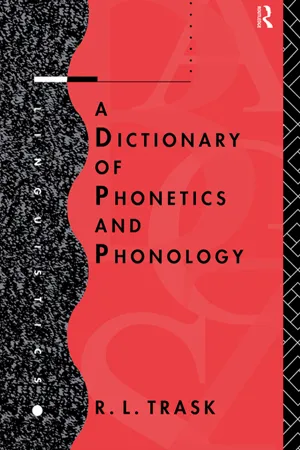
A Dictionary of Phonetics and Phonology
About this book
Written for students of linguistics, applied linguistics and speech therapy, this dictionary covers over 2,000 terms in phonetics and phonology. In addition to providing a comprehensive, yet concise, guide to an enormous number of individual terms, it also includes an explanation of the most important theoretical approaches to phonology. Its usefulness as a reference tool is further enhanced by the inclusion of pronunciations, notational devices and symbols, earliest sources of terms, suggestions for further reading, and advice with regard to usage.
The wide range of topics explained include:
* Classical phonology, including American Structuralism and the Prague School
* Contemporary approaches, including Autosegmental Phonology, Metrical Phonology, Dependency Phonology, Government Phonology and Lexical Phonology
* Prosodic ideas in phonology, both traditional and contemporary ^ * * historical phonology
* Intonation and tonology
This dictionary devotes space to the various theoretical approaches in proportion to their importance, but it concentrates most heavily on non-theory-bound descriptive terminology. It will remain a definitive reference for years to come.
Information
A Dictionary of Phonetics and Phonology
A
abbreviatory convention /ə'briːvieıtri kənvenʃən/ n. Any notational convention which allows two or more distinct but seemingly related statements to be written as what appears to be a single statement by combining common elements. The object of such a convention is the conflation of related rules into a rule schema, thereby gaining economy by avoiding restatement. Among the conventions which have been widely used in phonology are braces, parentheses, angle brackets, mirror-image environments and the alpha notation. Analysts differ as to whether these conventions should be regarded as representations of an underlying reality or merely as descriptive conveniences with no theoretical standing.
abduction /æb'dʌkʃən/ n. The moving apart of the vocal folds. V. abduct. Ant. adduction.
ablaut /'æblɑʊt/ n. (also vowel gradation, apophony) 1. A morphological process expressed by a change in the quality of a vowel within a root or stem for purely grammatical purposes, with the vowel alternation typically serving as the only exponent of the grammatical distinction. English examples include the inflectional patterns exhibited by ‘strong’ verbs like sing/sang/sung and write/wrote/written. The term is most usually applied to such phenomena in the older Indo-European languages, in which it was grammatically central: Latin tegō ‘cover’ but toga ‘toga’, Greek legō ‘read’ but logos ‘word’, Latin sedeō ‘sit’ but sodālis ‘companion’; but it is also sometimes applied to similar phenomena in other languages. Ablaut differs from umlaut only in its historical source: originally, ‘ablaut’ was applied to cases of vowel alternation for which no phonetic motivation could be identified. See also e-grade, o-grade and zero grade. 2. A historical change by which such an alternation comes about. Coates (1994) recommends restricting ‘ablaut’ to sense 2 and using ‘apophony’ for sense 1. He also suggests the term ‘consonantal apophony’ for those instances of Celtic mutation in which no overt trigger is present.
abrupt release /ə'brʌpt/ n. (also instantaneous release, abrupt offset) 1. The phenomenon in which a complete oral closure is released suddenly, without perceptible friction noise. Abrupt release is the property that distinguishes plosives from corresponding affricates. 2. (abrrel) See instantaneous release.
absolute bleeding /'æbsəluːt/ n. The relation between two ordered rules A and В in which the earlier rule A destroys all possible cases to which В could apply, leaving В without function. See bleeding order.
absolute feeding n. The relation between two ordered rules A and В in which the earlier rule A creates all the possible inputs to B. See feeding order.
absolute final position /pə'zıʃn/ n. The position of the last segment in an utterance, before a following pause; utterance-final position.
absolute initial position n. The position of the first segment in an utterance, after a preceding pause; utterance-initial position.
absolute neutralization n. An analysis which posits an underlying contrast which is never realized phonetically on the surface. Such analyses have most often been invoked to account for an observation that some single segment exhibits two distinct and conflicting types of behaviour. A famous example concerns Hungarian vowel harmony. In general, a Hungarian word consists entirely of back vowels or entirely of front vowels, but the front vowels /i/ and /е/ are anomalous, behaving (as expected) like front vowels in some words but like back vowels in others. The analysis of Vago (1973) accounts for this anomaly by positing the two additional back vowels /ɯ/ and /ɤ/, unattested on the surface, which participate normally in vowel harmony and then merge unconditionally (absolutely) with /i/ and /e/, respectively. Absolute neutralizations were an important if highly controversial feature of classical generative phonology, but were generally prohibited in Natural Generative Phonology and its successors by the Alternation Condition. Useful summaries of the issues can be found in Hyman (1975: 3.3.5), Sommerstein (1977: ch. 9) and Lass (1984: ch. 9); Lass (1984: 234) enumerates the most important papers. See also abstract segment. Kiparsky (1968b); an extension of neutralization.
absolute slicing hypothesis /'slaısıŋ/ n. The claim that speech can be exhaustively divided into a linear sequence of segments. Accepted by most earlier theories of phonology (though not by Prosodic Analysis), this claim is generally denied by non-linear approaches. Goldsmith (1976).
absolute threshold of hearing /'θreʃhəʊld/ n. The intensity at which sound is just distinguishable from silence, commonly taken for reference as a value of 10-16 watts per square centimetre, arbitrarily but conveniently equated with a value of zero decibels.
absolute universal n. A universal which holds for every single natural language without exception, hence, a statement which partially defines the notion ‘natural language’. Among the absolute universals often suggested in phonology are ‘Every language has both consonants and vowels’ and ‘Every language has at least one high vowel’. Cf. statistical universal.
absorption /əb'sɔːpʃən/ n. The phonological phenomenon in which the end point of a contour tone is lost when immediately followed by another tone which is identical to the end point of the contour. For example, if HL represents a high-to-low contour tone and L a low tone, the sequence HL L might undergo absorption to yield Η L. Such absorption is a common phenomenon in tone languages. Cf. spreading, and see the Obligatory Contour Principle. Hyman (1973); Hyman and Schuh (1974).
abstract /'æbstrækt/ adj. (of an analysis) Characterized by the use of an underlying form which is significantly different from the surface form. Except perhaps for the most extreme versions of American Structuralism, all theories of phonology permit some degree of abstractness, but abstract analyses flourished in a particularly unconstrained way within classical generative phonology. For example, SPE represents reduction underlyingly as re=duke+æːt+iVn and courage underlyingly as kdorægde, with a long sequence of phonological rules applying in each case to derive the surface form. Absolute neutralizations represent another striking kind of abstract analysis. See Lightner (1975) for a defence of extreme abstractness. Abstr. n. abstractness.
abstract feature n. A proposed distinctive feature for a particular language which lacks any clear phonetic motivation but which serves to distinguish a class of segments which unexpectedly pattern together in that language. For example, in many dialects of Basque, the coronal consonants /t s ś ts tś n l/ all palatalize after a high front vowel, but the coronals /d r rr/ do not. There being no clear phonetic basis for the distinction, one might conceivably distinguish the two groups by means of an abstract feature, say, [+P] for the first group and [−P] for the second. Most analysts, however, regard such abstract features with distaste. See Clark and Yallop (1990: 314–315) for some discussion. See also cover feature.
abstract segment n. In an analysis employing absolute neutralization, a segment posited as underlyingly present which never shows up overtly on the surface. For example, some analyses of French set up an abstract word-initial segment /h/ which, like any consonant, blocks liaison; having done so, the segment then disappears (merges with zero), accounting for the failure of certain words which are vowel-initial on the surface to undergo liaison.
abstract sound n. A conception of varying nature invoked frequently in the development of phonetics and phonology in the early twentieth century, notably by Daniel Jones in his refinement of the phoneme concept. Trubetzkoy (1939) distinguishes abstract sounds of the first level (hypothetical phonetic targets for the slightly varying individual phones occurring in different tokens) and those of the second level (allophones of a phoneme).
abstract suffix n. An abstract element, conveniently if somewhat arbitrarily regarded as an affix, posited in some analyses to account for the derivation of such forms as kiss (noun) from kiss (verb), belief (noun) from believe (verb) and record (noun) from record (verb), or possibly the other wa...
Table of contents
- Cover
- Half Title
- Title Page
- Copyright
- Contents
- List of figures
- Preface
- Acknowledgements
- List of abbreviations
- Guide to pronunciation
- A Dictionary of Phonetics and Phonology
- Appendix: the International Phonetic Alphabet (revised to 1993)
- References
Trusted by 375,005 students
Access to over 1.5 million titles for a fair monthly price.
Study more efficiently using our study tools.
Frequently asked questions
Yes, you can cancel anytime from the Subscription tab in your account settings on the Perlego website. Your subscription will stay active until the end of your current billing period. Learn how to cancel your subscription
No, books cannot be downloaded as external files, such as PDFs, for use outside of Perlego. However, you can download books within the Perlego app for offline reading on mobile or tablet. Learn how to download books offline
Perlego offers two plans: Essential and Complete
- Essential is ideal for learners and professionals who enjoy exploring a wide range of subjects. Access the Essential Library with 800,000+ trusted titles and best-sellers across business, personal growth, and the humanities. Includes unlimited reading time and Standard Read Aloud voice.
- Complete: Perfect for advanced learners and researchers needing full, unrestricted access. Unlock 1.5M+ books across hundreds of subjects, including academic and specialized titles. The Complete Plan also includes advanced features like Premium Read Aloud and Research Assistant.
We are an online textbook subscription service, where you can get access to an entire online library for less than the price of a single book per month. With over 1.5 million books across 990+ topics, we’ve got you covered! Learn about our mission
Look out for the read-aloud symbol on your next book to see if you can listen to it. The read-aloud tool reads text aloud for you, highlighting the text as it is being read. You can pause it, speed it up and slow it down. Learn more about Read Aloud
Yes! You can use the Perlego app on both iOS and Android devices to read anytime, anywhere — even offline. Perfect for commutes or when you’re on the go.
Please note we cannot support devices running on iOS 13 and Android 7 or earlier. Learn more about using the app
Please note we cannot support devices running on iOS 13 and Android 7 or earlier. Learn more about using the app
Yes, you can access A Dictionary of Phonetics and Phonology by R.L. Trask in PDF and/or ePUB format, as well as other popular books in Languages & Linguistics & Linguistics. We have over 1.5 million books available in our catalogue for you to explore.