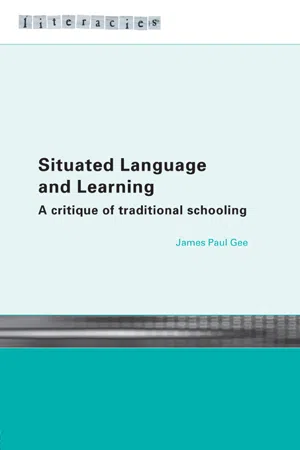
Why do poor and minority students under-perform in school? Do computer games help or hinder learning? What can new research in psychology teach our educational policy-makers?
In this major new book, Gee tackles the 'big ideas' about language, literacy and learning, putting forward an integrated theory that crosses disciplinary boundaries, and applying it to some of the very real problems that face educationalists today.
Situated Language and Learning looks at the specialist academic varieties of language that are used in disciplines such as mathematics and the sciences. It argues that the language acquisition process needed to learn these forms of language is not given enough attention by schools, and that this places unfair demands on poor and minority students.
The book compares this with learning as a process outside the classroom, applying this idea to computer and video games, and exploring the particular processes of learning which take place as a child interacts with others and technology to learn and play. In doing so, Gee examines what video games can teach us about how to improve learning in schools and engages with current debates on subjects such as 'communities of practice' and 'digital literacies'.
Bringing together the latest research from a number of disciplines, Situated Language and Learning is a bold and controversial book by a leading figure in the field, and is essential reading for anyone interested in education and language.
- 144 pages
- English
- ePUB (mobile friendly)
- Available on iOS & Android
eBook - ePub
About this book
Information
1
Introduction
I am a linguist whose interests have changed over the years. Today I am interested in the role language plays in learning. However, earlier in my career I spent my time studying things like “naked infinitives.” This is, of course, a topic that sounds a lot sexier than it is. Naked infinitives are grammatical constructions like the verb “leave” in “I saw Mary leave.” In this sentence, “leave” is an “infinitive” (a verb not marked for “tense,” that is not marked as “present” or “past”). In English, infinitives are usually preceded by a “to,” as in “I wanted Mary to leave.” Since the “to” is missing in “I saw Mary leave,” “leave” is said to be “naked.” I also studied “headless relatives,” another topic that sounds more exciting than it is. Headless relatives are grammatical constructions like “who I want to marry” in “I will marry who I want to marry.” “Who I want to marry” is a relative clause. Such clauses are normally preceded by a noun phrase called their “head,” as in “I will marry the person I want to marry,” where “the person” is the head of the relative clause. Thus, since there is no head in front of “who I want to marry” in “I will marry who I want to marry,” it is called a “headless relative clause.”
This book has nothing to do with naked infinitives or headless relatives. It does, however, have something to do with why the last paragraph, my first in the book, will not be very inviting to many readers. You don’t really want to hear a lot more technical information about naked infinitives and headless relatives, do you? You lost a lot of your interest when you found out naked infinitives had nothing to do with naked bodies and headless relatives had nothing to do with decapitating people. If you didn’t like school, the first paragraph reminded you a lot of school, except that school didn’t even try to titillate you with nakedness and decapitation.
For some people the first paragraph was alienating, for others it wasn’t. Some feared I would continue, perhaps to do something like tell them what parasitic gaps are. Some few might have hoped I would continue—too few to sell enough copies of this book to keep me alive. People who found the first paragraph alienating feared they were about to fall into the black hole of “jargon” and “academic language”—language they don’t particularly like or care about. It’s a black hole they experienced too often in school. On the other hand, people who can’t wait for the parasitic gap discussion have, for one reason or another, made a larger peace with academic ways with words.
In the not too distant past people who had made peace with school-based academic jargon and ways with words could be pretty much assured, all things being equal, of success in modern developed countries. But the times they are achanging and things are more problematic now. Today, to hedge your bets, you probably want to make some sort of peace with academic learning—with school-based learning. But there are new ways with words, and new ways of learning, afoot in the world—ways not necessarily connected to academics or schools. These ways are, in their own fashion, just as special, technical, and complex as academic and school ways. But they are motivating for many people for whom school wasn’t. At the same time, they may be alienating for many people for whom school ways were motivating. These new ways, though, are just as important—maybe more important—for success in the modern world as school ways. These new ways are the ways with words (and their concomitant ways of thinking) connected to contemporary digital technologies and the myriad of popular culture and specialist practices to which they have given rise.
We face, then, a new challenge: how to get all children—rich and poor—to be successful in school, but to ensure also that all children—rich and poor—are able to learn, think, and act in new ways fit for our new high-tech global world. We have barely begun on the first task only to have the second become more pressing by the day.
Most of you will be glad to know that I don’t do theoretical linguistics any more. I have for the last number of years been an educational linguist, interested in how language and learning work at school and in society at large. But, alas, some of you will find that I still write in “jargon” and academic language. Others will find my writing a bit too “folksy”—not academic enough for rigorous reputability. It all depends on the sorts of peace you have or have not made with certain ways with words. I have tried to be as clear as I can while still using the language tools I need to get my job done—and that is part of the point of this book: that there are different ways with words because we need different tools to get different sorts of jobs done. More generally, this book is about the tension that we readers, former students all, feel about academic and school-based forms of language and thinking, that some people find alienating and others find liberating. It is about facing that tension at a time when these academic and school-based ways are challenged by new ways with words and new ways of thinking and learning.
This book will constantly move back and forth between ways with words, deeds, and thoughts in school and out of school. Predominant among the out-of-school things I talk about will be computer and video games (I will in this book just use the term “video games” to mean both computer and video games). Some of my most academic readers will now themselves fear a black hole, in this case a place where they haven’t been and don’t want to be. I hope I can convince such readers that this is a mistake. For many people in our modern world—not all of them particularly young—video games are not a black hole, but a liberating entrée to new worlds—worlds more compelling than either the worlds they see or have seen at school or read about in academic books. But, then, the core argument of this book will be that people learn new ways with words, in or out of school, only when they find the worlds to which these words apply compelling.
This book is actually one argument, broken into pieces, that can be summarized fairly concisely. So here is a quick overview of what is to come:
- What’s hard about school is not learning to read, which has received the lion’s share of attention from educators and policy-makers, but learning to read and learn in academic content areas like mathematics, social studies, and science (students can’t get out of a good high school, let alone get out of any decent college, if they can’t handle their content-area textbooks in biology or algebra). Unfortunately, a good many students, at all levels of schooling, hate the types of language associated with academic content areas. Indeed, many people in the public don’t very much like us academics and our “ways with words.”
- What’s hard about learning in academic content areas is that each area is tied to academic specialist varieties of language (and other special symbol systems) that are complex, technical, and initially alienating to many learners (just open a high-school biology or algebra textbook). These varieties of language are significantly different from people’s “everyday” varieties of language, sometimes called their “vernacular” varieties.
- Such academic varieties of language are integrally connected (actually “married”) to complex and technical ways of thinking. They are the tools through which certain types of content (e.g. biology or social studies) are thought about and acted on.
- Privileged children (children from well-off, educated homes) often get an important head start before school at home on the acquisition of such academic varieties of language; less privileged children (poor children or children from some minority groups) often do not. The privileged children continue to receive support outside of school on their academic language acquisition process throughout their school years, support that less privileged children do not receive.
- Schools do a very poor job at teaching children academic varieties of language. Indeed, many schools are barely aware they exist, that they have to be learned, and that the acquisition process must start early. At best they believe you can teach children to think (e.g. about science or mathematics) without worrying too much about the tools children do or do not have with which to do that thinking. Indeed, schools create more alienation over academic varieties of language and thinking than they do understanding.
- All children, privileged and not, can readily learn specialist varieties of language and their concomitant ways of thinking as part and parcel of their “popular culture.” These specialist language varieties are, in their own ways, as complex as academic varieties of language. The examples I use in the book involve Pokémon and video games. (If you don’t think things like Pokémon involve specialist language and ways of thinking connected to it, go get some Pokémon or Digimon cards.) There are many more such examples. While confronting specialist academic languages and thinking in school is alienating, confronting non-academic specialist languages and thinking outside school often is not.
- The human mind works best when it can build and run simulations of experiences its owner has had (much like playing a video game in the mind) in order to understand new things and get ready for action in the world. Think about an employee role-playing a coming confrontation with a boss, a young person role-playing an imminent encounter with someone he or she wants to invite out on a date, or a soldier role-playing his or her part in a looming battle. Such role-playing in our minds helps us to think about what we are about to do and usually helps us to do it better. Think about how poorly such things go when you have had no prior experiences with which to build such role-playing simulations and you have to go in completely “cold.” Furthermore, a lecture on employee-employer relations, dating, or war won’t help anywhere near as much as some rich experiences with which you can build and run different simulations to get ready for different eventualities.
- People learn (academic or non-academic) specialist languages and their concomitant ways of thinking best when they can tie the words and structures of those languages to experiences they have had—experiences with which they can build simulations to prepare themselves for action in the domains in which the specialist language is used (e.g. biology or video games).
- Because video games (which are often long, complex, and difficult) are simulations of experience and new worlds, and thus not unlike a favored form of human thinking, and because their makers would go broke if no one could learn to play them, they constitute an area where we have lots to learn about learning. Better yet, they are a domain where young people of all races and classes readily learn specialist varieties of language and ways of thinking without alienation. Thus it is useful to think about what they can teach us about how to make the learning of specialist varieties of language and thinking in school more equitable, less alienating, and more motivating.
- In the midst of our new high-tech global economy, people are learning in new ways for new purposes. One important way is via specially designed spaces (physical and virtual) constructed to resource people tied together, not primarily via shared culture, gender, race, or class, but by a shared interest or endeavor. Schools are way behind in the construction of such spaces. Once again, popular culture is ahead here.
- More and more in the modern world, if people are to be successful, they must become “shape-shifting portfolio people”: that is, people who gain many diverse experiences that they can then use to transform and adapt themselves for fast-changing circumstances throughout their lives.
- Learning academic varieties of language and thinking in school is now “old.” It is (for most people) important, but not sufficient for success in modern society. People must be ready to learn new specialist varieties of language and thinking outside of school, not necessarily connected to academic disciplines, throughout their lives. Children are having more and more learning experiences outside of school that are more important for their futures than is much of the learning they do at school.
Well, let’s jump in. I hope it’s not a black hole for any of you.
2
A Strange Fact About not Learning to Read
A strange fact
Politicians, policy-makers, and media in the United States claim we have a “reading crisis” (National Institute of Child Health and Human Development 2000a, b). They argue that lots of children are not learning to read well enough. Traditionalists argue that this is because children don’t get enough overt instruction on “phonics”: that is, the relationship between sounds and letters (e.g. the fact that the letter “a” stands for different sounds in words like “bat”, “bate”, and “calm”). More progressive educators argue it is because schools are too centered on meaningless and unmotivating skill-and-drill.
Oddly enough, learning to read is not a good thing over which to have a major controversy. Most children learn to read, regardless of what instructional approach a school adopts, as long it is not particularly stupid (Coles 1998, 2000). Furthermore, school children in the United States do well on international comparisons of early reading (Elley 1992; Snow et al. 1998).
Who, then, are the children who do not fare well in early reading? Some are children with genuine neurological disorders making learning to read quite difficult. But the majority are poor or come from minority groups whose members have faced a history of prejudice and oppression (Snow et al. 1998). Though this fact is now well known enough to be taken for granted, we ought to see it as strange. Why should being poor or a member of a particular social group have anything whatsoever to do with learning to read in school? Isn’t the whole purpose of public schooling to create a level playing field for all children?
I should hasten to add that, though I will concentrate now on “poor” and minority children, the issue is not really poverty or minority group status in and of itself. The real issue is failing, for whatever reason, to be a member of a particular “in group.” For now, let’s just call this “in group” the “school club.” You don’t have to be particularly poor to fail to be a member of this “in group.” You simply have to feel unaffiliated with school and formal schooling for any of a variety of reasons. Not everyone who goes to school is in the “school club” and not everyone who is not in the club is poor or non-white. But, for now, let’s leave this issue aside and continue to talk about poverty and minority status.
Controversies over reading should have less to do with debates about methods of instruction and more to do with understanding the links between poverty and (not) learning to read. Understanding these links will illuminate much wider issues about learning and schooling, as well. The strange fact that poverty and learning to read in school are linked is not caused by poor children being less good at learning than rich kids. To see that this is so, consider the phenomenon of Pokémon, perhaps the longest-running popular culture “fad” ever (waning now, though the points made below could equally well be made with Digimon, Dragon Ball Z, or Yu-Gi-Oh). Pokémon (“Pocket Monsters”) are odd-looking little creatures that human trainers care for. They can fight each other, but losers don’t die, they just fall asleep. Pokémon appear on cards, as plastic figures, in video games, and in television shows and movies.
There are over 250 Pokémon now. But let’s just consider the Pokémon world as of the time the Nintendo Game Boy games Pokémon Red, Blue, and Yellow were out in the late 1990s (e.g., see, Hollinger and Ratkos 1999). Newer games have introduced yet more Pokémon. At the time, there were 150 Pokémon. They all had polysyllabic names, ranging from Aerodactyle through Nidoran to Wartortle. Each Pokémon name stands not for just an individual Pokémon, but a type. A child can collect several Aerodactyles or Nidorans in a game.
Each Pokémon falls into one of 16 types (Bug, Dark, Dragon, Electric, Fighting, Fire, Ghost, Grass, Ground, Ice, Normal, Poison, Psychic, Rock, Steel, and Water) that determines how the Pokémon fights. There are actually more than 16 types, since some Pokémon are mixed or hybrid types, but let’s leave that aside. Take Charmander, a Pokémon that looks something like an orange dinosaur with fire coming out of its long tail, as an example. Charmander is a Fire type and has such attack skills as Ember, Leer, Flamethrower, and Spin Fire.
Many, but not all, Pokémon can evolve, as they gain experience, into one or two other Pokémon. Thus, Charmander can evolve into Charmeleon. Charmander and Charmeleon look alike except that Charmeleon has horns. In turn, Charmeleon can eventually evolve into Charizard, who looks like Charmeleon with wings.
Each Pokémon has a set of skills that determines various sorts of attacks that the Pokémon can make in fights against other Pokémon. For example, Charmander has the following attack skills (some of which are obtained only when the player’s Charmander advances to a certain skill level by winning battles in the game): Scratch, Growl, Ember, Leer, Rage, Slash, Flamethrower, and Fire Spin. Some Pokémon have a somewhat shorter list of attack skills, many have a longer list. Let’s for simplicity’s sake say that each Pokémon has eight possible attack skills.
There are other things children know about each Pokémon (e.g. which type is particularly good or bad at fighting which other types). But let’s stop here. What does a child have to know to name and recognize Pokémon? The child has to learn a system: the Pokémon system. And that system is this: 150 Pokémon names; 16 types; 2 possible other Pokémon a given Pokémon can evolve into; 8 possible attack skills from a list of hundreds of possible skills. The system is 150 × 16 × 2 × 8, and, of course, we have greatly simplified the real system.
However, many children’s Pokémon knowledge is deeper than even this implies. Children we have studied could readily name all 150 Pokémon and state their type, skills, and what other Pokémon they could evolve into when shown a picture of a Pokémon. But they could do more. When they searched for pictures of Pokémon on the Internet, the picture often came in slowly, one little strip at a time. When a small part of the top of a Pokémon was on the screen and the children were waiting for the rest of the picture to fill in, they could often identify the Pokémon. Since these children can identify one of 150 Pokémon by seeing only a small bit of it, this means that they have done a feature analysis of the whole system. From a small subset of one Pokémon’s features, the child can discriminate that Pokémon from all the others.
We had no trouble finding children who knew their Pokémon—children as young as five and six. Some of these children did not yet play the Pokémon video games or the card game. They knew Pokémon as plastic figures and pictures from books and the Internet. They imagined and acted out their fights, based on what they had learned from “Pokedexes” they had seen in books or on the Internet (a “Pokedex” is a list of the Pokémon, their types, evolutionary states, and skills).
I know of no evidence that mastering the Pokémon universe differs by the race, class, and gender of children. Poor children do it as well as rich, if they have access to the cards, games, or figures. Many schools banned Pokémon cards because poor children couldn’t get as many cards as richer children and spent lots of times trying to trade cards at recess. You can’t make good trades if you don’t know the system. There is no evidence that poor children weren’t often sagacious traders. In fact, it seems a bit strange—creepy even—to claim that an African-American child or a poor child might be inherently less able to engage with Pokémon than white or rich children. We do not, however, find such thoughts strange when we think about school learning, though we should. Certainly the capitalists who made and sell Pokémon have more trust in non-white and poor children than that.
Now, consider the following paradox. Traditionalists claim that the big problem in our schools is that we need to teach “phonics skills” more overtly and intensively. Phonics is the mapping between sound and letters (the fact that the letter “a” sometimes makes the sound /ae/, in a word like “mat”; the sound /ah/, in a word like “calm”; and the sound /A/, in a word like “made”). When ...
Table of contents
- Cover
- Half Title
- Title Page
- Copyright
- Contents
- 1. Introduction
- 2. A strange fact about not learning to read
- 3. Language and identity at home
- 4. Simulations and bodies
- 5. Learning and gaming
- 6. Affinity spaces
- 7. Shape-shifting portfolio people
- 8. A final word: the content fetish
- References
- Index
Trusted by 375,005 students
Access to over 1.5 million titles for a fair monthly price.
Study more efficiently using our study tools.
Frequently asked questions
Yes, you can cancel anytime from the Subscription tab in your account settings on the Perlego website. Your subscription will stay active until the end of your current billing period. Learn how to cancel your subscription
No, books cannot be downloaded as external files, such as PDFs, for use outside of Perlego. However, you can download books within the Perlego app for offline reading on mobile or tablet. Learn how to download books offline
Perlego offers two plans: Essential and Complete
- Essential is ideal for learners and professionals who enjoy exploring a wide range of subjects. Access the Essential Library with 800,000+ trusted titles and best-sellers across business, personal growth, and the humanities. Includes unlimited reading time and Standard Read Aloud voice.
- Complete: Perfect for advanced learners and researchers needing full, unrestricted access. Unlock 1.5M+ books across hundreds of subjects, including academic and specialized titles. The Complete Plan also includes advanced features like Premium Read Aloud and Research Assistant.
We are an online textbook subscription service, where you can get access to an entire online library for less than the price of a single book per month. With over 1.5 million books across 990+ topics, we’ve got you covered! Learn about our mission
Look out for the read-aloud symbol on your next book to see if you can listen to it. The read-aloud tool reads text aloud for you, highlighting the text as it is being read. You can pause it, speed it up and slow it down. Learn more about Read Aloud
Yes! You can use the Perlego app on both iOS and Android devices to read anytime, anywhere — even offline. Perfect for commutes or when you’re on the go.
Please note we cannot support devices running on iOS 13 and Android 7 or earlier. Learn more about using the app
Please note we cannot support devices running on iOS 13 and Android 7 or earlier. Learn more about using the app
Yes, you can access Situated Language and Learning by James Paul Gee in PDF and/or ePUB format, as well as other popular books in Languages & Linguistics & Linguistics. We have over 1.5 million books available in our catalogue for you to explore.