- 372 pages
- English
- ePUB (mobile friendly)
- Available on iOS & Android
eBook - ePub
Course Notes: Criminal Law
About this book
The ideal companion to developing the essential skills needed to undertake the core module of criminal law as part of undergraduate study of law or a qualifying GDL/CPE conversion course. Providing support for learning and revision throughout, the key skills are demonstrated in the context of the core topics of study with expertly written example sets of notes, followed by opportunities to learn and test your knowledge by creating and maintaining your own summaries of the key points. The chapters are reinforced with a series of workpoints to test your analytical, communication and organisational skills; checkpoints, to test recall of the essential facts; and research points, to practice self-study and to gain familiarity with legal sources.
"Course Notes: Criminal Law" is designed for those keen to succeed in examinations and assessments with view to taking you one step further towards the development of the professional skills required for your later career. In addition, concepts are set out both verbally and in diagrammatic form for clarity, and the essential case law is displayed in a series of straightforward and indisposable tables illustrating how best to analyse and compare legal points as expressed by the opinions of the authorities in each case.
To check your answers to questions examples are provided online along with sample essay plans and web links to useful web sites and sources at www.unlockingthelaw.co.uk, making this the ideal resource to guide you through the demands of compiling and revising the information you will need for your exams.
Chapter 1
Introduction to Criminal Law
The criminal law has many different purposes and comes from a wide range of sources. Criminal offences are made up of different elements and are classified into certain groups, and the criminal justice system follows a set hierarchy.
1.1 The Purpose of Criminal Law
- The criminal law has several purposes:
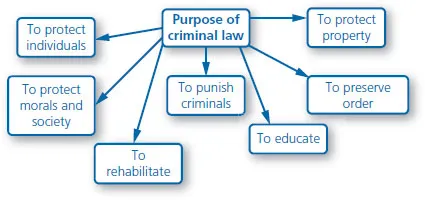
- Some of the purposes listed above have particular aims. For example, when the criminal law punishes criminals, it aims to:
- incapacitate the criminal;
- punish the criminal;
- deter the criminal;
- reform the criminal;
- educate the public;
- affirm moral standards;
- restore justice in society.
Workpoint
In 1967 the drink-driving laws in the UK were tightened up, and drivers can now be prosecuted for being over a specified legal limit of alcohol. Before 1967, specific limits were not measured or required; the driver simply had to be ‘unfit’ to drive. What do you think are the aims of this stricter law?
1.1.1 Enforcing Morals
- One of the purposes of the criminal law is to protect morals and society.
- Morals are important in law because they control personal behaviour, and some moral standards are shared by society as a whole (e.g. ‘murder is wrong’).
- However, morals are also personal to the individual. Every person in society has a different set of morals that are shaped by many different influences.WorkpointList five influences on your morals and beliefs.
- The Wolfenden Committee (1957) on homosexual offences and prostitution felt that the private lives of individuals should only be regulated by the criminal courts to:
- Preserve public order and decency;
- Protect the citizen from offensive and injurious things;
- Provide safeguards against exploitation and corruption.
Case: | |
R v Brown (1993) | Lord Templeman: ‘Society is entitled and bound to protect itself against a cult of violence. Pleasure derived from the infliction of pain is an evil thing. Cruelty is uncivilised.’ Lord Slynn: ‘In the end it is a matter of policy in an area where social and moral factors are extremely important and where attitudes could change.’ |
R v Wilson (1996) | Russell LJ: ‘Consensual activity between husband and wife, in the privacy of the matrimonial home, is not, in our judgment, a proper matter for criminal investigation, let alone criminal prosecution.’ |
The main differences between Brown and Wilson | |
|---|---|
|
|
1.1.2 The Changing Criminal Law
- Below are some examples of how the criminal law can change to reflect or accommodate the changing morals and beliefs of society.
- Statutory defences were provided for doctors carrying out abortions ...
Table of contents
- Cover
- Title Page
- Copyright Page
- Table of Contents
- Guide to the book
- Guide to the website
- Acknowledgments
- Preface
- Table of cases
- Table of statutes
- 1: Introduction to criminal law
- 2: Actus reus and causation
- 3: Mens rea
- 4: Strict liability
- 5: Parties to a crime
- 6: Capacity
- 7: General defences
- 8: Homicide
- 9: Non-fatal offences against the person
- 10: Sexual offences
- 11: Theft
- 12: Robbery, burglary and other offences under the Theft Acts
- 13: Fraud
- 14: Criminal damage
- Glossary
- Index
Trusted by 375,005 students
Access to over 1.5 million titles for a fair monthly price.
Study more efficiently using our study tools.
Frequently asked questions
Yes, you can cancel anytime from the Subscription tab in your account settings on the Perlego website. Your subscription will stay active until the end of your current billing period. Learn how to cancel your subscription
No, books cannot be downloaded as external files, such as PDFs, for use outside of Perlego. However, you can download books within the Perlego app for offline reading on mobile or tablet. Learn how to download books offline
Perlego offers two plans: Essential and Complete
- Essential is ideal for learners and professionals who enjoy exploring a wide range of subjects. Access the Essential Library with 800,000+ trusted titles and best-sellers across business, personal growth, and the humanities. Includes unlimited reading time and Standard Read Aloud voice.
- Complete: Perfect for advanced learners and researchers needing full, unrestricted access. Unlock 1.5M+ books across hundreds of subjects, including academic and specialized titles. The Complete Plan also includes advanced features like Premium Read Aloud and Research Assistant.
We are an online textbook subscription service, where you can get access to an entire online library for less than the price of a single book per month. With over 1.5 million books across 990+ topics, we’ve got you covered! Learn about our mission
Look out for the read-aloud symbol on your next book to see if you can listen to it. The read-aloud tool reads text aloud for you, highlighting the text as it is being read. You can pause it, speed it up and slow it down. Learn more about Read Aloud
Yes! You can use the Perlego app on both iOS and Android devices to read anytime, anywhere — even offline. Perfect for commutes or when you’re on the go.
Please note we cannot support devices running on iOS 13 and Android 7 or earlier. Learn more about using the app
Please note we cannot support devices running on iOS 13 and Android 7 or earlier. Learn more about using the app
Yes, you can access Course Notes: Criminal Law by Lisa Cherkassky in PDF and/or ePUB format, as well as other popular books in Law & Criminal Law. We have over 1.5 million books available in our catalogue for you to explore.