Professional knowledge doesn't guarantee you'll make the right decisions when it comes to professional ethics
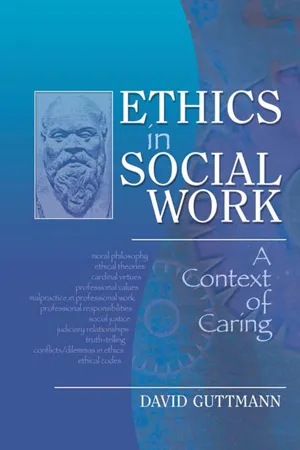
Ethics in Social Work introduces students, practitioners, and educators to theoretical and conceptual approaches to professional ethics and to the practice-related aspects of dealing with ethical problems and dilemmas. This unique book equips social workers with the ability to choose among different perspectives on the place and value of ethics in their approach to clients, and to use, defend, and explain their choices to clients, colleagues, supervisors, administrators, the general public, and the courts, if necessary. The book examines classical ethics, theories, and codes of ethics, virtues and values, etiquette, professional responsibilities, distributive justice, judiciary relationships, professional misconduct, and malpractice.
A working knowledge of ethics is essential for the development of a healthy and happy relationship between service providers and consumers. Ethics in Social Work looks at how ethical issues and conflicts can affect the daily lives of social work practitioners and how an increased sensitivity to those issues can help enrich their professional experience. The book addresses the basic concepts relating to ethics, as well as theories, principles, rules and values that guide service provision based on the National Association of Social Workers Code of Ethics and Standards for Cultural Competence in social work practice.
Ethics in Social Work examines:
* the leading theories of ethics, including deontology and teleology
* compromising or choosing between opposing values
* professional etiquette in advertising and counseling
* moral and professional responsibilities
* the ethical dilemmas of telling the truth
* social justice
* practice-related aspects of distributive justice
* fiduciary relationships
* confidentiality in therapeutic work
* resolving ethical dilemmas
* the Hippocratic Oath and its relevance to social work
* the Code of Ethics in social work
* real-life cases of malpractice
* and much moreEthics in Social Work includes case illustrations from existing literature and from professional experience, as well as an up-to-date bibliography. It is an essential read for anyone working, or preparing to work, in the helping professions.
- 312 pages
- English
- ePUB (mobile friendly)
- Available on iOS & Android
eBook - ePub
About this book
Information
PART I:
THEORETICAL AND PROFESSIONAL
PERSPECTIVES
THEORETICAL AND PROFESSIONAL
PERSPECTIVES
Chapter 1
Classical Ethics
THE EARLY GREEK TRADITION
Ethics comes from the ancient Greek term of ethicos, meaning habit or custom relating to morals. Thus an ethical person is one who has morals. Ethics is the science of duty. It deals with moral qualities in general, which are valid for everyone, and with the qualities and rules that are binding for professionals in the caring and helping professions.
The purpose of ethics is similar everywhere: Ethics is aimed at the good life. The good life has always been the expressed wish of all people, but the definition of good changes in accordance with values and social perceptions of given societies. Each of us has a vague idea of an overall goal in our life. This goal was expressed by the ancient Greeks from the times of Socrates, Plato, and Aristotle up to the times of the Roman philosophers by the concept of eudaemonia, which is usually defined as happiness or flourishing. It is the aim of all human pursuits, or the highest goal that a person can achieve by his or her actions. Today eudaemonism is a term used in the study of ancient philosophy to define the theory that happiness and well-being is the highest ethical goal.
What is considered good is a highly individualistic and subjective issue, whether thought of in the form of certain possessions or in spiritual terms. Aristotle raised questions of what this good is and how it can be obtained. If happiness is a form of knowledge, then can it be obtained through learning? Or is it a product of training? In Aristotle's Eudemian Ethics (Aristotle, 1992), it is stated that, wisdom, virtue, and pleasure are connected to certain patterns of living. Thus philosophical life is connected to wisdom, political life to virtue, and an amusing life to pleasure. These patterns, of course, are not necessarily divided equally among people: some aspire to all three, others are satisfied with two, and still others select one and pursue it throughout their lives.
In his Eudemian Ethics Aristotle said:
Taking note of these things, everyone who can live according to his own choice should adopt some goal for the fine life, whether it be honor or reputation or wealth or cultivation—an aim that he will have in view in all his actions; for not to have ordered one's life in relation to some end is a mark of extreme folly. But, above all, and before everything else, he should settle in his own mind—neither in a hurried nor in a dilatory manner—in which human thing living well consists, and what those things are without which it cannot belong to human beings. (Aristotle, 1992, 1214b6–1214b14)
Aristotle (1997) thought that the purpose of ethics was to gain a life full of happiness in every sense. Yet, to happiness belong both complete or perfect virtue and a fulfilled life. According to him, the proper behavior, as far as ethics is concerned, should be based on aiming at the “golden path,” or “middle of the road,” and refraining from all extremes in behavior. In his Nichomachean Ethics (Ross, 1954 cited in Aristotle, 1997) Aristotle wrote:
Now virtue is concerned with passions and actions, in which excess is a form of failure, and so is defect, while the intermediate is praised and is a form of “success”; and being praised and being successful are both characteristics of virtue. (Ross, 1954, cited in Aristotle, 1997, p. 38)
Ethics directs the decisions of those who adhere to its principles and rules. An ethical system is a system in action, and it can be judged by action—not by contemplation. Thus ethics is applied in its nature. Ethics for Socrates was first and foremost nobility of the human spirit, and it was loyalty to the virtues that should guide a person in life. Socrates was convinced that nothing bad could happen to such a person, whatever his or her end may be.
Plato (1994), the great philosopher in ancient Greece, emphasized that acceptance of philosophy and subsequently of ethics is dependent on the individual's psychic structure. He provides a valuable example of this in his book titled Gorgias (Plato, 1994), in which the charactor of Callicles represents those who think that the strong have naturally more rights than the weak. In Callicles's view, those who have less can by subjugated and exploited without mercy. That is what nature shows us. The weak invented the idea the satisfaction of the passions and the instincts should have limits, whereas the strong see this satisfaction as their natural right. This attitude toward ethics is condemned by Plato (via the character of Socrates), but Callicles firmly believes that his attitude is the appropriate one and rejects Socrates's well-supported contradictory arguments.
Many people live by their passions and completely identify with them. They can be characterized as lacking control of their own drives and instincts. Plato thinks that it is worthless to argue with such people, for they lack the ability to understand and accept the truth. The dialogue with Callicles ends when Socrates realizes this weakness in his opponent's psychic structure. It seems that Plato purposely depicts Callicles as a person who is immoral in the extreme. Plato seems to emphasize that we all tend to have some of the characteristics of Callicles in our souls, thus warning that we all must develop an ethical attitude toward the “rights” of the stronger to counteract the tendency to oppress the weak, and that we should adopt the ethic of what is just and appropriate as well as the ideal of the good (Szlezak, 2000).
STOIC AND EPICUREAN APPROACHES
TO HAPPINESS AND ETHICS
In the historical development of ethics two important approaches should be mentioned, the Stoic and the Epicurean (de Botton, 2000). The first relates to the Greek philosopher Zeno, and later to the Greek philosopher Epicurus. According to them, moral life means avoidance of moral judgment and extreme behaviors, such as addictions to various substances or satisfaction of the senses, and leading a natural life.
Contrary to popular belief, the Stoics did not recommend poverty. They neither feared it nor despised it. They could live in luxurious surroundings similar to any rich people. However, they differed from many rich people in their attitude to a sudden misfortune, such as losing their wealth, family, or friends, or even parts of their bodies. The Stoics claimed that the wise man can lose nothing, for he is self-sufficient and is satisfied with what he has. This did not mean that they welcomed poverty or that they desired to be without friends or family, it meant that they could live on with what was left in case of a disaster rather than committing suicide, as so many people did, for example, during the great economic crisis during the twenties and thirties of the past century.
The Stoics were interested in diminishing the external influences of the material world on the soul, in refraining from the pursuit of worldly pleasures, in concentrating on the present and foregoing the temptation to predict the future, in accepting death as inevitable and as not frightening, and in achieving serenity of the soul, the kind of serenity that creates continuous happiness. They divided their philosophy into three parts: Logics, physics, and ethics. The importance of each part was characterized by a fruit garden, in which logics represented the wall protecting the garden, physics the growing tree, and ethics the fruits of the garden. Their ethics was based on the notion that only the inner attitude of humankind to what is happening to them in the outside world is in their control. The aim of a human is to live in harmony with nature and cooperation with fellow humans, and this leads him or her to a happy life. Happiness can be attained when no impulse disturbs the calmness of the soul. The Stoic ideal was apathy, meaning freedom from harmful impulses, such as gaiety, annoyance, desire, and fear.
According to Stoic philosophy, life can be divided into the good, the bad, and the neutral. The virtues represent the good and their op-posites the bad, and everything else represents the neutral aspects, for these do not contribute to happiness. The neutral aspects of life were divided further into those that can be regarded as an advantage or a disadvantage, for example, health is an advantage and disease a disadvantage. Similarly, both good deeds and bad deeds exist as well as those in between. The good deeds emanate from right and true insight, and the bad from false. From the perspective of happiness, virtue is of major importance. Virtue is in its essence moral insight into the value of life. Virtue as understanding can be acquired through learning. No middle way exists regarding virtue and its opposite. One can act in accordance with one's insight, or contrary to it. If one attains a correct understanding of and attitude toward impulses and events, one is said to acquire harmony or happiness.
Perhaps the greatest philosopher among the Stoics, who did live and die according to this philosophy, was Seneca of ancient Rome. He was born around 4 BC and died in AD 65. He had a difficult life full of disasters and losses, and had to take his own life by knife at the command of the Roman Emperor Nero. Yet, Seneca never succumbed to the turns and twists of his fortune. He kept his Stoic attitude to life until his last moment, saying:
Never did I trust Fortune [the goddess], even when she seemed to be offering peace. All those blessings which she kindly bestowed on me—money, public office, influence—I relegated to a place from which she could take them back without disturbing me. (de Botton, 2000, p. 99)
The Epicureans based their approach to ethics on the ancient Greek concept of ataraxia, meaning a life without pain and disruptions and with moderate satisfaction from the pleasures of body and spirit. The Epicureans (followers of the Greek philosopher, Epicurus, born in 341 BC in Samos and died in 271 BC) thought that all people have a basic understanding about the value of life and its meaning, and therefore all people everywhere are equal. They were the first group of people to express this belief.
Ethics constitutes the main part of Epicurus's philosophy and teaching, and the basis of ethics, its chief principle, is joy. All living creatures aspire to attain joy. Someone is said to attain joy by avoiding bodily pain due to unfulfilled need and spiritual pain due to worries and anxieties. It is possible to achieve joy. The needs of human beings can be divided into three parts: necessary, unneccessary, and worthless. Food and water, for example, are natural and necessary. These needs can be satisfied without causing greater joy. Natural needs that are not necessary also exist, and then occur the worthless needs, which are falsely considered needs that do not increase joy. Satisfaction with what one has leads to joy. Thus satisfaction is an important virtue in Epicurean philosophy and ethics. Humans should weigh and calculate that which is useful and that which is harmful and avoid the kinds of joy that can cause bodily pain and mental anguish. Political activity, for example, was seen by Epicurus as an activity that brings much uncertainty into someone's life. It is therefore better to refrain from it.
Epicurus's philosophy was summarized by Alain de Botton (2000). He cites on the jacket of his famous book, The Consolations of Philosophy, a fragment from that philosophy, which seems to me to be appropriate for all helping professionals:
Any philosopher's argument which does not therapeutically treat human suffering is worthless; for just as there is no profit in medicine when it doesn't expel the diseases of the body, so there is no profit in philosophy when it doesn't expel the sufferings of the mind. (de Botton, 2000)
In all periods of history a will to attain increasing autonomy from the tyranny of the instincts has existed. People have tried to gain the necessary freedom to lead autonomous lives and pursue individual goals. Autonomy means freedom from the external world and to choose consciously the good rather than the bad. Therefore the purpose of ethics is to acquire mental powers that will enable one to overcome fleeting instincts and passions by means of preferring the general good over the bad, and by developing the self to a level at which the decision to be moral or ethical will come from the heart and soul and does not to be imposed by any outside power.
ETHICS IN THE WORKS OF
MAIMONIDES AND SPINOZA
The aim and purpose discussed in the previous section is also existent in Jewish ethics. Derived from classical Jewish texts, ethics stretches from biblical and Talmudic to modern times. According to Samuelson (2001), Jewish ethics can be traced back to biblical times. It combines four traditions of Jewish thought: biblical (Torah) ethics, classical Jewish philosophy, Jewish mysticism (kabbalah), and Jewish law (halacha). Each of these traditions is linked to many outstanding personalities. Thus for example, Maimonides is the representative of the classical Jewish approach to ethics and philosophy, Spinoza and the critics of his works are considered to represent the modern period in Jewish thinking up to the Holocaust, whereas the postmodern age is represented mainly in the works of Martin Buber, i.e. I and Thou, The Way of Man, Good and Evil, etc. Their thoughts on Jewish ethics will be elaborated in some detail in this chapter.
In the traditional Jewish approach to ethics, God revealed to the people of Israel a world in which everything relevant for human development, including all of ethics, is recorded in the Scriptures. The rules that guided the lives of the Jewish people throughout history, up to the Holocaust, and still guide them to a large degree in the twenty-first century are those that were laid down in the Pentateuch and further detailed in the Old Testament, the Talmud and other sacred writings. These rules specify the obligations of the Jewish people to themselves, to their families, to their communities, and to all larger entities up to the universe itself, and they direct them to behave as befits human beings.
Jewish ethical perspective refers to the positive aspects, such as love of fellow humans, generosity, modesty, justice, etc., and to the negative aspects, such as taking care not to be immodest in sexual matters, extinguishing the inclination to egoism, and conquering the beast in one's soul.
The religious and the moral approaches in ethics are bound together by a strong bond. The Torah demands from all men to do good deeds and to behave morally in order to promote the general good of society. According to the Old Testament, doing the right and the just thing is the essence of Jewish ethics. Therefore, the paradox of the suffering of the just and the naive, which has accompanied Jewish religious ethics since its beginnings and is emphasized by the prophets, continues to raise philosoph...
Table of contents
- Cover Page
- Half Title page
- Title Page
- Copyright Page
- Contents
- Acknowledgements
- List of Contributors
- Introduction
- Part I: Theoretical and Professional Perspectives
- Chapter 1 Classical Ethics
- Chapter 2 Theories of Ethics
- Chapter 3 Virtues
- Chapter 4 Valuees
- Chapter 5 Etiquette for Social Workers
- Chapter 6 Good and Bad in Professional Responsibility
- Chapter 7 Social Justice
- Part Ii: Applied Aspects of Therapeutic Work
- Chapter 8 Social Wetlfare and Distributive Justice
- Chapter 9 Trust in Client-Social Worker Relationships
- Chapter 10 Ethical Dilemmas
- Chapter 11 Resolution of Ethical Dilemmas
- Chapter 12 On Keeping Secrets and and Confidentiality
- Chapter 13 Oaths and Codes of Ethics
- Chapter 14 Professional Misconduct and Malpractice
- Epilogue
- Appendix A Code of Ethics fo the National Association of Social Workers
- Appendix B National Association of Black Social Workers (NABSW) Code of Ethics
- Bibliography
- Index
Trusted by 375,005 students
Access to over 1.5 million titles for a fair monthly price.
Study more efficiently using our study tools.
Frequently asked questions
Yes, you can cancel anytime from the Subscription tab in your account settings on the Perlego website. Your subscription will stay active until the end of your current billing period. Learn how to cancel your subscription
No, books cannot be downloaded as external files, such as PDFs, for use outside of Perlego. However, you can download books within the Perlego app for offline reading on mobile or tablet. Learn how to download books offline
Perlego offers two plans: Essential and Complete
- Essential is ideal for learners and professionals who enjoy exploring a wide range of subjects. Access the Essential Library with 800,000+ trusted titles and best-sellers across business, personal growth, and the humanities. Includes unlimited reading time and Standard Read Aloud voice.
- Complete: Perfect for advanced learners and researchers needing full, unrestricted access. Unlock 1.5M+ books across hundreds of subjects, including academic and specialized titles. The Complete Plan also includes advanced features like Premium Read Aloud and Research Assistant.
We are an online textbook subscription service, where you can get access to an entire online library for less than the price of a single book per month. With over 1.5 million books across 990+ topics, we’ve got you covered! Learn about our mission
Look out for the read-aloud symbol on your next book to see if you can listen to it. The read-aloud tool reads text aloud for you, highlighting the text as it is being read. You can pause it, speed it up and slow it down. Learn more about Read Aloud
Yes! You can use the Perlego app on both iOS and Android devices to read anytime, anywhere — even offline. Perfect for commutes or when you’re on the go.
Please note we cannot support devices running on iOS 13 and Android 7 or earlier. Learn more about using the app
Please note we cannot support devices running on iOS 13 and Android 7 or earlier. Learn more about using the app
Yes, you can access Ethics in Social Work by David Guttmann in PDF and/or ePUB format, as well as other popular books in Social Sciences & Ethics & Moral Philosophy. We have over 1.5 million books available in our catalogue for you to explore.