- 538 pages
- English
- ePUB (mobile friendly)
- Available on iOS & Android
eBook - ePub
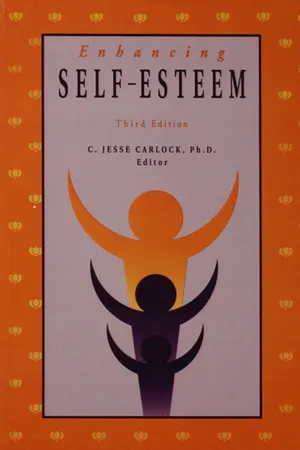
Enhancing Self Esteem
About this book
Providing comprehensive coverage of self esteem, this text presents a four phase process - Identity, Strengths and Weaknesses, Nurturance, and Maintenance - which is described along with the resistance on encounters, and provides the basis for successfully enhancing self-esteem. Interventions are outlined to bring together theory and methods - cognitive, emotional, and behavioral. The strategies included are applicable to several populations (child, teen, and adult) and several settings (school, business, and community).
For both children and adults, this book is designed to be a textbook for courses, workshops, and seminars. It will also serve as an excellent resource for teachers and counselors and will be used by individuals for self-improvement. Some key features of the third edition are: It translates theory into practice; provides 107 activities with specific procedures and anticipated outcomes; relates each activity to one of four phase processes; utilizes a systematic approach to enhancing self esteem; incorporates cognitive, emotional, and behavioral aspects of individuals.
Information
Publisher
Taylor & FrancisYear
2013Print ISBN
9781560323969
9781138463011
Edition
3eBook ISBN
9781135059019
PART I
Model to Enhance Self-Esteem
Chapter 1
ENHANCING SELF-ESTEEM: A MODEL FOR CHANGE
WHAT IS SELF-ESTEEM?
“Self-esteem” has been a common buzzword for at least a couple of decades now. The term is thrown about so glibly it has almost lost its meaning. That is not to say self-esteem is unimportant. Low self-esteem has been linked strongly with depression and poor relationship choice and tangentially associated with many other symptoms. Conversely, high self-esteem is associated with happiness, serenity, success, and fulfillment. But singing the praises of children (or adults) without grounding that praise in objective data will not build high self-esteem. Ungrounded praise only creates an unrealistic and skewed sense of self. The work of developing high self-esteem requires more involvement and precise work in identifying a realistic base.
When someone says, “I have problems with self-esteem,” it is only a starting place. You know the ballpark at this point—and it’s a huge one. Mapping the person’s problem areas and strengths in concrete terms is the next step.
Simply stated, self-esteem is the way you feel about yourself. Most people have a global feeling about themselves that runs along a continuum from high to low, good to bad. If 10 represents high self-esteem, and 1 represents low self-esteem, where would you fall? Anyone can judge where they usually fall along the continuum. But you may have no way of knowing where to begin to help raise your own or another’s self-esteem.
When directed, most people can become more specific in identifying self-aspects and rating their self-esteem in each of these areas (see chapter 10 for information on assessment). However, they may need guidance in the process. Satir’s (1981) self-mandala is a useful tool for partializing the different aspects of self. The mandala she created consists of the following parts (starting from the center, “I,” and moving out in a series of concentric circles):
I: the center; that which you call self; your overall sense of worth
physical self: appearance, health, posture, touch needs; body conditioning, hair care, and clothing (see chapter 5)
intellectual self: your mind, cognitive abilities, planning, problem solving, and ability to use good judgment (see chapter 3)
emotional self: your ability to experience the full range of emotions, regulate your emotions, express them appropriately, and use them in coping (see chapter 3)
sensual self: your ability to use all of your senses (visual, auditory, tactile, olfactory, gustatory, and kinesthetic) in making contact with yourself and the world (see chapter 5)
interactional self: your ability to make contact with others—to relate professionally, socially, or intimately; includes your ability to say what you think and feel, and ask for what you want and need; encompasses your style of relating to others and your communication skills (see chapter 4)
contextual self: your awareness of and use of time, space, color, light, and environmental factors; your view of your history, ground, and field of your life; your need for a calm or stimulating environment
nutritional self: your attention to how you nourish yourself—the foods, liquids, and substances you put into your body (see chapter 5)
life force: your attention to a force greater than yourself; your soul or spiritual force (see Activity 1.6)
What are your beliefs about yourself in each of these areas? How would you rate yourself? Do any of these ratings reduce your self-esteem? By making the concept of “self-esteem” more concrete, it becomes more amenable to change, allowing you to set specific, realistic goals.
WHAT IS THE BASIS OF HIGH SELF-ESTEEM?
Authors have come up with a variety of definitions of self-esteem (see Table 1.1). Borrowing bits and pieces from several theorists, let’s define self-esteem as how you feel about yourself, how highly you regard yourself. That degree of regard is based on your sense of
• how lovable and special you believe you are;
• how wanted you feel and your sense of belonging;
• how special or unique you believe you are;
• how competent you feel and how well you fulfill your potential;
• how willing you are to take risks and face challenges;
• and how able you are to set goals, make choices, and fulfill your goals and dreams (Cantor & Bernay, 1992; McDowell, 1984; Satir, 1981)
According to Cantor and Bernay (1992) and Shub (1994), people with high self-esteem have positive feelings about themselves that are not shaken by challenge or adversity. In essence, their self-esteem is rock-solid. But self-esteem is not an all-or-nothing commodity. That kind of thinking can impede our ability to accurately evaluate ourselves. The self is composed of many parts, and our feelings about these parts vary. For self-esteem to be stable, it must be based on a realistic appraisal, free from distortions, not overly inflated or diminished. Because self-esteem is based on dimensions that are not black and white (such as how lovable you believe you are and how special you see yourself being), everything is a matter of degree. So the inviolability of self-esteem also is a matter of degree.
In a nutshell, high self-esteem comes from actualizing yourself: that is, claiming and cultivating your natural talents and resources, and identifying and facing your challenges (for instance, being willing to assert who you are in the face of external pressures to be different).
“I am loved and special. I am wanted.”
So many of us lack a firm belief in these two core messages. It takes a healthy family to deliver them clearly, repeatedly, and believably—with actions supporting words—over those essential early years of childhood and onward. Yet, the drive toward growth is so strong that many people manage to build a decent foundation out of scraps of loving messages picked up along the way. People are instinctively creative about finding what they need to piece together a quilt of loving messages from even the most tangential sources. I remember a client who was raised in an extremely abusive home, where she was emotionally neglected and sexually abused. When I asked who in her childhood had helped her survive, she remembered a stranger she had met when her family was visiting relatives. This person had shown an interest in her, smiled, asked her questions about herself, and lightly touched her in a nonthreatening and nurturing way. The imprint of this single occasion with a stranger was embedded in her memory, and she had drawn on the memory to keep the embers of her sense of worth alive over the years.
TABLE 1.1
Definitions of Self-Esteem
Bednar & Peterson (1989) | Posited that an enduring sense of realistic self-appraisal, which reflects how the person views and values the self, is directly related to the degree to which the individual chooses to cope and face challenges rather than to avoid them, regardless of the outcome (similar to Allport, 1961). |
Horney (1992, 1994) | Believed that each person is born with unique potential, and that self-esteem derives from achieving that potential. High self-esteem comes from cultivating one’s talents, yet the self only flourishes with interpersonal recognition, affirmation, validation, encouragement, and support. |
James (1890) | Defined self-esteem as the degree to which one can achieve one’s goals and aspirations, or the ratio between one’s accomplishments and one’s supposed potentialities. |
Josephs (1992, p. 91) | Stated that self-esteem “refers to how highly one regards oneself.” Saw two dimensions of self-esteem: self-acceptance in belonging and pride in individuality. |
May (1973) | Regarded autonomy as crucial to self-esteem. Stressed the inevitable anxiety that comes from asserting one’s individuality in the face of external pressures to be different. If one can withstand that pressure, self-esteem is strengthened. |
Sullivan (1953) | Viewed self-esteem as a social need to be liked and accepted, to belong, to fit in. Believed self-esteem is derived from social interaction mediated by reflected self-appraisals, and is maintained by conforming to social expectations and resisting unacceptable roles. |
Each of us is unique: As Virginia Satir loved to remind us, “No one’s finger prints are exactly the same as anyone else’s.” But there are degrees to which people recognize their uniqueness and specialness. Some lucky children are raised in a bed of rich soil where their needs are attended to, where feelings of being loved and special are firmly and repeatedly planted, where they are seen, and heard, and responded to. Those around them seem to delight in reflecting the miracle of their unfolding personalities. For the rest of us, the soil was probably uneven. But thankfully, even if our family environment lacked the richness required to build high self-esteem, other significant people and experiences can (to some extent) compensate for deficiencies or further enrich an otherwise healthy base. How to facilitate that process is the purpose of this book.
THE EMERGENCE OF SELF
Many theorists have tried to define the concept of self (see Table 1.2). I believe the self is metamorphic: It forms early and gradually becomes stable, but it has the ability to alter over the course of a lifetime. It is always in process. The self is formed through genetics, introjects (undigested messages, beliefs, and behavior patterns incorporated from significant others), and life experiences. It emerges through our actions and our interactions with others and the environment. The self’s robustness is built through meeting the challenges life poses.
Through our interactions with others and the environment, we begin to organize our experiences, personal resources, talents, and abilities. Others also experience us in clusters of primary traits: For example, a person who is passive, unmotivated, and obstructionistic may be seen as having an avoiding aspect of self. Polster (1990) explained that traits which characterize us and are guiding and orienting forces in our lives become apparent, a...
Table of contents
- Cover Page
- Half Title page
- Title Page
- Copyright Page
- Contents
- List of Tables and Figures
- Dedication
- Preface
- Introduction
- Part I Model to Enhance Self-Esteem
- Part II Exploring Special Self-Esteem Issues and Interventions
- Appendices
- Index
- About the Editor
Trusted by 375,005 students
Access to over 1.5 million titles for a fair monthly price.
Study more efficiently using our study tools.
Frequently asked questions
Yes, you can cancel anytime from the Subscription tab in your account settings on the Perlego website. Your subscription will stay active until the end of your current billing period. Learn how to cancel your subscription
No, books cannot be downloaded as external files, such as PDFs, for use outside of Perlego. However, you can download books within the Perlego app for offline reading on mobile or tablet. Learn how to download books offline
Perlego offers two plans: Essential and Complete
- Essential is ideal for learners and professionals who enjoy exploring a wide range of subjects. Access the Essential Library with 800,000+ trusted titles and best-sellers across business, personal growth, and the humanities. Includes unlimited reading time and Standard Read Aloud voice.
- Complete: Perfect for advanced learners and researchers needing full, unrestricted access. Unlock 1.5M+ books across hundreds of subjects, including academic and specialized titles. The Complete Plan also includes advanced features like Premium Read Aloud and Research Assistant.
We are an online textbook subscription service, where you can get access to an entire online library for less than the price of a single book per month. With over 1.5 million books across 990+ topics, we’ve got you covered! Learn about our mission
Look out for the read-aloud symbol on your next book to see if you can listen to it. The read-aloud tool reads text aloud for you, highlighting the text as it is being read. You can pause it, speed it up and slow it down. Learn more about Read Aloud
Yes! You can use the Perlego app on both iOS and Android devices to read anytime, anywhere — even offline. Perfect for commutes or when you’re on the go.
Please note we cannot support devices running on iOS 13 and Android 7 or earlier. Learn more about using the app
Please note we cannot support devices running on iOS 13 and Android 7 or earlier. Learn more about using the app
Yes, you can access Enhancing Self Esteem by C. Jesse Carlock in PDF and/or ePUB format, as well as other popular books in Psychology & History & Theory in Psychology. We have over 1.5 million books available in our catalogue for you to explore.