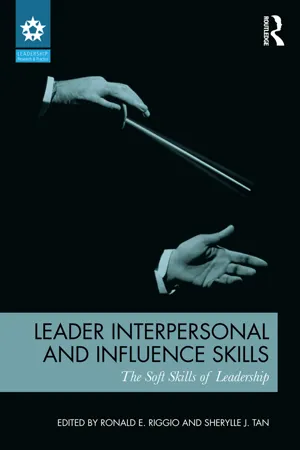
This edited volume explores different models, conceptualizations, and measures of leader interpersonal and influence "soft skills" that are so necessary for effective leadership. These include the communication skills, persuasion skills, political savvy, and emotional abilities used by leaders to inspire, motivate, and move followers toward the accomplishment of goals. The book emanates from the two-day-long 21st Kravis-de Roulet leadership conference, which brought together top scholars working in this area. The intent of the conference and this edited volume is to increase understanding of the interpersonal and influence skills, or "soft skills," of the leader, to highlight state-of-the-art research on the topic, and to provide clear, research-based guidelines for the development of leader skills.Chapter authors are recognized experts in their respective areas, and each section of the book will be introduced by an editor-authored chapter reviewing the specific topic area in brief.
eBook - ePub
Leader Interpersonal and Influence Skills
The Soft Skills of Leadership
- 352 pages
- English
- ePUB (mobile friendly)
- Available on iOS & Android
eBook - ePub
Leader Interpersonal and Influence Skills
The Soft Skills of Leadership
About this book
1 The “Hard” Science of Studying and Developing Leader “Soft” Skills
DOI: 10.4324/9780203760536-1
The serious study of leadership and management has had a glaring omission for more than a century. Leadership/management experts will assert that there are two sides to leading: the “hard” side of analyzing, planning, making decisions, and strategizing, and the “soft” side of leadership that involves inspiring, motivating, and persuading followers, building good working relationships, networking, rallying, and cajoling. The problem is that the vast majority of scholarship on the skills needed for effective leadership has focused on the hard skills. In fact, MBA programs focus almost entirely on developing the hard skills, and only give lip service (and a very small part of the curriculum) to the soft skills of leadership. Indeed, a classic critique by Porter and McKibbin (1988) found just that. They concluded that few of the practical elements of managing/leading people were actually taught in business schools. More than two decades later, things have not changed much. There is still not enough research and education dedicated to the interpersonal, “soft” side of management and leadership.
The title of this chapter suggests that studying and developing the soft side skills of leadership is hard … difficult. Researchers have developed no accepted, guiding models for categorizing leader soft skills (nor understanding where the hard skills leave off and the soft skills begin). Instead, there are odd collections of competencies, abilities, and behaviors that constitute the soft side of leadership. Moreover, there are no comprehensive, guiding frameworks for skill development. A wide variety of practices and techniques are used to develop leader interpersonal and influence skills, and scholars have little knowledge as to the effectiveness of these techniques, nor of the impact of training programs. This book, and the conference it emanated from, seeks to pull together some of the more important research on leader interpersonal and influence skills, to examine frameworks, to look at leadership development practices in the area of soft skills; in short, to try to move things forward.
THE KRAVIS-DE ROULET CONFERENCE ON “SOFT LEADER SKILLS”
On February 24–25, 2012, we held the 21st Kravis-de Roulet Leadership Conference at Claremont McKenna College, entitled “Understanding and Assessing Soft Leader Skills.” We invited a number of noted leadership experts whose research has focused on leader interpersonal and/or influence skills, as well as experts in emotional and nonverbal communication. We also published a call for papers and received a number of submissions, and we invited some of those authors to also present their research at the conference. One thing that did surprise us was the rather small number of submissions—far fewer than we had received for other leadership conference calls for papers. It seemed that few scholars were researching the soft skills, which our call suggested consisted of the “interpersonal skills, communication skills, persuasion skills, political savvy, and emotional abilities used by leaders.”
In the response to our call for papers, we were a bit surprised by both the low number and the broad scope of the submitted papers. Some of the topics seemed far afield from the domain of interpersonal and soft leader skills, such as research on virtual teams and communication technology, work on leader self-definition and identity, and research on leader character/ethics. The last topic was included and is represented in this book by Jennings and Hannah, in chapter 7. We began to realize that the soft side of leadership cut quite a wide swath.
The first day of the conference was a closed session with the conference presenters and invited scholars and guests. This day was designed to discuss issues related to the conceptualization and understanding of leader soft skills. We hoped to get our arms around the domain and to provide definitions, make connections among topics, and perhaps gain new insights. Another goal was for the presenters to preview their next day’s presentations in order to better integrate the topics and to discuss this book. Through this exchange, our eventual chapter authors had a good understanding of what would eventually become the book’s chapters, so that they could cross-reference each other’s work and come to some common understanding of the nature and scope of the topic.
One thing was clear from the outset. People did not like the term soft skills. So the discussion turned to labeling and defining the domain. We considered a number of terms: conceptual skills, interpersonal skills, communication skills, and so forth. In the end, we settled on the title of this book: interpersonal and influence skills, but the subtitle still uses the term soft skills for clarity’s sake. This issue of what to call the domain of leader “soft skills” will likely continue into the future.
It was clear to many of the participants that we lacked an agreed-upon framework for conceptualizing leader interpersonal and soft skills. Several of our presentations, and several of the chapters in this book, suggest specific frameworks for leader skills—although none of them is comprehensive enough to represent the broad domain of leader skills discussed throughout the day.
A third concern that emerged from our first day discussion was that of measurement. A number of techniques were discussed, but some participants expressed concern that reliance on ratings—either self-ratings or ratings by others—was deficient. Many of the studies presented in this book rely on ratings of leader interpersonal or influence skills, including self-report ratings and ratings by others (including 360-degree ratings from supervisors, subordinates, and others). Socially desirable responding (for self-report assessments), halo effects, and other biases are a problem with ratings. Clearly, observational methods or performance-based measures (e.g., assessment center exercises) could more accurately assess some of these skills, but these are expensive and time consuming to obtain, particularly in work organizations.
Another issue concerned whether there was a hierarchy of leader interpersonal skills, such that simpler, more basic skills lay at the foundation, with more complex skills building from the basic skills. Along the same line, are the skills of higher-level leaders more complex or different from, or the same as, the skills needed for the success of lower-level leaders? Another possible way that soft skills could be arranged concerned the locus of the skills, with skills of self-management/leadership at the core, interpersonal dyadic skills at the next level (think, perhaps, concentric circles), and group-level skills at the outermost level.
The final portion of the discussion on the first day of the conference focused on developing soft skills. Nearly all of the scholars in attendance had conducted some sort of leadership soft skills training at their universities with students, with managers in organizations, or with community groups. Moreover, everyone acknowledged that there are a great many leadership development efforts taking place worldwide as part of what Barbara Kellerman (2012) refers to as the “leadership industry”—leadership trainers, executive education programs, consultants, and the like. There was general agreement, however, that there is a dearth of sound studies of the impact of interpersonal skill training programs. Avolio, Reichard, Hannah, Walumbwa, and Chan (2009) conducted a meta-analysis of leadership development programs, both experimental and real world, and determined that on the whole these efforts led to modest positive outcomes. However, they made no distinction between programs that focused on hard versus soft leadership skills, and many, such as research on Pygmalion leadership training (e.g., leaders holding and conveying positive expectations for follower performance), likely blend hard and soft skills. One thing is certain, however: Leadership development takes a significant investment of time, and soft skills may take longer to develop than the more analytical/cognitive skills of leadership. Some participants likened leadership development to psychotherapy or long-term executive coaching, but insisted that it is important to continually assess growth and change.
THE BOOK
The book begins with three chapters that represent very different models for capturing the soft skills of leadership. In chapter 2, Shaun Pichler and Gerard Beenen describe a project to derive a framework for classifying and measuring managerial interpersonal skills. They begin with the literature and with qualitative interviews of managers in order to develop broad categories of managerial/leadership interpersonal skills. They then empirically derive general interpersonal skill factors, and come up with three: supporting, motivating others, and managing conflict. In chapter 3, Ronald Riggio presents his model of basic social skills, which represents the most fundamental building block of interpersonal communication—the ability to send, receive, and regulate the interpersonal communication of information and feelings. The Social Skill Model emphasizes the importance of emotional skills, as well as more complex and sophisticated social-verbal skills. While Pichler and Beenen try to map the domain of leader soft skills from the macro perspective, Riggio begins at the most micro level, and provides a foundation for more complex leader interpersonal and influence skills. While these two models are certainly viable ways of depicting the domain of the soft skills of leadership, much more work remains in mapping the wide range of skills that make leaders effective at the interpersonal level.
In chapter 4, Cary Cherniss and Richard E. Boyatzis discuss the popular construct of emotional intelligence and the related concepts of emotional and social competences and present these as a framework for understanding the domain of leader interpersonal soft skills, and for guiding leader skill development. Although grounded in the basics of emotion, emotional understanding, and the communication and management of emotions, Cherniss and Boyatzis go beyond this and bring in elements of personality and social competence. The chapter provides guidelines and examples of interpersonal and emotional skill development programs for leaders.
The next section of the book focuses on the role of emotions in leader interpersonal skills. In recent years, there has been a surge in research on the role that emotions play in leadership, and these three chapters review much of this work. In chapter 5, Annick Darioly and Marianne Schmid Mast begin to lay the groundwork by reviewing research on nonverbal communication and leadership. Much of nonverbal communication is grounded in emotions, and this far-ranging chapter discusses how leaders use nonverbal cues to express themselves, to gain leadership positions, and to build good leader-follower relationships. Moreover, skill in nonverbal communication is linked to emotional intelligence, so this chapter builds on the previous chapter.
In chapter 6, Shane Connelly and colleagues discuss the critical role of leader emotion management in the development of more complex leadership skills, such as conflict resolution, negotiation, risk management, and the building of leader-follower relationships. In addition to providing a detailed review of research on emotions and emotion management in leadership, the authors give directions for leader development. Both chapters in this section offer a wealth of important references for the further exploration of leadership and emotions.
The third section of the book focuses on leader influence and political skills. When we first envisioned this book, we did not consider character a part of a leader’s soft skills, but colleagues convinced us otherwise. Drawing on classic philosophy from the ancient Greeks, Peter L. Jennings and Sean T. Hannah suggest that character is a critical, foundational element for leader social influence, and that is the focus of chapter 7. They argue that character is key in establishing trust with followers, and that this is the foundation of leader influence.
In chapter 8, Darren C. Treadway and colleagues provide an overview of the leader’s use of political skills and suggest this perspective as a lens for viewing the interpersonal influence that a leader wields in groups, teams, and organizations. They argue that political skill is the foundation for effective leader behavior that helps mobilize teams to achieve collective goals. Their perspective is quite consistent with notions of social intelligence and social skills introduced earlier in the book.
In chapter 9, Viviane Seyranian suggests that leaders construct a shared vision with followers in an effort to achieve goals and social change. Drawing heavily on Social Identity Theory, she argues that leaders use this social identity framing to influence group members, near and distant, to achieve collective goals.
The final section of the book focuses on the development of leader interpersonal and influence skills. In chapter 10, Jay A. Conger begins by discussing how leaders can best use psychological principles—particularly drawing on research from memory researchers—to persuade and influence followers. Conger suggests that by leveraging memory science and adhering to basic principles that aid memory and retention, a leader can better influence his or her followers. The chapter provides very specific and straightforward guidelines for leaders to use when communicating to followers and other constituents.
Increasingly, leader development is taking place in curricular and co-curricular programs in universities (and even earlier in high schools), and in chapter 11, Craig R. Seal and colleagues present a model for one such program. Labeled “Responsible Leadership Development,” this program rests on a foundation of ethics and focuses on both self-development (intrapersonal) and the development of social and emotional skills. Going beyond simply focusing on leadership, the authors examine the soft skills needed for successful adult development. As the chapter states, “leadership development is for everyone,” and Seal and colleagues focus on the social and emotional competences necessary for successful development as adults and leaders. This chapter is quite broad and can be a good starting point for exploring one of the many paths for early leader development.
In chapter 12, Susan Elaine Murphy, Stefanie Putter, and Stefanie K. Johnson review a wide range of leadership development efforts taking place in industry, in professional graduate programs, and at all levels in higher education. They show that these programs, substantially focused on developing the soft skills of leaders, are both curricular and cocurricular and use a number of theoretical and practical approaches. This comprehensive chapter is a terrific starting point for understanding how leadership development efforts are proceeding, in the area of the soft skills of leadership. Their survey includes the top companies for leader development, top schools of engineering, medicine, and business, and undergraduate programs.
Finally, in chapter 13 Richard E. Boyatzis, Angela Passarelli, and Hongguo Wei present an overview of one of the most focused and longest-lasting efforts in graduate-level business education, the Weatherhead School of Management’s program at Case Western Reserve University, and an evaluation of the success of this program. It offers a model that should be emulated in trying to understand how leadership development efforts are paying off.
CONCLUSIONS
What lessons have we learned from the conference and this edited collection? First and foremost, the domain of leader interpersonal and influence skills is enormous—ranging from character to intrapersonal development processes to skills and competencies to higher-level political and persuasion skills. Second, although there is no agreed-upon model for conceptualizing this vast range of skills, researchers have made good attempts to capture large parts of the range, and some of these foundational models are useful starting points for scholars and practitioners. Finally, it is clear that when it comes to the soft skills of leadership, practice is way out in front of research, and that may not be a good thing. All one needs to do is go online to find hundreds of leadership development programs that focus on the soft skills of leadership—programs on soft skills, emotional intelligence, interpersonal skills, influence...
Table of contents
- Cover Page
- Half Title Page
- Title Page
- Copyright Page
- Table of Contents
- About the Editors
- About the Contributors
- Series Foreword
- Chapter 1 The “Hard” Science of Studying and Developing Leader “Soft” Skills
- Section I Foundational Models for Leader Interpersonal Skills and Competencies
- Section II Leader Emotional Competencies
- Section III Influence and Political Skills of the Leader
- Section IV Implementing and Developing Leader Interpersonal and Influence Skills
- Author Index
- Subject Index
Frequently asked questions
Yes, you can cancel anytime from the Subscription tab in your account settings on the Perlego website. Your subscription will stay active until the end of your current billing period. Learn how to cancel your subscription
No, books cannot be downloaded as external files, such as PDFs, for use outside of Perlego. However, you can download books within the Perlego app for offline reading on mobile or tablet. Learn how to download books offline
Perlego offers two plans: Essential and Complete
- Essential is ideal for learners and professionals who enjoy exploring a wide range of subjects. Access the Essential Library with 800,000+ trusted titles and best-sellers across business, personal growth, and the humanities. Includes unlimited reading time and Standard Read Aloud voice.
- Complete: Perfect for advanced learners and researchers needing full, unrestricted access. Unlock 1.5M+ books across hundreds of subjects, including academic and specialized titles. The Complete Plan also includes advanced features like Premium Read Aloud and Research Assistant.
We are an online textbook subscription service, where you can get access to an entire online library for less than the price of a single book per month. With over 1.5 million books across 990+ topics, we’ve got you covered! Learn about our mission
Look out for the read-aloud symbol on your next book to see if you can listen to it. The read-aloud tool reads text aloud for you, highlighting the text as it is being read. You can pause it, speed it up and slow it down. Learn more about Read Aloud
Yes! You can use the Perlego app on both iOS and Android devices to read anytime, anywhere — even offline. Perfect for commutes or when you’re on the go.
Please note we cannot support devices running on iOS 13 and Android 7 or earlier. Learn more about using the app
Please note we cannot support devices running on iOS 13 and Android 7 or earlier. Learn more about using the app
Yes, you can access Leader Interpersonal and Influence Skills by Ronald E. Riggio, Sherylle J. Tan, Ronald E. Riggio,Sherylle J. Tan in PDF and/or ePUB format, as well as other popular books in Business & Leadership. We have over 1.5 million books available in our catalogue for you to explore.