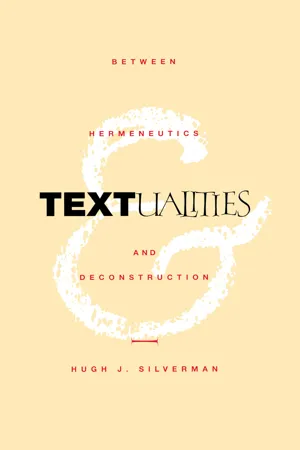
Textualities is both an account of recent developments in Continental philosophy and a demonstration of philosophy as a distinctive theoretical practice of its own. It can be read as a presentation and evaluation of major figures from Heidegger and Merleau-Ponty to Focault and Derrida with detailed acconts of Nietzsche, Sartre, Levi-Strauss, Barthes, Blanchot and Kristeva.
- 288 pages
- English
- ePUB (mobile friendly)
- Available on iOS & Android
eBook - ePub
About this book
Information
III
Autobiographical Textualities
9
AUTOBIOGRAPHICAL TEXTUALITY AND THOREAU'S WALDEN
Autobiographical textuality elaborates the autobiographical features (or meanings) of a text. It characterizes the respects in which a particular text develops autobiographical concerns. These concerns remain inherent in the text although they are not necessarily its central themes, issues, or foci of discussion. The elucidation of its autobiographical aspects informs about the function and features of the autobiographical in general. Thus an understanding of the autobiographical textuality of a text contributes to knowledge about the particular text and what constitutes the autobiographical per se.
An autobiographical textuality is an epistemological formation. It provides knowledge about how a text operates, what meanings the text incorporates, and the respects in which the text determines itself as enacting autobiographical considerations. As an epistemological formation, this particular type of textuality specifies dimensions, conditions, parameters, and determinations of the life narrated. The autobiographical text provides the narrative of a life. Its textuality establishes what is to be known about that particular life and the way it is to be known. An autobiographical textuality establishes a place in which essential knowledge about the autobiographical text can be made evident in terms of the relational elements, features, and signs of the narrated life. The textuality also calls into question what constitutes the life as this particular life. It circumscribes the limits of the life as narrated and sets itself off from the various forms and types of non-autobiographical textuality. The task of a deconstructive hermeneu-tic semiology is to explore textualities. In exploring them, it offers an understanding of the meaning of the sign systems operative in the text. The study of an autobiographical textuality is one such enterprise. Since autobiographical textualities are examined in relation to particular texts, the present consideration will take up Henry David Thoreau's Walden: or, Life in the Woods (1960 edition) in order to give a clearer account of autobiographical textuality in general.1
AUTOBIOGRAPHY AS PURE LIMIT
In autobiography, the self or subject is written as text. Auto-bio-graphizing is the writing of the self as text. In other words, the dialectic of selfhood is inscribed as textuality. Writing the self or subject is an activity in which the self or subject attempts to account for itself. The accounting is its textuality. Such an accounting approximates a recounting—though it will become evident that the self neither fully accounts for itself nor fully recounts itself. Yet the activity, the inscribing, the writing, the interface between accounting and recounting is autobiographical textuality. Autobiographizing is textualizing, its textuality is autobiographical signification—the act or process of textualizing the textualized self.
Although it may be possible to articulate the textuality of an autobiographical text, the placement of the textualized self is more problematical. Indeed, to indicate a distinctive space in which the textualized self is at home and in a place of its own is to provide a false sense of security, for the autobiographical is without space. What sort of space is in question here? It is most appropriately called topological space. Autobiographical textuality is a topos: neither a place nor a topic and yet situated at the intersection of the two. A topos is a discursive space. It has features derived from geography and features derived from rhetoric. Yet it occupies a domain all its own, for discursive spaces are at the same time delimited by texts and opened up by texts. A topology—the interpretation of topoi—maps out discursive spaces as they constitute texts and as they distinguish themselves from one another.
Autobiographical textuality is a topos in that it describes a unique topic and a place in the scheme of things. More specifically, autobiography involves a topos because it forms a type of discourse with an apparent space all its own. Writing the self as text has its own features just like other topoi, such as architecture, metaphysics, the body, political economy, etc. Yet under closer scrutiny, it becomes evident that autobiography as a genre is situated at the limits of discursive spaces and that it does not have a distinctive space of its own. This should not imply that autobiography is a counter-topos, an anti-discursive space, for a counter- topos or an anti-discursive space would already be a sort of topos. If the textuality of romanticism is a countertopos with respect to classicism, then romantic textuality is already a topos. If Rousseau's social contract theory is an anti-discursive space with respect to absolute monarchy, then social contract theory is already a discursive space. Rousseau's Confessions, however, is not an anti-discursive space with respect to any other—unless one were to distinguish it from all other autobiographies as a class. More specifically, Rousseau's Confessions is located at the limit of his particular enterprises. Considering all of Rousseau's adventures, theories, and personal contacts, none of these as such constitutes the autobiographical space, for they are each topoi in themselves.
The autobiographical in the case of Rousseau's Confessions is precisely at the limit of each of these topoi. The textuality of Rousseau's Confessions as autobiography is situated at the limits of the discourses of the text. However, the place of the autobiographical textuality is not located in any of the discourses of the text per se. And yet at the edge of all of these discourses is the achievement of autobiographical practice. The topology of the autobiographical occurs at the intersection of the autobiographical text and any other authorially linked texts, or at the limits of the author's theoretical, political, fictional, aesthetic, or other writings—as in the case of Rousseau's Confessions in relation to the Discourse on the Origin of Inequality among Mankind, Émile, The Social Contract, La Nouvelle Heloïse, etc. Although the autobiographical text may be juxtaposed with authorially linked non-autobiographical texts, the autobiographical space is located at the interface between autobiographical and non-autobiographical texts. To be located at an interface, in the intersection, is not to be located in any space at all. Autobiographical textuality is without space and therefore pure limit.
Consider now Thoreau's Walden. Here is a text written in large part between 1845 and 1847, while Thoreau lived in a wooden hut that he built himself near Walden Pond in Concord, Massachusetts. Published in 1854 with very little success, it represents one of two books that appeared during Thoreau's lifetime. Walden is a report of a two-year-and-two month experience. But the status of the text is in question. It is surely an account by an individual concerning his own life and thought. Writing his own life, Thoreau's text announces itself as autobiographical. The self is textualized in a pensive style and thereby presents itself as autobiography. The discursive space opened up by Walden is inscribed alongside A Week on the Concord and Merrimack Rivers (1849). Its textuality is autobiographical in that it is given in the first person singular as an “I” describing the “me.” Its space is a non-space not only because Thoreau was hardly read during his lifetime, but also because in privileging the autobiographical, Thoreau prioritizes his experience and places himself outside the frame of the standard writer. Even his apparently non-autobiographical texts, such as the famous essay On Civil Disobedience, are nevertheless imbued with a first-person singular point of view. Hence autobiographical textuality takes a central place in the self-determination of his writing across a variety of texts.
If Walden is an autobiography, it is not the autobiography per se that is of interest. Walden carries the form of autobiography—a written report of one's own life. Yet it is rarely read as such. Unlike Rousseau's Confessions, Goethe's Dichtung und Wahrheit, and Sartre's Les Mots—to name just a few canonical autobiographies—Thoreau's Walden is more often read as a naturalistic treatise, as an essay characteristic of nineteenth-century American thought, as an enacted Utopia, and as a segment of journals. Indeed, if one looks at Georges May's study of autobiography2 in which he lists some seventy autobiographies, Walden is not among them. Nor have I found it included in the discussion of many general studies of autobiography3. In some cases, Thoreau is cited only in passing.4 Thus the work is denied its important place among autobiographies—just as it was ignored when Thoreau first published it. Yet its reception and recognition is not what concerns us here, for autobiographical textuality does not rely upon statistics and classification for the establishment of its identity. The introductory paragraph of the text announces the autobiographical:
When I wrote the following pages, or rather the bulk of them, I lived alone, in the woods, a mile from any neighbor, in a house which I had built myself, on the shore of Walden Pond, in Concord, Massachusetts, and earned my living by the labor of my hands only. I lived there only two years and two months. At present I am a sojourner in civilized life again (Walden, p. 7).
The textualized self is put into operation. Prior experience is reported and, according to the account, portions that were written while in the woods are incorporated into the autobiographical narrative. The self is dispersed into a textuality—the writing of Thoreau's own life. This autobiographical textuality is, however, at most a limit of the textualized self.
AUTOBIOGRAPHY AS GENRE
If autobiographical textuality is pure limit, what are its implications for autobiography as a type of writing? Poetry, fiction, drama, etc. are well known as literary genres. But what of autobiography? It is certainly the case that one can cite many examples of writers who have produced autobiographical texts along with their general literary writings. One need only mention Goethe, Stendhal, Tolstoy, Yeats, Ionesco, and so on. Then again some autobiographical texts occupy a dominant place in certain authorial productions. Marcus Aurelius's Meditations, Henry Adams's Education of Henry Adams, and Simone de Beauvoir's Memoirs of a Dutiful Daughter, Prime of Life, Force of Circumstance, and All Said and Done constitute an autobiographical textuality that preoccupies the authorial literary space. Furthermore, certain autobiographical texts have a home in non-literary places. One would not cite Freud, Stravinsky, and Lévi-Strauss as the literary figures of our age, and yet their autobiographical texts do participate in a topological domain that constitutes the autobiographical. They do not write epics, lyrics, tragedies, comedies, historical novels, etc.—all of which have entered the canon of literary genres. Just as the historical novel makes claims to the literary and the historical, autobiography is situated at the interface between literature and a whole range of writing, psychoanalysis, music, anthropology, politics, philosophy, history, and so on.
What is curious about autobiographical texts is that they occur in strange places—places distinctively outside the literary domain—in psychology (B. F. Skinner's Particulars of My Life), in philosophy (Bertrand Russell's Autobiography and A. J. Ayer's Part of My Life), in theology (Loyola's Autobiography), and in politics (De Gaulle and Eisenhower are as likely as Caesar). Yet, autobiography is writing and specifically writing one's own life. Autobiographizing, then, occurs at the limits of literature and at the limits of psychology, philosophy, theology, politics, music, anthropology, etc. The coincidence of these limits is the space characterized by the autobiographical. Yet, can the autobiographical determine a genre? If texts could be gathered together and grouped under one head, then surely the answer would be affirmative. Yet what are the rules of this category—other than the writing of one's own life? Clearly it must be peculiar to the authorial field, but when what could count as an acceptable field is open, autobiographical texts begin to appear everywhere. The concern for establishing autobiography as a genre, however, indicates a specifically literary concern. Thus if autobiography is a literary genre, it falls on the side of literature. Since, by contrast, so much autobiography is not produced by members of the literary establishment but by authors outside, autobiography is generally a non-literary type of textuality. The generic space of autobiography is located precisely at the interface between the literary and the nonliterary. But there is no such space; it is pure difference—a difference that can be approximated only at the limits of the literary and the nonliterary. Hence autobiography is a genre activity whose only proper place is that appropriated by its author—whose authority is achieved in the writing.
Walden is a text that enters the autobiographical field, not in relation to other important works by the same author, but rather as an elaboration of an identity that is pure difference. In a certain respect, Walden approximates a literary text. Its descriptions of sounds, the pond, solitude, the coming of spring, all approach the sort of romantic adulation of nature that one finds in Wordsworth, Lamartine, and Goethe's Werther. But Thoreau's corpus does not define itself as poetry, novel, drama, romance, or the like. If anything, it approximates first person singular fictional journals in the tradition characterized by Dostoevsky's Notes from Underground and Sartre's La Nausée. First person singular journalistic novels, however, where the “I” predominates, are written explicitly with devices to separate the “I” of the text from the authorial “I.” For instance, editors are introduced as mediators. But in Thoreau's Walden, whatever editors there are have a real (rather than imaginary) status and they vary from edition to edition. The text itself is neither a novel nor a fictional journal. No distance stands between the author and the “I” in the text. Like John Dean at the Watergate trials, an eyewitness to an automobile accident, or a scientific researcher reporting his or her findings, the “I” in the narrative gives all appearance of veracity and identity with its author. Indeed, the project of Walden is one of non-deception and nonfictionalization. As to its genre, Walden is situated at the intersection of the first person novel or fictional journal and the various types of non-literary writing. The text appeals to navigation as Thoreau sounds the depths of the pond, to economics as he determines his expenses, to agriculture as he attends to his bean field, etc. Walden, however, is clearly not a scientific text—it hardly fulfills the genre of a treatise in navigation, economics, or agriculture. The place of Walden remains as a “limit genre” that has a marginal status in relation to the dominant literary types; on occasion it even risks falling into a scientific work. However, because it avoids both, in the end its status as genre is one of difference from each.
TEMPORALITY/SPATIALITY
The concern here has been oriented toward spatiality: the autobiographica...
Table of contents
- Cover
- Half Title
- Full Title
- Copyright
- Dedication
- CONTENTS
- Acknowledgments
- Abbreviations
- Introductory Remarks
- I CONTINENTAL PHILOSOPHY AND THE TEXTURE OF THEORY
- II TOWARD A THEORY OF TEXTUALITY
- III AUTOBIOGRAPHICAL TEXTUALITIES
- IV VISIBLE/SCRIPTIVE TEXTUALITIES
- V THE INSTITUTION(S) OF PHILOSOPHY AS TEXTUALITIES
- Notes
- Bibliography
- Index
Trusted by 375,005 students
Access to over 1.5 million titles for a fair monthly price.
Study more efficiently using our study tools.
Frequently asked questions
Yes, you can cancel anytime from the Subscription tab in your account settings on the Perlego website. Your subscription will stay active until the end of your current billing period. Learn how to cancel your subscription
No, books cannot be downloaded as external files, such as PDFs, for use outside of Perlego. However, you can download books within the Perlego app for offline reading on mobile or tablet. Learn how to download books offline
Perlego offers two plans: Essential and Complete
- Essential is ideal for learners and professionals who enjoy exploring a wide range of subjects. Access the Essential Library with 800,000+ trusted titles and best-sellers across business, personal growth, and the humanities. Includes unlimited reading time and Standard Read Aloud voice.
- Complete: Perfect for advanced learners and researchers needing full, unrestricted access. Unlock 1.5M+ books across hundreds of subjects, including academic and specialized titles. The Complete Plan also includes advanced features like Premium Read Aloud and Research Assistant.
We are an online textbook subscription service, where you can get access to an entire online library for less than the price of a single book per month. With over 1.5 million books across 990+ topics, we’ve got you covered! Learn about our mission
Look out for the read-aloud symbol on your next book to see if you can listen to it. The read-aloud tool reads text aloud for you, highlighting the text as it is being read. You can pause it, speed it up and slow it down. Learn more about Read Aloud
Yes! You can use the Perlego app on both iOS and Android devices to read anytime, anywhere — even offline. Perfect for commutes or when you’re on the go.
Please note we cannot support devices running on iOS 13 and Android 7 or earlier. Learn more about using the app
Please note we cannot support devices running on iOS 13 and Android 7 or earlier. Learn more about using the app
Yes, you can access Textualities by Hugh J. Silverman in PDF and/or ePUB format, as well as other popular books in Philosophy & Literary Criticism Theory. We have over 1.5 million books available in our catalogue for you to explore.