- 132 pages
- English
- ePUB (mobile friendly)
- Available on iOS & Android
eBook - ePub
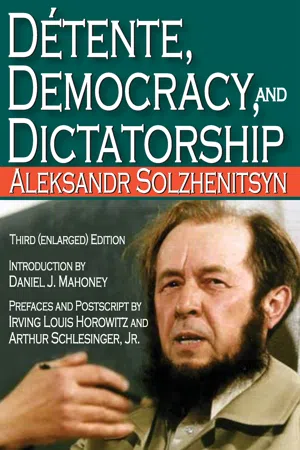
Detente, Democracy and Dictatorship
About this book
The subject of Detente, Democracy and Dictatorship has been with us since the breakdown of the Cold War and the termination of the Soviet system, indeed, if not since the origins of Bolshevism. No more vigorous critic of the uneasy co-existence of democracy and dictatorship exists than the greatest writer that the Soviet era of Russian history produced, Aleksandr Solzhenitsyn.This third edition is based on major addresses, especially aimed at Americans, delivered in 1975 in Washington, D.C. and New York, and again, in 1978, at Harvard University in Cambridge, all on the subject of detente, democracy and dictatorship. It also includes Solzhenitsyn's final 2007 interview with the German publication Der Spiegel.These major statements are brilliant and forthright comment on the risks of confusing ideology with diplomacy. But more than that, they summarize the Soviet debacle, the theoretical underpinnings, and distill Solzhenitsyn's multi-volumed masterpiece, the Gulag Archipelago.
Information
1
America: You Must Think About the World
Most of those present here today are workers. Creative workers. And I myself, having spent many years of my life as a stone cutter, as a foundryman, as a manual worker, in the name of all who have shared this forced labor with me, like the two Gulag prisoners whom you just saw, and on behalf of those who are doing forced labor in our country, I can start my speech today with the greeting: “Brothers!” “Brothers in Labor.”
And not to forget, also, the many honored guests present here tonight, let me add: “Ladies and Gentlemen.”
“Workers of the world unite!” Who of us has not heard this slogan, which has been sounding through the world for 125 years? Today you can find it in any Soviet pamphlet as well as in every issue of Pravda. But never have the leaders of the Communist revolution in the Soviet Union made application of these words sincerely and in their full meaning. When many lies have accumulated over the decades, we forget the radical and basic lie which is not on the leaves of the tree, but at its very roots.
Now, it’s almost impossible to remember or to believe... For instance, I recently published—had reprinted—a pamphlet from the year 1918. This was a precise record of a meeting of all representatives of the Petrograd factories, that being the city known in our country as the “cradle of the Revolution.”
Address delivered in Washington, DC. on June 30, 1975. Sponsored by the American Federation of Labor-Congress of Industrial Organizations (AFL-CIO).
I repeat, this was March 1918—only four months after the October Revolution—and all the representatives of the Petrograd factories were cursing the Communists, who had deceived them in all of their promises. What is more, not only had they abandoned Petrograd to cold and hunger themselves having fled from Petro-grad to Moscow, but had given orders to machinegun the crowds of workers in the courtyards of the factories who were demanding the election of independent factory committees.
Let me remind you this was March 1918. Scarcely anyone now can recall the crushing of the Petrograd strikes in 1921, or the shooting of workers in Kolpino in the same year.
Among the leadership, the Central Committee of the Communist Party, at the beginning of the Revolution, all were émigré intellectuals who had returned, after the uprisings had already broken out in Russia in order to carry through the Communist Revolution. One of them was a genuine worker a highly skilled lathe operator until the last day of his life. This was Alexander Shlyapnikov. Who knows that name today? Precisely because he expressed the true interests of the workers within the Communist leadership. In the years before the Revolution it was Shlyapnikov who ran the whole Communist Party in Russia—not Lenin, who was an émigré. In 1921, he headed the Workers’ Opposition which was charging the Communist leadership with betraying the workers’ interests with crushing and oppressing the proletariat and transforming itself into a bureaucracy.
Shlyapnikov disappeared from sight. He was arrested somewhat later and since he firmly stood his ground he was shot in prison and his name is perhaps unknown to most people here today. But I remind you: before the Revolution the head of the Communist Party of Russia was Shlyapnikov—not Lenin.
Since that time, the working class has never been able to stand up for its rights, and in distinction from all the western countries our working class only receives what they hand out to it. It only gets handouts. It cannot defend its simplest, everyday interests, and the least strike for pay or for better living conditions is viewed as counter-revolutionary. Thanks to the closed nature of the Soviet system, you have probably never heard of the textile strikes in 1930 in Ivanovo, or of the 1961 worker unrest in Murom and Alexandrovo, or of the major workers’ uprising in Novocherkassk in 1962—this in the time of Khrushchev, after the thaw.
This story will shortly be published in detail in your country in Gulag Archipelago, volume 3. It is a story of how workers went in a peaceful demonstration to the Party City Committee, carrying portraits of Lenin, to request a change in economic conditions. They fired at them with machine guns and dispersed the crowds with tanks. No family dared even to collect its wounded and dead, but all were taken away in secret by the authorities.
Precisely to those present here I don’t have to explain that in our country, since the Revolution, there’s never been such a thing as a free trade union.
The leaders of the British trade unions are free to play the unworthy game of visiting Russia’s so-called trade unions and receiving visits in return. But the AFL-CIO has never given in to these illusions.
The American workers’ movement has never allowed itself to be blinded and to mistake slavery for freedom. And I, today, on behalf of all of our oppressed people, thank you for this!
When liberal thinkers and wise men of the West, who had forgotten the meaning of the word “liberty,” were swearing that in the Soviet Union there were no concentration camps at all, the American Federation of Labor, published in 1947, a map of our concentration camps, and on behalf of all of the prisoners of those times, I want to thank the American workers’ movement for this.
But just as we feel ourselves your allies here, there also exists another alliance—at first glance a strange one, a surprising one—but if you think about it, in fact, one which is well-grounded and easy to understand: this is the alliance between our Communist leaders and your capitalists.
This alliance is not new. The very famous Armand Hammer, who is flourishing here today, laid the basis for this when he made the first exploratory trip into Russia, still in Lenin’s time, in the very first years of the Revolution. He was extremely successful in this intelligence mission and since that time for all these fifty years, we observe continuous and steady support by the businessmen of the West of the Soviet Communist leaders.
Their clumsy and awkward economy, which could never overcome its own difficulties by itself, is continually getting material and technological assistance. The major construction projects in the initial five-year plan were built exclusively with American technology and materials. Even Stalin recognized that two-thirds of what was needed was obtained from the West. And if today the Soviet Union has powerful military and police forces—in a country which is by contemporary standards poor—they are used to crush our movement for freedom in the Soviet Union—and we have Western capital to thank for this also.
Let me remind you of a recent incident which some of you may have seen in the newspapers, although others might have missed it: Certain of your businessmen, on their own initiative, established an exhibition of criminological technology in Moscow. This was the most recent and elaborate technology, which here, in your country, is used to catch criminals, to bug them, to spy on them, to photograph them, to tail them to identify criminals. This was taken to Moscow to an exhibition in order that the Soviet KGB agents could study it, as if not understanding what sort of criminals, who would be hunted by the KGB.
The Soviet government was extremely interested in this technology, and decided to purchase it. And your businessmen were quite willing to sell it. Only when a few sober voices here rose uproar against it was this deal blocked. Only for this reason it didn’t take place. But you have to realize how clever the KGB is. This technology didn’t have to stay two or three weeks in a Soviet building under Soviet guard. Two or three nights were enough for the KGB there to look through it and copy it. And if today, persons are being hunted down by the best and most advanced technology, for this, I can also thank your Western capitalists.
This is something which is almost incomprehensible to the human mind: that burning greed for profit which goes beyond all reason, all self-control, all conscience, only to get money.
I must say that Lenin foretold this whole process. Lenin, who spent most of his life in the West and not in Russia, who knew the West much better than Russia, always wrote and said that the Western capitalists would do anything to strengthen the economy of the USSR. They will compete with each other to sell us goods cheaper and sell them quicker, so that the Soviets will buy from one rather than from the other. He said: They will bring it themselves without thinking about their future. And, in a difficult moment, at a party meeting in Moscow, he said: “Comrades, don’t panic, when things go very hard for us, we will give a rope to the bourgeoisie, and the bourgeoisie will hang itself.”
Then, Karl Radek, whom you may have heard of, who was a very resourceful wit, said: “Vladimir Ilyich, but where are we going to get enough rope to hang the whole bourgeoisie?”
Lenin effortlessly replied, “They’ll supply us with it.”
Through the decades of the 1920s, the 1930s, the 1940s, the 1950s, the whole Soviet press wrote: Western capitalism, your end is near.
But it was as if the capitalists had not heard, could not understand, could not believe this.
Nikita Khrushchev came here and said, “We will bury you!” They didn’t believe that, either. They took it as a joke.
Now, of course, they have become cleverer in our country. Now they don’t say “we are going to bury you” anymore, now they say “détente.”
Nothing has changed in Communist ideology. The goals are the same as they were, but instead of the artless Khrushchev, who couldn’t hold his tongue, now, they say “détente.”
In order to understand this, I will take the liberty of making a short historic survey—the history of such relations, which in different periods have been called “trade,” “stabilization of the situation,” “recognition of realities,” and now “détente.” These relations now are at least forty years old.
Let me remind you with what sort of system they started.
The system was installed by armed uprising.
It dispersed the Constituent Assembly.
It capitulated to Germany—the common enemy.
It introduced execution without trial.
It crushed workers’ strikes.
It plundered the villagers to such an unbelievable extent that the peasants revolted, and when this happened it crushed the peasants in the bloodiest possible way.
It shattered the Church.
It reduced twenty provinces of our country to a condition of famine.
This was in 1921, the famous Volga famine. A very typical Communist technique: To seize power without thinking of the fact that the productive forces will collapse, that the fields will not be sown, the factories will stop, that the country will decline into poverty and famine—but when poverty and hunger come, then they request the humanitarian world to help them. We see this in North Vietnam today; perhaps Portugal is approaching this also. And the same thing happened in Russia in 1921. When the three-year civil war, started by the Communists-and “civil war” was a slogan of the Communists, civil war was Lenin’s purpose; read Lenin, this was his aim and his slogan when they had ruined Russia by this civil war, then they asked America, “America, feed our hungry.” And indeed, generous and magnanimous America did feed our hungry.
The so-called American Relief Administration was set up, headed by your future President Hoover, and indeed many millions of Russian lives were saved by this organization of yours.
But what sort of gratitude did you receive for this? In the USSR not only did they try to erase this whole event from the popular memory—it’s almost impossible today in the Soviet press to find any reference to the American Relief Administration—but they even denounce it as a clever spy organization, a clever scheme of American imperialism to set up a spy network in Russia. I repeat it was a system that introduced concentration camps for the first time in the history of the world.
A system that, in the twentieth entury, was the first to introduce the use of hostages, that is to say, not to seize the person whom they were seeking, but rather a member, of his family or someone at random, and shoot that person.
This system of hostages and persecution of the family exists to this day. It is still the most powerful weapon of persecution, because the bravest person, who is not afraid for himself, still shivers at the threat to his family.
It is a system which was the first—long before Hitler—to employ false registration, that is, to say: “Such and such people have to come in to register.” People would comply and then they were taken away to be annihilated.
We didn’t have gas chambers in those days. We used barges. A hundred or a thousand persons were put into a barge and then it was sunk.
It was a system which deceived the workers in all of its decrees-the decree on land, the decree on peace, the decree on factories, and the decree on freedom of the press.
It was a system which exterminated all additional parties, and let me make it clear to you that it not only disbanded the party itself, but destroyed its members. All members of every other party were exterminated. It was a system which carried out genocide of the peasantry; 15 million peasants were sent off to extermination.
It was a system which introduced serfdom, the so called “passport system.”
It was a system which, in time of peace, artificially created a famine, causing 6 million persons to die in the Ukraine in 1932 and 1933. They died on the very edge of Europe. And Europe didn’t even notice it. The world didn’t even notice it—6 million persons!
I could keep on enumerating these endlessly, but I have to stop because I have come to the year 1933 when, with all I have enumerated behind us, your President Roosevelt and your Congress recognized this system as one worthy of diplomatic recognition, of friendship and of assistance.
Let me remind you that the great Washington did not agree to recognize the French Convention because of its savagery. Let me remind you that in 1933, voices were raised in your country objecting to recognition of the Soviet Union. However, the recognition took place and this was the beginning of friendship and ultimately of a military alliance.
Let us remember that in 1904, the American press was delighted at the Japanese victories and everyone wanted Russia’s defeat because it was a conservative country. I want to remind you that in 1914 reproaches were directed at France and England for having entered into an alliance with such a conservative country as Russia.
The scope and the direction of my speech today do not permit me to say more about pre-revolutionary Russia. I will just say that information about prerevolutionary Russia was obtained by the West from persons who were either not sufficiently competent or not sufficiently conscientious. I will just cite for the sake of comparison a number of figures which you can read for yourself in Gulag Archipelago, volume 1, which has been published in the United States, and perhaps many of you may have read it. These are the figures:
According to calculations by specialists, based on the most precise objective statistics, in pre-revolutionary Russia, during the eighty years before the revolution—years of the revolutionary movement when there were attempts on the Tsar’s life, assassination of a Tsar, revolution—during these years about seventeen persons a year were executed. The famous Spanish Inquisition, during the decades when it was at the height of its persecution, destroyed perhaps ten persons a month. In the Archipelago—I cite a book which was published by the Cheka in 1920, proudly reporting on its revolutionary work in 1918 and 1919 and apologizing that its data were not quite complete—in 1918 and 1919 the Cheka executed without trial, more than a thousand persons a month! This was written by the Cheka itself, before it understood how this would look to history.
At the height of Stalin’s terror in 1937-38, if we divide the number of persons executed by the number of months, we get more than 40,000 persons shot per month! Here are the figures: seventeen a year, ten a month, more than 1,000 a month, more than 40,000 a month! Thus, that which had made it difficult for the democratic West to form an alliance with pre-revolutionary Russia had, by 1941, grown to such an extent and still did not prevent the entire united democracy of the world—England, France, the United States, Canada, Australia and small countries—from entering into a military alliance with the Soviet Union. How is this to be explained? How can we understand it? Here we can offer a few explanations. The first, I think, is that the entire united democracy of the world was too weak to fight against Hitler’s Germany alone. If this is the case, then it is a terrible sign. It is a terrible portent for the present day. If all these countries together could not defeat Hitler’s little Germany, what are they going to do today, when more than half the globe is flooded with totalitarianism? I don’t want to accept this explanation.
The second explanation is perhaps that there was simply an attack of panic—of fear—among the statesmen of the day. They simply didn’t have sufficient confidence in themselves; they simply had no strength of spirit, and in this confused state decided to enter into an alliance with Soviet totalitarianism. This is also not flattering to the West.
Finally, the third explanation is that it was a deliberate device. Democracy did not want to defend itself. For defense it wanted to use another totalitarian system, the Soviet totalitarian system.
I’m not talking now about the moral evaluation of this, I’m going to talk about that later. But in terms of simple calculation, how shortsighted, what profound self-deception!
We have a Russian proverb: “Do not call a wolf to help you against the dogs.” If dogs are attacking and tearing at you, fight against the dogs, but do not call a wolf for help. Because when the wolves come, they will destroy the dogs, but they will also tear you apart.
World democracy could have defeated one totalitarian regime after another, the German, then the Soviet. Instead, it strengthened Soviet totalitarianism, helped bring into existence a third totalitarianism that of China, and all this finally precipitated the present world situation.
Roosevelt, in Teheran, during one of his last toasts, said the following: “I do not doubt that the three of us”—meaning Roosevelt, Churchill and Stalin—”lead our peoples in accordance with their desires, in accordance with their aims.” How are we to explain this? Let the historians worry about that. At the time, we listened and were astonished. We thought, “when we reach Europe, we will meet the Americans, and we will tell them.” I was among the troops that were marching towards the Elbe. A little bit more and I would have reached the Elbe and would have shaken the hands of your American soldiers. But just before that happened, I was taken off to prison and my meeting did not take place.
But now, after all this great delay, the same hand has thrown me out of the country and here I am instead of the meeting at the Elbe. After a delay of thirty years, my Elbe is here today. I am here to tell you as a friend of the United States, what, as friends we wanted to tell y...
Table of contents
- Cover Page
- Half Title
- Title Page
- Copyright Page
- Table of Contents
- Preface I: The Washington, DC Addresses: An Amnesty International of One
- Preface II: The Harvard Address: The Solzhenitsyn We Refuse to See
- Introduction: Aleksandr Solzhenitsyn: Hero of a Dark Century
- 1 America: You Must Think About the World
- 2 Communism: A Legacy of Terror
- 3 The Exhausted West
- 4 I Am Not Afraid of Death: An Interview
- Postscript The Gulag Archipelago: The Anthropology of Life, Death, and Redemption
Trusted by 375,005 students
Access to over 1.5 million titles for a fair monthly price.
Study more efficiently using our study tools.
Frequently asked questions
Yes, you can cancel anytime from the Subscription tab in your account settings on the Perlego website. Your subscription will stay active until the end of your current billing period. Learn how to cancel your subscription
No, books cannot be downloaded as external files, such as PDFs, for use outside of Perlego. However, you can download books within the Perlego app for offline reading on mobile or tablet. Learn how to download books offline
Perlego offers two plans: Essential and Complete
- Essential is ideal for learners and professionals who enjoy exploring a wide range of subjects. Access the Essential Library with 800,000+ trusted titles and best-sellers across business, personal growth, and the humanities. Includes unlimited reading time and Standard Read Aloud voice.
- Complete: Perfect for advanced learners and researchers needing full, unrestricted access. Unlock 1.5M+ books across hundreds of subjects, including academic and specialized titles. The Complete Plan also includes advanced features like Premium Read Aloud and Research Assistant.
We are an online textbook subscription service, where you can get access to an entire online library for less than the price of a single book per month. With over 1.5 million books across 990+ topics, we’ve got you covered! Learn about our mission
Look out for the read-aloud symbol on your next book to see if you can listen to it. The read-aloud tool reads text aloud for you, highlighting the text as it is being read. You can pause it, speed it up and slow it down. Learn more about Read Aloud
Yes! You can use the Perlego app on both iOS and Android devices to read anytime, anywhere — even offline. Perfect for commutes or when you’re on the go.
Please note we cannot support devices running on iOS 13 and Android 7 or earlier. Learn more about using the app
Please note we cannot support devices running on iOS 13 and Android 7 or earlier. Learn more about using the app
Yes, you can access Detente, Democracy and Dictatorship by Aleksandr Solzhenitsyn in PDF and/or ePUB format, as well as other popular books in Politics & International Relations & Communism, Post-Communism & Socialism. We have over 1.5 million books available in our catalogue for you to explore.