- 320 pages
- English
- ePUB (mobile friendly)
- Available on iOS & Android
eBook - ePub
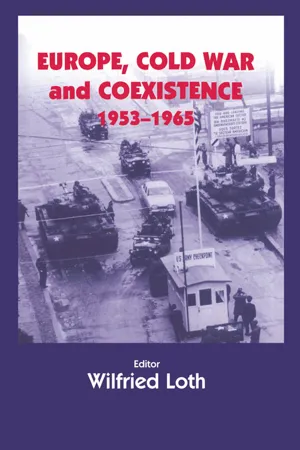
Europe, Cold War and Coexistence, 1955-1965
About this book
This title examines the role of the Europeans in the Cold War during the 'Khrushchev Era'. It was a period marked by the struggle for a regulated co-existence in a world of blocs, an initial arrangement to find a temporary arrangement failed due to German desires to quickly overcome the status quo. It was only when the danger of an unintended nuclear war was demonstrated through the crises over Berlin and Cuba that a tacit arrangement became possible, which was based on a system dominated by a nuclear arms race.
The book provides useful information on the role of Konrad Adenauer and the beginnings of the German 'new Eastern policy', as well as examining the Western European power policy in the era of Harold Macmillan and Charles de Gaulle.
Information
PART I:
EUROPE IN THE ‘FIRST DÉTENTE’, 1953–58
1
Britain as a Bridge between East and West
In late July of 1955, in the aftermath of the Geneva summit conference, British Prime Minister Anthony Eden had a talk with Evelyn Shuckburgh, at that time a senior Foreign Office official. The Conservative leader spoke about his experience at Geneva, saying that in his opinion, ‘the Russians were looking ahead, and saw in ten or twenty years a very strong China to the east of them and perhaps a very strong Germany to the West, and were looking for someone to hold their hands a little. They could not expect anything from the USA, and they saw that the French were no use, so they were looking for us.”1 This statement is representative of the attitudes, feelings, hopes, and misperceptions which characterized Britain’s policy toward the Eastern bloc and especially the Soviet Union during the early détente period. Furthermore, it may be argued that Britain played a leading part in favouring the end of the Cold War in Europe, although it would be difficult to claim that British decision makers gained much for their efforts.2
It would in fact be partially misleading to focus our attention only on the period from 1953 to 1956, that is, the two-and-a-half years from the death of Stalin to the crises over the Suez and Budapest. In order to understand the UK’s policy during those crucial years, it would be of some help to go back to an earlier period. In the immediate postwar years, the Labour Cabinet did its best to create a new world order which could be based on some form of agreement not only with the USA and France but also with the Soviet Union.3 It was especially on the European continent that the UK was confronted with a frightening power vacuum which could easily be filled only by the Soviet Union, British decision makers could not be sure of the USA’s intentions, and a return to the isolationist tradition could not be excluded. In spite of Churchill’s efforts in the late stages of the war, France was perceived as a defeated nation whose restoration as a great power would be an almost impossible task. Only the UK could counter Soviet ambitions to achieve hegemony over the whole European continent. At the same time, British decision makers were well aware of their nation’s plight, which weakened their power despite the fact that the UK was still the centre of a great empire.4 The Attlee government could not oppose both Soviet military strength and Stalin’s political prestige, a consequence of the ‘great patriotic war’ and of the victory over Nazi Germany; from an ideological viewpoint, Labour’s peaceful ‘revolution’ was no match for the almost religious appeal of the communist faith with its millions of loyal militants. Last but not least, wide sectors of British public opinion saw the Soviet Union as the gallant ally which had greatly contributed to the final victory rather than as a powerful and unfriendly competitor.5
So diplomacy and compromise were the tools through which London tried to create a lasting peace—especially on the European continent—which would safeguard Britain’s imperial interests and allow the Labour Party to achieve its domestic goals.6 In fact, the British leaders desperately needed time to implement the Labour social and political programme, to prompt the nation’s economic recovery, and to reform the Empire; a stable settlement on the European scene would offer such a chance. In this regard, Britain tried to deal with the Soviet Union on the basis of traditional power politics—in Whitehall, it was hoped that the war had transformed the USSR into Russia and Stalin into a sort of Red Tsar.7 Very early, however, British leaders realized that it would be quite difficult to achieve a lasting settlement with the Soviet Union. They thought that Stalin’s policy was largely shaped by ideological bias which led Moscow toward an aggressive strategy, that is, toward conflict with the West. This interpretation was nothing new but rather the rediscovery of deeply rooted fears and beliefs which had their origins in the 1920s.8 But only the USA had the power and means to counter effectively Stalin’s imperial ambitions, and in 1947 the British Foreign Office and its head, Ernest Bevin, did their best in order to pave the way for the USA’s involvement on the European scene.9 On the other hand, the Truman administration were already working out a ‘revolution’ of the USA’s international role, dramatically marked by developments such as the Truman Doctrine’, the Marshall Plan, and later the creation of the North Atlantic Alliance.10 Britain played a significant role in this process: the Truman Doctrine’ was prompted by London’s appeal concerning the deteriorating situation in Greece11; the British favoured the launching of the Marshall Plan, and the UK was the most important recipient of that ERP (European Recovery Programme) aid.12 Bevin also launched the plan for a Western Union and concurred in shaping the main characteristics of the Atlantic alliance.13 That was the beginning of the ‘special relationship’. In 1948, Churchill, although at that time in the opposition, skilfully sketched out the priorities of the UK’s foreign policy when he spoke of the three interlocking ‘circles’ (that is, the ‘special relationship’, the Commonwealth and Western Europe).14 The ‘special relationship’ and the Cold War were in fact closely linked, and both elements became almost vital factors of Britain’s foreign policy, as the Cold War was at the root of the ‘special relationship’, and the Anglo-American alliance, supported by the Commonwealth, gave new life to London’s role as a great power with worldwide responsibilities and interests. In late 1949, the USA and Britain appeared to be the two pillars of a powerful transatlantic partnership, of an ‘Atlantic community’.15
But Britain’s ‘special’ position rapidly eroded. The Korean War marked a turning point in the Cold War, as the USA on the one hand were directly involved in the Far East and on the other they were very mindful of the communist threat to Central Europe, that is, to West Germany. In the latter case, the Truman administration singled out as their main goals West Germany’s rearmament and closer economic, political and military integration among the nations of Western Europe. French fears and ambitions led the Fourth Republic’s decision-makers to support Jean Monnet’s ‘functionalist’ projects, and the French government launched both the Schuman Plan and the Pleven Plan.16 So from the middle of 1950, West Germany’s role became the main concern of the Truman administration, and France became the most important factor in US policy on Western Europe.17 For their part, British leaders rejected London’s involvement in both the Schuman Plan and the Pleven Plan, not only as a consequence of their dislike of vague ‘federalist’ projects but also on the ground that such a commitment would jeopardize Britain’s world role.18 That may be partially true, but for some time the creation of an effective Western European system appeared to be in the hands of French and West German decision makers as well as the US administration.
In the Far East, the British supported the political and military initiatives developed by Washington, but by late 1950, the Labour Cabinet began to be worried about General McArthur’s aggressive strategy which could lead to a major nuclear war.19 Furthermore, they could not forget the ‘Commonwealth circle’ and, in this regard, it was often difficult to reconcile the Anglo-American ‘special relationship’ with the close ties developed with some Asian members of the Commonwealth, especially Nehru’s India, which had serious doubts about the USA’s tough policy toward Communist China.20 Last but not least, a serious illness led to Bevin’s resignation; his substitute, Herbert Morrison, lacked experience, making the Foreign Office appear less effective.
In the autumn of 1951, the Conservatives won the general elections: Churchill was appointed prime minister and Eden was once again his foreign secretary.21 Churchill was obviously interested in foreign policy, but his relationship with Eden was less smooth than in the war years, as the former was becoming an old man who clung to power and the latter was not happy at his being the prime minister’s ‘heir apparent’, an heir who was waiting for a position which that old man had no intention of giving up.22 In spite of those personal difficulties, both Churchill and Eden had a common goal: the confirmation of Britain as a world power which could stand with both the USA and the USSR. They were aware of their nation’s weaknesses, but they still hoped to have some chance of achieving such an ambitious goal. In fact, Churchill and Eden developed different strategies. The prime minister seemed to nurture a sort of dream: to be remembered by posterity as a man of peace through his ending of the Cold War; dialogue with Moscow was the main goal of his ‘last campaign’.23 In case of a successful outcome of his strategy, Britain would impose itself at the centre of the international stage. He hoped that he could win Washington’s support for his policy. Eden did not share Churchill’s enthusiasms and was more concerned about the numerous problems which London had to face in various areas, from the Middle East, where Britain’s relations with Egypt were more and more strained, to South East Asia, where the British were facing a communist guerrilla movement in Malaya. Additionally, the Foreign Office’s evaluations confirmed the widespread opinion that Stalin was not interested in starting any dialogue with the West, and it is not surprising that the famous Stalin Note of March 1952 was rejected by Whitehall as a mere propaganda move.24 On the other hand, creation of an effective Western European defence system was still perceived as the only instrument for constructing a strong bulwark against Moscow’s aggressive policies. So, at least for the time being, Whitehall decided to be faithful to the close alliance with the USA and to cooperate with Washington on the European scene. The British cabinet gave growing support to the project for a European Defence Community (EDC), but the launching of the so-called Eden Plan for the revival of the Council of Europe, although doomed to failure, showed that the foreign secretary did not consider the ‘functionalist’ approach the only way toward European cooperation and that Britain wished to play some role in any future Western European political structure.25
In fact, the Republican victory at the US presidential elections in late 1952 and the death of Stalin in early 1953 prompted a dramatic development in Britain’s policy toward the Eastern bloc. At first, Churchill hoped that it would be possible to renew close contacts with Eisenhower and to influence the new US administration’s position toward the USSR, but he quickly discovered that the Republican administration was committed to a militant anti-communist policy which openly clashed with the prime minister’s aspirations.26 In Washington’s opinion, the Western European allies had to show a more forthcoming attitude in their support of the ‘Cold War’ strategy under the firm leadership of the USA.27 But the death of Stalin a...
Table of contents
- Cover Page
- Title Page
- Copyright Page
- Contents
- Series Editor’s Preface
- Notes on Contributors
- Abbreviations
- Introduction
- PART I: EUROPE IN THE ‘FIRST DÉTENTE’, 1953-58
- PART II: EUROPEAN REACTIONS TO THE BERLIN AND CUBAN CRISES, 1958-62
- PART III: EUROPE IN SEARCH OF DÉTENTE, 1962-65
- PART IV: DIRECT NEGOTIATIONS BETWEEN EASTERN AND WESTERN EUROPE
- Index
Trusted by 375,005 students
Access to over 1.5 million titles for a fair monthly price.
Study more efficiently using our study tools.
Frequently asked questions
Yes, you can cancel anytime from the Subscription tab in your account settings on the Perlego website. Your subscription will stay active until the end of your current billing period. Learn how to cancel your subscription
No, books cannot be downloaded as external files, such as PDFs, for use outside of Perlego. However, you can download books within the Perlego app for offline reading on mobile or tablet. Learn how to download books offline
Perlego offers two plans: Essential and Complete
- Essential is ideal for learners and professionals who enjoy exploring a wide range of subjects. Access the Essential Library with 800,000+ trusted titles and best-sellers across business, personal growth, and the humanities. Includes unlimited reading time and Standard Read Aloud voice.
- Complete: Perfect for advanced learners and researchers needing full, unrestricted access. Unlock 1.5M+ books across hundreds of subjects, including academic and specialized titles. The Complete Plan also includes advanced features like Premium Read Aloud and Research Assistant.
We are an online textbook subscription service, where you can get access to an entire online library for less than the price of a single book per month. With over 1.5 million books across 990+ topics, we’ve got you covered! Learn about our mission
Look out for the read-aloud symbol on your next book to see if you can listen to it. The read-aloud tool reads text aloud for you, highlighting the text as it is being read. You can pause it, speed it up and slow it down. Learn more about Read Aloud
Yes! You can use the Perlego app on both iOS and Android devices to read anytime, anywhere — even offline. Perfect for commutes or when you’re on the go.
Please note we cannot support devices running on iOS 13 and Android 7 or earlier. Learn more about using the app
Please note we cannot support devices running on iOS 13 and Android 7 or earlier. Learn more about using the app
Yes, you can access Europe, Cold War and Coexistence, 1955-1965 by WILFRED LOTH in PDF and/or ePUB format, as well as other popular books in Storia & Storia europea. We have over 1.5 million books available in our catalogue for you to explore.