Anorexia Nervosa
eBook - ePub

Anorexia Nervosa

A Recovery Guide for Sufferers, Families and Friends

  1. 178 pages
  2. English
  3. ePUB (mobile friendly)
  4. Available on iOS & Android
eBook - ePub

Anorexia Nervosa

A Recovery Guide for Sufferers, Families and Friends

About this book

The highly respected and widely known Anorexia Nervosa: A Survival Guide for Sufferers and Friends was written in 1997. This long-awaited new edition builds on the work of the first book, providing essential new and updated research outcomes on anorexia nervosa. It offers a unique insight and guidance into the recovery process for those who suffer from an eating disorder as well as advice and information for their loved ones. Written collaboratively by both an expert in the field and someone with personal experience of eating disorders, this book offers exceptional understanding of the issues surrounding the illness.

Divided into four sections, it includes:

an outline of anorexia nervosa

coping strategies for sufferers

advice and information for families, carers and friends

guidelines for professionals who are involved in the sufferer's life.

Families, friends, carers and professionals such as teachers and GPs are encouraged to read all sections in order to fully understand the illness. With an emphasis on collaboration and a layout that enables content to be referenced and read in any order, this book is an essential resource for anyone affected, directly or indirectly, by anorexia nervosa.

Frequently asked questions

Yes, you can cancel anytime from the Subscription tab in your account settings on the Perlego website. Your subscription will stay active until the end of your current billing period. Learn how to cancel your subscription.
No, books cannot be downloaded as external files, such as PDFs, for use outside of Perlego. However, you can download books within the Perlego app for offline reading on mobile or tablet. Learn more here.
Perlego offers two plans: Essential and Complete
  • Essential is ideal for learners and professionals who enjoy exploring a wide range of subjects. Access the Essential Library with 800,000+ trusted titles and best-sellers across business, personal growth, and the humanities. Includes unlimited reading time and Standard Read Aloud voice.
  • Complete: Perfect for advanced learners and researchers needing full, unrestricted access. Unlock 1.4M+ books across hundreds of subjects, including academic and specialized titles. The Complete Plan also includes advanced features like Premium Read Aloud and Research Assistant.
Both plans are available with monthly, semester, or annual billing cycles.
We are an online textbook subscription service, where you can get access to an entire online library for less than the price of a single book per month. With over 1 million books across 1000+ topics, we’ve got you covered! Learn more here.
Look out for the read-aloud symbol on your next book to see if you can listen to it. The read-aloud tool reads text aloud for you, highlighting the text as it is being read. You can pause it, speed it up and slow it down. Learn more here.
Yes! You can use the Perlego app on both iOS or Android devices to read anytime, anywhere — even offline. Perfect for commutes or when you’re on the go.
Please note we cannot support devices running on iOS 13 and Android 7 or earlier. Learn more about using the app.
Yes, you can access Anorexia Nervosa by Janet Treasure,June Alexander in PDF and/or ePUB format, as well as other popular books in Psychology & Abnormal Psychology. We have over one million books available in our catalogue for you to explore.

Information

Section Two For sufferers

4 Starting the recovery journey

DOI: 10.4324/9780203640197-4

Recruiting help

Section Two is primarily for the sufferer – especially for people who feel ready to regain their true self and be free of their anorexia nervosa bully. You may be fortunate to be able to work through this section with professional help. Some chapters in Sections One and Three also will be relevant to you. For example, you may be interested to understand the causes of the illness outlined in Section One.
Section Three describes the stages you need to go through when trying to come to grips with and understand your anorexia nervosa. Perhaps you are reading this book because you are in the contemplation stage; that is, you think you might have a problem but are undecided. Alternatively, you may have reached the action stage where you need as much help as you can get, as you are fighting on all fronts. There again, you may be in the pre-contemplation stage and reading this because someone asked you to, but you don’t think you have a problem.
Whatever stage you are at, this section contains the tools you need to get moving and regain your true identity and freedom. Parents and concerned others may also find this section helpful. The first stage of the work is to ensure that you understand as much as possible about what is going on.
We need to be honest at this point. Getting over anorexia nervosa often involves getting much worse before you get better. The illness seems to sense when people are on to it, and it bucks and creates a ruckus, hoping to frighten you off. So hang in there, be vigilant and hold steadfastly on to hope at all times. Remember that this is one of the toughest challenges you will ever face. People may have said to you, ‘If only you would eat this or that, you would be better’. In the long term they are right but in the short term this is far from the truth. An eating disorder is about much more than food.
Recovery takes a lot of courage and energy. Physically, you may feel awful, your stomach and gut may become bloated and sore, your bones and muscles may ache and psychologically and emotionally you will be on a seesaw. We will work through these difficulties in more detail as we progress through this book.
Negotiating recovery alone is difficult and we therefore suggest that you find someone (ideally more than one person) with whom to share the task. Your recovery guide doesn’t have to be a family member but someone who is often highly motivated to help. They should be someone who can see you regularly. Here is a checklist of qualities to look for in choosing your helper.
Support questionnaire
Could ‘X’ be your support? Answer the following questions.
  1. How easy is it to talk to X about your problem?
    • Very easy (5 points)
    • Quite easy (4 points)
    • Not sure (3 points)
    • Quite difficult (2 points)
    • Very difficult (1 point)
  2. Is X critical or easily upset about your eating? Does X take your eating behaviour personally?
    • Always (1 point)
    • Often (2 points)
    • Sometimes (3 points)
    • Rarely (4 points)
    • Never (5 points)
  3. Could you talk to X even if you weren’t making progress?
    • Definitely (3 points)
    • Not sure (2 points)
    • Definitely not (1point)
  4. Can you trust X to be always there when you need someone – with no strings attached? No moral blackmail?
    • Definitely (5 points)
    • Probably (4 points)
    • Maybe (3 points)
    • Probably not (2 points)
    • Definitely not (1 point)
  5. When you overcome your anorexia, what will X’s likely response be?
    • X may feel threatened by this. They will have to find a new role and way of living (0 points)
    • X may feel lost and slightly jealous that I can become more independent and successful with my life (0 points)
    • I haven’t a clue (1 point)
    • X will be very pleased for me (2 points)
  6. How often are you in contact with X?
    • At least once a week (3 points)
    • At least once a fortnight (2 points)
    • At least once a month (1 point)
    • Less than once a month (0 points)
Total points 19–23: You are in the lucky position of having a near perfect supporter nearby. Definitely invite person X to help you in your efforts to overcome your eating disorder.
Total points 12–18: It is uncertain whether X should be your supporter. Possibly, this person is too emotionally involved to be helpful. They may not be able to cope with the ramifications.
Total points 4–11: Look for someone else or go it alone.
We suggest that you ask your chosen helper to read Section Four. It is easy for helpers with the best will in the world to fall into a trap set up by the anorexic bully and hinder rather than help change.

Phase one: first steps

The most difficult step is to let yourself realise, acknowledge and accept that you have an illness. If you have not done so already, we suggest you read some of the chapters in Section One, especially the historical one (Chapter 3). You will note an integral feature of anorexia nervosa is that sufferers often think they don’t have a problem. That is, you probably do have anorexia nervosa if others are worried about you but you are not worried about yourself! Eventually, most sufferers reach the stage when they recognise that the anorexia bully has strangled their life and they long to be free. At first this idea comes and goes.
Doing anything about overcoming your anorexia is difficult until you fully accept that your anorexia is a concern for you. This chapter will help you reach this stage.
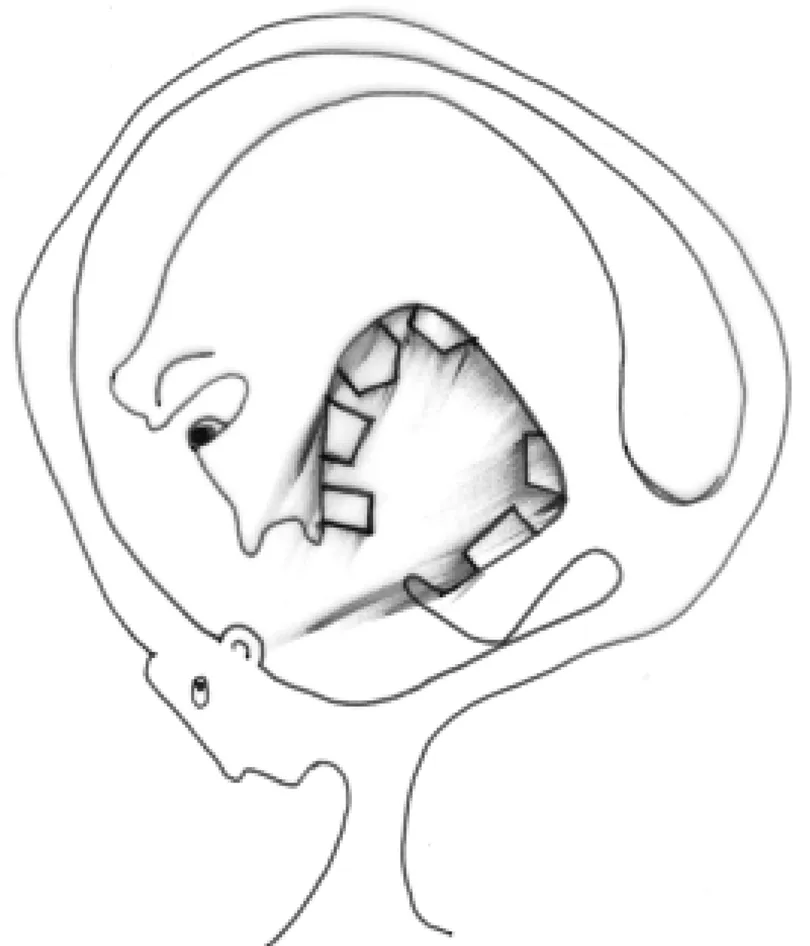
One concept that we have found useful is to conceptualise anorexia nervosa as a ‘bully’ that sits in your brain and whispers instructions and orders to you about how to behave and cope with a situation. Hold this thought and think about your illness as something that does not have your best interests at heart and is separate from your true self.
The anorexia bully
You will find it helpful to start working out which thoughts and behaviours belong to the bully, and which belong to the real you. This helps you to start seeing the illness for what it is – and to start working on dismantling it. Picture this manipulative bully in the ‘schoolyard’ of your mind. How does it make you think? How does it make you feel? How does it make you behave? Write down your thoughts. Do you have an image, other than a bully, that makes more sense to you? Focus on this for a while. Write about or draw it.
Seeing how other people set about this task may help you get started. For example:

Julie

I was aged 28 when I decided enough was enough. I had developed anorexia nervosa four years earlier. I decided to seek treatment because my boyfriend and I had become more committed to each other. I wanted treatment for my anorexia nervosa before our relationship went further. After my first session with the therapist I took the image of the anorexia bully home with me and started to work on it. I structured the way the anorexia bully was affecting my health (physical and psychological) and the way it was affecting my social life (career and family).

How the anorexia bully affects my physical health

I'm exhausted all the time and end up falling asleep during the day for a few hours.
  1. When I’m working out, my body and muscles are telling me to stop, but I won’t. My eating disorder thoughts drive me on.
  2. I have headaches all the time. This may be because of dehydration.
  3. I feel light-headed all the time. I feel faint if I get up too quickly.
  4. I don’t sleep well at nights. I keep waking up every hour.
  5. I look pale most of the time.
  6. When I’ve eaten I feel so full that my stomach is distended. I’m afraid to look at it.
  7. I get constipated sometimes.
  8. Having a dry mouth all the time makes me feel weak and dirty. I’m always cleaning my teeth.
  9. I feel weak and listless all the time and seem to have no energy – even though I drive myself to do the physical workouts.
  10. Sometimes I feel my arms and legs are just too heavy to lift.
  11. I get aches in my joints all the time.

How the anorexia bully is affecting my psychological health

  1. I feel I’m too fat even though people tell me that I am thin. But I can’t see it. I know they are lying and saying I look thin to make me feel better. Well, I don’t feel better. I am fat, fat, fat.
  2. I have to exercise constantly otherwise I’ll have extra blobs of fat where I don’t want them. I feel very guilty and annoyed with myself if l don’t exercise a certain number of times each week. Each day, actually.
  3. I am very controlled about my diet. I feel guilty just for eating. I get panicky about it.
  4. I feel the need to be very strict with myself – I have rules and I have to live by them to feel I can cope and get through each day.
  5. I feel tearful most of the time. I feel I am putting on a front to show people I am fine. I am ashamed of how I feel inside. I’m so weak, always letting myself down.
  6. I’m very unhappy about myself. I hate myself and get depressed, wondering how much longer I can go on.
  7. I don’t have enough enthusiasm for things anymore. I used to be enthusiastic about everything. My day is consumed with the number of calories I can eat for the day and the amount of exercise I must do to alleviate my anxiety.
  8. I don’t have the get up and go I once had. Everything is such an effort now.
  9. I have to write everything down as I have trouble remembering things.

How the anorexia bully has affected my career

  1. I work part time at the moment because I’m not fit or strong enough to work full time. I work in the morning when I’m at my best. In the evenings I’m exhausted from trying to meet the demands of my illness.
  2. My career development has been put on hold.

How the anorexia bully affects relationships

  1. Mother constantly tells me I need food, but I ignore her and eat nothing. She gets angry but I’m afraid to eat and feel better if I don’t eat. If I do eat, I feel guilty and have to do more exercise to compensate. I try to keep busy and shut out the food thoughts but they keep bothering me.
  2. I have lost interest in sex with my boyfriend, although I think about it quite often. I don’t want him to see my body and see how big I am. Also I dread him hugging or touching me in case he feels some fat. I don’t want him put off for life.

How the anorexia bully has affected friendships

  1. Before this illness I had a lot of friends but now I hardly see them because I’m too exhausted to go out at night. Sometimes they come round to visit me.
  2. If I’ve agreed to see them, I start to worry and want to cancel, thinking I won’t enjoy it. Once they arrive, I do enjoy myself but being in the moment, focusing on conversations taking place around me, takes so much effort. Yet my friends are very important to me.
  3. I have to psyche myself up to see them. I have to get into the mood/right frame of mind. It is so easy to listen to the eating disorder ‘voice’ in my head, which wants me to be alone and go nowhere.
  4. I miss out on a lot of fun and many social occasions because I avoid eating out with my friends. Eating in front of others makes me very anxious so I pretend I have something else on, and stay home, alone with my bossy eating disorder thoughts. I worry that my friends will not understand that my behaviour is due to fear and will give up on me.
Do you recognise and identify with any of these thoughts? Can you add to these lists?
While you are at this stage, another useful exercise is to write several letters. First, write a letter to your anorexia nervosa bully as if it were your enemy. Tell it exactly what you think of it. Accuse it of causing you problems, which it most certainly has done, and be explicit. What troubles has it pulled you into? Jackie wrote the following letter.

Jackie's letter

Dear Anorexia (my enemy),
You have been dogging every hour of my life for more than 10 years. You were with me during all my student days. You made it difficult for me to join in with everyone else. You wanted me all to yourself. I tended to withdraw from opportunities to have fun with friends, especially if they were going out for a meal, saying that I needed to study. I passed my exams with distinction but, due to your domination, I didn’t make any friendships that are still with me. Also I don’t seem to be getting on at work now I’ve qualified. I feel like I am on the periphery of what is happening rather than really part of things. I find it difficult to concentrate and I sometimes miss the point.
All of my peers at college are now marrying and having babies. I have never had a relationship, however fleeting. I guess I have spent all my time thinking inwards, listening to you, instead of engaging with the out...

Table of contents

  1. Cover Page
  2. Half Title Page
  3. Title Page
  4. Copyright Page
  5. Contents
  6. About the authors
  7. About the illustrator
  8. Acknowledgements
  9. Introduction
  10. SECTION ONE Anorexia nervosa: An overview
  11. SECTION TWO For sufferers
  12. SECTION THREE For families, carers and friends
  13. SECTION FOUR Guidelines for professionals
  14. Appendix
  15. Index