In the last decade, the significance of siblings in children's development and adjustment has been widely recognized, and research on brothers and sisters has increased dramatically. Bringing together exciting research on siblings by leading developmental psychologists and clinicians, this volume's contributions were originally presented at the First International Symposium on Siblings held in Leiden. This book focuses on both the significance of siblings as influences on individual development, and on the importance of the relationship in families with sick, disabled or troubled children. It covers the recent developmental research with chapters on the development of sibling relationships in early and middle childhood, the links between sibling relationships and those with parents, peers and friends, and the influence of siblings on children's adjustment. It then focuses on clinical issues such as siblings as sources of support for unhappy or sick children, or for children in disharmonious homes, and the vulnerability of siblings of disabled children. These clinical issues are discussed in practical terms by leading practitioners.
Clear in presentation, comprehensive in its coverage of the exciting recent research, and full of practical insights, this volume brings to light important developmental principles, and raises questions regarding the assumptions about family processes and how different relationships within the family affect one another. For family researchers, those interested in the individual development of children, and for clinicians concerned about the impact of troubled or disabled children on their siblings or the potential of siblings as therapists, this book will be the key. No other book covers the recent research in this important topic and discusses the clinical issues in depth and in practical terms.
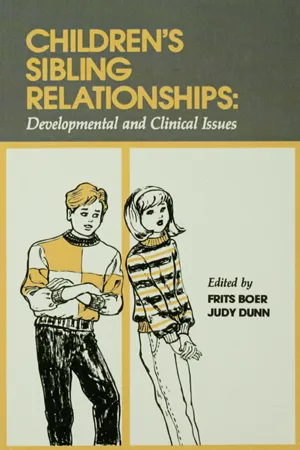
eBook - ePub
Children's Sibling Relationships
Developmental and Clinical Issues
- 384 pages
- English
- ePUB (mobile friendly)
- Available on iOS & Android
eBook - ePub
Children's Sibling Relationships
Developmental and Clinical Issues
About this book
Information
Publisher
Psychology PressYear
2013Print ISBN
9781138876286
9780805811070
Edition
1eBook ISBN
9781134769094
Part I
Developmental Issues
Chapter 1
Sisters and Brothers: Current Issues in Developmental Research
The idea that siblings can play an important role in children’s development has a long history: brothers and sisters appear as significant figures in folk stories and in classical and biblical writing, and they are conspicuous in many biographical and autobiographical accounts of childhood and adolescence. Even though they figure prominently in our cultural stories and accounts of individual development, they have received scant attention from developmental psychologists until relatively recently. Since about the 1980s, the volume of research on siblings by both developmental psychologists and clinicians has grown rapidly, spanning a wide array of developmental issues. In this chapter I consider some of the chief themes in this work: the nature of sibling relationships and how they change with development, individual differences in sibling relationships, the links between sibling relationships and parent–child and peer relationships, sibling relationships and individual adjustment and outcome, and sibling relationships in special populations.
The Nature and Development of Sibling Relationships
Research into the nature of sibling relationships has made especially vigorous progress in two domains, namely, the study of developmental changes in the relationships of young siblings and the study of siblings’ relationships in middle childhood. Before considering these, we should note that there has been much progress on the issue of how we can best measure the relationship of siblings of different ages (e.g., Buhrmester & Furman, 1987; Dunn, Stocker, & Plomin, 1990a), and a new awareness of the importance of obtaining assessments of the relationship from different family members and sources (e.g., Boer, 1990).
How does the relationship between siblings change as children develop greater powers of understanding and communicating with each other? It is clear that, during the early years, there are marked changes in the nature of the relationship. Younger siblings play an increasingly active role in the relationship during the preschool years (Munn & Dunn, 1988), and their older siblings begin to take an increasing interest in them some time between their third and fourth birthday (Brown & Dunn, in press). The nature of collaboration and cooperation with an older sibling change as children reach 4 years old, and these studies also strongly suggest that sibling relationships become more important in children’s sociocognitive development by the time they are 4—and become both effective companions and effective antagonists. Furthermore, children’s efforts become more efficacious as they intervene in mother–sibling interactions, making them more active participants in family life (Dunn & Shatz, 1989).
Particularly exciting is the increased interest in the sibling relationship in middle childhood. We have learned that sibling relationships become more egalitarian during middle childhood, though there is some disagreement about whether the change reflects a decrease in the dominance both siblings attempt to exert (Buhrmester, this volume; Burmester & Furman, 1987) or an increase in the power exerted by younger siblings on their older siblings (Vandell, Minnett, & Santrock, 1987). There is also some inconsistency in the reports on changes in closeness and conflict, with Vandell and her colleagues reporting an increase in positive emotional tone and conflict between 8 and 11 years, and Buhrmester and his colleagues finding little change in intimacy and affection but a decline in companionship between 8 and 17 years. The changes in age depend on whether it is the perceptions of older or younger siblings that are being documented; the argument put forward by Buhrmester, that the changes in warmth during adolescence parallel those found for perceptions of relationships with parents, and are likely to reflect increasing involvement with peers outside the family, is a convincing one.
On the issue of whether there is stability in the development of the way siblings relate to one another over the period when they move into middle childhood and adolescence, we remain in need of more information. In our own studies of children in Cambridge, England, the correlations over a 4-year period (from the preschool to middle childhood periods) were for the positive aspects of the relationship, r(40) = .42 and r(40) = .60, for the younger and older siblings, respectively, and for the negative aspects of the relationship, r(40) = .28 and r(40) = .43. Although these correlations are significant, and we could choose to stress the stability they represent, they are certainly not very high, and it is clear that for many sibling pairs, there are marked changes in their relationships as they progress from preschool to middle childhood. The question of what factors lead to changes in the relationship is clearly of interest, and we consider it in the next section.
Influences on Sibling Differences
For clinicians, parents, and developmental researchers the striking differences between sibling pairs in closeness and hostility are of considerable interest. What factors influence these differences? We know more about what influences hostility and conflict between siblings than what leads to affection and closeness.
First, it is clear that the temperament of both siblings in a dyad is important in relation to the level of conflict between them, with children who are active, intense, or unadaptable in temperament having more conflicted relationships (Boer, 1990; Brody & Stoneman, 1987; Brody, Stoneman, & Burke, 1987; Stocker, Dunn, & Plomin, 1989). The match between the temperament of the two children is also important (Munn & Dunn, 1988).
Second, recent research on the impact of life events on family relationships is providing some useful leads for explaining individual differences in sibling relationships (see, e.g., Jenkins, this volume). Research on divorce, for instance, shows that after divorce the presence of a stepfather is associated with poor sibling relationships (Hetherington, 1988), and that the quality of the spouse–ex-spouse relationships contributes significantly to the quality of the sibling relationship (MacKinnon, 1989). Difficult relations between siblings after divorce are also reported to be more common in dyads with at least one boy (Hetherington, 1988; MacKinnon, 1989). The question of how normative life transitions affect siblings’ relationships is an interesting one, on which we have, as yet, little systematic information; it seems likely, for example, that the transition to secondary school, and indeed school changes more generally, may affect the sibling relationship.
How the gender of the siblings and the age gap between them affect the quality of their relationship is less clear than is the impact of temperament and of divorce. Findings are inconsistent: The recent studies of siblings in middle childhood show, for example, that family constellation effects influence the relationship in complex ways (Buhrmester, this volume; Buhrmester & Furman, 1991). However, in the preschool and early childhood periods, the data reported show few relations with these variables or simply inconsistent results (Dunn, 1988b; Stoneman, Brody, & MacKinnon, 1984; Teti, Bond, & Gibbs, 1986; Teti, Gibbs, & Bond, 1989). Whether there is a developmental pattern, with birth position, gender, and age gap increasing in importance with development remains unknown.
The issue of the extent to which individual differences in sibling dyads’ relationships are linked to differences in other family relationships is currently receiving much attention, especially the question of how the quality of the parent–child relationship is linked to that of the sibling relationship. Before turning to this issue, we should note that there is evidence that the emotional climate of the family, including marital conflict and satisfaction, is linked to the quality of the relationship between siblings (Brody & Stoneman, 1987). As Jenkins (this volume) describes, conflict is more common among siblings from disharmonious homes, but siblings also provide real support for one another in homes with unhappy marriages (Jenkins & Smith, 1990).
Links between Sibling Relationships and Parent–Child Relationships
That parent–child relationships are important influences on the relationships that develop between siblings is an idea that has had wide currency in clinical and developmental writing from Freud onward (Boer et al., this volume). Just how extensive the links between parent–child and sibling relationships in fact are, and what processes might mediate any associations between the two, are issues that are currently the focus of much debate.
One important question is whether the security of children’s attachment to their parents is linked to the quality of their later sibling relationships. The prediction from attachment theory is that children who are insecurely attached to their parents will be more hostile to their siblings, as they “re-enact aspects of the non-nurturant caregiver role” in their interaction with one another (Teti & Ablard, 1989, p. 1520). The notion is that the child’s “internal working model” of relationships, formed within the context of the mother–child relationship, will be carried forward to the sibling relationship. There is some evidence that when both the younger and the older sibling are securely attached to their mother, they are more likely to develop non-antagonistic relationships, whereas when both were insecurely attached, they were less likely to do so (Teti & Ablard, 1989). Still, it is not clear that attachment status, per se, played a causal role in mediating these connections; it is possible that, for example, the children’s temperament might have been causally important, with each child eliciting similar reactions from the other individual in each of their dyadic relationships. Moreover, most aspects of sibling behavior in the Teti and Ablard study did not, in fact, show links to attachment status.
Compatible with the predictions of attachment theory are the findings on links between positive parental care and good sibling relationships in middle childhood, discussed by Boer, Goedhart, and Treffers (this volume). As Boer et al. note, such evidence does not fit with the argument that there is an inverse relation between parent–child and sibling relations, with intense relationships developing in sibling pairs who grow up in families in which parents are uninvolved, the “vacuum of parental care” discussed by Bank (this volume; see also Bank & Kahn, 1982). It is possible that this “compensatory” pattern is to be found chiefly in extreme groups, such as those studied by Bank, rather than in the nonclinical populations, such as those on whom Boer and his colleagues focused.
A second theme in the research on connections between parent–child and sibling relationships concerns differential parental treatment. As Boer et al. (this volume) comment, there is a notable consensus in recent research that maternal differential treatment is associated with more conflicted and hostile sibling relationships (Boer, 1990; Brody & Stoneman, 1987; Brody et al., 1987; Bryant & Crockenberg, 1980; Stocker, Dunn, & Plomin, 1987). These links appear to be especially strong in families under stress: They are reported in studies of siblings following divorce (Hetherington, 1988), in studies of siblings of cancer patients (Cairns, Clark, Smith, & Lansky, 1979), and in research on children whose siblings have disabilities (McHale & Gamble, 1987, 1989; McHale & Harris, this volume). The evidence for links between parental differential treatment and children’s adjustment (discussed further on) suggests that this aspect of family life is of considerable importance in development.
The evidence for such associations is, of course, correlational, and as Boer and colleagues emphasize in their chapter (this volume), we have to be very cautious in making causal inferences about the direction of these links. The issue of causal influence is one that arises, too, in a third theme in the parent–child–sibling research, namely, the role of parental involvement in sibling conflict. It is usually assumed that parental involvement in such conflict increases the conflict because—it is presumed—children quarrel with their siblings to gain parental attention (Dreikurs, 1964), and because if parents intervene, their children do not have the opportunity to learn how to resolve conflict themselves (Brody & Stoneman, 1987). Schachter and Stone (1987) have argued that in extreme cases, the deprivation of opportunities to practice conflict resolution can lead to serious pathological consequences, in which individuals become bullying, anti-social, and self-seeking. We have two kinds of evidence related to this matter. First, correlational studies show that the frequency of sibling conflict is indeed related to the frequency of parental intervention in such conflict (Brody & Stoneman, 1987; Brody et al., 1987; Dunn & Munn, 1986a), but it is not clear that parents’ involvement led to the frequent conflict in these data: It could well be that parents become involved in sibling quarrels when they are intense and frequent, as a result of the conflict. To answer these questions about direction of effects the second source of evidence, intervention studies, is of particular importance. However, to date such studies have been small in scale, and present some methodological problems (see Brody & Stoneman, 1983). In my view, the issue of how much parent intervention per se increases sibling conflict remains unresolved; further research that examines the impact of different kinds of parental intervention is required.
A fourth theme in the parent-sibling research concerns the effects of the birth of a sibling. The birth of a sibling is accompanied by sharp changes in the parent–child relationship, and these changes are linked to the quality of the relationship that develops between the siblings (Dunn & Kendcick, 1982). These links might be seen as one aspect of a more general increase in problems following the sibling’s birth, associated with changes in parent–child interaction; a number of studies have now replicated and extended the studies of the early 1980s documenting the increase in such problems (discussed further on). The issue of what other kinds of process might mediate the connections between the relationships is considered next.
In summary, a number of general theoretical issues concerning the mechanisms linking the parent–child and sibling relationships, then, are raised by the research just outlined. The first is that there are a range of processes of very different sorts implicated in the connecti...
Table of contents
- Cover
- Half Title
- Title Page
- Copyright
- Contents
- Acknowledgments
- Foreword
- Introduction
- Part I: Developmental Issues
- Part II: Clinical Issues
- Epilogue
- Author Index
- Subject Index
Trusted by 375,005 students
Access to over 1.5 million titles for a fair monthly price.
Study more efficiently using our study tools.
Frequently asked questions
Yes, you can cancel anytime from the Subscription tab in your account settings on the Perlego website. Your subscription will stay active until the end of your current billing period. Learn how to cancel your subscription
No, books cannot be downloaded as external files, such as PDFs, for use outside of Perlego. However, you can download books within the Perlego app for offline reading on mobile or tablet. Learn how to download books offline
Perlego offers two plans: Essential and Complete
- Essential is ideal for learners and professionals who enjoy exploring a wide range of subjects. Access the Essential Library with 800,000+ trusted titles and best-sellers across business, personal growth, and the humanities. Includes unlimited reading time and Standard Read Aloud voice.
- Complete: Perfect for advanced learners and researchers needing full, unrestricted access. Unlock 1.5M+ books across hundreds of subjects, including academic and specialized titles. The Complete Plan also includes advanced features like Premium Read Aloud and Research Assistant.
We are an online textbook subscription service, where you can get access to an entire online library for less than the price of a single book per month. With over 1.5 million books across 990+ topics, we’ve got you covered! Learn about our mission
Look out for the read-aloud symbol on your next book to see if you can listen to it. The read-aloud tool reads text aloud for you, highlighting the text as it is being read. You can pause it, speed it up and slow it down. Learn more about Read Aloud
Yes! You can use the Perlego app on both iOS and Android devices to read anytime, anywhere — even offline. Perfect for commutes or when you’re on the go.
Please note we cannot support devices running on iOS 13 and Android 7 or earlier. Learn more about using the app
Please note we cannot support devices running on iOS 13 and Android 7 or earlier. Learn more about using the app
Yes, you can access Children's Sibling Relationships by Frits Boer,Judy Dunn,Judith F. Dunn in PDF and/or ePUB format, as well as other popular books in Psychology & Developmental Psychology. We have over 1.5 million books available in our catalogue for you to explore.