eBook - ePub
Secure and Tranquil Travel
- 238 pages
- English
- ePUB (mobile friendly)
- Available on iOS & Android
eBook - ePub
Secure and Tranquil Travel
About this book
Herein lie the answers to crime and disorder. So many people become dispirited, fatalistic or angry about crime instead of seeing crime problems, like business setbacks, as challenges or even opportunities. This book sets out a clear, systematic and demonstrably successful strategy for reducing the temptations and opportunities for crime. You cannot change the travelling public or the communities which public transport serves, but you can change the immediate circumstances and surroundings that you present to people, you can re-think and reinvigorate your service offering, you can recruit help from other agencies, from staff and even those who ride the system, and you can make the transition from being reactive to being ahead of the game. The theory is backed up by concrete examples of how and why and where smart-thinking has worked before to outflank crime-this is not just off-the-shelf self-help philosophy but a compendium of real-world best practice. What's more, you can often make money, or at least save a lot of money, by doing the right thing, and this book tells you how. Nick Ross,BBC Crimewatch UK, Chairman, UCL Jill Dando Institute of Crime Science Advisory Board
Information
| Introduction: Crime and Disorder on Public Transport | 1 |
This chapter begins with a brief description of rail, underground and bus systems in Great Britain. It goes on to review statistical and other information about crime, disorder and fear on public transport systems, the impact of these problems on the service provided by public transport, and the broader impact on local communities. It then discusses the theory and practice of preventing transport crimes, looks at some illustrative cases, and describes design guidelines proposed for a range of transport settings. Finally, it outlines the contents of the rest of the volume.
Public Transport in Great Britain
The term public transport covers a wide range and type of services – some longstanding, some more recent, and others still at the experimental or conceptual stage. For convenience, the field can be divided into two broad groupings: traditional transport and light rapid transit. Traditional transport covers ‘heavy rail’ systems, such as overground and underground trains, and road-based ones, such as bus and coach services, older urban tramways, and trolleybuses.1 Light rapid transit refers to more recent rail and road-based public transport systems.
In relation to heavy rail, the National Rail network in Great Britain provides Inter-City, regional and local services, with the latter including suburban rail services in metropolitan areas. Since the privatisation of British Rail in stages between 1994 and 1997, these services have been provided by a number of Train Operating Companies (TOCs) under franchise agreements with the Strategic Rail Authority (SRA).2 Each company manages its rail services and the majority of stations it uses. The interests of railway operators are represented by their trade association, the Association of Train Operating Companies (ATOC). Network Rail (formerly Railtrack) is responsible for the national rail network’s infrastructure (track and lineside), and for the management of the principal mainline stations. In addition, the railway industry owns and funds the Rail Safety and Standards Board (RSSB) which leads the industry’s efforts to improve the health and safety performance of the railways. Until recently, the Health and Safety Executive (HSE), within which H.M. Railway Inspectorate was located, had responsibilities for railway safety regulation. Under the provisions of the Railways Act 2005 these responsibilities (and the Inspectorate itself) are being transferred to the newly established Office of Rail Regulation, which will combine the roles of safety and economic regulator.
Underground railway systems operate in London and Glasgow. London Underground Limited (LUL) has been managed since 2003 by Transport for London (TfL), the body responsible for most of the capital’s transport services.3 The other traditional underground system, the Glasgow Subway, is run by the Strathclyde Passenger Transport Executive (PTE).
In contrast to traditional ‘heavy rail’ public transport, new rail-based light rapid transit systems have recently emerged as alternative ways to serve transport needs within metropolitan areas in Great Britain.4 Private operators manage the majority of these light rapid transit systems. A number of systems, such as the Manchester Metrolink, share stations with rail franchise holders. There are two rail-based light rapid transit systems in London: the Croydon Tramlink and the Docklands Light Railway (DLR). Although these systems are operated privately, they are both the responsibility of TfL. Outside London there are five major light rapid transit systems, all of which – apart from the Tyne and Wear Metro – are tramway systems. At the end of 2004 a new National Tramways Forum, ‘UKTram’ was established to address problems involved in the development of light rail and tramway systems.5
As far as traditional road-based public transport is concerned, commercial bus companies currently run most local bus services in Great Britain. The Confederation of Passenger Transport (CPT) is the trade association for the bus, coach and light rail industries and represents their interests. In terms of the number of passenger journeys made, local buses are by far the dominant public transport modality in Great Britain – although, as observers of the public transport industry have remarked, they attract much less media attention.6 Local buses outside London were deregulated in 1986 and the privatisation of public-sector bus operations also commenced in that year. In London, full deregulation did not take place. Instead a competitive tendering regime was introduced, and the vast majority of local bus services currently operating are private-sector operations under contract to Transport for London. Bus stations, interchanges, bus stops and bus shelters in metropolitan areas are the responsibility of the Passenger Transport Authorities (PTAs) and PTEs. In non-metropolitan areas the local authority is responsible for the bus infrastructure. In some cases a private company oversees the provision and maintenance of bus shelters.
Although light rapid transit systems are often viewed as synonymous with rail-based ones – whether light railway or tramway – attempts are being made to bring some of the benefits of such systems to road-based public transport. Developments include the downsizing of buses to provide lighter, more agile fleets with greater suburban penetration, the introduction of more modern vehicle designs, the use of bus priority arrangements and segregated busways, the introduction of guided buses,7 and efforts to reintroduce various forms of trolleybus.8
The British Transport Police (BTP), under the supervision since 2004 of its own police authority,9 is the responsible police force for the railways in England, Wales and Scotland, and the railway companies fund a proportion of the Force’s costs. Their remit also includes the London Underground, with which the BTP have been running a Crime and Disorder Partnership since 2000, and the Docklands Light Railway, the Midland Metro Tram System and the Croydon Tramlink. Some rail systems and the bus networks are policed by the local Home Office police force in their area.10 Our discussion of crime and disorder problems and measures to prevent or reduce them has been largely confined to the UK scene – although we have referred to international studies where relevant. This is consistent with our focus on the problem-solving process and on situational crime prevention – both of which are by nature crime-and location-specific activities.
Crime and Disorder on Public Transport
Public transport is vital to preserving energy resources and to minimising pollution in urban areas. It is fundamental to the economic wellbeing of an area and provides access for residents to essential services. For the poorest, their only choice may be between using public transport and not travelling at all. In such circumstances, concerns about crime and disorder may provide a significant barrier to social inclusion.11
Crime and disorder on public transport systems can also have serious consequences for the operations of the systems. If people become afraid to travel because of crime, patronage will fall. This will result in reduced revenues, which may result in cut-backs in staff and services. The vicious spiral that develops will harm not only the transport systems but also the communities that depend upon them.
Many crime and disorder problems occurring in the wider community also occur in the public transport environment. However, the public transport environment is particularly conducive to certain problems, such as pickpocketing, indecent assaults, robbery and vandalism. Two features of this environment contribute to the heightened risks of these crimes.
- Overcrowding during peak periods makes thefts and indecent assaults (e.g. groping) easier to commit.
- Lack of supervision from staff at other times of the day or night contributes to vandalism and graffiti, robbery of staff and passengers, assaults on staff and passengers, persons being pushed under trains, fare evasion and staff theft of fares.
Lack of perimeter security often means that segregated transport environments, such as the railways, face additional problems in relation to trespass, damage to infrastructure and other line-of-route offences.
Numerous surveys have found that passengers fall victim to a wide range of crimes while using public transport. A 1996 household survey carried out in England by Crime Concern and Transport and Travel Research (1997) provides some baseline information about passengers’ experiences of victimisation (see Figure 1.1).
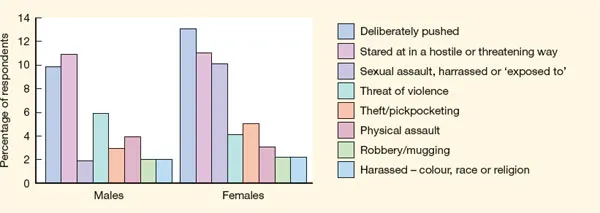
Figure 1.1 Percentage of household survey respondents reporting personal experience of certain types of incidents on public transport (Source: adapted from Crime Concern and Transport and Travel Research, 1997)
The differences in types of incidents reported and rates of reporting that were observed between males and females in the 1996 survey probably reflect both the different experiences of males and females on public transport and the different characteristics of the respondents, with females more likely to recall and report some types of incidents. When the survey was repeated in 2002,12 broadly similar results were found for pushing and staring, but some reported incident rates had become appreciably higher, especially for men. Ethnic minority respondents to the 20...
Table of contents
- Cover
- Half Title
- Title Page
- Copyright
- Contents
- Acknowledgements
- Contributors
- Foreword
- 1. Introduction – crime and disorder on public transport
- 2. Understanding local transport crime problems
- 3. Anti-social behaviour
- 4. Crimes against passengers – theft, robbery, assault and indecent assault
- 5. Crimes against employees – assault and robbery
- 6. Vandalism and graffiti
- 7. Line-of-route crimes
- 8. Concluding remarks
- Appendix 1: Acronyms and abbreviations used in this manual
- Appendix 2: Local data sources for crime, disorder and fear on public transport
- Appendix 3: Funding sources and award schemes
- References
- Index
Trusted by 375,005 students
Access to over 1.5 million titles for a fair monthly price.
Study more efficiently using our study tools.
Frequently asked questions
Yes, you can cancel anytime from the Subscription tab in your account settings on the Perlego website. Your subscription will stay active until the end of your current billing period. Learn how to cancel your subscription
No, books cannot be downloaded as external files, such as PDFs, for use outside of Perlego. However, you can download books within the Perlego app for offline reading on mobile or tablet. Learn how to download books offline
Perlego offers two plans: Essential and Complete
- Essential is ideal for learners and professionals who enjoy exploring a wide range of subjects. Access the Essential Library with 800,000+ trusted titles and best-sellers across business, personal growth, and the humanities. Includes unlimited reading time and Standard Read Aloud voice.
- Complete: Perfect for advanced learners and researchers needing full, unrestricted access. Unlock 1.5M+ books across hundreds of subjects, including academic and specialized titles. The Complete Plan also includes advanced features like Premium Read Aloud and Research Assistant.
We are an online textbook subscription service, where you can get access to an entire online library for less than the price of a single book per month. With over 1.5 million books across 990+ topics, we’ve got you covered! Learn about our mission
Look out for the read-aloud symbol on your next book to see if you can listen to it. The read-aloud tool reads text aloud for you, highlighting the text as it is being read. You can pause it, speed it up and slow it down. Learn more about Read Aloud
Yes! You can use the Perlego app on both iOS and Android devices to read anytime, anywhere — even offline. Perfect for commutes or when you’re on the go.
Please note we cannot support devices running on iOS 13 and Android 7 or earlier. Learn more about using the app
Please note we cannot support devices running on iOS 13 and Android 7 or earlier. Learn more about using the app
Yes, you can access Secure and Tranquil Travel by Martha J. Smith, Derek B. Cornish, Martha J. Smith,Derek B. Cornish in PDF and/or ePUB format, as well as other popular books in Scienze sociali & Criminologia. We have over 1.5 million books available in our catalogue for you to explore.