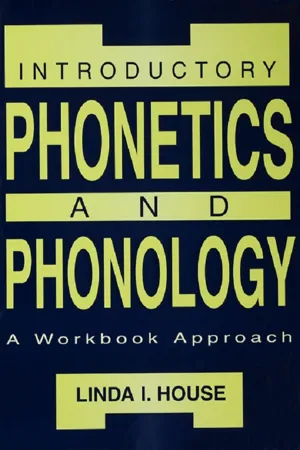
Success in mastering any language requires knowledge in speaking, reading, and writing the language. The speaking component requires the understanding and use of correct pronunciation, emphasis, and syntactic patterns. The written component requires mastery of the alphabet, spelling, and the ability to write, print, or type the pattern. Very early in the learning process, speakers of the English language become keenly aware of the language's lack of sound to symbol correspondence. To help speech/language researchers, media personnel, individuals learning English as a second language, and others interested in correct pronunciation, the International Phonetic Alphabet (IPA) was devised.
Extensively class tested, this book offers a practical understanding approach to phonetics and the IPA in a workbook format. It will be welcomed by professionals, students, and trainees in the fields of communication science, communication disorders, speech pathology, and linguistics.
- 312 pages
- English
- ePUB (mobile friendly)
- Available on iOS & Android
eBook - ePub
About this book
Information
Topic
EducationSubtopic
Inclusive EducationPart I
Understanding Phonetics and Phonology
Chapter 1
The Basis of Phonetics and Phonology
Success in mastering any language requires knowledge in speaking, reading, and writing the language. The speaking component requires the understanding and use of correct pronunciation, emphasis, and syntactic patterns. The written component requires mastery of the alphabet, spelling, and the ability to write, print, or type the pattern.
Very early in the learning process, English-language speakers become keenly aware of the language’s lack of sound to symbol correspondence. Any young child studying the alphabet can point out that cat starts with the letter c that sounds like a /k/ and the word race ends in the letters ce but sounds like an /s/.
In order to help speech/language pathologists, linguists, media personnel, individuals learning English as a second language (ESL) and others interested in correct pronunciation the International Phonetic Alphabet (IPA) was devised.
International Phonetic Alphabet
In 1886, a group of phoneticians from France, Germany, Britain, and Denmark met to discuss the adoption of a universal system of pronunciation. The IPA based on an alphabet written by British phonetician Henry Sweet, represented the first successful attempt to systemize the pronunciation of speech sounds across most languages.
The IPA provides the user with a universally accepted symbol for each of the speech sounds. The IPA is phonetic, not phonemic in design. In other words, a particular symbol is used to represent the pronunciation of a speech sound, not to delineate a change in meaning. Linguistically significant, the IPA symbols summarize present linguistic theory. The IPA has been revised several times over the past century, the most recent changes taking place in 1996.
The International Phonetic Association, the agency governing the IPA, has a system of detailed principles applied to the formation and variation of the alphabet. In its present form, the IPA provides detailed information on vowels, consonants, other additional symbols, diacritics and suprasegmentals. (See Fig. 1.1 for a copy of the IPA.)
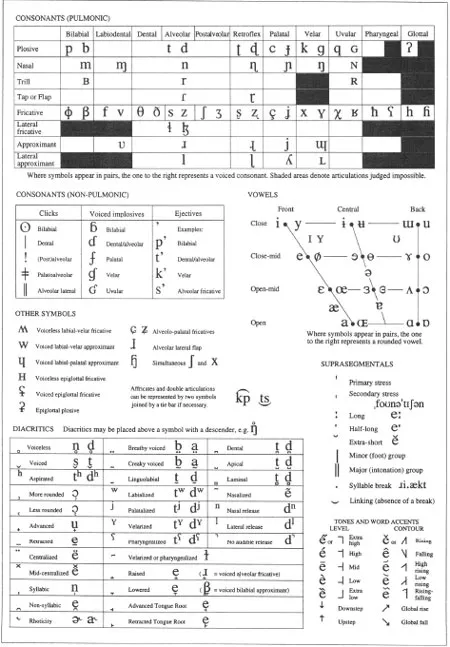
Fig. 1.1. The IPA (revised to 1993, corrected 1996).
Basic Terminology
Allophone: The individual variation of the phoneme caused by such factors as position in the word, anatomical structure, and surrounding allophones. Allophones are nondistinctive variations of a phoneme. The use of an allophone does not change the meaning of a word.
Bisyllabic word: A word having two syllables.
Broad transcription: A general type of transcription using phonemes that appear in the vowel and consonant sections of the IPA. This type of t...
Table of contents
- Cover Page
- Half Title page
- Title Page
- Copyright Page
- Dedication
- Contents
- Preface
- Part I Understanding Phonetics and Phonology
- Part II Stress and Theory
- Appendix A Background of the English Language
- Appendix B Old English (ErƷlisć)
- Appendix C Middle English (Englysshe)
- Appendix D The Modern Period
- Appendix E Alphabets, Writing, Spelling, and Dictionaries Throughout the Years
- Appendix F Loanwords
- References
- Index
Trusted by 375,005 students
Access to over 1.5 million titles for a fair monthly price.
Study more efficiently using our study tools.
Frequently asked questions
Yes, you can cancel anytime from the Subscription tab in your account settings on the Perlego website. Your subscription will stay active until the end of your current billing period. Learn how to cancel your subscription
No, books cannot be downloaded as external files, such as PDFs, for use outside of Perlego. However, you can download books within the Perlego app for offline reading on mobile or tablet. Learn how to download books offline
Perlego offers two plans: Essential and Complete
- Essential is ideal for learners and professionals who enjoy exploring a wide range of subjects. Access the Essential Library with 800,000+ trusted titles and best-sellers across business, personal growth, and the humanities. Includes unlimited reading time and Standard Read Aloud voice.
- Complete: Perfect for advanced learners and researchers needing full, unrestricted access. Unlock 1.5M+ books across hundreds of subjects, including academic and specialized titles. The Complete Plan also includes advanced features like Premium Read Aloud and Research Assistant.
We are an online textbook subscription service, where you can get access to an entire online library for less than the price of a single book per month. With over 1.5 million books across 990+ topics, we’ve got you covered! Learn about our mission
Look out for the read-aloud symbol on your next book to see if you can listen to it. The read-aloud tool reads text aloud for you, highlighting the text as it is being read. You can pause it, speed it up and slow it down. Learn more about Read Aloud
Yes! You can use the Perlego app on both iOS and Android devices to read anytime, anywhere — even offline. Perfect for commutes or when you’re on the go.
Please note we cannot support devices running on iOS 13 and Android 7 or earlier. Learn more about using the app
Please note we cannot support devices running on iOS 13 and Android 7 or earlier. Learn more about using the app
Yes, you can access Introductory Phonetics and Phonology by Linda I. House in PDF and/or ePUB format, as well as other popular books in Education & Inclusive Education. We have over 1.5 million books available in our catalogue for you to explore.