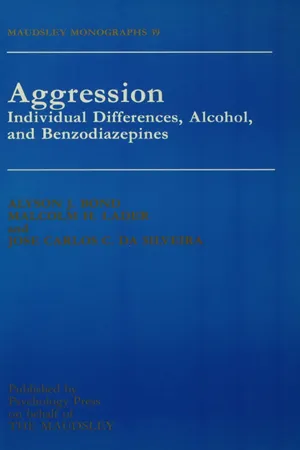
eBook - ePub
Aggression
Individual Differences, Alcohol And Benzodiazepines
- 168 pages
- English
- ePUB (mobile friendly)
- Available on iOS & Android
eBook - ePub
Aggression
Individual Differences, Alcohol And Benzodiazepines
About this book
The incidence of aggression and violence is of wide concern. It is therefore vital that we try to understand the mechanisms involved. This book outlines definitions and theories of aggressive behaviour and points out the contribution of both biological and psychological factors. Aggression primarily occurs within an interpersonal exchange and is often accompanied by increased arousal and negative feelings. It is most likely to occur in response to provocation but individuals differ in what they consider constitutes provocation. Aggressive behaviour is both multicausal and multifaceted but in order to study it, we have to break it down into components and find ways in which to measure these.
This book describes a body of research examining the conditions under which the behavioural, affective and physiological components of aggression are elicited. A specific experimental technique which measures behavioural aggression in the laboratory is described. The task was found to be sensitive to individual differences in aggressive disposition. Aggression is not, however, confined to a small group of extremely hostile individuals. Alcohol or substance abuse is often associated with aggression in the general population. The results of some studies examining the effects of alcohol and benzodiazepines on the feelings and behaviour of healthy volunteers are reported. The way in which people appraise a situation influences the way they feel and behave. These drugs, therefore, impair the ability to process socially relevant information which, in turn, lowers the threshold at which aggressive behaviour is likely to occur. It is only by continuing to study the complex interaction between pharmacological and psychological factors that we will gain more insight into the processes underlying aggressive behaviour.
Information
Publisher
Psychology PressYear
2013Print ISBN
9781138884489
9780863774829
Edition
1eBook ISBN
9781134836857
CHAPTER ONE
The psychology of aggression
In this chapter, definitions and theories of aggressive behaviour are discussed. Several factors are important in aggressive behaviour and these are discussed under three broad headings: interpersonal factors, external factors, and individual differences.
TERMINOLOGY
Aggression is a word that in ordinary language encompasses a wide range of behaviours. However, these sometimes diverse behaviours seem to have a common thread and the aim of a psychological definition is to explain this. There have been many definitions of aggression. For example, Harre and Lamb (1983, p.13) catalogued more than 250. These various definitions seem to share the idea that aggression involves inflicting harm or damage but beyond this, there are a number of differences. For example, does the damage have to be inflicted on a living creature or does damage to objects or property also count as aggression? Does the damage have to be physical as argued by Zillman (1978) or does psychological harm such as saying something hurtful or damaging someone's reputation also constitute an aggressive act? Given that these distinctions may be important, one solution is to define aggression broadly but then describe different types of aggression. This approach has been taken by Buss (1961) who said aggression could be physical or verbal, active or passive, direct or indirect. Combining these factors yields eight types of aggression altogether.
Another issue, perhaps less easily resolved, concerns whether the damage or harm must be inflicted intentionally for the act to be considered aggressive. On the one hand it seems desirable to exclude inflicting harm accidentally, e.g. accidentally hitting someone with an object or saying something tactless without thinking. On the other hand, intentions cannot be observed and it may cause problems to use a definition that rests on unobservable behaviour. This was the view of Buss (1961) and Bandura (1973) whose definitions ignore the intentions that may lie behind the "response that delivers noxious stimuli to another organism". Despite these difficulties, many authors have included intention in their definitions of aggression. For example, Dollard, Doob, Miller, Mowrer, and Sears (1939) defined aggression as "an act whose goal-response is injury to an organism". Berkowitz (1974) also argues that intention is crucial. This was taken up by Geen (1976) whose working definition can be summarised in three points: (1) "Aggression consists of the delivery of noxious stimuli by one organism to another"; (2) "The stimuli are delivered by the former with the intent to harm the latter"; (3) "The one delivering the stimuli expects that the probability of the stimuli reaching the source is greater than zero". Note that this definition does not specify any particular emotional state, such as anger, or any particular attitude towards the victim, such as dislike or hostility. It does specify intention to harm but this should not be taken to exclude other intentions or motives.
This definition then implies that aggression is a form of social interaction in which the perpetrator intends to harm the victim in some way. Baron (1977) also proposes that the victim must be motivated to avoid such treatment in order to exclude sado-masochistic behaviour. Aggressive behaviour may also be classified into subtypes.
AFFECTIVE AND INSTRUMENTAL AGGRESSION
Behaviours characterised as aggressive may have different antecedents and intervening processes. Thus, aggressive behaviours are different from each other with respect to what motivates them, although they may be accommodated heuristically under the terms of affective or hostile and instrumental (cf. Baron, 1977). "Affective" aggression is that accompanied by a strong negative emotional state (see Table 1.1). In this case an intervening process—anger—instigates and guides the aggressive behaviour of which the main goal is injury or harm to the provocateur (Feshbach, 1964). Johansson (1981) lists its main characteristics: activation of the hypothalamus, increased blood flow to the musculature, heightened blood pressure and pulse rate, pupillary dilatation and decreased flow of blood to the viscera. Anger is inferred as a necessary but not sufficient condition—its presence does not inevitably produce affective aggression. However, the closeness between anger and the actual aggressive behaviour sometimes reinforces the idea of a cause-effect relationship.
TABLE 1.1
Characteristics of different types of aggression
Characteristics of different types of aggression
| Affective | Instrumental |
| Hostile | Goal-directed |
| Primary intent to harm | Coercive power |
| Strong negative emotional state | Military |
| Provoked | Obedience to authority |
| Annoyance-motivated | Incentive-motivated |
| Reactive | Proactive |
Another type of aggression has been dubbed by Tedeschi (1984) "instrumental", and is related to behaviour whose main goal is not intent to harm but to establish social and coercive power over others through aggressive means. In this case, an aggressive option has been judged as most likely to be successful in achieving a favourable outcome to a conflict of interests. This form of aggression may occur when people defend property or rights and is found in war and social conflicts: Following a command from a person in authority some peaceful individuals are capable of committing extreme acts of violence (Milgram, 1963). Bandura (1973) argues that both affective and instrumental aggression are directed towards the attainment of specific goals and are therefore instrumental. As a result of this, other terms have been coined (see Table 1.1). Zillmann (1979) refers to annoyance-motivated and incentive-motivated. Dodge and Coie (1987) have proposed the terms reactive and proactive. Reactive aggression concerns retaliation to a perceived threat, whereas proactive aggression is used to obtain some other goal, e.g. dominance. However, an aggressive act often has elements of both types.
THEORETICAL PERSPECTIVES
Having defined aggressive behaviour, we now need to consider the reasons why it occurs. Many theoretical perspectives exist but Baron and Richardson (1994) divide them into four categories, which we will briefly discuss.
Aggression as an instinct
According to the theories of instinctive aggression, aggression occurs because humans are genetically programmed for such behaviour. These theories have generally arisen from animal work and assume that aggression provided biological advantages to our prehistoric ancestors. Lorenz (1966) proposed an evolutionary perspective. He suggested that the aggressive instinct is a source of energy that builds up over time and needs to be discharged. The greater the amount of energy accumulated, the weaker the stimulus necessary for overt aggression to occur. Freud (1920) also proposed that aggression stemmed from an innate, self-directed death instinct (thanatos) that is turned outward towards destruction of others. Both these theories regarded aggression as inevitable: The energy would build up until it could be released in some way either to attain the original goal or in some form of displacement activity. Lorenz believed that aggressive energy could be dispersed by many minor hostile but noninjurious acts, thus decreasing the likelihood of violent outbursts. According to instinctive theories, aggression is an unavoidable, integral part of human nature.
Aggression as a drive
The theories of aggression as a drive assume that it is a motivational force induced by some kind of deprivation to terminate or reduce that state. This perspective was elaborated by Dollard et al. (1939) in the frustration—aggression hypothesis: "aggression is always a consequence of frustration and, contrariwise, that the existence of frustration always leads to some form of aggression". Frustration, i.e. the blocking of some form of goal-directed behaviour, induces an aggressive drive, which facilitates aggressive behaviour. This theory initially gained widespread support but it eventually faltered on the certainty of both premises. First, the tenet that frustration always leads to aggression has been challenged by many empirical studies showing that frustration may lead to numerous alternative responses, e.g. despair. Thus, Miller (1941) refined the model to include other possible forms of behaviour. Second, there is much evidence that aggression may occur as a result of factors other than frustration. Indeed, frustration does not seem necessary for instrumental aggression such as self-defence.
Berkowitz (1974) further modified the drive theory to include contextual cues. He still accepted frustration as an important antecedent for aggressive behaviour but stressed the role of mediating factors in the environment. He therefore postulated that frustration led to negative affect or anger but this only led to aggression in the presence of aggressive cues. Both people and objects may become aggressive cues by previous association with anger arousal.
Cognitive models
The instinctive and drive theories of aggression ignore both emotion and cognition. Newer theories have attempted to revise the frustration theory to include these important elements. Thus, Berkowitz (1989) revised his earlier theory to state that frustration or other aversive stimuli (external factors) instigate aggressive reactions by creating negative affect. The response would then be determined by the individual's interpretation of the negative affect. If it was interpreted as anger, then aggressive tendencies would be likely to be aroused and more attention might be paid to aggressive cues. This was termed the "cognitive neoassociation model".
Zillman (1988) argued that cognition and excitation (arousal) are truly interdependent. Under very high levels of excitation, there may be interference with the cognitive processes that inhibit aggression, leading to impulsive aggression. At moderate levels of excitation, cognitive processes would operate to reduce aggression. In the same way, in a normal state of arousal, cognitions about an event are likely to influence the extent of arousal. If mitigating circumstances are recognised, there is likely to be a decay of any excitation. According to cognitive theories, people might be able to reduce aggressive behaviour by learning new ways of coping with provocation.
Social learning models
In contrast to aggression perceived as an instinct or a drive, Bandura (1977) has postulated that aggressive behaviour is acquired and maintained in a similar way to other forms of social behaviour. He does not discount biological or motivational factors, but postulates that the specific form, frequency, location, and target of aggressive behaviour are largely determined by social learning. Thus, reinforcing or rewarding aggressive behaviour increases the likelihood of repetition. Although direct experience may be important, work on children has shown observation and imitation (modelling) to be very influential. Bandura has suggested that there are three principal sources of aggressive models: the family, the subculture, and the mass media. If we observe aggressive behaviour being rewarded and we identify with the aggressor, we are more likely to use it ourselves. We may in fact learn new (aggressive) ways of responding. This behaviour can, however, be modified by self-imposed consequences. Thus, habitually aggressive people may reward themselves for successful intimidation of others, whereas people who disapprove of aggressive behaviour may experience guilt if they behave in the same way. Social learning theory then suggests that aggression only occurs under appropriate social conditions and we can change these conditions to reduce it.
INTERPERSONAL FACTORS IN AGGRESSION
Aggressive behaviour occurs within an interactive situation. Several possible behaviours may occur in an interpersonal exchange and therefore much research has been devoted to examining the conditions that facilitate an aggressive response. These studies have focused on frustration, provocation, attack, and instigation from others.
Frustration
Frustration, defined as the thwarting by one individual of another's goal-directed behaviour, has been assumed to be a strong elicitor of aggressive behaviour since the original hypothesis (Dollard et al., 1939). A large number of experiments seem at first to confirm that frustration is indeed an important antecedent of aggression. However, Baron and Richardson (1994) have pointed out that frustration has often been confounded by other factors in these early investigations. Studies that have carefully isolated different antecedents do confirm that frustration is one important factor in the induction of aggression (Berkowitz & Geen, 1967; Burnstein & Worchel, 1962). In one study it was shown that both frustration and personal insult increased aggression (Geen, 1968). Moreover, frustration did not need to be a result of the actions of others. Subjects who became frustrated through their own inability to accomplish a task also showed more aggression.
Other studies have found that frustration does not necessarily lead to an aggressive response (Buss, 1966; Kuhn, Madsen, & Becker, 1967). In these studies no differences were found between the frustrated and control groups. Together these studies cast some doubts on the early formulations that frustration is always a cause for aggression. Perhaps even more surprising than these results, however, is the suggestion in several additional experiments (Gentry, 1970; Rule & Hewitt, 1971) that exposure to strong frustration may sometimes serve to reduce rather than enhance later aggression. Frustration may elicit behaviours other than aggressive ones that attenuate the connection between frustration and aggression (cf. Buss, 1961). Barker, Dembo, and Lewin (1941, cf. Buss, 1961) contend that frustration may also produce useless, maladaptive, or regressive behaviour. Mandler (1972) argues that helplessness and anxiety, not aggression, may follow as a consequence of a person's response to feeling frustrated. Thus, the sequence of behaviours would depend on the subject's understanding of the responses that are available.
The current position seems to be that frustration sometimes facilitates aggression depending on certain factors. Baron and Richardson (1994) cite four important mediating factors: the magnitude; the presence of aggressive cues; the extent to which it is arbitrary or unexpected; and the emotional and cognitive processes of the frustrated individual. Frustration can be increased by intervening when the subject is close to his or her goal, by blocking expectation of success, and by making the subject's reasons for the action less legitimate (Harris, 1974; Kulick & Brown, 1979). Berkowitz (1989) has argued that frustration only produces a readiness for aggressive behaviour. The occurrence will depend on the presence of aggressive cues, i.e. stimuli associated with anger arousal. Such cues may be heightened by viewing violent films. Frustration that can be predicted or expected rarely produces aggression. However, if it is seen to be arbitrary or unjustified, it is more likely to result in aggressive behaviour. As well as aggressive cues, Berkowitz (1989) has emphasised the current feelings of the individual. Interpersonal or external factors that lead to negative affect or irritation increase the likelihood of aggressive behaviour.
In his reformulation of the relationship between frustration and aggression, Berkowitz (1989) discerns an associative network between negative affects, frustration, and aggression. In his model, the intensity and arbitrariness of the frustration leads to negative affect, and then aggressive cues may intensify the instigation to aggress. Attributions and judgements may facilitate or inhibit this process.
Provocation and attack
Attack is the key instigator to retaliatory aggression. Interpersonal aggression takes place in an interactive situation between two people. Therefore Bandura (1973, p.153) suggests that "if one wished to provoke aggression, the most dependable way to do so would be simply to physically assault another person, who would then be likely to oblige with a vigorous counterattack". Many studies support this idea. Persons who have been insulted or physically attacked are likely to respond with verbal abuse (James & Mosher, 1967), or with physical counterattack (Baron, 1972; Berkowitz, 1974). Moreover, the intensity of aggression depends on the intensity of the initiating attack (Epstein & Taylor, 1967; O'Leary & Dengerink, 1973). Verbal provocation can often lead on to aggressive actions. In research examining police reports of criminal violence, Felson (1982, 1984) found a typical pattern to start with an insult leading to verbal retaliation, escalating to an argument, threats, and finally physical assault. This work emphasises the interactive nature of aggression. Several investigators have compared frustration (blocking of ongoing behaviour) with attack (delivery of noxious stimulus) as antecedents of aggression (e.g. Buss, 1963; Geen, 1968; Geen & Berkowitz, 1967). They conclude that attack is a more effective manoeuvre in eliciting aggression. Diamond et al. (1984) have also shown that attack is a more powerful source of arousal than is frustration. Baron (1977), however, argues that although frustration seems to be a weaker stimulus for aggression than either physical or verbal attack, comparable outcomes between the two variables have sometimes been misleading due to the ignorance of the subjective effects of each on the individual. The relevant question is whether or not a mild insult would always be more effective in eliciting subsequent aggression than extremely strong frustration. Somewhat more unexpected, however, is evidence that individuals often react aggressively to indications of aggressive intention on the part of others, even when they are not actually attacked by these persons. Greenwell and Dengerink (1973) found experimentally that although attack is an important instigator of aggressive behaviour, symbolic elements that are incorporated in that attack may play a major role.
These results have received support from many other empirical studies. Epstein and Taylor (1967) also showed that intent to harm is in fact a more powerful determinant of retaliation than is the absolute intensity of an attack. Dodge, Murphy, and Buchsbaum (1984) showed that subjects tend to be more aggressive when they perceive a hostile intention in the other party, whether or not the person is actually hostile. The absence of malice or lack of intention in the attacker constrains victims not to retaliate (Johnson & Rule, 1986; Zillmann & Cantor, 1976). The role of perceived intentionality in aggression also seems to be influenced by personality characteristics (Dodge, 1980). Attribution of hostile intent by aggressive boys, even in ambiguous circumstances, has been explained by Nasby, Hayden, and DePaulo (1979) as a consequence of a hostile attributional bias resulting from a generally aggressive disposition.
A factor related to the relationship between attack and aggression is that of apology. Schwartz, Kane, Joseph, and Tedeschi (1978) and Darby and Schlenker (1982) studied the belief that apologies can mitigate a victim's anger and aggression. These authors found that the subjects tended to judge the transgressors as less liable to punishment if they made apologies. Schlenker and Darby (1981) suggested that people tend to use a more complex apology involving a larger number of components as the harm gets more serious. When the harm is severe, they argue, more intense apologies may be needed to alleviate the conditions of the victims. It seems likely that the severity of harm may in some way control the inhibitory effects of apologies on aggression.
Instigation from others
Aggression may not just be an interaction between two people. The presence of others may influence behaviour. This may be either by emphasising restraint or conversely by encouraging increased aggression. This is related to anticipated approval or disapproval of onlookers (Borden, 1975). Figures of authority have much more power to influence events. Many acts of aggression, especially those carried out by the police or armed forces, stem from commands from superiors, not from provocation or frustration. Obedience to these figures of authority may not be surprising b...
Table of contents
- Front Cover
- Half Title
- MAUDSLEY MONOGRAPHS
- Title Page
- Copyright
- Contents
- Acknowledgements
- Preface
- 1. The psychology of aggression
- 2. The psychopharmacology of aggression
- 3. Methods: General approaches and experimental techniques
- 4. Behavioural aggression in a clinical group
- 5. The effects of alcohol on behavioural aggression
- 6. The effects of benzodiazepines on behavioural aggression
- 7. The effects of alprazolam on behavioural aggression
- 8. General discussion and conclusions
- References
- Author index
- Subject index
Trusted by 375,005 students
Access to over 1.5 million titles for a fair monthly price.
Study more efficiently using our study tools.
Frequently asked questions
Yes, you can cancel anytime from the Subscription tab in your account settings on the Perlego website. Your subscription will stay active until the end of your current billing period. Learn how to cancel your subscription
No, books cannot be downloaded as external files, such as PDFs, for use outside of Perlego. However, you can download books within the Perlego app for offline reading on mobile or tablet. Learn how to download books offline
We are an online textbook subscription service, where you can get access to an entire online library for less than the price of a single book per month. With over 1.5 million books across 990+ topics, we’ve got you covered! Learn about our mission
Look out for the read-aloud symbol on your next book to see if you can listen to it. The read-aloud tool reads text aloud for you, highlighting the text as it is being read. You can pause it, speed it up and slow it down. Learn more about Read Aloud
Yes! You can use the Perlego app on both iOS and Android devices to read anytime, anywhere — even offline. Perfect for commutes or when you’re on the go.
Please note we cannot support devices running on iOS 13 and Android 7 or earlier. Learn more about using the app
Please note we cannot support devices running on iOS 13 and Android 7 or earlier. Learn more about using the app
Yes, you can access Aggression by Alyson Bond,Malcolm Lader,Jose da Silveira in PDF and/or ePUB format, as well as other popular books in Psychology & Psychiatry & Mental Health. We have over 1.5 million books available in our catalogue for you to explore.