![]()
A potato by any other name ….
Without the name, any flower is still more or less a stranger to you.
The name betrays its family, its relationship to other flowers,
and gives the mind something tangible to grasp.
– John Burroughs (1894), American naturalist and essayist
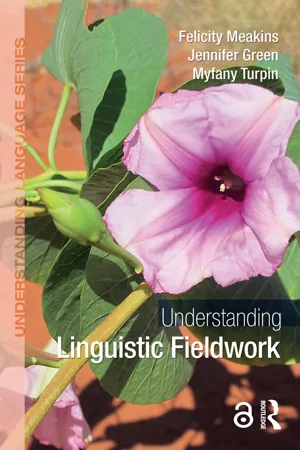
On the front cover of this textbook is a picture of an anaty which is the Alyawarr (Pama-Nyungan, Australia) name of a type of bush potato or yam (Ipomoea costata). This name and its associations are also found in the related Arandic languages Kaytetye and Anmatyerr. The anaty plant grows to a metre high, with green leafy tendrils that creep across the red desert sand, and large edible tubers that are found underneath its surface. In certain seasons the plants are prolific and women head to favourite destinations to dig them up. The pink trumpet-like flowers are called nalal, young tubers are known as akwerrk ‘young, newly grown’ and the main yam is called amikw ‘mother’.
But what has a bush potato got to do with a textbook on linguistic fieldwork? The various names of the plant reveal how important it is to Alyawarr people. Other vocabulary coalesces around the plant: for example a bird called anatyelepwerray (Melanodryas cucullata) originated as an anaty in the creation period or ‘Dreamtime’ (Green, 1992, p. 42). In neighbouring Kaytetye anatyaylewene ‘potato-singer’ refers to a lizard (Lialis burtonis) that makes a whistling sound said to encourage the plant to proliferate; and also to a beetle whose shrill sound has the same effect (Turpin & Ross, 2012, pp. 110, 442). The anaty plant features in songs and verbal arts practices, and is also found in the sign languages of the region. In-depth documentation of this small network of semantic and cultural signification helps us understand a little of the Alyawarr worldview and how ethnobiological knowledge and language inter-relate. It demonstrates the value of a multi-faceted approach to language documentation that draws on expertise from different domains.
1.1 Overview
In a world where increasing numbers of languages are losing speakers (§1.2.5), the place of fieldwork in the discipline of linguistics and its relevance for speech communities is gaining importance. The term ‘fieldwork’ has been used to describe linguistic research in many different contexts (§1.2.3), but the focus of this textbook is on the methods, ethical practices and procedures for researching under-described languages in endangered language settings. We pay particular attention to fieldwork in countries and continents which have undergone European or other expansion (e.g. Australia and the Pacific, the United States, Canada, South America, Africa) and the roles and responsibilities of linguists in engaging with communities in these settings (cf. Austin & Sallabank, 2011).
If we are to understand more about the rich diversity of the world’s remaining languages, then fieldwork is essential. Taking stock of the inventory of linguistic structures across the world’s languages and their parameters of use is basic to an understanding of the human language faculty. Capturing this diversity means undertaking research in remote areas of the world and getting training in how to work in an ethical and responsible manner (Chapter 2) and in how to collect and curate quality linguistic data (Chapters 3–4). This data is important to all of the standard subfields of linguistics, e.g. phonology, morpho-syntax and semantics (Chapters 5–7), and also to other areas of linguistics, for example typology and historical linguistics. Some of these sub-disciplines require particular methods and ethical considerations. As such, we devote chapters to discussion of gesture and sign (Chapter 8), language acquisition (Chapter 9), language contact (Chapter 10), and poetry and song (Chapter 11). In doing so, we take a broad view of language, including not only speech, but also multimodal forms of communication, and the performative and visual dimensions of language. Many of the discussions and scenarios presented in this book also include other disciplines that involve the collection of primary linguistic data of under-described languages such as ethnobiology and anthropology.
Not all of the things you will learn in this book can be practised in your field methods class where the language, the speaker and ethics processes have all been organised by your lecturer. You will also probably work with only one speaker in class, which tends to give consistent data, whereas in the field you will work with multiple speakers. As a result, you are likely to encounter inter-speaker variation and other complexities of language-in-use. Finding the systematicity in this seemingly ‘messy’ data can be challenging (but fun!). Another difference is that in a field methods class the speaker is usually the outsider, whereas in the actual field you will be the outsider unless you are an ‘insider’ linguist (§1.2.2). Finally, previous documentation of the language is usually out of bounds for field methods students as you are expected to work things out from scratch. In the field you should be on top of all that has been written on the language before you go there (§2.7.4 & §6.6.1).
1.2 Definitions
Before we launch into the details of field methods, it is important to think about what we mean by ‘field linguist’ and ‘fieldwork’. Another distinction – between ‘linguistic description’ and ‘language documentation’ – has also become very important in recent decades to the way that fieldwork is conceptualised and planned. How you undertake fieldwork may vary depending on how endangered the language you plan to work on is and the varying skills of the language team.
1.2.1 What makes a good field linguist?
How do you know if you’ve ‘got what it takes’ to be a field linguist? Linguistic training and the ability to undertake analysis is obviously important, but is there a personality type that makes a good field linguist? The most common stereotype around is that of the adventurous and outgoing “dirty-feet linguist” (Crowley, 2007, p. 12) but in fact field linguists come in all different personality types and dispositions. Marianne Mithun, who has collaborated with First Nations people in North America for decades, describes her own beginnings as a field linguist and reflects on what she believes constitutes a good linguist. She talks about the happy accident of how she came to work with the Mohawk. It turned out that their astute and energetic approach to language learning matched Mithun’s own nature.
Ingredients for collaborating with the community – Marianne Mithun
What makes for successful collaboration between linguists and communities? For the linguist, some things are obvious: Training: the more you know about languages in general, the faster you’ll spot categories and patterns in a new language and the less speaker patience you’ll waste; Attentiveness: most people volunteer information they think will interest their audience; Respect: the longer you work, the more you discover how much speakers know; But perhaps the most powerful factors are happy accidents.
Some time ago, members of a Mohawk community in Quebec noticed that children were no longer speaking the language. They soon realised that being a good speaker did not automatically make one an effective teacher. Being very enterprising, they approached the provincial powers that be and demanded university training in Mohawk linguistics. The result was a series of intensive summer courses for speakers of all languages indigenous to Quebec, held in an idyllic, remote mountain area. Though I was just a graduate student and had never heard Mohawk, I was invited to work with the Mohawk group because of my experience with a related language.
Mohawks are generally some of the sharpest, liveliest, kindest people one could ever hope to meet. Our days and nights were filled with rollicking conversation and laughter, people talking all at once but always in collaboration. At one point I noticed a ring of faces around the doorway at the back of our room, each registering wide-eyed wonder. They belonged to members of a colleague’s group who, drawn by the noise, had been observing in silence. As my colleague later explained, in their culture people normally do not talk unless they have something to say. This friend, who is naturally taciturn, conducted class by simply starting to write on the blackboard. Participants would drift in, watch for a while, then eventually try it themselves. Sometimes when I would pass by their room I would think at first that everyone had left, only to discover that the room was full of people working. My friend explained that this is a traditional way of learning: children watch how things are done, then gradually imitate what they have observed. The two of us are extremely grateful that we each landed with the group we did. Now many years later, I still feel extraordinarily fortunate to have these amazing Mohawks and their language in my life. And it started with a happy accident.
What makes a good field linguist is someone who has an interest in understanding other languages and cultures and enjoys working with people. The qualities of patience, humility, humour and the ability to think laterally also help to make a good fieldworker. A good ear, a knack for seeing patterns and a respect for data – even obsession – without losing sight of the big picture, are other abilities that also serve the field linguist well.
1.2.2 ‘Insider’ and ‘outsider’ linguists
Some of the Mohawk students Mithun worked with went on to become linguists themselves which leads us to an important distinction which we use throughout this book – between ‘insider’ and ‘outsider’ linguists (cf. Crowley, 2007, p. 56; Evans, 2011, p. 222). ‘Insider’ linguists belong to the speech community where the fieldwork is based and they study their own language. They may be a native speaker of the language or perhaps their language is only still spoken by older members of the community. ‘Insider’ linguists typically have a lot of personal investment in their project as their own family and history is embedded in the speech community. As an insider, their influence in the community is often very different from that of an outsider. They may be focused on the position of the language in the community and, more broadly, the status of the language in the region, particularly where their community is a minority or marginalised group. ‘Insider’ linguists who live in the speech community may also have other roles such as teachers or interpreters.
‘Insider’ linguists have a clear advantage over ‘outsider’ linguists. They often speak the language they are researching and have a pre-existing relationship with its speakers. They also have a good understanding of the research context and identify potential ethical dilemmas quickly. There are some pitfalls, however. As James Crippen (2009), a Tlingit linguist from British Columbia points out, because ‘home’ and the ‘field’ are one and the same, there can be many demands made on ‘insider’ linguists:
‘Outsider’ linguists are external to the speech community and are often members of the dominant group in the very country that may be responsible for the marginalisation of the speech community. All ‘outsider’ linguists need to be mindful of the impact of their research projects in communities, understand fully their responsibility to the community, communicate openly with the leaders in those communities, and negotiate projects with speakers (§2.4). While many ‘outsider’ linguists may have a p...