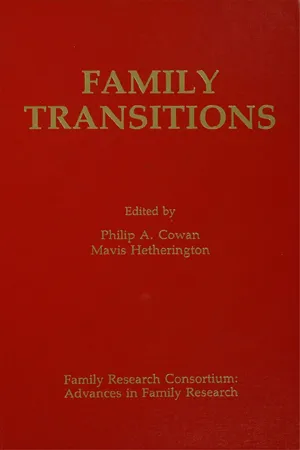
This volume, the result of the second annual Summer Institute sponsored by the Family Research Consortium, focuses on family transitions--both normative and non-normative. The subject of family transitions has been a central concern of the consortium largely because studies of families in motion help to highlight mechanisms leading to adaptation and dysfunction. This text represents a collective effort to understand the techniques individuals and families employ to adapt to the pressing issues they encounter along their life course.
eBook - ePub
Family Transitions
- 332 pages
- English
- ePUB (mobile friendly)
- Available on iOS & Android
eBook - ePub
Family Transitions
About this book
Trusted by 375,005 students
Access to over 1.5 million titles for a fair monthly price.
Study more efficiently using our study tools.
Information
Subtopic
Developmental PsychologyIndex
PsychologyI
PERSPECTIVES
1
Individual and Family Life Transitions: A Proposal for a New Definition
Americans have always been in transition. Whereas Old World families began with a place, New World families began with an act of migration. Nor did the transition from an old life to a new one end with the immigrants arrived on these shores. From place to place and job to job they kept moving.
—(Bridges, 1980, p. 2)
“Who are you?” said the Caterpillar. “I-I hardly know, Sir, just at present,” Alice replied rather shyly, “at least I know who I was when I got up this morning, but I think I must have changed several times since then.”
—(Carroll, from Alice’s Adventures in Wonderland)
These two examples are used by the author of a book titled Transitions, to suggest that people may be “in transition” a good deal of the time (Bridges, 1980). Are Americans in fact “always in transition?” Are poor Alice’s abrupt shifts of size and setting all to be regarded as transitional? It seems intuitively clear that in becoming an adolescent or a senior citizen, entering kindergarten or graduating from university, becoming a parent or contemplating an empty nest, individuals make transitions from one way of life to another. It also seems clear that some changes should not ordinarily be regarded as transitions—such as going on a long vacation or buying a new car. What about remodeling one’s home or winning a promotion at work? Where do we draw the line between transitional and nontransitional change? Why is it important to do so?
At the beginning of any science, researchers and theorists devote most of their energies to describing relatively stable phenomena. In developmental psychology and family sociology, for example, great effort was initially devoted to classification—the identification of stable states called stages, and the presumably universal sequence in which these stages occur (Freud, 1917/1963; Mattesich & Hill, 1987; Piaget, 1968/1970). If the major interest of the theorist lies in describing a sequence through which almost all people pass, then focusing on what happens in between stages is relatively unimportant. Not until we want to explain why individuals and families differ in their rate of progress from one stage to another, or why they fail to follow the expected sequence of life changes does the search for laws of transition inevitably begin.
Are There Principles of Transition that Hold Across the Lifespan?
A primary assumption of transition theorists is that despite clear differences in the content of major life changes at different ages—adolescence or retirement, for example—general principles of transition apply to any phase of the life cycle. There are several reasons why this assumption has never been adequately tested.
1. Researchers tend to focus their studies at one age level (childhood, adulthood) and, within that age level, to investigate a single transition (school transitions, marriage, parenthood, empty nest). Comparisons between transitions, then, are usually made on the basis of data from different studies attempting to answer different questions with different methods.
2. The few investigators examining several transitions within the same study (Lowenthal, Thurner, & Chiriboga, 1976; Pearlin, 1980) use cross-sectional samples of subjects at different ages. Because the same individuals are not followed over time, we cannot know whether there is general consistency in people’s adaptation to transitions across successive developmental milestones.
3. There are very real problems in the definition of transition. Most writers assume that the meaning is so obvious that it requires little explanation. Transition is loosely equated with change, sometimes qualified by major change. Yet, there are no guidelines to distinguish between major and minor change, or definitions of the kind of change that should be designated as transitional. If continual change implies never-ending transition, then the concept adds nothing to our understanding of development.
General principles of transition should apply equally well to children and adults. In this chapter, I examine definitions of transitions currently used in individual and family development theories and show that there are fundamental differences in the way transitions in childhood and adulthood tend to be described. My goal is to propose a formal definition that does justice to the complexity of development all along the life course.
Are There Differences Between Normative and Nonnormative Transitions?
Developmental theorists studying children, adults, and families across the lifespan have focused on what have come to be called normative transitions, expectable changes made by virtually every person (e.g., puberty) or by the vast majority of people in a defined population (e.g., married couples becoming parents). Other theorists have been more interested in individual or family stress and coping in the wake of nonnormative, often catastrophic events (war, unemployment, serious illness, loss of loved ones). I believe that theorists have blurred the distinction between normative and nonnormative transitions. I will expand on the argument by Felner, Farber, and Primavera (1983) that there has been an unfortunate tendency to focus on the life stress events that trigger crisis and disorganization, as if coping with the stress of becoming a parent, for example, is directly comparable to dealing with the aftermath of a tornado. (It may be, but we don’t really know for certain.)
I propose instead to describe transitions as longterm processes that result in a qualitative reorganization of both inner life and external behavior. For a life change to be designated as transitional, it must involve a qualitative shift from the inside looking out (how the individual understands and feels about the self and the world) and from the outside looking in (reorganization of the individual’s or family’s level of personal competence, role arrangements, and relationships with significant others). Passing a life marker (e.g., entering school) or changing one’s identity (e.g., becoming a husband or father) does not in itself signify that a transition has been completed. A central task for researchers is to determine the conditions under which both normative and nonnormative events stimulate developmental advances, produce dysfunctional crises, or leave the individual and family relatively unchanged.
I focus primarily on psychological interpretations of transitions, leaving for a final section some speculations about the biological, social, and historical contexts that help us to understand psychological adaptation and dysfunction in individuals and families as they proceed along their life course. I am responding to the challenge initiated both in conversations and written interchanges with my fellow contributors to this volume of Family Transitions. My goal is to contribute to a more precise formulation of transitions that will allow us to examine both normal and dysfunctional life change from different perspectives (biological, psychological, historical), using different levels of analysis (individual, family, societal), at any stage and phase of the lifespan.
CHILDHOOD VS. ADULTHOOD TRANSITIONS
According to Tyhurst (1957), the root meaning of transition is derived from two Latin words meaning “to go across.” The word refers to a “passage or change from one place or state or act or set of circumstances to another” (Oxford English Dictionary). As a concept describing periods of developmental change, transition was first used in theories describing children’s progress through a defined sequence of stages. It was then extended to describe individual and family changes along the adult life course.
Child Development
Developmental psychologists and psychiatrists (e.g., Freud, 1905/1953; Piaget, 1975/1985) have attempted to understand how individuals move from one stage to another, beginning with birth and extending through adolescence, with a few theorists considering transitions across the lifespan (e.g., Erikson, 1950; Jung, 1964). In these theories, changes are defined as transitions when they constitute a shift from one relatively stable form of biological or psychological organization to another. During the period when one set of rules for transacting with the environment (Kessen, 1962) is being replaced by a new set, the child may oscillate between two or more stages. Transition is conceived of as a time of disequilibration and internal conflict. Old cognitive/affective structures and behavior patterns are being reorganized; new patterns are not yet set. Successful resolution of the disequilibration and conflict leads to a higher, more differentiated and integrated level of adaptation. Unsuccessful resolution leads to developmental delay and regression.
Adult Development
A second group of theorists, including psychologists (Helson, Mitchell, & Moane, 1984; Levinson, 1978), psychiatrists (Gould, 1978; Vaillant, 1977), and sociologists (Havighurst, 1953; Neugarten, 1968), have been interested in development during the adult years. An individual is in transition when he or she passes a turning point in a life trajectory. Leaving home, choosing a job or career, getting married, becoming a parent, changing career directions, getting divorced, and moving into retirement all have been described as major life transitions.
The metaphoric connotation of transition for adults is a journey from one kingdom to another with no assurance of a successful passage. There are forks in the road, choices to be made, rough terrain to be crossed, risks to be faced and surmounted. There is an apparent or perceived discontinuity between the old country and the new. The traveler’s eye is usually on his or her destination, focusing on what is to be gained in the new phase of life. After reaching the goal, there is sometimes disappointment about what has been left or lost along the way. As in child development theories, the adult development literature portrays transitions as periods of change, disequilibrium, and internal conflict about gains and losses that occur between periods of stability, balance, and relative quiescence.
Family Development
Both child and adult developmentalists focus their attention on transitions made by individuals. By contrast, family sociologists (Hill & Mattesich, 1979), life course theorists (Elder, 1978), and some therapists (e.g., Carter & McGoldrick, 1988), attempt to understand transitions made by families who are in the process of formation and reorganization. Couples get married, have children, send their children to school, struggle with careers; they cope with children leaving home, retirement, the death of a parent, and widowhood.
Although stages or phases are often marked by change in individual family members, the family transition model emphasizes “multiple developmental trajectories” (Parke, 1988) or the “web of interdependencies both within the dyadic unit and across the lineage system” (Elder, Caspi, & Burton, 1989). It is critical to remember, for example, that the first day of kindergarten, nervously anticipated by both child and parents, is only one event in a long process of the child’s transition to school, with implications for change in children’s and parents’ views of themselves, their relationships in the family, and the family’s connections with community institutions (Klein & Ross, 1965; Signell, 1972). Similarly, as children enter adolescence, their parents may be in a midlife individual or marital transition of their own (Johnson & Irvin, 1983), which makes the transition to adolescence very complex indeed. Change in the life course of any one family member, dyad, or triad, then, may trigger disequilibration and reorganization of the whole family system.
Differences Between Child and Adult Transitions
Elsewhere, I have raised serious questions about whether adult developmental milestones, either individual or family, can be described as developmental stages in the same sense as children’s movement from the preoperational to the concrete operational stage or from oral to anal stages (P. Cowan, 1988a). The criteria for the definition of stages in childhood and adulthood differ radically. Childhood developmental stages are described as occurring (a) in an invariant sequence, (b) across all cultures, (c) with qualitative differences between successive periods, (d) with each period constituting a “structured whole,” defined by synchronous development in many domains and a relatively dynamic equilibrium (e) that hierarchically integrates rather than replaces previous stages (e.g., Fisher, 1983; Kohlberg, 1969).
There is some question about whether childhood stages actually fit this model (see Fisher, 1983), but no doubt that adult life changes violate most of the defining criteria (P.Cowan, 1988a; Mattessich & Hill, 1987). Not all men and women leave their families of origin; some get married before they leave home. Not all couples get married before having children, and some never marry or have children at all. There appear to be no invariant sequences in the adult life course, and little evidence, perhaps due to lack of research, that movement between one life milestone and another necessarily results in a new level of personal or relationship organization.
Although there are many distinctions to be made between child and adult transitions, I believe that one may be central. According to stage theories of child development, transitions happen to individuals; movement from one stage to another is not under the child’s voluntary control. Transitions are triggered by changes in biological structure, psychological organization, or “the culturally controlled social agenda that determines the timing of the child’s entry into various social settings such as the transition to elementary school…” (Parke, 1988, p. 161). There is little sense of the child consciously initiating a move toward latency or concrete operations.
In theories of adult development or the family cycle, by contrast, there is a clear emphasis on the volitional character of the change. Adolescents, decide to quit school with or without parental consent. Men and women decide to change career direction. Later in life, even if retirement is mandatory, we can choose how to prepare for retirement, and what we plan to use it for. Adult developmentalists do not characterize transitions as entirely under voluntary control, because there is a good deal of expectation and pressure involved in taking certain life steps. Nevertheless, there is a large component of choice in the journey, and the ever-present possibility of refusing to embark upon it, or of turning back even after the journey has been completed. This volitional, reversible aspect of life change is not found in descriptions of childhood stages.
At first glance, it may seem that the contrast between child and adult transitions follows from the “fact” that children’s stage changes are impelled by reorganizations of biological or psychological structure, while adults’ stages are self- or socially-determined and regulated. But children’s stage development is also affected by social institutions (e.g., cultural differences in the meaning and timing of adolescence), and adults’ life choices at the end of the life cycle are affected in part by biological regularities or irregularities in the aging process. The essential contrast between childhood and adulth...
Table of contents
- Cover
- Halftitle
- Title
- Copyright
- Contents
- Preface
- Part I: Perspectives
- Part II: Normative and Nonnormative Transitions
- Part III: Metaphors and Models
- Author Index
- Subject Index
Frequently asked questions
Yes, you can cancel anytime from the Subscription tab in your account settings on the Perlego website. Your subscription will stay active until the end of your current billing period. Learn how to cancel your subscription
No, books cannot be downloaded as external files, such as PDFs, for use outside of Perlego. However, you can download books within the Perlego app for offline reading on mobile or tablet. Learn how to download books offline
Perlego offers two plans: Essential and Complete
- Essential is ideal for learners and professionals who enjoy exploring a wide range of subjects. Access the Essential Library with 800,000+ trusted titles and best-sellers across business, personal growth, and the humanities. Includes unlimited reading time and Standard Read Aloud voice.
- Complete: Perfect for advanced learners and researchers needing full, unrestricted access. Unlock 1.5M+ books across hundreds of subjects, including academic and specialized titles. The Complete Plan also includes advanced features like Premium Read Aloud and Research Assistant.
We are an online textbook subscription service, where you can get access to an entire online library for less than the price of a single book per month. With over 1.5 million books across 990+ topics, we’ve got you covered! Learn about our mission
Look out for the read-aloud symbol on your next book to see if you can listen to it. The read-aloud tool reads text aloud for you, highlighting the text as it is being read. You can pause it, speed it up and slow it down. Learn more about Read Aloud
Yes! You can use the Perlego app on both iOS and Android devices to read anytime, anywhere — even offline. Perfect for commutes or when you’re on the go.
Please note we cannot support devices running on iOS 13 and Android 7 or earlier. Learn more about using the app
Please note we cannot support devices running on iOS 13 and Android 7 or earlier. Learn more about using the app
Yes, you can access Family Transitions by Philip A. Cowan, E. Mavis Hetherington, Philip A. Cowan,E. Mavis Hetherington in PDF and/or ePUB format, as well as other popular books in Psychology & Developmental Psychology. We have over 1.5 million books available in our catalogue for you to explore.