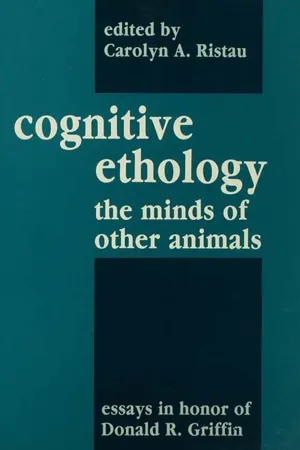
This collection of essays was written by former students, associates, admirers, critics and friends of Donald R. Griffin -- the creator of cognitive ethology. Stimulated by his work, this volume presents ideas and experiments in the field of cognitive ethology -- the exploration of the mental experiences of animals as they behave in their natural environment during the course of their normal lives.
Cognitive Ethology discusses the possibility that animals may have abilities to experience, communicate, reason, and plan beyond those usually ascribed to them in a "black box" or "stimulus-response" interpretation of their behavior. Contributions from scientists who have been associated with or influenced by Griffin offer a lively array of views, some disparate from one another and some especially selected to present approaches contrary to his.
eBook - ePub
Cognitive Ethology
Essays in Honor of Donald R. Griffin
- 352 pages
- English
- ePUB (mobile friendly)
- Available on iOS & Android
eBook - ePub
Cognitive Ethology
Essays in Honor of Donald R. Griffin
About this book
Information
Publisher
Psychology PressYear
2013Print ISBN
9780805802528
9781138159815
Edition
1eBook ISBN
9781134990924
PART I:
THEORETICAL PERSPECTIVES
1 | PROGRESS TOWARD A COGNITIVE ETHOLOGY |
The Rockefeller University
Princeton University
ABSTRACT
The investigation of animal cognition and mental experience is beginning to reveal that animals guide their behavior by surprisingly complex thinking. The versatile adaptability of some animals in the face of unpredictable challenges suggests simple conscious thinking about alternative actions and their probable results. When animals communicate with each other, their communicative signals may provide objective data about their thoughts. Although this “window” on animal thoughts may not be ideally transparent, it can help us to escape from the lingering inhibitions of behaviorism that have impeded research into animal minds. Simple conscious thinking may be an efficient and economical mode of operation by which the central nervous systems enable animals to cope with the multiple problems of finding food, avoiding predators, finding mates, and raising young. If so, it may be most advantageous for animals with small brains.
Cognition and conscious thinking by nonhuman animals present a variety of exciting and significant research challenges for scientists concerned with animal behavior. The extent to which animals think about what they are doing and about the behavioral choices they make is a highly significant attribute that must be understood before we can fully appreciate what it is like to be a certain type of animal. We don't yet know much about this subject, and until quite recently we have been reluctant even to think about it, let alone study it. This is changing, however, and the number of papers devoted to cognitive ethology at the 1987 meeting of the Animal Behavior Society reflected this rekindling of interest. Animal cognition is now a recognized scientific subject, and several books and symposia have recently been devoted to this topic (e.g., Griffin, 1984; Roitblat, 1987; Roitblat, Bever, & Terrace, 1984; Walker, 1983).
Many students of animal behavior are concerned not only with what animals do, but also with the cognitive processes within their central nervous systems that interact with sensory information to produce the observed behavior. Nevertheless, many of us still hesitate to consider the possibility that some animal cognition may also entail conscious awareness on the animal's part. Contemporary behavioral scientists tend to limit their investigations of animal cognition to patterns of information processing within the central nervous systems of the animals they study and ignore the possibility that subjective mental experiences may occur and may influence behavior. This reluctance to consider subjective mental experiences, so clearly expressed by Yoerg and Kamil in this volume, may result, in part, from unrecognized vestiges of behaviorism that inhibit inquiry – even when we believe we have recovered from the negative dogmatism of strict behaviorism. We tend to find the notion of conscious awareness disturbing and struggle to find ways of analyzing animal behavior without allowing what seem like subversive notions of subjectivity to get a foot in the door. But Radner and Radner (1989) have recently explained how insubstantial a philosophical basis underlies this widespread antipathy to animal consciousness among behavioral scientists. Cognitive ethology should certainly include, but not be limited to, information processing in animal brains.
DEFINITIONS
One reason for avoiding the question of animal consciousness is a feeling that it is too vague a subject for scientific investigation because we lack objective criteria by which to judge whether an animal is conscious. Although we all know in a rough and general way the sorts of things that are meant by thinking and consciousness, these meanings are multiple; they do not refer to homogeneous categories. Given the variety of phenomena and processes that the word thinking calls to mind, it seems premature to expect a unitary definition as a prerequisite for scientific investigation. Because we remain almost totally ignorant of the neurophysiological basis of either conscious or unconscious thinking, we cannot define thinking in as concrete terms as molecular geneticists employ when defining genes in terms of DNA. Other widely used terms, such as learning, motivation, or metabolism are also resistant to rigorous definition; but this has fortunately not prevented effective scientific analysis of the phenomena described by these terms. It is therefore neither necessary nor advisable to become so bogged down in quibbles about definitions that the investigation of animal cognition and consciousness is neglected altogether.
I suggest that we cope with the difficulty of formulating wholly satisfactory definitions by employing the same basic procedure that has proved fruitful with many other complex and challenging scientific problems. This is to start with some of the least complicated cases, and then, if we can make progress toward understanding them, move on to the more complex and difficult examples. One promising approach of this general type is to inquire whether animals may experience relatively simple thoughts about things that are important to them. When faced with a threatening predator, does an animal think something roughly like: “If that beast gets me, it will hurt?” Or does a hungry animal think about what a particular food will taste like?
This approach suggests the following preliminary working definition of elementary animal consciousness: An animal may be considered to experience a simple level of consciousness if it subjectively thinks about objects and events. Thinking about something in this sense means attending to the animal's internal mental images or representations of objects and events. These may represent current situations confronting the animal, memories, or anticipations of future situations. Such thinking often leads to comparisons between two or more representations and to choices and decisions about behavior that the animal believes is likely to attain desired results or avoid unpleasant ones. It is important to recognize that this working definition leaves open the possibility of more complex sorts of consciousness; it focuses on processes and phenomena that are basic to conscious thinking and which we can hope to identify by gathering objective evidence bearing on their occurrence and nature by employing procedures outlined below. This definition does, however, assume the presence of both internal representations or mental images about which the animal thinks and also of simple beliefs and desires about what it likes and dislikes.
This definition does not include two other attributes that are sometimes proposed as necessary features of consciousness: self-awareness and thinking about the process of thinking itself. Because an animal's own body is a very prominent feature of its situation and contributes enormously to its sensory input, it seems likely that if an animal thinks consciously about anything, it must sometimes think about parts of its own body. But many who tend to deny consciousness to nonhuman animals require for true self-consciousness the capacity to experience such thoughts as: “It is I who see that predator or smell that delicious food.” Or they may claim that animals know but are incapable of knowing that they know. In an attempt to keep a preliminary investigation of animal consciousness as manageable as possible, I suggest leaving aside the question whether nonhuman animals are capable of this sort of propositional self-awareness or of thinking about their own thoughts as well as other more complicated forms of conscious thinking. If and when cognitive ethologists learn how to determine the presence or absence of the simpler sorts of conscious thinking defined above, later stages of investigation can include these and other more complex levels of consciousness.
CRITICAL STANDARDS
Our traditional inhibitions that have discouraged the study of animal minds can be relaxed without lowering critical scientific standards. Indeed, the danger of jumping prematurely to definite convictions is so great that it is desirable to increase scientific caution rather than relax it. There are two pitfalls to be guarded against. The first has been to ignore the problem of animal thoughts and feelings because such phenomena are considered beyond the reach of scientific investigation. That was an easy way out a few years ago, but the progress in identifying cognitive processes in a wide variety of animals has forced a retreat to a second line of defense. This line of defense recognizes the existence and significance of animal cognition but denies that we can tell whether it is ever accompanied by conscious thinking.
The second pitfall is to leap enthusiastically to firm conclusions and to advocate positions that cannot be convincingly supported by the available evidence. Scientists ordinarily make strong and positive assertions only when the supporting evidence is convincing. But when questions of animal mentality arise, we have an unfortunate tendency to do just the opposite; the vigor of assertions tends to be inversely, rather than directly, proportional to the quality of the evidence available. Thus, we sometimes hear vehement arguments that a nonhuman animal cannot possibly have certain kinds of mental experiences. Meanwhile, others are equally certain that some particular beast must want, wish, or believe something related to its current or impending behavior. As critical scientists we must first recognize the extent of our ignorance as a prerequisite for reducing it.
PREMATURE PERFECTIONISM
In many areas of science, we cannot aspire to entirely satisfactory logically watertight evidence when a subject is first studied. But when questions of possible conscious thinking by animals are raised, we tend to demand perfection prematurely. We often conclude a priori that it is not worthwhile to study this sort of phenomenon because we are convinced that we cannot hope to prove anything with absolute certainity. But why are we so much more demanding of perfection in this area than in other scientific areas? It is helpful to contrast these attitudes with the enthusiastic investigation of the adaptive significance of behavior and how it appears to contribute to inclusive fitness. Underlying this active area of research is an unmentioned implicit assumption that in the remote past the ancestors of living animals reproduced more effectively because they behaved in certain ways. Yet the behavior of extinct animals cannot be studied directly, and we are limited to inferences based on contemporary behavior under current conditions. Such inferences are reasonable and fruitful, but in this popular area of investigation we refrain from demanding the sort of rigorous proof that many scientists require as prerequisite for studying animal consciousness.
EPIPHENOMENALISM
Many scientists find reasons for believing that conscious thinking, even in our own species, has no effect on behavior. This view is known as epiphenomenalism, defined by Edwards and Pap (1973) as the belief that “mental states are caused by brain processes, but do not in turn exert any causal influence” (p. 177). This is a very strong claim that one process – conscious thinking – never, under any circumstances, has even the slightest effect on another process – overt behavior. Absolute proof of such a global negative statement is notoriously difficult to obtain, and this one is so counterintuitive that strong evidence would be required to render it convincing. Indeed, it is not accepted by many philosophers. Yet adherence to epiphenomenalism is often taken by scientists as evidence of commendable rigor when, in fact, it may be little more than an excuse for neglecting or ignoring an important scientific problem.
Some biologists tend to feel that it does not matter for questions of evolutionary adaptiveness whether a given behavior pattern is executed with or without conscious awareness on the animal's part. But insofar as an animal can think consciously about its situation and the results of its own behavior, and can make simple rational choices about its problems and prospects, this ability is clearly an advantageous phenotypic trait. Therefore, insofar as conscious thinking occurs, neglecting it will result in an incomplete and inaccurate understanding of the species in question.
IMPLICATIONS OF ASSUMING HUMAN MENTAL UNIQUENESS
It is conceivable that conscious thinking is a uniquely human accomplishment, wholly lacking in all other species. Even if this rather extreme view is correct, it raises an important scientific question: What is different about human brains that permits them to give rise to consciousness, while the central nervous systems of all other species lack this capacity despite the similarity if not identity of all known basic properties of neurons and synapses? Thus the existence or nature of animal consciousness is a central question of major scientific importance. If it occurs only in our species, or perhaps is shared only by our closest relatives, neuroethologists must look for those properties that allow some central nervous systems, but not others, to produce conscious thinking. Conversely, if conscious thinking is more widespread among nonhuman animals, it is scientifically significant to learn its extent and limits and, in particular, how the content of animal consciousness differs between species or according to the circumstances in which animals find themselves.
COGNITIVE CREATIVITY
The ability to think about the probable results of alternative actions and to choose the one most likely to achieve a desired result is especially valuable when animals face unpredictable problems in carrying out important activities such as obtaining food, avoiding predators or other hazards, seeking mates, or raising young. The traditional view of animal behavior has emphasized prior determination of responses either genetically, through learning, or by some interactive combination of the two. But a fundamental limitation of prescribed responses is that to be effective, the prescriptions must provide for most or all contingencies the animal is likely to encounter. The real world in which animals live under natural conditions is characterized by complex variability. Few if any of the important details lend themselves to simple descriptions or simple rules that can prescribe the most effective way of coping with complicated contingencies. The most appropriate responses vary according to innumerable factors, and the necessary instructions would become astronomically voluminous if they adequately covered the contingencies an animal is likely to encounter.
If, on the other hand, an animal can think about what it wants and how desired objectives can be achieved, many relevant factors can be taken into account and modestly rational decisions can lead to appropriate actions. Even quite simple conscious thinking can be creative in the limited sense that it adaptively integrates a variety of information from current perceptions, memories, and anticipations of probable events – including the anticipated results of the animal's own actions. Of course such thinking, human or animal, is unlikely to achieve perfection. Mistakes will be made, but if they are not fatal, they can often be corrected by learning what does and does not achieve what the animal wants.
SPECIES SOLIPSISM
Skeptical philosophers can argue eloquently that no one can ever prove, with logical rigor, that another person is conscious. We can only make inferences (some would say merely guesses) about the existence or content of another person's thoughts. If a solipsist claims that he is the only conscious organism in the universe, and that all evidence of consciousness in others is inconclusive, we cannot refute his arguments in any rigorously logical fashion. But only in specialized philosophical discussions are such arguments taken seriously. We all go through life assuming that other people do have conscious thoughts, plans, beliefs, intentions, and the like. Indeed it is difficult to imagine how human societies (or perhaps any society) could function effectively if their members acted as consistent solipsists. Of course the difficulties of inferring what animals may be thinking are much greater than with our conspecifics, and many scientists continue to feel that it is not worth the bother of trying. But the extensive and significant discoveries that have resulted from investigations of animal behavior suggest increasingly that these inhibitions may be outdated impediments to research. Species solipsism may be as impractical and arcane an intellectual exercise as its more familiar philosophical counterpart when applied to other people.
DISPARAGEMENT OF “FOLK PSYCHOLOGY”
Three eloquent philosophers (among others) recently advanced another argument that may tend to discourage consideration of animal consciousness. Stich (1983), P. S. Churchland (1986), and Dennett (1987) have argued with varying degrees of vigor that what they disparage as folk psychology relies on inappropriate and misguided concepts. Churchland defines folk psychology as “commonsense psychology – the psychological lore in virtue of which we explain behavior as the outcome of beliefs, desires, perceptions, expectations, goals, sensations, and so forth. . . . the preeminent elements in folk psychological explanations of behavior include the concepts of belief and desire” (p. 299). Churchland and Stich assert that these terms are as obsolete and misleading as witchcraft or a flat earth,...
Table of contents
- Front Cover
- Half Title
- Comparative Cognition and Neuroscience
- Title Page
- Copyright
- CONTENTS
- PREFACE
- REMINISCENCES
- PART I: THEORETICAL PERSPECTIVES
- PART II: EVIDENCE FROM THE LABORATORY AND FIELD
- AUTHOR INDEX
- SUBJECT INDEX
- SPECIES INDEX
Trusted by 375,005 students
Access to over 1.5 million titles for a fair monthly price.
Study more efficiently using our study tools.
Frequently asked questions
Yes, you can cancel anytime from the Subscription tab in your account settings on the Perlego website. Your subscription will stay active until the end of your current billing period. Learn how to cancel your subscription
No, books cannot be downloaded as external files, such as PDFs, for use outside of Perlego. However, you can download books within the Perlego app for offline reading on mobile or tablet. Learn how to download books offline
Perlego offers two plans: Essential and Complete
- Essential is ideal for learners and professionals who enjoy exploring a wide range of subjects. Access the Essential Library with 800,000+ trusted titles and best-sellers across business, personal growth, and the humanities. Includes unlimited reading time and Standard Read Aloud voice.
- Complete: Perfect for advanced learners and researchers needing full, unrestricted access. Unlock 1.5M+ books across hundreds of subjects, including academic and specialized titles. The Complete Plan also includes advanced features like Premium Read Aloud and Research Assistant.
We are an online textbook subscription service, where you can get access to an entire online library for less than the price of a single book per month. With over 1.5 million books across 990+ topics, we’ve got you covered! Learn about our mission
Look out for the read-aloud symbol on your next book to see if you can listen to it. The read-aloud tool reads text aloud for you, highlighting the text as it is being read. You can pause it, speed it up and slow it down. Learn more about Read Aloud
Yes! You can use the Perlego app on both iOS and Android devices to read anytime, anywhere — even offline. Perfect for commutes or when you’re on the go.
Please note we cannot support devices running on iOS 13 and Android 7 or earlier. Learn more about using the app
Please note we cannot support devices running on iOS 13 and Android 7 or earlier. Learn more about using the app
Yes, you can access Cognitive Ethology by Peter Marler, Carolyn A. Ristau, Peter Marler,Carolyn A. Ristau in PDF and/or ePUB format, as well as other popular books in Psychology & History & Theory in Psychology. We have over 1.5 million books available in our catalogue for you to explore.