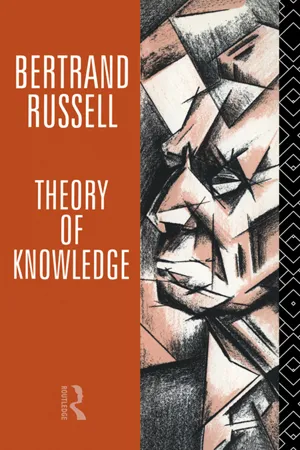
Theory of Knowledge gives us a picture of one of the great minds of the twentieth century at work. It is possible to see the unsolved problems left without disguise or evasion. Historically, it is invaluable to our understanding of both Russell's own thought and his relationship with Wittgenstein.
eBook - ePub
Theory of Knowledge
The 1913 Manuscript
- 248 pages
- English
- ePUB (mobile friendly)
- Available on iOS & Android
eBook - ePub
Theory of Knowledge
The 1913 Manuscript
About this book
Information
On the Nature of Acquaintance
Chapter I
Preliminary Description of Experience
THE PURPOSE OF what follows is to advocate a certain analysis of the simplest and most pervading aspect of experience, namely what I call “acquaintance”. It will be maintained that acquaintance is a dual relation between a subject and an object which need not have any community of nature. The subject is “mental”, the object is not known to be mental except in introspection. The object may be in the present, in the past, or not in time at all; it may be a sensible particular, or a universal, or an abstract logical fact. All cognitive relations—attention, sensation, memory, imagination, believing, disbelieving, etc.—presuppose acquaintance.
This theory has to be defended against three rival theories: (1) the theory of Mach and James, according to which there is no distinctive relation such as “acquaintance”, involved in all mental facts, but merely a different grouping of the same objects as those dealt with by non-psychological sciences; (2) the theory that the immediate object is mental, as well as the subject; (3) the theory that between subject and object there is a third entity, the “content”, which is mental, and is that thought or state of mind by means of which the subject apprehends the object. The first of these rivals is the most interesting and the most formidable, and can only be met by a full and detailed discussion, which will occupy a second chapter. The other theories, along with my own, will be considered in a third chapter, while the first chapter will consist of an introductory survey of data.
The word “experience”, like most of the words expressing fundamental ideas in philosophy, has been imported into the technical vocabulary from the language of daily life, and it retains some of the grime of its outdoor existence in spite of some scrubbing and brushing by impatient philosophers. Originally, the “philosophy of experience” was opposed to the a priori philosophy, and “experience” was confined to what we learn through the senses. Gradually, however, its scope widened until it included everything of which we are in any way conscious, and became the watchword of an emaciated idealism imported from Germany. The word had, on the one hand, the reassuring associations of the “appeal to experience”, which seemed to preclude the wilder vagaries of transcendental metaphysicians; while on the other hand it held, as it were in solution, the doctrine that nothing can happen except as the “experience” of some mind. Thus by the use of this one word the idealists cunningly forced upon their antagonists the odium of the a priori and the apparent necessity of maintaining the bare dogma of an unknowable reality, which must, it was thought, be either wholly arbitrary or not really unknowable.
In the revolt against idealism, the ambiguities of the word “experience” have been perceived, with the result that realists have more and more avoided the word. It is to be feared, however, that if the word is avoided the confusions of thought with which it has been associated may persist. It seems better to persevere in the attempt to analyze and clarify the somewhat vague and muddy ideas commonly called up by the word “experience”, since it is not improbable that in this process we may come upon something of fundamental importance to the theory of knowledge.
A certain difficulty as regards the use of words is unavoidable here, as in all philosophical inquiries. The meanings of common words are vague, fluctuating and ambiguous, like the shadow thrown by a flickering street-lamp on a windy night; yet in the nucleus of this uncertain patch of meaning, we may find some precise concept for which philosophy requires a name. If we choose a new technical term, the connection with ordinary thought is obscured and the clarifying of ordinary thought is retarded; but if we use the common word with a new precise significance, we may seem to run counter to usage, and we may confuse the reader’s thoughts by irrelevant associations. It is impossible to lay down a rule for the avoidance of these opposite dangers; sometimes it will be well to introduce a new technical term, sometimes it will be better to polish the common word until it becomes suitable for technical purposes. In the case of “experience”, the latter course seems preferable, since the actual process of polishing the word is instructive, and the confusions of thought which it covers cannot well be otherwise dispelled.
In seeking the central idea embodied in the word “experience”, we shall at the same time be performing the analysis required for a definition of “mind” and “mental”. Common sense divides human beings into souls and bodies, and Cartesian philosophy generalized this division by classifying everything that exists as either mind or matter. This division is so familiar, and of such respectable antiquity, that it has become part of our habits, and seems scarcely to embody a theory. Mind is what we know from within—thoughts and feelings and volitions—while matter is what is in space outside our minds. Nevertheless, almost all the great philosophers since Leibniz have challenged the dualism of mind and matter. Most of them, regarding mind as something immediately given, have assimilated to it what appeared to be “matter”, and have thus achieved the monism of the idealist. We may define an idealist as a man who believes that whatever exists may be called “mental”, in the sense of having a certain character, known to us by introspection as belonging to our own minds. In recent times, however, this theory has been criticized from various points of view. On the one hand, men who admitted that we know by introspection things having the character we call “mental” have urged that we also know other things not having this character. On the other hand, William James and the American realists have urged that there is no specific character of “mental” things, but that the things which are called mental are identical with the things which are called physical, the difference being merely one of context and arrangement.
We have thus three opinions to consider. There are first those who deny that there is a character called “mental” which is revealed in introspection. These men may be called “neutral monists”, because, while rejecting the division of the world into mind and matter, they do not say “all reality is mind”, nor yet “all reality is matter”. Next, there are “idealistic monists”, who admit a character called “mental”, and hold that everything has this character. Next, there are “dualists”, who hold that there is such a character, but that there are things which do not possess it. In order to decide among these views, it is necessary to decide whether anything is meant by the word “mental”; and this inquiry brings us back to the meaning of “experience”.
When we consider the world without the knowledge and the ignorance that are taught by philosophy, we seem to see that it contains a number of things and persons, and that some of the things are “experienced” by some of the persons. A man may experience different things at different times, and different men may experience different things at the same time. Some things, such as the inside of the earth or the other side of the moon, are never experienced by anybody, but are nevertheless believed to exist. The things which a man is said to experience are the things that are given in sensation, his own thoughts and feelings (at any rate so far as he is aware of them), and perhaps (though on this point common sense might hesitate) the facts which he comes to know by thinking. At any given moment, there are certain things of which a man is “aware”, certain things which are “before his mind”. Now although it is very difficult to define “awareness”, it is not at all difficult to say that I am aware of such and such things. If I am asked, I can reply that I am aware of this, and that, and the other, and so on through a heterogeneous collection of objects. If I describe these objects, I may of course describe them wrongly; hence I cannot with certainty communicate to another what are the things of which I am aware. But if I speak to myself, and denote them by what may be called “proper names”, rather than by descriptive words, I cannot be in error. So long as the names which I use really are names at the moment, i.e. are naming things to me, so long the things must be objects of which I am aware, since otherwise the words would be meaningless sounds, not names of things. There is thus at any given moment a certain assemblage of objects to which I could, if I chose, give proper names; these are the objects of my “awareness”, the objects “before my mind”, or the objects that are within my present “experience”.
There is a certain unity, important to realize but hard to analyze, in “my present experience”. If we assumed that “I” am the same at one time and at another, we might suppose that “my present experience” might be defined as all the experience which “I” have “now”. But in fact we shall find that “I” and “now”, in the order of knowledge, must be defined in terms of “my present experience”, rather than vice versa. Moreover, we cannot define “my present experience” as “all experience contemporaneous with this” (where this is some actual part of what I now experience), since that would ignore the possibility of experience other than mine. Nor can we define it as “all experience which I experience as contemporaneous with this”, since that would exclude all that part of my experiencing of which I do not become introspectively conscious. We shall have to say, I think, that “being experienced together” is a relation between experienced things, which can itself be experienced, for example when we become aware of two things which we are seeing together, or of a thing seen and a thing heard simultaneously. Having come to know in this way what is meant by “being experienced together”, we can define “my present contents of experience” as “everything experienced together with this”, where this is any experienced thing selected by attention. We shall return to this topic on several subsequent occasions.
I do not propose as yet to attempt a logical analysis of “experience”. For the present, I wish to consider its extent, its boundaries, its prolongation in time, and the reasons for regarding it as not all-embracing. These topics may be dealt with by discussing successively the following questions: (1) Are faint and peripheral sensations included in “experience”? (2) Are all or any of our present true beliefs included in present “experience”? (3) Do we now “experience” past things which we remember? (4) How do we come to know that the group of things now experienced is not all-embracing? (5) Why do we regard our present and past experiences as all parts of one experience, namely the experience which we call “ours”? (6) What leads us to believe that “our” total experience is not all-embracing? Many of these questions will have to be discussed again more fully at a later stage; for the present, we are not discussing them on their own account, but in order to become familiar with the notion of experience.
(1). Are faint and peripheral sensations included in “experience”? This question may be asked, not only with regard to sensations, but also with regard to faint wishes, dim thoughts, and whatever else is not in the focus of attention; but for illustrative purposes, the case of sensation, which is the simplest, may suffice. For the sake of definiteness, let us consider the field of vision. Normally, if we are attending to anything seen, it is to what is in the centre of the field that we attend, but we can, by an effort of will, attend to what is in the margin. It is obvious that, when we do so, what we attend to is indubitably experienced. Thus the question we have to consider is whether attention constitutes experience, or whether things not attended to are also experienced. It seems we must admit things to which we do not attend, for attention is a selection among objects that are “before the mind”, and therefore presupposes a larger field, constituted in some less exclusive manner, out of which attention chooses what it wants. In cases, however, where, in spite of the physical conditions which might be expected to produce a sensation, no sensation appears to exist, as for example when we fail to hear a faint sound which we should hear if our attention were called to it, it would seem that there is no corresponding “experience”; in such cases, in spite of the physical existence of the sound-stimulus, there seems to be sometimes no answering “mental” existent.
(2). Our mental life is largely composed of beliefs, and of what we are pleased to call “knowledge” of “facts”. When I speak of a “fact”, I mean the kind ofthing that is expressed by the phrase “that so-and-so is the case”. A “fact” in this sense is something different from an existing sensible thing; it is the kind of object towards which we have a belief, expressed in a proposition. The question I am asking now is not whether believing is experienced, for that I take to be obvious; the question is, whether the facts towards which beliefs are directed are ever experienced. It is obvious at once that most of the facts which we consider to be within our knowledge are not experienced. We do not experience that the earth goes round the sun, or that London has six million inhabitants, or that Napoleon was defeated at Waterloo. I think, however, that some facts are experienced, namely those which we see for ourselves, without relying either upon our own reasoning from previous facts, or upon the testimony of others. These “primitive” facts, which are known to us by an immediate insight as luminous and indubitable as that of sense, must, if I am not mistaken, be included in the original matter of experience. Their importance in the theory of knowledge is very great, and we shall have occasion to consider them very fully in the sequel.
(3). Do we now experience past things which we remember? We cannot of course discuss this question adequately without a consideration of the psychology of memory. But in a brief preliminary way, something may be said to indicate an affirmative conclusion. In the first place, we must not confound true memory with present images of past things. I may call up now before my mind an image of a man I saw yesterday; the image is not in the past, and I certainly experience it now, but the image itself is not memory. The remembering refers to something known to be in the past, to what I saw yesterday, not to the image which I call up now. But even when the present image has been set aside as irrelevant, there still remains a distinction between what may be called “intellectual” memory and what may be called “sensational” memory. When I merely know “that I saw Jones yesterday”, this is intellectual memory; my knowledge is of one of those “primitive facts” which we considered in the preceding paragraph. But in the immediate memory of something which has just happened, the thing itself seems to remain in experience, in spite of the fact that it is known to be no longer present. How long this sort of memory may last, I do not profess to know; but it may certainly last long enough to make us conscious of a lapse of time since the thing remembered was present. Thus it would seem that in two different ways past things may form parts of present experience.
The conclusion that past things are experienced in memory may be reinforced by considering the difference between past and future. Through scientific prediction, we may come to know, with greater or less probability, many things about the future, but all these things are inferred: not one of them is known immediately. We do not even know immediately what we mean by the word “future”: the future is essentially that period of time when the present will be past. “Present” and “past” are given in experience, and “future” is defined in terms of them. The difference between past and future, from the standpoint of theory of knowledge, consists just in the fact that the past is in part experienced now, while the future still lies wholly outside experience.
(4). How do we come to know that the group of things now experienced is not all-embracing? This question arises naturally out of what has just been said concerning the future; for our belief that there will be a future is just one of those that take us beyond present experience. It is not, however, one of the most indubitable; we have no very good reas...
Table of contents
- Cover
- Half Title
- Full Title
- Copyright
- Contents
- Introduction
- Acknowledgements
- Chronology
- Theory of Knowledge
- Part I. On the Nature of Acquaintance
- Part II. Atomic Propositional Thought
- Bibliographical Index
- General Index
Trusted by 375,005 students
Access to over 1.5 million titles for a fair monthly price.
Study more efficiently using our study tools.
Frequently asked questions
Yes, you can cancel anytime from the Subscription tab in your account settings on the Perlego website. Your subscription will stay active until the end of your current billing period. Learn how to cancel your subscription
No, books cannot be downloaded as external files, such as PDFs, for use outside of Perlego. However, you can download books within the Perlego app for offline reading on mobile or tablet. Learn how to download books offline
Perlego offers two plans: Essential and Complete
- Essential is ideal for learners and professionals who enjoy exploring a wide range of subjects. Access the Essential Library with 800,000+ trusted titles and best-sellers across business, personal growth, and the humanities. Includes unlimited reading time and Standard Read Aloud voice.
- Complete: Perfect for advanced learners and researchers needing full, unrestricted access. Unlock 1.5M+ books across hundreds of subjects, including academic and specialized titles. The Complete Plan also includes advanced features like Premium Read Aloud and Research Assistant.
We are an online textbook subscription service, where you can get access to an entire online library for less than the price of a single book per month. With over 1.5 million books across 990+ topics, we’ve got you covered! Learn about our mission
Look out for the read-aloud symbol on your next book to see if you can listen to it. The read-aloud tool reads text aloud for you, highlighting the text as it is being read. You can pause it, speed it up and slow it down. Learn more about Read Aloud
Yes! You can use the Perlego app on both iOS and Android devices to read anytime, anywhere — even offline. Perfect for commutes or when you’re on the go.
Please note we cannot support devices running on iOS 13 and Android 7 or earlier. Learn more about using the app
Please note we cannot support devices running on iOS 13 and Android 7 or earlier. Learn more about using the app
Yes, you can access Theory of Knowledge by Bertrand Russell, Kenneth Blackwell,Elizabeth Ramsden Eames, Kenneth Blackwell, Elizabeth Ramsden Eames in PDF and/or ePUB format, as well as other popular books in Philosophy & Epistemology in Philosophy. We have over 1.5 million books available in our catalogue for you to explore.