The result of a conference on language and related cognitive processes in animals, this book brings together scientists working on language and communication, reviews research done on language in apes and dolphins, and places this work in a larger perspective of animal communication and cognition. The conference convened an international group of distinguished scientists interested in exploring the neurological, cognitive, social, and behavioral aspects of communication in animals. A broad spectrum of perspectives was represented, including naturalistic investigations of animals in their natural habitat as well as strictly controlled laboratory investigations. Similarly, a broad range of species was described including rats, parrots, monkeys, apes, dolphins, and humans.
New methodologies and perspectives are continuously emerging that allow consideration of issues that previously could not be resolved. Emerging technology such as video equipment and advanced database systems allow one to exhaustively record in an accessible format the evidence on which scientific conclusions must be based. Investigation of animal language and communication is a small, but vigorously exciting area of scientific investigation as the chapters in this volume clearly attest.
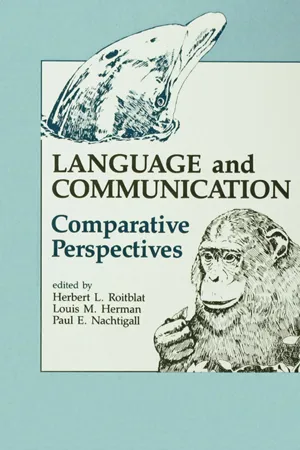
eBook - ePub
Language and Communication
Comparative Perspectives
- 520 pages
- English
- ePUB (mobile friendly)
- Available on iOS & Android
eBook - ePub
Language and Communication
Comparative Perspectives
About this book
Information
Publisher
Psychology PressYear
2013Print ISBN
9781138876200
9780805809466
Edition
1eBook ISBN
9781134765171
1
Cognitive Processing in Artificial Language Research
It was immensely foolish not to have anticipated the intense fervor this work would generate. Yet it was not easy to prepare for the occasion because so few other issues in recent academic psychology had had a comparable effect. The attention given the work by the media kept the emotion dancing. While most work in psychological laboratories proceeds without the slightest attention or diversion from the outside world, the chimpanzee language work was held continually before the public eye. This did little to quell the emotion and equally little, unfortunately, to maintain the quality of the work. (Premack, 1986, p. 1)
In this chapter we outline some alternative conceptualizations of the research on teaching artificial language to animals. In order to make our perspective clear, we state our biases at the outset:
1. No animal has a communication system like that of a normal adult human.
2. There are many similarities and also substantial differences between the performance of animals and the performance of young children in the age range at which they produce utterances with a mean length of utterance (MLU) of approximately 1.0 to 3.0 morphemes.
3. Much of animal performance has been compared with an idealized model of human language acquisition and performance that is probably untenable.
4. Learning, formulaic patterns, and language rituals play important roles in human and animal language acquisition.
5. The question of whether animals have been shown to have (a full adult human) language is ill formed and of little heuristic value.
6. More interesting questions concern the psychology of the systems that animals in language-training experiments acquire.
We refer frequently to “animal language.” We use this term as a shorthand for the use by animals of (frequently tiny) artificial language-like systems. We do not wish to beg the question of whether the performance of animals actually constitutes a language in any particular sense, but it seems too awkward always to use the kind of qualifications that do not prejudge the issues.
Animal Language Research and its Controversies
Historically, the field of animal language research has been racked by frequent controversy. These controversies often provide dramatic spectacles for the participants and the observers, but they frequently place greater emphasis on the supposed intellectual and social shortcomings of the participants than on the merits of the argument. The reasons for such controversies are complex; nevertheless, they can be summarized into five major categories: (a) sociology, (b) methodology, (c) justificationism, (d) reductionism, and (e) the problem of resemblance.
Sociology
Little work in psychology has engendered as much emotional involvement and heated argument as has research in animal language. The very enterprise attacks beliefs that some individuals hold very dear, for example, those concerned with what it means to be a human, or with what it means to know a word. The research has taken tremendous investments of time, effort, and in some cases even personal money.
All of the projects are long-term, with payoffs, in the form of conclusive data, typically delayed for several years (if ever forthcoming). Most projects have focused on individual animals and on the development of a warm personal relationship with those animals. These factors make it very difficult to view the research and its criticism with the kind of objective detachment people would like for a scientific discipline.
Methodology
Animal language research presents particularly difficult methodological task. Research typically involves single subject designs, in which the variable of interest either is learned or is related to learned variables. Development of proper control procedures is difficult, especially with the limited numbers of subjects typically available for each project. Experiments frequently take many months or years to conduct and often require changes in the nature or approach toward the research during the training period. Researchers who are used to conducting experiments in which they have access to large numbers of subjects, have tighter controls over environmental and methodological variables, and can conduct pilot experiments before investing their experimental subjects in a procedure frequently have difficulties accepting typical animal language research designs.
Justificationism
In addition to these methodological and sociological factors that have contributed to the acrimony in animal language research, the controversy has often been fueled by what we consider to be ill-formed questions. Many of these questions have been the result of a quest for some kind of “positivist ideal”(Premack, 1986). This ideal is based on the assumption that fundamental scientific questions can be answered by simple crucial experiments. One has merely to conduct the crucial experiment and all issues will be settled. By judiciously sticking close to ones observations one can develop sound theories and prove that they are correct.
The positivist ideal is a form of justificationism (Lakatos & Musgrave, 1970). Justificationism is the epistemological position that scientific theories can somehow be justified or proved. Implicit in this position is the belief that theory-free observations can prove the validity of scientific theories. As long as the observations are made under sensible conditions, one can be sure that they are infallibly valid and can use them to justify or verify scientific statements.
Unfortunately, neither positivism nor justificationism has fared very well as an epistemological position (see Bechtel, 1988, for an overview of these approaches and the issues). The reasons for this failure are manifold, and space limitations prevent a more complete discussion. They can be summarized by noting that there is no infallibly valid inductive theory that guarantees the correctness of observations or the validity of statements about those observations. Sound deductive logic can transmit truth infallibly from premises to conclusions, but there is no infallible inductive method and no means of guaranteeing the soundness and pertinence of observations. Theories transcend observations in at least three ways, each of which requires a fallible induction: (a) a theory is a universal extension of a finite number of observations; (b) a theory is a precise formulation based on observations accurate only within limits of experimental error; (c) a theory attempts to specify the mechanism underlying observed phenomena, but the phenomena are not those mechanisms. Ultimately, theories depend on the semantic interpretation of the concepts used in the theory and there can be no simple correspondence between finite observations and the concepts of a the theory (see Suppe, 1989).
Although many investigators hold implicitly to the positivist ideal, as a description of the scientific enterprise it is more science fiction than science fact (e.g., see Lakatos & Musgrave, 1970). Science does not proceed by the hypothetico-deductive method, but by fits, starts, and reorganization. Criticism is the engine that drives scientific progress (see Roitblat, 1982). It is naive to believe that fundamental questions about the nature of such phenomena as language can be settled once and for all, even by distinguished scientists. The point of this discussion for present purposes is that it is probably mistaken to expect that any particular research program will be able to settle with finality the issues in animal language research. The implication that the programs fail because they do not provide irrefutable data is to demand a standard of rigor that is unachievable in any area of science. It is in the nature of science that experiments are subject to interpretation and that the interpretations must be arguable. Methodology is far easier to criticize than to perform. Interdisciplinary collaboration is essential to make the best use of the critical and research skills available.
Reductionism
Our biological perspective leads us to reject one approach to understanding the competencies of animals that can be called nothing-but-ism. In this approach, the competencies of an animal are dismissed as nothing but the operation of such factors as temporal or conditional discrimination. The approach seeks to reduce phenomena of animal language to allegedly simpler phenomena.
We avoid such reductionistic approaches for two reasons. First, the mere fact that one can describe some performance in terms used for simpler phenomena is not the same as explaining the phenomenon in terms of those processes. All learning can be described, for example, as changes in response tendencies in particular situations. This description does not imply that learning is the connection of response tendencies with situations. Learning, even as studied in the laboratory, consists of processes with a great deal more complexity than the formation of S-R (stimulus-response) connections (see Roitblat, 1987).
In understanding one phenomenon scientists often attempt to reduce it to simpler phenomena. For example, we may seek to explain the language-like competencies of animals as nothing but the result of conditional discriminations. This analysis implies that conditional discriminations are adequate to explain the phenomenon, are well understood, and are simple, at least relative to the phenomena we wish to reduce. None of these assumptions is necessarily true, and the mere fact that the candidate phenomenon for reduction can be studied in less intelligent or less complex (note the biological irony) organisms than chimpanzees or dolphins fails to imply that the relation is a reduction (see Churchland, 1986, for a discussion of reductionism).
Second, human linguistic processes are not themselves ineffable. Human competence is the result of the operation of biological mechanisms. Human performance may be intelligent, but the mechanisms themselves need not be. Somehow humans compile “intelligent” linguistic behavior out of nothing but “stupid” biological mechanisms. Animals may or may not employ the same mechanisms that humans use, but it would be misleading to dismiss these phenomena as unimportant when they can be attributed to “nothing but” the mechanisms that instantiate it. We want to know how animals perform their tasks. Linguistic competence remains linguistic competence even if we do understand the mechanisms that produce it. Psychologists often erroneously reject as not psychological any phenomenon that they can actually understand in terms of the mechanisms that produce it.
Resemblance
Finally, the last major factor we wish to highlight concerns resemblance. Critics and proponents of the progress in animal language research have often argued about the resemblance between animals’ capacities versus those of human language users. There is no unambiguous way to decide how similar two phenomena must be before they can be said to resemble one another. One person might say, “That woman over there looks just like Meryl Streep,” to which a second person might reply, “No her lips are broader, her hair is shorter, and her eyes are larger.” Finally, the first person might reply, “Yes, but she looks just like Meryl Streep.” Both conversants know that they are not looking at Meryl Streep, but rather at someone who resembles her. We cannot definitively decide which of these conversants is correct. A simple yes or no answer, even if we could establish some criterion by which to provide an answer, would be inadequate. This is not just scientific waffling, but is a fundamental issue. Animal language (or whatever animals in animal language projects have) is not adult human language, and may never be, but opinions about its resemblance to adult human language are fundamentally and forever just opinions. We think that such yes/no questions about the existence or nature of language are best avoided.
The Value of Animal Language Research
Evolutionary Questions
We consider animal language research to be well worth pursuing. These phenomena contribute to our understanding of such issues as the evolution of linguistic competencies (Roitblat, 1987). There are two ways one can study evolution. One way is to examine the fossil record for evidence of change and for the presence of the features in which one is interested. Although some concomitants of linguistic competence can be found in the fossil record (e.g., Marshack, 1984), language itself leaves no record. The other way to investigate the evolution of a capacity is to examine the distribution of these features in current living species. Although no current species is truly ancestral to any other living species, much can be learned by assuming (tentatively) that common features in two species are the result of their presence in a common ancestor. This assumption must be tentative because evolution is a continuing process and because environmental demands often support convergent evolution.
Examination of communalities among species has the added benefit of forcing us to view human language as an example of possibly several alternative systems. One difficulty with studying language in humans is that our familiarity with our own language makes it difficult to avoid glossing over problematic areas and makes it easy to miss hidden assumptions. For example, Braine (1976) has noted that many researchers concerned with language development in children have presupposed the presence of adult linguistic categories such as verb and adjective. These categories are so salient to adult language users that it takes special effort to gain the perspective necessary to see that it might be otherwise, for example, that children may use “grammatical” categories that are described for each lexical item separately, and only later induce abstract class categories for the representation of these rules (see Maratsos, 1988).
Perspectives and Detachment
Research on animals is useful because it encourages us to view cognitive problems with greater detachment and allows us to avoid the seduction of hidden assumptions. We can attempt explanations with greater parsimony because we have no a priori reason to believe that animals must solve their problems in the same way we solve ours. Animal research, in short, allows us to be critical in ways that are difficult when dealing with our fellow human beings. This criticism comes at a cost, however. The cost is being too ready to dismiss examples of complex cognitive functioning in animals as the result of processes that are viewed as simpler. Morgan’s (1894) canon enjoined psychologists from seeking complex explanations of an animal’s behavior as long as mechanisms lower in psychological scale were adequate. On the other hand, Marshall (1971) noted that if we apply the same standards to human language that we apply to animal language, we would find that humans do not talk either! There is thus a slippery path to tread between abject parsimony and flaky entelechy. It is too easy to find “stupid” explanations for phenomena that may be produced by very sophisticated mechanisms (see Roitblat & Herman, 1988). Parsimony cannot be abandoned, but neither should it be applied willy-nilly. Morgan’s canon requires phenomena to be arrayed along a psychological scale so that higher-order phenomena can be replaced by sufficient lower-order phenomena, but such scales have, in fact, been impossible to produce (Hodos & Campbell, 1969). Furthermore, attributing a corpus of behavior to a collection of independent but simple mechanisms may be less parsimonious than attributing the same corpus to a single coherent, though abstract, mechanism. Complex collections of simple mechanisms are not necessarily simpler than a single complex mechanism. Deciding which alternative is simpler requires an adequate theory of the phenomenon and of the alternative mechanisms. The relative simplicity must be considered in light of this theory, because there is no theory-free infallible way to make these decisions. In the following sections of this chapter we offer some suggestions for alternative mechanisms and for their analysis.
Some General Issues in Cognitive Processing
The language-like systems in which animals have been schooled have tended to consist of strings of tokens or lexical items. The animals either are required to produce these strings or to respond in appropriate ways to strings that are presented to them. We would like to know how the animals process these strings, how they represent the tokens that make up the strings, and how they represent the instructions or intentions that the strings are designed (by the human experimenters) to communicate. In addressing these questions we would also like to know the extent to which the strings do actually communicate, that is, transfer new information.
Animals presumably employ at least implicit rules of some sort in dealing with these strings. Considering the representation of the tokens, the rules that animals employ could be quite direct in the sense that they specify certain specific relations between individual tokens an...
Table of contents
- Cover
- Half Title
- Title Page
- Copyright
- Contents
- Preface
- Contributors
- 1. Cognitive Processing in Artificial Language Research
- 2. Beyond Animal Language
- 3. Similarities and Differences in Human and Animal Language Research: Toward a Comparative Psychology of Language
- 4. Knowing How to Use Language: Developing a Rapprochement Between Two Theoretical Traditions
- 5. A Proposal for Computer Modeling of Animal Linguistic Comprehension
- 6. Language Acquisition and the Power of Expression
- 7. Animal Language Research Needs a Broader Comparative and Evolutionary Framework
- 8. Frequency-modulated Whistles as a Medium for Communication with the Bottlenose Dolphin (Tursiops truncatus)
- 9. Linguistic Phenomena in the Natural Communication of Animals
- 10. Meaning, Reference, and Intentionality in the Natural Vocalizations of Monkeys
- 11. Cognition and Communication in an African Grey Parrot (Psittacus erithacus): Studies on a Nonhuman, Nonprimate, Nonmammalian Subject
- 12. Behavior Control by Exclusion and Attempts at Establishing Semanticity in Marine Mammals Using Match-to-sample Paradigms
- 13. Auditory Sequence Complexity and Hemispheric Asymmetry of Function in Rats
- 14. Hemispheric Priming as a Technique in the Study of Lateralized Cognitive Processes in Chimpanzees: Some Recent Findings
- 15. Cognitive Factors Affecting Comprehension of Gesture Language Signs: A Brief Comparison of Dolphins and Humans
- 16. Chimpanzee Competence for Comprehension Video-formatted Task Situation
- 17. Acquisition of Personal Pronouns by a Chimpanzee
- 18. “Language Training” and its Role in the Expression of Tacit Propositional Knowledge by Chimpanzees (Pan troglodytes)
- 19. The Effects of Language on Information Processing and Abstract Concept Learning in Dolphins, Monkeys, and Humans
- 20. Representational and Conceptual Skills of Dolphins
- 21. A Bottlenosed Dolphin’s Responses to Anomalous Sequences Expressed Within an Artificial Gestural Language
- 22. Language Learnability in Man, Ape, and Dolphin
- Author Index
- Subject Index
Trusted by 375,005 students
Access to over 1.5 million titles for a fair monthly price.
Study more efficiently using our study tools.
Frequently asked questions
Yes, you can cancel anytime from the Subscription tab in your account settings on the Perlego website. Your subscription will stay active until the end of your current billing period. Learn how to cancel your subscription
No, books cannot be downloaded as external files, such as PDFs, for use outside of Perlego. However, you can download books within the Perlego app for offline reading on mobile or tablet. Learn how to download books offline
Perlego offers two plans: Essential and Complete
- Essential is ideal for learners and professionals who enjoy exploring a wide range of subjects. Access the Essential Library with 800,000+ trusted titles and best-sellers across business, personal growth, and the humanities. Includes unlimited reading time and Standard Read Aloud voice.
- Complete: Perfect for advanced learners and researchers needing full, unrestricted access. Unlock 1.5M+ books across hundreds of subjects, including academic and specialized titles. The Complete Plan also includes advanced features like Premium Read Aloud and Research Assistant.
We are an online textbook subscription service, where you can get access to an entire online library for less than the price of a single book per month. With over 1.5 million books across 990+ topics, we’ve got you covered! Learn about our mission
Look out for the read-aloud symbol on your next book to see if you can listen to it. The read-aloud tool reads text aloud for you, highlighting the text as it is being read. You can pause it, speed it up and slow it down. Learn more about Read Aloud
Yes! You can use the Perlego app on both iOS and Android devices to read anytime, anywhere — even offline. Perfect for commutes or when you’re on the go.
Please note we cannot support devices running on iOS 13 and Android 7 or earlier. Learn more about using the app
Please note we cannot support devices running on iOS 13 and Android 7 or earlier. Learn more about using the app
Yes, you can access Language and Communication by Herbert L. Roitblat,Louis M. Herman,Paul E. Nachtigall in PDF and/or ePUB format, as well as other popular books in Psychology & History & Theory in Psychology. We have over 1.5 million books available in our catalogue for you to explore.