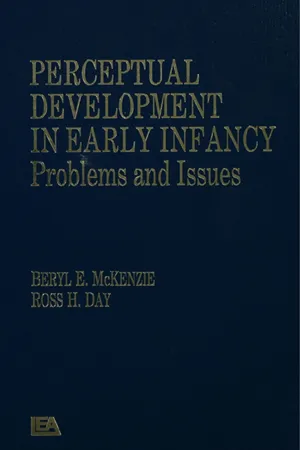
First published in 1987. This book is not intended to be either a comprehensive reference work or a systematic handbook on perception in infancy. Nor is it another published report of a recently held conference. It is a collection of state-of-the-art essays on perception during the first year or so of infant development. Rather than first choosing the topics and then finding experts to write about them the editors first chose the experts and invited them to write about those topics in which we know them to be interested and closely involved. The outcome of this approach is a collection of chapters in which the authors at the same time critically review earlier contributions to the topic, report their own work, identify numerous unresolved problems and key issues, and point out directions for future inquiry. Naturally the emphasis placed on these facets varies markedly with both topic and author. The result is a collection of commentaries that we believe to be comprehensive, informative, interesting, and provocative.
eBook - ePub
Perceptual Development in Early Infancy
Problems & Issues
- 312 pages
- English
- ePUB (mobile friendly)
- Available on iOS & Android
eBook - ePub
Perceptual Development in Early Infancy
Problems & Issues
About this book
Information
1 Problems and Issues in the Study of Perceptual Development in Infancy
Evidence of the rapid and extensive growth of knowledge of early development is provided in the Handbook of Child Psychology (Mussen, 1983) where the largest of the four volumes is devoted to the period of infancy (Haith & Campos, 1983). This intense interest derives from the general aim of investigators to outline the sequence of steps by which infants reach maturity and from the more circumscribed aim of specifying capacities and processes at the initial phase of development. It may also be, as Spelke (1983) argues, that by studying infants we can peel away the layers of specialized notions that are gradually acquired and so reveal more clearly the initial core conceptions about the nature of the world that guide our interactions throughout life.
The purpose of this chapter is to provide a background for the research described later. In the area of early perceptual development, no less than in other areas of psychological enquiry, models of reality influence research findings in terms of methods of investigation, question selection, and interpretation of data. Because the habituation paradigm is a pivotal method that is frequently used to examine the capacities of infants, one objective of this chapter is to explore its logic and evaluate the validity of inferences deriving from it. Particular attention is directed towards the multistimulus habituation procedure which involves presentation of several different items in an acquisition or habituation phase prior to examining responsiveness to novel items in the test phase of an experiment. An important issue arising from studies using this method is whether a distinction can be made between perceptual and cognitive processing, and if so, to examine the consequences of such a distinction. Changes in the nature of questions that are asked about perceptual development are next discussed. Whereas early studies were concerned mainly with the simple presence or absence of perceptual capacities, more recent studies direct attention to the processes that underlie them. The final section is concerned with the types of stimulus patterns and objects that might best serve to illustrate the nature of early perception.
METHODS FOR STUDYING INFANT PERCEPTION
The study of the development of perceptual systems has many facets with questions posed at several levels. The biological limitations of sensory systems throughout development place constraints on the information that may be processed. The methods of psychophysics and psychophysiology have been applied to define these limitations. Such findings have been described in detail elsewhere (e.g., Werner & Lipsitt, 1981) and are not considered further except to note that development in the visual modality has been studied in more detail than development in the other senses. The meticulous studies of Teller, Peeples, and Sekel (1978), for instance, indicate that infant color space is most likely different from that of trichromatic adults. The many studies of developmental changes in the contrast sensitivity function (e.g., Adams & Maurer, 1984; Atkinson & Braddick, 1981; Dobson & Teller, 1978) alert us to physiological restrictions that are relevant to the perception of form (Banks & Salapatek, 1981; Banks, Stephens, & Hartman, 1985; Gayl, Roberts, & Werner, 1983). How these changing capacities direct experience in each developmental period for sensory systems other than vision is less well known.
Questions concerning the phenomenological and feature-detection or descriptive (Marr, 1982) aspects of perception have been studied mainly by examining either differential spontaneous behavior or by the use of some method of training. Many studies indicate the selectivity of visual, auditory, haptic, and gustatory exploration in young infants (Gibson & Spelke, 1983; Werner & Lipsitt, 1981). Paired presentation of visual stimulus patterns may reveal a tendency to look at one rather than the other, some objects are mouthed more than others and some substances yield avoidance behavior when tasted or smelled while others do not. Differential behaviors in these circumstances index perceptual discrimination that is immediate. In this sense it is spontaneous and its demonstration is not based on training procedures. A productive variation of this approach exploits the tendency of infants to prefer matched to unmatched stimulus input. Thus in visual search studies Spelke (1979) has shown that, from an early age, infants will look towards one of two films that matches a nondirectional auditory input rather than at one that does not (see also Kuhl &. Meltzoff, 1984).
Procedures that involve some form of training frequently rely on the infant’s ability to detect change. After a period of exposure to one form of stimulation, behavior to familiar and novel stimulus input is compared. The typical finding is greater responsiveness to novel stimulation. However, the theoretical bases for this behavior are not well understood. Reference usually is made to stimulusmodel comparator theories in which repeated or prolonged exposure is thought to produce some internal representation of external events. Orienting to stimulus change occurs because the external events no longer match the neuronal or cognitive model. Prediction of those stimulus changes that will elicit maximum orienting depends on theoretical position (e.g., Hunt, 1970; McCall & McGhee, 1977; Reznick & Kagan, 1983; Sokolov, 1963). Given the predominance of stimulus-model comparator theories and the general expectation of increased orienting to novel stimulation, it is disturbing that, with what appear to be basically similar procedures, increased attention to familiar stimulation sometimes occurs. For instance, Meltzoff and Borton (1979) found that infants at 4-weeks-of-age looked longer at an object that corresponded in shape to one that had been made haptically familiar by mouthing. That is to say, they oriented more to the familiar than the novel object. Theoretical clarification is needed concerning specification of the conditions under which greater responsiveness to novel or familiar, and matching or mismatching stimulation might be predicted. Some promising beginnings in this respect are emerging (e.g., Hunter, Ames, & Koopman, 1983; Reznick & Kagan, 1983; Rolfe-Zikman, Chapter 9). Whether novelty and, presumably, familiarity preference is exhibited depends intimately on the age of the subjects, the type of stimulus, procedural variables, and the response measure.
The Habituation-Discrimination Paradigm
A method that has been commonly used to specify the capacity of infants to distinguish between stimuli is that of habituation. The logic of this paradigm is similar to that of novelty preference but, rather than exposing the stimulus object or event for a fixed interval, stimulation is continued until a criterion of response decrement is attained. Following habituation to the one stimulus, generalization of habituation is predicted in the test phase to the same stimulus but not to another that is discriminably different. When response recovery to the latter occurs, it is concluded that the habituation stimulus is both recognized and distinguished from the comparison stimulus. In the absence of response recovery, however, it is not possible to conclude that the stimuli are not distinguished since memory for the habituation stimulus and preference for the comparison stimulus are confounded. As Sophian (1980) has observed, this confounding creates problems not only for the interpretation of null results, but also for the interpretation of age and condition comparisons even when reliable differences are obtained. If the experimental aim is simply to specify the presence of discrimination, this paradigm is relatively sensitive and flexible. However, specification of the aspects of the stimulus to which the infant is responding is more complex since it might involve the experimenter-defined stimulus, some particular aspect of it, or of the experimental situation as a whole. Nevertheless, it is clear that familiarization and habituation procedures reveal discrimination and recognition memory when spontaneous preferences are not evident.
Interpretation of visual habituation in terms of sensory adaptation can readily be discounted even for newborns. It has been observed that newborns habituated while viewing with one eye exhibit novelty preference when tested with the other (Slater, Morison, & Rose, 1983). Dannemiller and Banks (1983) suggest the possibility that visual habituation in infants less than about 4-months-of-age may be explained in terms not of retinal adaptation but of adaptation of feature-selective cortical neurons. This suggestion is not strongly supported. (For discussion of this argument see Slater & Morison, 1985; Dannemiller & Banks, 1986.) Further evidence against a sensory explanation of habituation derives from a variant of the paradigm—the multistimulus habituation procedure.
The Multistimulus Habituation Procedure
Infants are first made familiar with a range of stimuli from the same “conceptual” category before being tested with novel stimuli that either do or do not belong to it. The inference that infants perceive similarity between category members—an equivalence class—and recognize new instances of the category, is based on the demonstration of greater responsiveness to noncategory members and generalized habituation to new instances of the category. For this inference to be valid it needs to be established that the differences between stimuli are discriminable, i.e., that generalization is something other than sensory immaturity, and that the test stimuli, both category and noncategory members, have similar interest value for naive infants who have not undergone habituation. In this way it can be shown that infants have detected some similarity between different category members and differentiated these from stimulus items that do not share these properties.
Without an ability to apprehend equivalence in environmental stimulation, the task of abstracting object characteristics would be one of acquiring an infinite number of associations between sensory inputs. Although the human infant from birth (Little, Lipsitt, & Rovee-Collier, 1984) and possibly prior to birth (see Kolata, 1984) is well equipped to form such associations, it is clear that some properties of objects and events are recognized with minimal dependence on experience.
Using a multiple familiarization procedure, Bomba (1984) studied the formation and development of categorization of the orientation of grating patterns in infants aged from 2-to 4-months. When presented with a vertical (0°) and an oblique (45°) pattern following familiarization with patterns of intermediate slant, 4-month-old infants generalized habituation to the oblique but not to the vertical pattern. Greater attention to the vertical grating was found over a wide range of familiarization obliques, 14.5° to 45°, suggesting a process of categorization rather than stimulus generalization. In the absence of familiarization, there was no preference for vertical over oblique gratings. Thus oblique gratings were perceived as similar and different from vertical gratings well before acquisition of the linguistic terms that describe them. The perceptual boundary between them was at about 8°. Categorization could not be attributed to lack of discrimination because infants at this age were equally able to distinguish between- and within-category samples. Since, even at 2 months, novelty preferences were more reliable when vertical rather than oblique patterns were familiar, Bomba (1984) suggested the possibility that the human infant is born with a perceptual system that makes it easy to discriminate any variation from the vertical. Discriminations between obliques are more difficult and the development of an oblique category is more gradual. It is possible that the existence of a unique percept of “vertical” serves as a reference point around which the categories of orientation develop—a kind of natural category (Rosch, 1973). These findings have implications for theories of categorization and may represent an instance of one of the initial “core conceptions” that shape later development.
The multiple habituation technique has been used to examine categorization in such diverse areas as speech perception (Kuhl, 1983), face perception (Strauss, 1979), form perception (Bomba & Siqueland, 1983; Ruff, 1982), perception of hue (Bornstein, 1981), and perception of numerosity (Strauss & Curtis, 1984). These studies have demonstrated that infants at an early age abstract information about similarities of objects and events after exposure to a range of exemplars. The processes and abilities necessary for the formation of equivalence classes appear to be inherent aspects of the human information processing system.
It is of interest to establish the extent to which various types of information are categorized, to examine the timetable and sequence of categorization, and to compare the nature of the categories at different ages with that of adults. Bomba and Siqueland (1983) have begun a program of this kind to study two-dimensional form perception. Infants at 3- to 4-months-of-age, like adults, appear to recognize an unseen prototype of a category. When presented with various distortions of a triangular form, for instance, they recognize a regular triangle as the best example of the triangle category. This prototype effect, in infants as in adults, is increased both by delay procedures and by increasing the number of exemplars in the familiarization phase. These findings have interesting implications for memory as well as perceptual processing. Superior recognition of a prototype after delay may be produced by faster decay of the specific information pertaining to particular members than of general information that is relevant to the category as a whole.
Interpretation of multiple habituation data. If we are to distinguish features of the environment to which infants exhibit a natural competence (e.g., orientation, number, color, speech sounds) it needs to be established that the ability is determined solely on the basis of the invariant feature and not on any other correlated attribute. For example, in studies of the perception of numerosity, factors such as configuration, brightness, density, and figural area need to be controlled. Strauss and Curtis (1984) conclude that the ability of infants from about the age of 5 months to detect the numerosity of small numbers of items in an array is well established, but that the process by which this is accomplished is as yet not clear. Is numerosity perceived in the same way as color or form? That infants generalize habituation to a novel instance of “twoness” and not to an instance of “threeness” and vice versa suggests discrimination of numerosity but does not mean that infants can count, that the abstract notion of “two” is immediately perceived, or that “three” is conceived as greater than “two.” The early sensitivity to numerosity that is displayed in multiple habituation studies does not necessarily imply notions of ordinality, cardinality, counting, and other features that are associated with the mature number concept. In studies of this kind any given set of habituation events may be categorized in more than one way; it is important to recognize that the equivalence detected by the infant may not correspond to that defined by the experimenter.
Whether categorization is demonstrable at all depends on a complex set of factors including the characteristics of the infant, the stimulus set, and the experimental procedure. Procedural variables include the mode of stimulus presentation (paired or single), the number of trials in habituation, and the nature of the dependent variable (e.g., duration of looking, vacillation in looking between stimuli, heart rate). Stimulus-set variables include the size of the acquisition set in the habituation phase, the discriminability of the relevant dimension of the category, and the degree of discrepancy between the test and the acquisition set. Individual-difference variables have not yet been explored in any depth. There are however indications that the multistimuli habituation paradigm may be developed to serve a valuable clinical function. Caron and Caron (1981) have shown that the categorization of pre-and postmature infants ma...
Table of contents
- Cover Page
- Half Title Page
- Title Page
- Copyright Page
- Contents
- List of Contributors
- Preface
- Part I History and Methods
- Part II Perception of Objects
- Part III Bimodal Perception
- Part IV Speech Perception
- Part V A Concluding Commentary
- Author Index
- Subject Index
Trusted by 375,005 students
Access to over 1.5 million titles for a fair monthly price.
Study more efficiently using our study tools.
Frequently asked questions
Yes, you can cancel anytime from the Subscription tab in your account settings on the Perlego website. Your subscription will stay active until the end of your current billing period. Learn how to cancel your subscription
No, books cannot be downloaded as external files, such as PDFs, for use outside of Perlego. However, you can download books within the Perlego app for offline reading on mobile or tablet. Learn how to download books offline
Perlego offers two plans: Essential and Complete
- Essential is ideal for learners and professionals who enjoy exploring a wide range of subjects. Access the Essential Library with 800,000+ trusted titles and best-sellers across business, personal growth, and the humanities. Includes unlimited reading time and Standard Read Aloud voice.
- Complete: Perfect for advanced learners and researchers needing full, unrestricted access. Unlock 1.5M+ books across hundreds of subjects, including academic and specialized titles. The Complete Plan also includes advanced features like Premium Read Aloud and Research Assistant.
We are an online textbook subscription service, where you can get access to an entire online library for less than the price of a single book per month. With over 1.5 million books across 990+ topics, we’ve got you covered! Learn about our mission
Look out for the read-aloud symbol on your next book to see if you can listen to it. The read-aloud tool reads text aloud for you, highlighting the text as it is being read. You can pause it, speed it up and slow it down. Learn more about Read Aloud
Yes! You can use the Perlego app on both iOS and Android devices to read anytime, anywhere — even offline. Perfect for commutes or when you’re on the go.
Please note we cannot support devices running on iOS 13 and Android 7 or earlier. Learn more about using the app
Please note we cannot support devices running on iOS 13 and Android 7 or earlier. Learn more about using the app
Yes, you can access Perceptual Development in Early Infancy by B. McKenzie, R. H. Day, B. McKenzie,R. H. Day in PDF and/or ePUB format, as well as other popular books in Psychology & Developmental Psychology. We have over 1.5 million books available in our catalogue for you to explore.