![]()
1
ANTHROPOLOGY, BICYCLES, AND URBAN MOBILITY
“Whoever thought it would come to this? Our cavalcade grows exponentially! Hath you seen it? On the roadways of every city there are bicyclists emerging again after a century in shadows. We are here to claim what’s rightfully ours: respectful free movement on streets everywhere. In Milwaukee, and Pittsburgh, Dallas, too, and Bellingham, Grand Rapids, and Los Angeles, even!”
—Boneshaker, bicycle ’zine, 2011
During the Fall of 2011, General Motors, the largest automobile company in the world, began running an advertisement targeted at U.S. college students. The ad, which appeared in posters placed around college campuses and in campus newspapers throughout the country, shows an image of a young man wearing a backpack sitting on a bicycle, shielding his embarrassed face with one of his hands, while an attractive young woman smiles at him from a car. Splashed across the top of the ad, in bold print, it says, “REALITY SUCKS. Luckily the GM college discount doesn’t.” With the tag line “Stop Pedaling … Start Driving,” the ad explains that college students and recent graduates are eligible to receive a special discount of anywhere from several hundred to several thousand dollars on a new GM car or truck.
That such an ad exists is not especially remarkable. Automobile ads are ubiquitous in our public sphere, tailored carefully to appeal to specific audiences with special messages and incentives. This particular ad communicates a (possibly amusing) message that a lot of American college students can probably relate to: having been driven around in cars since they were little, and then driving themselves in their teenage years, they are reduced to riding bicycles, an inferior and undignified state of affairs, because money is tight or maybe because their college limits the number of cars on campus. But it’s a temporary thing. Because bicycles are children’s toys, and adults who ride them are not quite grown up, or worse, they wear lycra shorts. Because automobiles are cool, innovative, and fast, and bicycles are not. And because bicycling is an impractical, inconvenient, maybe even dangerous way to get around. Once you return to the “real world” beyond college, the ad communicates, you can get on with your life, a life in which the automobile plays an obvious and central role.
These ideas about cars and bicycles are familiar to many Americans. But what is remarkable in this situation is that not long after the ads appeared, there was a public outpouring of rage and resentment from cyclists, many of them people who use bicycles as their primary means of getting around. Across the internet—in blogs, online forums, Twitter feeds, and viral emails—thousands of them laid into GM and its top executives for spreading an anti-bicycle message. National bicycle advocacy groups based in Washington, D.C., and their allies in dozens of cities and towns throughout the country, alerted their members to write letters and send emails of complaint to GM. The world’s largest bicycle company, Taiwan-based Giant Bicycles, even remade the original GM ad using an image of gridlocked traffic, and a message “REALITY DOES SUCK. Luckily bicycles don’t …”. With its own tag line of “Stop driving … start pedaling,” Giant’s ad declares that cycling is healthy at any age and, compared with the massive expenditures associated with buying and maintaining an automobile, can save you thousands of dollars a year. Facing this unexpected backlash (and recognizing that among the 57 million Americans who ride bicycles are a lot of car owners), GM pulled its ads, expressed regret for any disrespect it may have communicated to cyclists, and promised to change its campaign’s message.
Reflecting on the situation not long after GM pulled the ad, one blogger observed, “When a car company publicly apologizes—multiple times—for making an anti-bike ad and promises to change it? Could you have seen that happening five years ago? I think we’re getting somewhere.”
Reconsidering the Bicycle
It is difficult to tell where that “somewhere” is, but the bicycle does seem to be enjoying what a pair of transportation planners recently termed a “renaissance” (Pucher et al. 2011) and one journalist even called a “pedaling revolution” (Mapes 2009). Not only is the bicycle industry enjoying booming sales, in dozens of major cities and hundreds of suburbs throughout the United States, among them the country’s most important urban centers—New York, Chicago, San Francisco, Minneapolis, Boston, Philadelphia, Boulder, Portland, Madison, Los Angeles, and Washington, D.C. to name a few—people have been taking to bicycles in noticeable, even surprising, numbers. The rise in cycling may not be quite “exponential” as the epigraph above expresses—it also tends to be gendered (with men constituting the majority of new riders)—but the number of bicycle trips made in the U.S. has been growing, much faster than the rate of population growth. Between 1977 and 2009, for example, the total number of bicycle trips has tripled, the pace of that increase intensifying during the past five years (Pucher et al. 2011). Much of that growth has been in urban areas where people have turned to using bicycles as a utilitarian vehicle, and where currently 52 percent of all bike trips are for practical purposes, the rest being for recreation or exercise (Pucher et al. 2011). In certain cities, rates of growth in cycling have been astonishing, such as a 77 percent increase in New York City in the past five years, and since 2007, 80 percent increase in Washington, D.C.
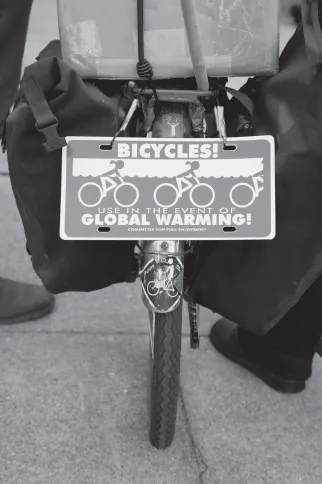
One of the most striking features of the bicycle’s rise is that it involves an upheaval in meanings surrounding the object itself. Americans are accustomed to thinking of the bicycle as a child’s toy or as a performance machine for the lycra-clad competitor or recreational enthusiast, but with its current rise there is a new sensitivity to the bicycle as a functional vehicle for getting around in everyday life. In the current zeitgeist, this shift in meanings can denote a couple of things. One is a growing recognition that bicycles can provide a useful, quick, healthy, inexpensive, technologically-simple, efficient, and even enjoyable method of getting from point A to B. This usefulness is especially true in flat and dense urban areas where the distances are relatively short, and where persistent traffic congestion makes it a pain to get around by car. The other idea here is more focused on the bicycle as a tool of socio-political, environmental, and cultural change. As the late Susie Stephens, a prominent bicycle advocate during the 1990s, expressed, the bicycle creates “sustainable living, a cleaner earth, egalitarianism, and community.” In an era of public concern over increasingly expensive fossil fuels, global warming, the sustainability of consumption-oriented lifestyles, an obesity epidemic, and interest in reducing the scale of everyday life, the bicycle helps people “get around how they get around” (Figure 1.1). In other words, it appears to offer a viable, effective, and, perhaps above all, sustainable alternative to the transportation status quo, which in the U.S. revolves around the private automobile.
The rise of the bicycle in recent years is thus set against a backdrop of automobile dominance, what some scholars call a condition of “hyperautomobility” (Adams 2001; Freund and Martin 2007; Vannini 2009). The United States is, to an historically and globally unmatched extent, a nation of private automobile users. As the National Household Travel Survey (2009) shows, almost 90 percent of the “trips”—defined in transportation research circles as “mobility for a purpose”—that Americans make are by private automobile. Americans spend on average 18.5 hours a week in a car, typically driving about 40 miles per day. Some of that time is spent getting to and from work (91 percent of American workers drive in a car to work every day) but most of it (80 percent) is spent involved in the mundane activity of running errands—going to the grocery store, picking up the kids, dropping off the laundry. Half of all discrete trips Americans take are under three miles and 40 percent under two miles—both of which are generally considered “bikeable distance” for most adults—and yet still only about 1 percent of overall trips Americans take are by bicycle.
Figure 1.1 Climate Action, San Francisco.
Source: Universal Images Group Editorial
With more than 250 million registered automobiles, the highest number of any country on the planet, Americans are often told that they love their automobiles. It would be difficult to say otherwise to a NASCAR fan, a vintage car collector, or the automobile advertising executives who created the GM ad campaign discussed above. But for most Americans, love is not really the point. Automobiles are a fact of life, a taken-for-granted necessity for doing the things they expect, and are expected, to do in their lives. During the twentieth century the U.S. underwent unprecedented change as our economy, social relations, residential patterns, and landscape were reorganized around mass automobilization. Automobiles came to occupy the heart of American industrial and economic growth (reflected in the famous quotation “What’s good for General Motors is good for the country”), how Americans think of themselves as a nation (as inventive people who love the speed, freedom, and technological progress associated with cars), and at least since the 1950s, where they live (in sprawling suburbs without public transportation where cars are necessary to get around). This transformation has been buttressed by a powerful “car ideology” that shapes how they view the world, structuring and limiting their most basic perceptions of how to get around, what to spend their money on, and what kinds of risks they accept (Lutz and Fernandez 2010: 11).
Yet even as it seems difficult, undesirable, or downright traitorous to imagine an alternative to the automobile, this condition of hyperautomobility exerts a heavy toll: On American lives and bodies, with 35,000 to 40,000 deaths and 2 million injuries each year due to collisions (Lutz and Fernandez 2010); long-term chronic issues related to the carcinogenic substances people breathe from automobile emissions (Deka 2004); and a public health crisis in which lack of physical activity is a major cause of high rates of obesity (Pucher et al. 2010). On economic productivity, in which American businesses lose six billion person hours and over $100 billion in productivity each year due to traffic congestion (Federal Highway Administration 2011). On personal income, in which the average expenditure to keep a car running is $8,000 per year, and over a lifetime of driving an average expenditure of about $1 million per household is spent on cars and their upkeep (Lutz and Fernandez 2010). On social relations, in which automobility fosters individuality, competition, rejection of collective responsibility, aggressiveness, and domination by way of movement, speed, and escape (Bauman 2000: 12). On social equality, in which social groups that have less access to cars, or choose not to use them, including the elderly, poor, youth, disabled, non-car owners, and members of immigrant groups and ethnic minorities, are endangered or experience inhibited mobility because of automobile domination (Cass, Shove, and Urry 2005). And on the environment, in which automobiles consume 70 percent of the petroleum this country uses, emit critical amounts of greenhouse gases linked to climate change, and motivate the creation of extensive road networks and parking lots (enough to cover an area the size of Connecticut) that disrupt biodiversity and cause run-off of toxic substances into waterways (Bae 2004; Deka 2004; Lutz and Fernandez 2010).
Enter the bicycle. Or maybe re-enter the bicycle. Beginning back in the 1970s, a number of strong voices emerged clamoring for a change in our automobile dominant transportation system, arguing that it was leading toward a “carmageddon,” in which the “energy slavery” of petroleum dependence was generating an impending ecological catastrophe, and bicycles offered a useful alternative (Illich 1977). A loosely organized “bike movement” formed, and its major accomplishment throughout the 1970s and 1980s was to gain for cyclists the legal right to ride as vehicles on the roads. Today, in an era of public concern over environmental sustainability and obesity, the bike movement has new legs, and has reemerged as a vocal and often effective lobbying presence in national and local government (Wray 2008; Mapes 2009). Cycling advocacy groups have been joined in their promotion of the bicycle by environmentalists, urban neighborhood activists, and even public health officials, all of whom have begun shifting their attention toward the realm of transportation policy and planning, based on a perception of the bicycle’s key role in promoting non-polluting sustainable transportation, a locally-oriented lifestyle, quality of life, and community health (Batterbury 2003; Horton 2006; Parkin 2012). It is not uncommon in these circles to hear that the bicycle represents a simple solution to the many complex problems confronting contemporary society. As a Boston-based activist explained at a bicycle advocacy summit I attended, “If I were running for office, here is what my campaign platform would be. Less crime. Better school performance. Reduced greenhouse gases. Better looking communities. Friendlier neighborhoods. A more prosperous business district. And you know how I would be able to achieve these things? Bicycles. All we have to do is create the conditions to get people riding bicycles.”
Politicians long beholden to the automobile are also rethinking the bicycle. One indication of this fact is the increase since the 1990s at the federal level of investment in bicycle-related infrastructure and programs, which has hovered between $600 million and $1 billion a year during the past several years. Although even $1 billion is a drop in the bucket compared to the more than $100–120 billion invested in automobile-related highway and road expenditures, bicycle advocates were further encouraged when Ray LaHood, U.S. Secretary of Transportation, announced in early 2010 “the end of favoring motorized transportation at the expense of non-motorized.” Declaring it a “sea change” in federal policy, LaHood announced that the government would thereafter integrate the needs of cyclists in federally funded transportation projects, discourage transportation investments that negatively affect cyclists, and encourage investments that go beyond minimum requirements to meet the needs of cyclists and walkers. Explaining the decision, LaHood wrote in his blog (LaHood 2010), “Look, bike projects are relatively fast and inexpensive to build and are environmentally sustainable; they reduce travel costs; dramatically improve safety and public health; and reconnect citizens with their communities.”
At the municipal level, many city leaders have also begun to think of the bicycle as a cost-effective way to address some pressing practical and political problems. These problems include persistent traffic congestion, populist backlashes against ill-conceived road projects, pressure to meet city targets for reductions in greenhouse gas emissions, preparations for a post-oil future, and demands to remain competitive with other cities that offer a high quality of life, which typically means public spaces devoid of noisy and polluting automobiles (Mapes 2009; Furness 2010). As a result, dozens of U.S. cities have been implementing bicycle-friendly projects, such as bike-share programs, bike lane expansions, and incentive and education programs to get more people bicycling. Such projects have not been uncontroversial, generating in some places, most notably New York City, “a simmering cultural conflict between competing notions of urban transportation” (Goodman 2010; Blickstein 2010). In the past couple of years, the city has seen a rise in sharp tensions and open conflicts between bicycle advocates and critics who complain ardently of inconsiderate cyclists, or the dedication of precious public funds toward the interests of a minority of users. When a well-known Wall Street Journal columnist joined in the fray—he wrote “A fibrosis of bicycle lanes is spreading through the cities of the world. The well-being of innocent motorists is threatened as traffic passageways are choked by the spread of dull whirs, sharp whistles, and sanctimonious pedal-pushing” (O’Rourke 2011)—it was clear that the city’s pursuit of bicycle-friendliness was grating on some prominent nerves.
These efforts and their controversies do not exist in a global vaccuum, which is to say that bicycles are on agendas for urban social change across the world. Indeed, bicycle advocates in the U.S. explain why and how the American transportation system can accommodate the bicycle by pointing to non-U.S. examples of bicycle-friendly innovations. Amsterdam (The Netherlands), Copenhagen (Denmark), and Freiburg (Germany) are among the first to be mentioned, not simply because of their high rates of cycling (upwards of 30–40 percent of all trips are by bicycle in these cities), but because those high rates of cycling were achieved in spite of the fact that these countries, like the U.S., have histories of mass motorization. In London, Paris, Bogotá, Mexico City, Montreal, Vancouver, Barcelona, and Berlin (among many others), leaders have recently made high profile commitments to promoting bicycles, implementing bicycle-only avenues, charging cars to enter the city center, creating bike-share programs, and aggressively expanding bike lanes. And in Asian countries like China and Japan, the bicycle remains a common—and in some places, dominant—mode of urban mobility. Even as the growing middle classes of Beijing and Shanghai in China aspire to own automobiles, 20 percent of trips in those cities continue to be by bicycle; in other Chinese cities, rates of cycling remain much higher (Gardner 1998; Haixiao 2012). Delegations of mayors and urban planners from the U.S. have been traveling to and from some of these places, searching for inspiration and practical guidance on how to implement bicycle-friendly solutions back home.
The point of all this is not that there is a worldwide bicycle conspiracy, much less a tightly coordinated international effort to promote bicycles. If anything, even as bicycles outsell automobiles worldwide by a margin of almost two to one (130 million bicycles vs. 70 million automobiles produced in 2007; Brown 2010), transportation experts project a global future of increasing automobility, in which a current world total of 850 million automobiles could lead to upwards of 2 billion by 2050 as the U.S., European, and Asian automobile industries turn their attention to new frontiers of expansion in Chinese and Indian markets (Shafer and Victor 2000). Rather, the social and political energy coalescing around the bicycle as a utilitarian vehicle in particular seems be speaking to a number of widespread concerns and ambivalences in people’s everyday lives, among them the environmental consequences of petroleum dependence—including global climate change and localized air pollution—as well as persistent t...