- 256 pages
- English
- ePUB (mobile friendly)
- Available on iOS & Android
eBook - ePub
The World Apple Market
About this book
Growers, packers, processors, and distributors of apples who wish to survive into the twenty-first century need to understand that they are now operating in an interconnected world market. The World Apple Market explains in lay terms the economics of the changes taking place in each phase of the apple business and assists firms in weighing decisions on organization, adoption of new technology, distribution systems and other crucial areas, allowing them to adjust operations and refocus their activities for the future.
Readers will find the best available data on current industry operations and practices in this book, which is helpful to both established firms and new operators in reviewing their practices. Author A. Desmond O?Rourke describes evolving world apple supply and demand, changing distribution systems, and governmental and other societal pressure to which the industry must respond. Throughout, the book focuses on the economic forces which affect firm and industry profitability and even more specifically, it focuses on how to maintain cost efficiency while maintaining the quality of a perishable product.
The World Apple Market explains the economics of practical decisionmaking at every level of the apple industry. This is crucial information for managers of operations that grow, pack, process, and market apples. As changes in market demand, distribution systems, and government regulation continue to alter the environment for decisionmaking, this book assists all involved in the apple market from researchers and extension agents, to industry associations, suppliers, and apple promoters, to government planners, students planning to enter the apple industry, and investors weighing the feasibility of participating in the industry at any level.
Chapter 1
World Apple Supplies
Most of the world’s supplies of apples come from the temperate zone of the Northern and Southern hemispheres between latitudes 40° and 50° north in Europe and North America, 30° and 40° north in Asia and 20° and 40° south in the Southern Hemisphere. Historically, production has been possible outside these zones where climate was moderated by ocean influences (as in New Zealand) or by higher elevations in some semitropical areas.
Apples require sufficient cold temperatures in winter to induce dormancy and the setting of fruit in the subsequent season. They require long, warm summers in order to obtain ripening of most varieties. Thus, apples do not generally thrive in colder, continental climates. However, technology has permitted a gradual expansion of the range of areas in which apples can be grown successfully. Advances in cold hardiness of rootstock and in frost control have permitted production in harsher winter and spring conditions. The development of irrigation and of more heat-tolerant varieties has permitted expansion into semitropical desert conditions. Over time, the industry appears to be inching closer to the equator as the advantages of climate control in the warmer areas offset the greater hazards of production in the cooler climates.
PRODUCTION TRENDS
World apple production grew steadily in the decades of the 1960s, 1970s and 1980s (Table 1.1). This was similar to the experience of deciduous fruits such as pears, peaches, apricots, and cherries. However, while apples became relatively more important among deciduous fruits, they were facing increasing supplies of tropical and semitropical fruits and of more exotic items such as kiwi fruit, avocados, mangos, and papayas. Per capita production of apples and other deciduous fruits grew little in the 1970s and 1980s.
TABLE 1.1 World Production of Major Deciduous Fruit, Selected Years
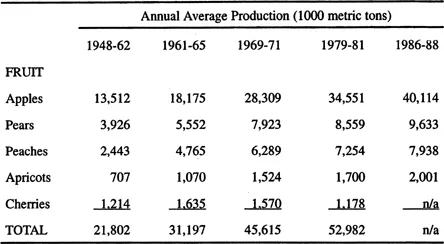
SOURCE: United Nations Food and Agriculture Organization. Production Yearbook, Annual (selected issues).
Expansion of apple production has not been uniform around the world (Table 1.2). While the quality of statistics on apples varies by country, we can only assume that the annual production figures reported by the United Nations Food and Agriculture Organization at least correctly capture the direction of trends in production. Throughout the period studied, the European continent has remained the dominant supplier of apples. Growth in western Europe was rapid in the 1960s but tapered off in the 1970s as the European Community began a grubbing program to offset an oversupply problem. During the same period, production was reported to have expanded rapidly in the centrally planned countries of Europe and Asia, although these statistics cannot be easily verified.
While some growth occurred in North America, it was particularly rapid in the Southern Hemisphere and in nontraditional suppliers such as India, Iran, Pakistan and Turkey. Much production expansion in the 1970s was stimulated by generous credit from agencies such as the World Bank, individual governments interested in of intensive and private investors.
While investment in new plantings slowed dramatically during the 1980s, production continued to increase in many areas as the new plantings reached full maturity. Growth was greatest in the United States, Mexico, Chile, New Zealand, South Africa, Brazil, Turkey, and France. Expansion of plantings continued in Southern Hemisphere countries such as Chile, New Zealand, and Brazil. Orchard abandonment increased in more marginal production areas in Europe, North America and Australia. Political and economic turmoil dramatically altered the environment for production and marketing of apples in many centrally planned countries.
The outlook for production in the 1990s reflected a continuation of these trends. Total European production was expected to stagnate. However, growth was expected to continue in the United States, Mexico, selected countries of south and east Asia, and among leading producers in the Southern Hemisphere such as Chile, Brazil, South Africa, Australia, and New Zealand. Consider-able uncertainty surrounded prospects for the former USSR and the People’s Republic of China. It seemed unlikely, however, that world apple production would grow faster than world population in the 1990s.
APPLE VARIETIES
While apple trees frequently remain in production even in commercial orchards for many decades, there is a continual process of abandoning older varieties and strains as newer varieties are tried and prove successful. There is also considerable seesawing in the popularity of varieties from region to region. For example, during the 1970s, as Granny Smith plantings were expanding in the Northern Hemisphere, they were contracting in the Southern Hemisphere (O’Rourke, 1986b).
Varieties can be distinguished in many ways (Norton and King, 1987). For example, varieties vary in their color, usually variants of red, yellow or green. The color may be solid, striped, or have a blush of a different hue. They vary in shape: round, conic, oblate, or oblong when looked at from the front; regular, elliptical, angular, or ribbed when looked at from above. They vary in taste as a result of skin toughness, flesh texture, sweetness, or juiciness.
TABLE 1.2. World Production of Apples by Continent and Major Producing Countries, Selected Years
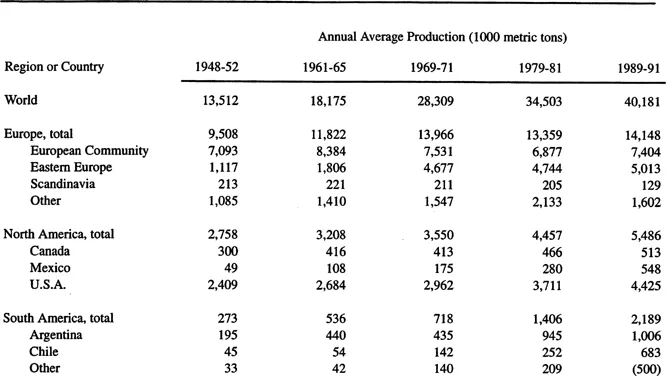
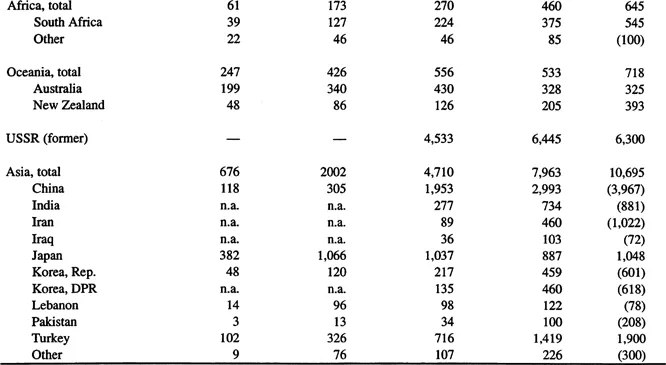
SOURCE: United Nations Food and Agriculture Organization. Production Yearbook, Annual (selected issues) (Numbers in parentheses are author’s estimates.)
Varieties also vary in their adaptability to differing climatic conditions, soil types, and rootstocks; in their ease of management, in their susceptibility to disease, winter injury, drought and rainfall; and in the quantity, quality and consistency of yield. They vary in their durability in packing, storage and shipment and in their appropriateness for different end uses such as eating out of hand, home cooking, food processing (e.g., as juice), or in industrial uses.
Clearly, the long-term changes in the popularity of different varieties are affected by changes in the technology of growing, handling, processing and marketing apples and by changes in consumer preferences. While economists can identify the supply response of individual varieties to price factors, there has never been a comprehensive study of the multiple factors affecting changes in varietal preference among growers, marketers and consumers. Thus, there is no simple model to help predict what sort of varietal changes we may expect in the world market in the future. Only fragmentary evidence is available on world production of major varieties. The USDA’s Foreign Agricultural Service, Horticultural and Tropical Products Division developed an estimate of apple production by varieties for 32 countries in 1977 and 1978. While the People’s Republic of China and the former USSR were not included, the survey covered over 90 percent of the remaining production recorded by UNFAO for those ...
Table of contents
- Cover
- Half Title
- Title Page
- Copyright Page
- Table of Contents
- List of Tables
- List of Figures
- Foreword
- Introduction
- Chapter 1. World Apple Supplies
- Chapter 2. Production Systems and Costs
- Chapter 3. Apple Consumption Patterns
- Chapter 4. Warehousing and Packing: Technical Aspects
- Chapter 5. Warehousing and Packing: Economic Aspects
- Chapter 6. Transportation and Wholesaling
- Chapter 7. Retailing
- Chapter 8. Apple Processing Systems
- Chapter 9. Government Influence
- Chapter 10. International Trade
- Chapter 11. Future Issues
- References
- Index
Trusted by 375,005 students
Access to over 1.5 million titles for a fair monthly price.
Study more efficiently using our study tools.
Frequently asked questions
Yes, you can cancel anytime from the Subscription tab in your account settings on the Perlego website. Your subscription will stay active until the end of your current billing period. Learn how to cancel your subscription
No, books cannot be downloaded as external files, such as PDFs, for use outside of Perlego. However, you can download books within the Perlego app for offline reading on mobile or tablet. Learn how to download books offline
Perlego offers two plans: Essential and Complete
- Essential is ideal for learners and professionals who enjoy exploring a wide range of subjects. Access the Essential Library with 800,000+ trusted titles and best-sellers across business, personal growth, and the humanities. Includes unlimited reading time and Standard Read Aloud voice.
- Complete: Perfect for advanced learners and researchers needing full, unrestricted access. Unlock 1.5M+ books across hundreds of subjects, including academic and specialized titles. The Complete Plan also includes advanced features like Premium Read Aloud and Research Assistant.
We are an online textbook subscription service, where you can get access to an entire online library for less than the price of a single book per month. With over 1.5 million books across 990+ topics, we’ve got you covered! Learn about our mission
Look out for the read-aloud symbol on your next book to see if you can listen to it. The read-aloud tool reads text aloud for you, highlighting the text as it is being read. You can pause it, speed it up and slow it down. Learn more about Read Aloud
Yes! You can use the Perlego app on both iOS and Android devices to read anytime, anywhere — even offline. Perfect for commutes or when you’re on the go.
Please note we cannot support devices running on iOS 13 and Android 7 or earlier. Learn more about using the app
Please note we cannot support devices running on iOS 13 and Android 7 or earlier. Learn more about using the app
Yes, you can access The World Apple Market by Andrew D O'Rourke in PDF and/or ePUB format, as well as other popular books in Business & Agribusiness. We have over 1.5 million books available in our catalogue for you to explore.