Simone Weil (1909-1943) was a defining figure of the twentieth century; a philosopher, Christian (although never baptised), resistance fighter, Labour activist and teacher, described by Albert Camus as 'the only great spirit of our time'. In 1941 Weil was introduced to Father Joseph-Marie Perrin, a Dominican priest whose friendship became a key influence on her life. When Weil asked Perrin for work as a farm hand he sent her to Gustave Thibon, a farmer and Christian philosopher. Weil stayed with the Thibon family, working in the fields and writing the notebooks which became Gravity and Grace and other posthumous works.
Perrin and Thibon met Weil at a time when her spiritual life and creative genius were at their height. During the short but deep period of their acquaintance with her, they came to know her as she actually was. First published in English in 1953, and now introduced by J.P. Little, this unique portrait depicts Weil through the eyes of her friends, not as a strange and unaccountable genius but as an ardent and human person in search of truth and knowledge.
- 184 pages
- English
- ePUB (mobile friendly)
- Available on iOS & Android
eBook - ePub
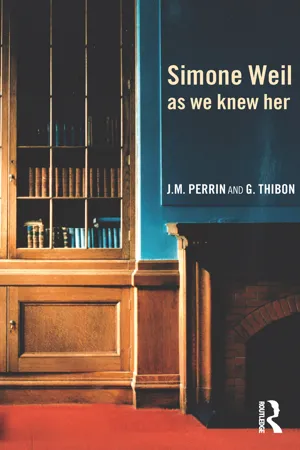
Simone Weil as we knew her
About this book
Information
Part One
by J. M.Perrin
FOREWORD
It is impossible to understand a conversation without listening to both speakers; it would be unjust to judge its full significance and to accept its testimony apart from such a context; that is why as more and more of Simone Weil’s thought is made known I feel impelled to undertake this work, which is in a sense a marginal accompaniment to Waiting on God and Intuitions Pré-Chrétiennes.
Unfortunately it is impossible after the passage of years—and what years they have been!—to recreate a dialogue which was spread over ten months and which was not coloured by any external happenings.
The setting was practically always one of the bare, shiny parlours of the Dominican convent at Marseilles; the subject was always the great preoccupation which had first brought Simone Weil to me.
In terms which would overwhelm me if I did not know that they do not apply to me personally but to my mission, she has said what these meetings meant to her and what she found in our intercourse. It is not for me to return to the subject, but I must insist, now that thousands of readers have broken in upon our conversation with their prejudices and problems, their superficiality or their profundity, that what she said then represents her thought
Time in its inexorable justice will show the value of her work, but since so many of our contemporaries are passionately interested in her testimony and spiritual experience, I should like to try to describe more fully than is possible in a preface—a preface is always too long—the development, or rather the ‘waiting’, of Simone Weil.
I have no preconceived opinion as to the outcome of that development, although I am more in a position to judge it now than I was a year ago.
It is true that the publication of her later writings has posed many problems and baffled more than one of her admirers; a thousand interpretations, favourable or antagonistic, and even some of my own formulae, have combined to increase the tangle. Everyone has pulled the thread that suits him, and this is one of the things against which I think it is my duty to protest; no one has any right to misrepresent the thought of Simone Weil, either by distorting it, or by using it as a cloak for his own prejudices.
Facts are facts, and truth cannot gain through any misunderstanding. I know the value of the unique confidences she gave me, but I also know the agonizing sense of incompleteness which tormented her. I will not even try to say how far she was from Christianity—that remains a mystery—but I will merely redescribe the orientation of her thoughts and the subject matter of our conversations.
I can do this more easily now, since the publication of La Connaissance Surnaturelle has brought out the importance of certain pages of The Need for Roots and since the Letter to a Priest has given, not so much an enumeration of her real difficulties, as an account of one of the tendencies of her spirit and of the inward conflict which rent her. I can do it still better since the unpublished papers she wrote in London have been communicated to me through the extreme courtesy of Monsieur Maurice Schumann—writings which form what is perhaps the most vigorous expression of Simone Weil’s soul during the last months of her life.
Precious as these documents are, they are subsequent to the months in Marseilles and are therefore outside the subject to which I feel I should confine myself.
As for that period—in addition to my personal memories and the testimony of a few friends, I have had the good fortune to find some notes and several passages of hitherto unpublished letters of Simone Weil; the correspondence with G.Thibon supplies some very exact information about her deepest thoughts, and, at least once, about her reactions after we had had an interview.
The texts which have appeared under the title Intuitions Pré-Chrétiennes belong to the same period. They are all covered by our conversation, and even form one of the most essential parts of it. They show how deeply Simone Weil was concerned to find Christ in pre-Christian times, and especially in Plato. Were these texts to solve the problems raised so many centuries ago by the philosopher? Do not Plotinus and Saint Augustine both stem from him? Specialists will admire her very extensive knowledge of ancient Greece, but will they share this interpretation? That is their business. From my own point of view these pages throw important light on Simone Weil’s religious quest.
To complete this documentation, I must mention the three articles belonging to the same period which appeared in the Cahiers du Sud under the signature of Émile Novis (an anagram of her name).
I have left nothing out so that I may be as objective as possible and reduce to a minimum all chances of error or of a refraction of memory due to the passage of time.
As for the spirit of this essay, it is the same as that which always inspired our conversations: a spirit of attentive listening for the truth. Should it be possible, justifiable and perhaps necessary to pass an abstract judgment and to refute an impersonal error by supra-personal arguments, it would further be necessary, in order to be just and objective, to make an effort to understand the sense of the words used and their bearing in a system different from our own.
I could never attempt to do this, however, I am always conscious of a very living person and of a mind whose sense of the incompleteness of its own thought I am perhaps better able to measure than anyone else. A Christian is the disciple of a master who did not wish to crush the broken reed…above all the ‘thinking’ reed.1 I am mindful of the words which Saint Augustine addressed to the Manicheans although he was acutely aware of their perfidy and their errors: ‘May those upbraid you who do not know how much labour is required to find the truth, and how many difficulties have to be overcome to avoid error!
May those upbraid you who do not know how rare and hardlywon is the triumph of serenity over carnal imaginations in a soul which has found peace in piety! May those upbraid you who do not know how difficult it is to cure the inward eye and enable it to look fixedly upon its sun—not the sun you worship which the eyes of men and animals behold, but that of which the prophet wrote: “The Sun of Justice shall arise” (Mal. iv, 2), of that of which the Gospel says: “That was the true light which enlighteneth every man that cometh into the world” (John i, 9), May those upbraid you who do not know at the price of how many sighs and groans we attain to a knowledge of God, however feeble and partial it may be. May those upbraid you, in short, who have never been misled by an error such as they detect in you (Migne, P.L.,xlii, col.174).
I have seen too many souls labouring with doubt in their arduous quest, I have seen too many struggling with inexplicable misunderstandings, not to realize with what respect we should approach them. Of course I know that there are too many who do not love the truth because their works are evil, but none of us know how far we ourselves or any others share this condemnation.
We only truly hate error when we love those whom it deludes; the Augustinian injunction to combine the love of persons with the hatred of vice is obligatory. Truth without charity is an idol.’
Besides, do we not refute an error best by showing what it contains of truth? The tarnished reflection will only shine if it is brought back to the light from which it emanates. My Greek master used to love to repeat to us the far-reaching maxim that every error is ‘a broken ray of truth’.
We save an idea by freeing it from its falsifications and perversions in order to bring it back to the truth, rather than by fighting against it—just as we save a soul by bringing it back to God. In his own infinitesimal way the Christian, like Christ, knows that he is sent not to judge but to save.2
I will therefore try to give a faithful account of the ideas and the searchings of Simone Weil, showing what were the causes of her inner conflict and the directions in which she might have found the peace of truth in charity.
Simone Weil as I knew her, and as I shall try to portray her, still remains all that is truest—superior to the fragmentary writings which have appeared under her name and which are in the nature of preliminary sketches, produced while she knew herself to be in a state of evolution and incompletion. In order to understand her and not to reproach her for her contradictions, her gropings and her oscillations, it has to be remembered that she does not provide us with a solution but a question: not a reply, but an appeal; not a conclusion, but a need.
J.M.R
Notes
1 Cf. Pascal: ‘Man is but a reed, the most feeble thing in nature, but he is a thinking reed’, Pensées.
2 This, indeed, has always been the spirit of the Church. Plus XII expresses it in the following words: The Church has never scorned and disdained pagan doctrines, but she has freed them from all errors and impurities, and then completed and crowned them with Christian wisdom.’
I
BIOGRAPHICAL NOTES
Simone Weil, faithfiil to her principles, scarcely ever spoke to me about herself, her childhood, her family or even her political or social activities. She said in a letter to me that friendship ‘is not really pure unless it is so to speak surrounded on all sides by a compact envelope of indifference which preserves a distance’ (Letter IV). Deep as was her friendship, she strove to keep it impersonal It may be useful, all the same, to recall briefly the main features of a biography already known to many of my readers. Simone Weil was born in Paris on 3rd February 1909. She received no religious education: ‘I was brought up by my parents and my brother in complete agnosticism,’ she wrote to me (Letter VI). Yet one could almost say that her outlook was Christian from the start. ‘I might say that I was born, I grew up and I always remained within the Christian inspiration’ (Letter IV).
One of her dominant characteristics as a child was a compassionate love for those in misfortune. ‘From my earliest childhood I always had the Christian idea of love for one’s neighbour’ (ibid.). During the 1914 war, when she was only six, she went without sugar in order to send all her share to the soldiers who were suffering at the front. When she was nine or ten, the anti–German reaction which followed the Treaty of Versailles made her into a Communist (Letter to Bernanos).
Striking, also, was the precocity of her intelligence which enabled her to win every kind of scholastic success. On the advice of a friend, she went to the Lycée Duruy for her year of philosophy in order to be taught by Le Senne. She prepared for the competitive entrance examination of the École Normale at the Henry IV where she was deeply influenced by Alain. She was nineteen when in 1928 she entered the Normale, and twenty-two when in 1931 she passed out as an agrégée (or qualified teacher) of philosophy. During the months spent at the École she showed herself to be thoroughly ‘antitala’,1 she was even anti-religious enough to quarrel for several months with a friend who was about to become a Catholic. It was at this period that she came into contact with the trade union movement and the Revolution Prolétarienne. Afterwards she continued to support these movements, but without joining any party. She never spoke to me of the important people she had occasion to meet or help, or of the part she was called upon to play; she knew my point of view: while a priest is in sympathy with all that makes for human progress, yet he is bound to keep out of politics as far as possible. Moreover, in her own case it was surely a love for the oppressed and suffering that predominated, A young working man who was one of her companions in these social struggles said to me: ‘She never went in for politics’, and he added: ‘If everyone was like her, there would be no more destitution.’ It seems now that many of her former companions have deserted her on account of her spiritual evolution; I think that she, on the other hand, remained faithfiil to them. In any case this part of her life deserves special attention from her future biographers—through it they will discover one of the essential aspects of her inner life.
Her first post was at Le Puy: there she began to give free expression to her compassion, that real communion with the hardships and suffering of others. In order to have a right to the unemployment dole, the workmen were set to very heavy tasks; she saw them breaking stones and wanted to take her share with a pickaxe. She accompanied them when they went to present their case at the Prefecture. She reached the point of spending no more on her own needs than the daily sum allowed by the dole, distributing everything else she had to the unemployed. Thus it came about that on the day when the young teacher of philosophy received her salary, a procession of her new friends was to be seen besieging her door. Later on, she even carried her delicate sympathy—perhaps one of the most beautiful of her characteristics—so far as to give generously of her time, time snatched from the books she loved so passionately, in order to play their favourite card game of belote with some of these friends, to have a try at singing with others, and to become in every way one of themselves.
Simone was far from feeling satisfied, however. Compassion is torture for anyone who truly loves. That is why in 1934 she decided to embrace the workers’ lot in its utmost severity. She knew hunger and weariness, the rebuffs and tyranny of work in a chain factory, the agony of being unemployed. It was never just an experiment with her but it was a real and total self-giving. Her ‘factory diary’ is a poignant testimony. The trial was beyond her strength; her soul was, as it were, crushed by this consciousness of affliction: she bore its mark for the rest of her life. ‘After my year in the factory… I was, as it were, in pieces, soul and body. That contact with affliction had killed my youth. Until then I had not had any contact with affliction, unless we count my own, which, as it was my own, seemed to me to have little importance, and which, moreover, was only a partial affliction, being biological and not social. I knew quite well that there was a great deal of affliction in the world, I was obsessed with the idea, but I had not had prolonged and first-hand experience of it. As I worked in the factory, indistinguishable to all eyes, including my own, from the anonymous mass, the affliction of others entered into my flesh and my soul. Nothing separated me from it, for I had really forgotten my past and I looked forward to no future, finding it difficult to imagine the possibility of surviving all the fatigue. What I went through there marked me in so lasting a manner that still today when any human being, whoever he may be and in whatever circumstances, speaks to me without brutality, I cannot help having the impression that there must be a mistake and that unfortunately the mistake will in all probability disappear. There I received for ever the mark of a slave like the branding of the red-hot iron which the Romans put on the foreheads of their most despised slaves. Since then I have always regarded myself as a slave’ (Letter IV).2
When the Spanish war broke out in 1936 Simone, who had strongly supported the strikes then going on (articles in the Revolution Prolétarienne), did not hesitate to leave for the Barcelona front: an accident due to her lack of manual dexterity (she scalded herself with oil) caused her to be evacuated almost immediately. Simone scarcely ever referred to this part of her life except to speak of one or other of her comrades in arms. Her recently published Letter to Bernanos seems to be the best source of information about this period of her existence and about the deep impressions it left with her.
In 1938 she spent Holy Week at Solesmes and the great illumination which was to change her life followed a few months later: ‘Christ came down and took possession of me.’ It is difficult to determine the exact date of this experience for she guards the secret of it jealously; there is no mention of it in any of her private papers and, as far as I know, she did not confide it to any of her friends, apart from what she said in her letter to Jö Bousquet and what she told me by word of mouth or by letter. One thing is clear - in the midst of the gropings of her search and the oscillations of her thought, she never lost her sense of it: in the light of this unknown experience, she had a new outlook on the world, its poetry and its religious traditions.
Then came the war. She did not leave Paris until after it had been declared an open city. It was then that she arrived in Marseilles. The anti-Jewish regulations affected her. In June 1941 she came to see me and in one of our first conversations she spoke to me of her wish to share the work of the agricultural labourers. I could see quite well that this was not just an unconsidered impulse but a deep decision. It was then that I asked Gustave Thibon to help in the scheme. Thus she spent several weeks in the Rhône valley and knew the arduous toil of grape-harvesting.
How can I describe these months in Marseilles? As I have already said, she spoke little of herself and her activities, yet, in spite of herself, how could she pass un...
Table of contents
- Cover
- Half Title
- Title Page
- Copyright Page
- Table of Contents
- Notes on the authors
- Introduction
- Simone Weil as we knew her
- Introduction to the Original Work
- Part One Joseph-Marie Perrin
- Part Two Gustave Thibon
Trusted by 375,005 students
Access to over 1.5 million titles for a fair monthly price.
Study more efficiently using our study tools.
Frequently asked questions
Yes, you can cancel anytime from the Subscription tab in your account settings on the Perlego website. Your subscription will stay active until the end of your current billing period. Learn how to cancel your subscription
No, books cannot be downloaded as external files, such as PDFs, for use outside of Perlego. However, you can download books within the Perlego app for offline reading on mobile or tablet. Learn how to download books offline
Perlego offers two plans: Essential and Complete
- Essential is ideal for learners and professionals who enjoy exploring a wide range of subjects. Access the Essential Library with 800,000+ trusted titles and best-sellers across business, personal growth, and the humanities. Includes unlimited reading time and Standard Read Aloud voice.
- Complete: Perfect for advanced learners and researchers needing full, unrestricted access. Unlock 1.5M+ books across hundreds of subjects, including academic and specialized titles. The Complete Plan also includes advanced features like Premium Read Aloud and Research Assistant.
We are an online textbook subscription service, where you can get access to an entire online library for less than the price of a single book per month. With over 1.5 million books across 990+ topics, we’ve got you covered! Learn about our mission
Look out for the read-aloud symbol on your next book to see if you can listen to it. The read-aloud tool reads text aloud for you, highlighting the text as it is being read. You can pause it, speed it up and slow it down. Learn more about Read Aloud
Yes! You can use the Perlego app on both iOS and Android devices to read anytime, anywhere — even offline. Perfect for commutes or when you’re on the go.
Please note we cannot support devices running on iOS 13 and Android 7 or earlier. Learn more about using the app
Please note we cannot support devices running on iOS 13 and Android 7 or earlier. Learn more about using the app
Yes, you can access Simone Weil as we knew her by Joseph-Marie Perrin,Gustave Thibon in PDF and/or ePUB format, as well as other popular books in Philosophy & Philosopher Biographies. We have over 1.5 million books available in our catalogue for you to explore.