![]()
Part I
Nine elements of leadership
![]()
1Vision and character (yang and yin)
This part of the book is about the nine archetypes inside the main ‘box’ of the Leadership Matrix (the Matrix). But first, I want to look at the two axes and explain why they are as they are. I shall start with the horizontal axis.
Vision
This book seeks to breathe new life into the concept of vision. Leadership requires a genuine focus on vision and creativity – ever more so, as the business world changes more and more rapidly.
At the same time, vision must not be just an ethereal activity. It is there to create clear benefits: a positive culture, a unique market position and identity and the ability to continuously create new products and services (or adapt existing ones). There is also a ‘mechanistic’ vision – of a business run with elegant processes. And vision cannot just be insular; it needs to extend outside the organisation to form a wider world view.
This book also argues that different business functions have their own unique visions. Finance directors see the world differently to sales directors. Both see a bigger picture, but a different bigger picture. Far from generating chaos, the tension between these various visions can be highly creative.
Vision is desirable from the moment you start to take on direct reports. If you start your career journey by only spotting what others do wrong, you will not develop the essential skills needed later, when you are asked to lead a larger unit. This is the reason, I believe, why the person who can run a ten-person business or department often can’t run a 100-person unit, or the person who can run a 100-person unit stumbles at running one with 1,000 people (and so on). People who hit these career ceilings lack the ability to evolve a vision, both for themselves and for their people. Instead, you have to grow with the challenge: as Jack Welch said, ‘If the rate of change on the outside exceeds the rate of change on the inside, the end is near’.
This means creating a bespoke vision for the team you lead, one that is genuinely inspirational. Creating a vision at this level is not just a regurgitation of the corporate mission – it is active work, and I have seen how good team leaders use this skill to help harmonise a vision between their team and that of the larger organisation.
The bigger the challenges faced by the leader, the more essential vision becomes. I coached Keith, who was the managing partner of a successful mid-size professional partnership but was now struggling after a major acquisition. His solution was to work harder, but he was burning out: he told me once, ‘I don’t work that hard. I never get to the office before 5.30am’. His approach to business was to fix things that weren’t working, but this no longer seemed sufficient. A big breakthrough came when he suddenly looked at me and said, ‘I don’t know where I am going’. This was a powerful insight for me, too. Keith had worked out that the next phase of his evolution into leadership was to develop a clear vision for where both he and the partnership were headed. He needed to shift from micro-managing partners to trusting them to lead their function under a guiding vision.
Vision is also something that needs flexibility, the ability to ‘zoom in and out’, to see a grand vision but also to see if it is relevant to a specific individual in the team. One also needs to be able to consider the vision from different timeframes, to adjust and make a vision more robust by anticipating potential problems. These are all within the skill set of visioning.
Character
True excellence in any area of business is not just about knowing how to do things, it is about being the right kind of person for the job. It is about having the right character.
Character is a term that can have a wide variety of meanings. Beyond personality, it is about having a set of values and then living by them – having personal integrity. It is also something that has to be worked on: people can be born with talent, but character requires effort to develop and maintain, especially under pressure.
Character is not something people either have or don’t have. Different people have different characters, that suit (or don’t suit) the roles they play.
I also see character as two mutually balancing traits, a model which neatly fits the traditional Chinese notion of yang and yin. In this tradition, every force has its opposite, and is given value by that opposite. Neither yang nor yin is ‘better’ than the other. They are complementary, combining to create a bigger whole. The world shifts each day between yin and yang: when you sleep at night, it is dark and cold (yin characteristics); when you wake up, you become active in the day which is warm and bright (yang). This repeated cycle provides the balance for well-being. Likewise, the human character at times needs to be strong and forceful (yang) and other times understanding and sensitive (yin). Valuing both and being able to ‘be’ one of these at the appropriate time is a sign of having a balanced character.
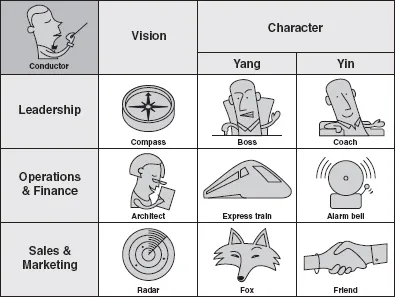
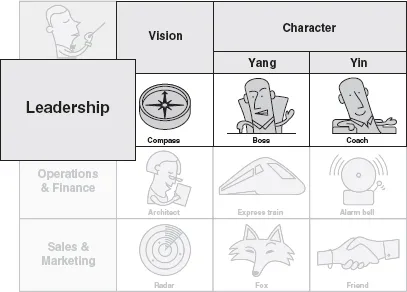
With these three concepts – vision and character (yang and its complement yin) – we have the top axis of the matrix.
The ‘Three Capability Sets’
This section covers the vertical axis of the Matrix: leadership, finance and operations and sales and marketing.
After my talk with John, I understood that a business leader has to have good ability in all areas of business. He had eight directors, however, which would make my model too cumbersome to be of practical use. After a lot of thinking, discussion and experimentation, I concluded that three essential areas of expertise were big enough to capture what the leader needs to master, yet small enough to be workable. I call these areas the ‘Three Capability Sets’. These are leadership itself, plus the technical disciplines of operations and finance, and the more people-based disciplines of sales and marketing.
Practitioners of operations and finance or sales and marketing may insist that their discipline is not ‘about technical skills’ or ‘about people’, but a mixture of both. My response is to agree, but to point out that this model is not about operations, finance or sales in themselves but about the aspects of those activities that a leader needs to grasp.
In business, it is likely that a new leader will already be skilled at an area of the operations and finance set or at an area of the sales and marketing set. They will also probably be less familiar with the other set and its ways. It is a core theme of this book that to step up to leadership, a leader will need to embrace his or her weaker ‘other’ set, as well as pure leadership.
A brief self-assessment exercise
In the diagram below, simply give yourself marks out of ten for your current actual strength in each area. Be realistic, both about your current strength and about what constitutes a ten. In this exercise, ten is neither Nelson Mandela in leadership nor George Soros in finance; it is a level that you regard as excellent but realistically achievable. Just mark with a pencil or pen, where you are right now (not where you would like to be.)
When you have done this, repeat the exercise and make a mark for the level you wish to acquire and think you could acquire with a practical amount of effort (and time). By all means, aim high – but if you want ten in all three sets, consider if the amount of work you would need to put in to get to that level is truly doable. For instance, are you really willing to spend several weeks a year to keep up with social media platforms to gain a ten at sales and marketing, or would a seven or eight do? Remember that John’s maxim was ‘better than average’.
Sometimes people object to this: an attendee at one of my leadership courses said, ‘If I can’t be truly excellent at something, then there is no point in doing it all’. This type of perfectionist thinking can undermine the journey to becoming a rounded leader. (I shall say more about the common inner drive to ‘be perfect’ in Appendix B.)
Now you have completed the exercise, note which areas seem a stretch for you and be curious why.
I hope that this book will provide you with answers on how to progress – and how to get around inner barriers which might stop you: I have often found that it is not a lack of skill in an area, but a lack of belief in the desirability or the possibility of acquiring that skill that holds people back. (See Appendix A for more on this topic.)
Refer back to this section after you have finished reading the book and repeat the exercise – you may be surprised to find that your rating has already changed.
The Three Capability Sets give us the vertical axis of the Matrix
Combining these ‘Three Capability Sets’ with the top axis of vision and character (yin and yang) you have the Leadership Matrix Model containing the nine archetypes. I will explain the ‘conductor’ later in the book.
The following chapters will discuss this Matrix row by row, with one chapter for leadership, one for operations and finance and one for sales and marketing. In these chapters, I shall describe each respective archetype and its associated shadow.
![]()
2Leadership
This is about strategy, culture, inspiration, fighting for the organisation and developing and supporting talent.
When I transitioned into leadership, I was very similar to the numerous coaching clients (and business contacts) that I have since worked with: although it was my own business, I was effectively an overworked manager, highly frustrated as to why I had so much to do and why the people who reported to me seemed unable to do things right. What I lacked was any real understanding of what leadership was and how little time I actually spent on it.
Leadership is a skill, just like any other business function, and needs to be valued as such. Modern managers are often so squeezed by huge work demands that they fail to grow this essential area. Part of their leadership journey will be to learn how to claw back that necessary time – otherwise, it is their superiors who will benefit from all their diligent work and they will eventually be left behind.
I recall the moment that was a last straw for me. I had a pile of papers on my desk and loads of emails; I was getting more and more aggravated as I read them, saying to myself, ‘Why has no one dealt with this? Why do I have to deal with everything?’ Then I had a sudden moment of realisation: ‘I don’t need to get this stuff done; I need to work out why I am doing it’. I called a rising star in my company and asked her to simply take all the letters on my desk and deal with them herself. Anything she needed help with, I would be there. From then on, I saw my role as giving away as much work as possible and coined the (somewhat smug) motto: ‘If I am doing something, I am doing something wrong, because someone else should be doing it.’
There is a saying that a general needs to go up the side of a high hill to survey the terrain and remove him- or herself from the battlefield. With this in mind and armed with a choice of readings inspired by Stephen Covey and Hyrum Smith, I headed for a self-styled retreat in a lovely hillside hotel in Vence in the south of France. An unusual activity for me then, I spent the daytime contemplating my values, the roles I play in life and drafting various versions of a personal mission statement: what was important to me and where was I going. This structured self-reflection took me around a week. Back at home, some people laughed at the idea that I was taking time off to write my mission statement. However, I just knew something had to change. I found my time spent ‘on the hill’ truly invigorating and profound.
Within two years my businesses had more than doubled in size. I didn’t stop working, but filled much of the space I created with more productive activity. I learnt that it takes time to lead – time and energy to make new things happen. If you don’t stop doing certain old things, then you won’t free up the...