- 352 pages
- English
- ePUB (mobile friendly)
- Available on iOS & Android
eBook - ePub
Flexural-Torsional Buckling of Structures
About this book
Flexural-Torsional Buckling of Structures provides an up-to-date, comprehensive treatment of flexural-torsional buckling and demonstrates how to design against this mode of failure. The author first explains the fundamentals of this type of buckling behavior and then summarizes results that will be of use to designers and researchers in either equation or graphical form. This approach makes the book an ideal text/reference for students in structural engineering as well as for practicing civil engineers, structural engineers, and constructional steel researchers and designers.
The book begins by introducing the modern development of the theory of flexural-torsional buckling through discussions on the general concepts of equilibrium, total potential, virtual work, and buckling. It then continues with in-depth coverage of hand methods for solving buckling problems, the analysis of flexural-torsional buckling using the finite element method, and the buckling of different types of structural elements and frames composed of various elastic materials. Other topics addressed include the design and inelastic buckling of steel members. The book's final chapter considers a collection of special topics.
Information
1 Introduction
1.1 General
Thin-walled structural members may fail in a flexural-torsional buckling mode, in which the member suddenly deflects laterally and twists out of the plane of loading. This form of buckling may occur in a member which has low lateral bending and torsional stiffnesses compared with its stiffness in the plane of loading.
The most common form of flexural-torsional buckling is for I-section beams which are loaded in the planes of their webs, but which buckle by deflecting laterally and twisting, as shown in Figures 1.1 and 1.2a. Flexural-torsional buckling may also occur in concentrically loaded columns. This can be regarded as a general case, of which flexural buckling without twisting is one limiting example (Figure 1.2b). Some columns may buckle torsionally without bending (Figure 1.2c), which is the other limiting example of the flexural-torsional buckling of columns. Beam-columns bent in a plane of symmetry may also buckle in a flexural-torsional mode.
Flexural-torsional buckling is not confined to individual members, but also occurs in rigid-jointed structures, where continuity of rotations between adjacent members causes them to interact during buckling.
Flexural-torsional buckling is a primary consideration in the design of steel structures, as it may reduce the load-carrying capacity. Unless it is prevented by using either sufficient bracing or members which have adequate flexural and torsional stiffnesses, then larger members must be used to avoid premature failure. The determination of these larger members will be dominated by considerations of flexural-torsional buckling.
This chapter provides an introduction to flexural-torsional buckling. An historical survey is made in section 1.2, which is followed by general reviews of structural behaviour in section 1.3, of buckling in section 1.4, and of design against buckling in section 1.5.
Chapter 2 provides a general treatment of buckling with particular reference to flexural-torsional buckling, while Chapters 3 and 4 present hand and computer methods of predicting elastic flexural-torsional buckling.
The buckling of individual columns, beams, and beam-columns is described in Chapter 5, Chapter 6, Chapter 7, Chapter 8, Chapter 9 and 11, while the buckling of continuous beams, frames, and arches (Figure 1.3) and rings is discussed in Chapters 10, 12, and 13.
Inelastic buckling is dealt with in Chapter 14, while the use of flexural-torsional buckling predictions in the determination of design strength is described in Chapter 15. A number of special topics are briefly discussed in Chapter 16.
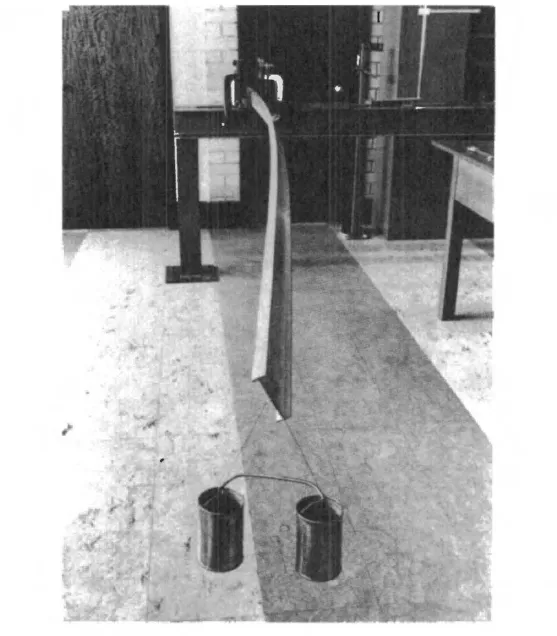
Figure 1.1 Flexural-torsional buckling of a cantilever.
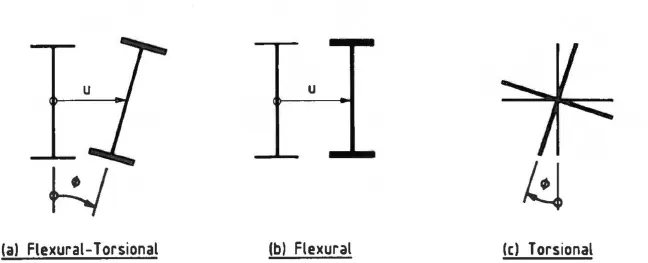
Figure 1.2 Forms of member buckling.
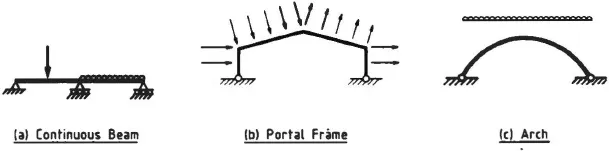
Figure 1.3 Some structural forms.
1.2 Historical Development
1.2.1 ELASTIC BUCKLING THEORY
The initial theoretical research into elastic flexural-torsional buckling was preceded by Euler’s 1759 treatise [1] on column flexural buckling (Figure 1.4a), which gave the first analytical method of predicting the reduced strengths of slender columns, and by Saint-Venant’s 1855 memoir [2] on uniform torsion (Figure 1.4b), which gave the first reliable description of the twisting response of members to torsion.
However, it was not until 1899 that the first treatments were published of flexural-torsional buckling by Michell [3] and Prandtl [4], who considered the lateral buckling of beams of narrow rectangular cross-section. Their work was extended in 1905 by Timoshenko [5, 6] to include the effects of warping torsion in I-section beams.
Subsequent work in 1929 by Wagner [7] and later work by others led to the development of a general theory of flexural-torsional buckling, as stated by Timoshenko [8] and Vlasov [9], and incorporated in the textbooks of Timoshenko [10] and Bleich [11].
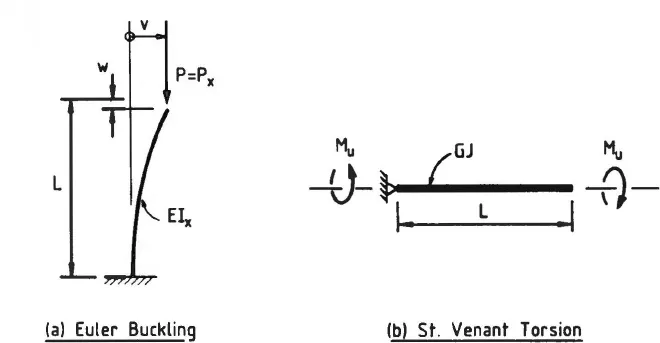
Figure 1.4 Euler buckling and St Venant torsion.
Specific studies of flexural-torsional buckling were made by many researchers, but prior to the 1960s, these were limited by the necessity to make extensive calculations by hand. Some of these are included in the 1960 survey by Lee [12].
This situation changed dramatically with the advent of the modern digital computer, and the 1960s saw an explosion in the amount of published research. As a result, the focus of research moved from the flexural-torsional buckling of isolated members under various loading conditions to the effects of end restraints exerted on a member of a rigid-jointed frame as a result of its continuity with adjacent members. Many of these studies are summarized in the 1971 survey of the Column Research Committee of Japan [13].
The extension of the general finite element method of structural analysis [14] to flexural-torsional buckling problems by Barsoum and Gallagher in 1970 [15] saw a further change, in that it was no longer necessary to publish comprehensive results of elastic flexural-torsional buckling studies, since almost any particular situation could now be analysed using a general purpose computer program. This development is similar to that which occurred in the in-plane analysis of plane rigid-jointed frames, in which the tabulations of solutions used in the 1930s were replaced by general purpose plane frame computer analysis programs.
Many of the developments of the theory of flexural-torsional buckling have been made by extensions of the previously accepted theories, as expressed either by the differential equations of elastic bending and torsion or by the energy equation for buckling. Not all of these extensions have received general acceptance, and so a number of attempts have been made through the 1980s to produce a generally acceptable theory of flexural-torsional buckling. This book includes such a general theory which is based on the use of the second-order relationships between the deformations and strains that take place during bending and torsion, the concept of the total potential, and the principles of virtual work and equilibrium, and of conservation of energy during buckling. This approach has been used, for example, to re-examine the flexural-torsional buckling of arches, early studies of which were reported by Vlasov [9] and Timoshenko [10],
1.2.2 STRENGTH AND DESIGN OF STEEL STRUCTURES
While the historical development of knowledge of flexural-torsional buckling undoubtedly was initiated by the need to prevent premature failure of steel structures in this mode, this is not well documented. It seems likely, however, that early design procedures for preventing the lateral buckling of steel beams followed and were closely related to those used for preventing the flexural failure of columns.
The need to be able to design against flexural-torsional buckling was the catalyst for the development of a theory for flexural-torsional buckling which would allow the successful prediction of failure. Early theoretical research was into the elastic buckling of perfectly straight members, some of which was verified experimentally. However, the very straight and slender members used for these experiments were unrepresentative of the real steel beams used in practice, tests of which showed that their strengths were reduced below those predicted solely by elastic buckling theory.
Theoretical research therefore extended from the elastic buckling of straight members to study the influences of crookedness, yielding, and residual stresses on the strengths of real steel beams, and to determine how to incorporate these into the procedures used in design. These developments tended to follow behind the corresponding developments from the elastic flexural buckling theory to the streng...
Table of contents
- Cover
- Half Title
- Title Page
- Copyright Page
- Table of Contents
- Preface
- Units and conversion factors
- Glossary of terms
- Principal notation
- 1 Introduction
- 2 Equilibrium, buckling, and total potential
- 3 Buckling analysis of simple structures
- 4 Finite element buckling analysis
- 5 Simply supported columns
- 6 Restrained columns
- 7 Simply supported beams
- 8 Restrained beams
- 9 Cantilevers
- 10 Braced and continuous beams
- 11 Beam-columns
- 12 Plane frames
- 13 Arches and rings
- 14 Inelastic buckling
- 15 Strength and design of steel members
- 16 Special topics
- 17 Appendices
- Index
Trusted by 375,005 students
Access to over 1.5 million titles for a fair monthly price.
Study more efficiently using our study tools.
Frequently asked questions
Yes, you can cancel anytime from the Subscription tab in your account settings on the Perlego website. Your subscription will stay active until the end of your current billing period. Learn how to cancel your subscription
No, books cannot be downloaded as external files, such as PDFs, for use outside of Perlego. However, you can download books within the Perlego app for offline reading on mobile or tablet. Learn how to download books offline
Perlego offers two plans: Essential and Complete
- Essential is ideal for learners and professionals who enjoy exploring a wide range of subjects. Access the Essential Library with 800,000+ trusted titles and best-sellers across business, personal growth, and the humanities. Includes unlimited reading time and Standard Read Aloud voice.
- Complete: Perfect for advanced learners and researchers needing full, unrestricted access. Unlock 1.5M+ books across hundreds of subjects, including academic and specialized titles. The Complete Plan also includes advanced features like Premium Read Aloud and Research Assistant.
We are an online textbook subscription service, where you can get access to an entire online library for less than the price of a single book per month. With over 1.5 million books across 990+ topics, we’ve got you covered! Learn about our mission
Look out for the read-aloud symbol on your next book to see if you can listen to it. The read-aloud tool reads text aloud for you, highlighting the text as it is being read. You can pause it, speed it up and slow it down. Learn more about Read Aloud
Yes! You can use the Perlego app on both iOS and Android devices to read anytime, anywhere — even offline. Perfect for commutes or when you’re on the go.
Please note we cannot support devices running on iOS 13 and Android 7 or earlier. Learn more about using the app
Please note we cannot support devices running on iOS 13 and Android 7 or earlier. Learn more about using the app
Yes, you can access Flexural-Torsional Buckling of Structures by N. S. Trahair in PDF and/or ePUB format, as well as other popular books in Technology & Engineering & Biology. We have over 1.5 million books available in our catalogue for you to explore.