![]()
Part 1
Law-making: sources of law in the English legal system
Why do we obey law? Where does it come from? How did we arrive at the laws which operate in our country today? How do we create new laws?
These questions are all part of the study of sources of law – really this is an investigation into where the laws which regulate our lives come from and how they apply to us. There are some very ancient sources of law which, although interesting historically, are beyond the scope of A-level study. In this section of the book, however, we will look at the major sources of the law operating in our country now.
The main sources of law to study for examination purposes are:
• European law – arguably the most important at present, since it is growing very quickly indeed.
• Statute law – Acts of Parliament, how they are passed and how they are interpreted by courts. Also delegated legislation – laws made by other bodies, with the authority of Parliament.
• Judicial precedent – how cases follow each other in court, creating new law.
We will also examine two further areas briefly (you should know a little of these for the examination):
• the influences on parliamentary law-making;
• the general issue of law reform (the methods by which the law can be changed, or a new law introduced).
Sometimes these areas of law conflict, and then we need to decide which law to follow. For example, there may be a judgment in a case on an issue over which either Parliament has since created a statute, or where there is a statute which applies, but since the statute's creation European law has introduced a regulation. We will see that where European law is formed on an issue, this must be followed, even if it conflicts with existing national law. In this sense then, European law could be said to be the most important modern source of law, so we will examine this first, before looking at the more traditional sources.
![]()
1 European law
Introduction
Do you feel European? Most people would usually describe themselves as British, English, Welsh, French, Indian, American or whatever happens to reflect most accurately their personal nationality. However, everyone resident in one of the 27 countries which now form part of the European Union is also bound legally by the laws of that body of member states, and is therefore, at least in the legal sense, European. This presents all sorts of openings for individuals and organisations, and can be viewed with promise and excitement. New opportunities exist for travel, employment and business dealing; and rather than taking a leap into the dark, EU citizens can make the most of these opportunities knowing that there is a legal framework for their protection.
Figure 1.1
In the past, the United Kingdom has had a tendency to take a rather insular approach to being an integral part of Europe, possibly because:
• our geographical location of being separated by water from other member states created a feeling of division, especially when travelling;
• political and economic strength over a long period of our history allowed a degree of independence from other European countries;
• divisions caused by war in the past have taken a long time to heal.
The legal system, and judges in particular, were no exception to this reluctance to move away from total patriotism, but gradually over a period of time both the courts and society generally are realising that the European Union, with its own legal structure, is here to stay, and that the United Kingdom can benefit from being an integral part of it. In fact, it will be seen from the material that follows, that the United Kingdom plays a large part in forming the laws which are created under European law, and is therefore a relatively influential member of the European Union.
Your study of European law will involve four main issues:
• The development of the European Union (briefly).
• The institutions of Europe – an investigation into exactly who makes European laws.
• The effect of the European Union on national sovereignty – in other words, how much being part of Europe affects the individual status of member states.
• Legislation and its effect on national law – how European law operates in our own country.
Practical task
Find out the names of the 27 member states and the years in which they joined the European Union. You may wish to visit the following website for help: http://en.wikipedia.org/wiki/European_Union_member_states or this one (which has links to a map and country details) http://europa.eu.int/abc/governments/index_en.htm
Development of the European Union
The original idea of forming a group of states was not based on an aim to be one integrated legal entity, but on economics. It was felt that there would be considerable advantages in countries joining together to manage large commodities, such as coal and steel. Today, the European Union is one of the world's largest trading units. This can be seen as an exciting opportunity to form an ideal civilised body of people and organisations – almost like playing a strategy game, such as Sim City, but in reality! However, unlike a strategy game, people and member states are all very different, and many practical problems arise – as we will see.
Some of the aims of the present European Union, which are now much wider than the original economic ideal, can be seen in Article 2 of the Treaty of Rome (amended by later treaties):
The Community shall have as its task … to promote throughout the Community a harmonious and balanced development of economic activities … a high level of employment and of social protection, the raising of the standard of living and quality of life …
These are some of the important stages of development:
| 1952 | A European Coal and Steel Community was formed, the forerunner of the present day European Union. |
| 1957 | The Treaty of Rome was formed, creating the legal status of the European Union. |
| 1972 | The United Kingdom joined what was then known as the European Economic Community. This was achieved by passing the European Communities Act 1972, which incorporated the Treaty of Rome into English law. This came into effect on 1 January 1973. |
| 1986 | The Single European Act of 1986 was passed, which became effective in 1992, and amongst other things gave much more freedom of movement to workers. |
| 1992 | The ratification of the Maastricht Treaty, and under the Treaty of European Union 1993 the European Community changed its name to the European Union. |
| 1999 | The Treaty of Amsterdam added a new Article to the Treaty of Rome to ‘take appropriate action to combat discrimination based on sex, racial or ethnic origin, religion or belief, disability, age or sexual orientation’. |
| The Articles of the original Treaty were renumbered, so, for example, the former Article 177 is now Article 234. |
| 2001–4 | The Treaty of Nice 2001 made provision for enlargement. Accession Treaties, signed in Athens in 2003, resulted in the group of ‘new’ member states joining in May 2004, making a total of 25 countries in with 450 million inhabitants. It also limited Commissioners to one per country and altered qualified majority voting. |
| 2005 | The Treaty of Luxembourg allowed for two further member states. |
| 2006 | Bulgaria and Romania joined the EU, bringing the total number of member states to 27. |
Thinking point
Why do you think that the aims of the European Union have changed from the purely economic origins to embrace issues such as standards of living and, more recently, issues of equality and non-discrimination?
European institutions
The Commission
The Commission has responsibility for running the European Union on a day-to-day basis, and is the executive branch of the Union. It could be likened to the civil service, and has thousands of employees. The role of the Commission is as follows.
• To propose ideas for discussion to the European Parliament, and to draft formal proposals for changes in European law to the Council. Under the Treaty of Amsterdam, national Parliaments are given notice of Commission proposals six weeks before those proposals are discussed by the Council. The European Parliament may request the Commission to make a proposal to the Council.
• To implement the EU budget and take general responsibility for administration within the European Union.
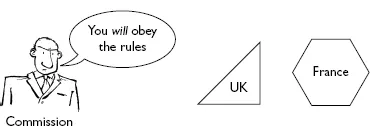
• To ensure that member states obey the rules of the European Union. The Commission has the power to take a member state to the European Court of Justice for infringement of a law or failure to implement it.
Figure 1.2
The 27 Commissioners serve for a renewable term of five years. There is one Commissioner from each of the smaller member states and two from each of the larger ones (the United Kingdom is one of these larger states). A Commissioner's duty is to serve the interests of the European Union, not the interests of an individual member state.
The European Parliament
This is sometimes known as the Assembly and, surprisingly, is not the legislative body of the European Union. It does not make law directly, but acts as a discussion forum. It is made up of over 600 Members of European Parliament (MEPs) who are elected directly every five years by the citizens of the member states. Seats are allocated to member states in proportion to their population. Issues which are proposed by the Commission are discussed by the European Parliament and are then passed back to the Commission for formal drafting.
Practical task
Find out who has been elected as your Member of European Parliament, and try to discover a little of their background. Find out what geographical area he or she represents and compare this to the area represented by your Member of Parliament.
The Eu...