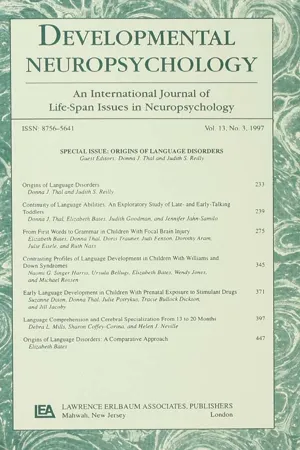
This special issue represents the initial products of the first five years of a multi-center project entitled "Origins of Communicative Disorders." As the title implies, the common goal of investigators involved in this project was to describe the development of communicative skills from their earliest measurable points so that factors characterizing the earliest stages of communicative disorders can be teased apart from those which lead to development of typical language ability in later childhood.
The papers in this volume provide a comprehensive picture of early language development and its neural correlates across a range of typical and atypical populations. By looking at language abilities from their point of origin--from the very first signs of word comprehension to the emergence of grammar--the authors construct a foundation for future research on the nature and etiology of communication disorders.
eBook - ePub
Origins of Language Disorders
A Special Issue of developmental Neuropsychology
- 248 pages
- English
- ePUB (mobile friendly)
- Available on iOS & Android
eBook - ePub
Origins of Language Disorders
A Special Issue of developmental Neuropsychology
About this book
Information
Subtopic
Developmental PsychologyIndex
PsychologyFrom First Words to Grammar in Children With Focal Brain Injury
University of California, San Diego
San Diego State University
University of California, San Diego
University of California, San Diego
University of California, San Diego
University of California, San Diego
Emerson College
Skidmore College
New York University Medical Center
The effects of focal brain injury were investigated in the first stages of language development, during the passage from first words to grammar. Parent report, free-speech data, or both are reported for 53 infants and preschool children between 10 and 44 months of age. All children had suffered a single, unilateral brain injury to the left or right hemisphere, incurred before 6 months of age (usually in the pre- or perinatal period). This is the period in which one would expect to see maximal plasticity, but it is also the period in which the initial specializations of particular cortical regions ought to be most evident. In direct contradiction of hypotheses based on the adult aphasia literature, results from 10 to 17 months suggest that children with right-hemisphere injuries are at greater risk for delays in word comprehension and in the gestures that normally precede and accompany language onset. Although there were no differences between left- and right-hemisphere injury per se on expressive language, children whose lesions included the left-temporal lobe showed significantly greater delays in expressive vocabulary and grammar throughout the period from 10 to 44 months. No specific deficits were associated with left-frontal damage, but there was a significant effect of frontal lobe injury to either hemisphere in the period from 16 to 31 months, when normal children usually show a burst in vocabulary and grammar. This bilateral effect of frontal damage is independent of motor impairment. Hence, there are specific effects of lesion site in early language development, but they are consistent neither with the lesion-syndrome correlations observed in adults with homologous injuries nor with the literature on acquired lesions in older children. Results are used to argue against innate localization of linguistic representations, and in favor of an alternative view in which innate regional biases in style of information processing lead to familiar patterns of brain organization for language under normal conditions and permit alternative patterns to emerge in children with focal brain injury.
In 1861, Paul Broca described a case of nonfluent aphasia with preserved comprehension, associated with damage to a region of left-frontal cortex that now bears Broca’s name. By 1874, Carl Wernicke had described a very different form of aphasia, a severe comprehension deficit with preserved fluency and melodic line (albeit with clear impairment of word retrieval). This syndrome was associated with damage to the posterior portion of the left-temporal lobe, a region now referred to as Wernicke’s area. The reliability and significance of these two complementary lesion-syndrome mappings have been called into question many times (Freud 1891/1953; Goldstein, 1948; Head, 1963; Marie, 1906; Mohr et al., 1978), including recent studies using in vivo brain imaging that showed the classic lesion-syndrome correlations are violated at least 20% of the time (Basso, Capitani, Laiacona, & Luzzatti, 1980; Bates, Appelbaum, & Allard, 1991; Dronkers, Shapiro, Redfern, & Knight, 1992; Willmes & Poeck, 1993). Nevertheless, there is still broad consensus on four points.
1. The left hemisphere is specialized for language in over 95% of normal adults (Bryden, 1982; Damasio & Damasio, 1992; Galaburda, 1994; Gazzaniga, 1994; Hellige, 1993).
2. The perisylvian regions of the left hemisphere are particularly important for language (Damasio, 1989; Damasio & Damasio, 1992; Geschwind, 1972; Rasmussen & Milner, 1977), although they are not the only relevant areas (Ojemann, 1991).
3. The contrasting syndromes described by Broca and Wernicke are robust findings across natural languages (Bates & Wulfeck, 1989; Menn & Obler, 1990).
4. These syndromes are reliably, albeit imperfectly, correlated with anterior versus posterior lesion sites along the Sylvian fissure (Damasio, 1992; Goodglass, 1993; Naeser, Helm-Estabrooks, Haas, Auerbach, & Levine, 1984).
Given these findings in adults, it is not unreasonable to assume that the left hemisphere must be innately specialized for language, with privileged roles for the perisylvian areas that are implicated in the major forms of aphasia. On these grounds, one would expect to find forms of language impairment in small children with unilateral brain injury that are grossly analogous to the major categories of aphasia in adults, an expectation that can be framed in terms of three hypotheses.
1. The left-specialization hypothesis predicts the most severe language impairments overall in children with injuries to the left hemisphere.
2. The Broca hypothesis predicts severe deficits in language production among children with damage to the anterior regions of the left hemisphere (in particular, the perisylvian area of the left-frontal lobe).
3. The Wernicke hypothesis predicts severe deficits in language comprehension in children with damage to the posterior regions of the left hemisphere (in particular, the posterior portion of the left temporal lobe).
Although these adult-based hypotheses form a reasonable starting point for developmental research, they are largely unsupported by the literature on language development in children with focal brain injury (Alajouanine & Lhermitte, 1965; Almli & Finger, 1984; Annett, 1973; Aram, 1988, 1992; Aram, Ekelman, Rose, & Whitaker, 1985; Aram, Ekelman, & Whitaker, 1986; Aram, Meyers, & Ekelman, 1990;Bishop, 1981, 1983, 1992; Day & Ulatowska, 1979; Fletcher, 1993;Hammill & Irwin, 1966;Hecaen, 1976, 1983;Hecaen, Perenin, & Jeannerod, 1984; Isaacson, 1975; Janowsky & Finlay, 1986; Kohn, 1980; Kohn & Dennis, 1974; Marchman, Miller, & Bates, 1991; Reed & Reitan, 1969; Reilly, Bates, & Marchman, in press; Riva & Cazzaniga, 1986; Riva, Cazzaniga, Pantaleoni, Milani, & Fedrizzi, 1986; Smith, 1984; Stiles & Thal, 1993; Thal et al., 1991; Trauner, Chase, Walker, & Wulfeck, 1993; Vargha-Khadem, Isaacs, Papaleloudi, Polkey, & Wilson, 1991; Vargha-Khadem, Isaacs, van der Werf, Robb, & Wilson, 1992; Vargha-Khadem, O’Gorman, & Watters, 1985; Vargha-Khadem & Polkey, 1992; Woods, 1980; Woods & Carey, 1979; Woods & Teuber, 1978; Wulfeck, Trauner, & Tallal, 1991; for another view, see St. James-Roberts, 1979).
The first and most important challenge lies in the fact that most children with early unilateral brain injury go on to achieve levels of language performance that are within the normal range. This does not mean that early brain damage has no effect on language outcomes. However, the impairments observed in children with this neurological history are more subtle and less persistent than are the outcomes observed in adults with homologous injuries (for reviews, see Eisele & Aram, 1995; Fletcher, 1993; Riva, Milani, Pantaleoni, Devoti, & Zorzi, 1992; Satz, Strauss, & Whitaker, 1990; Stiles, 1995; Stiles & Thal, 1993; Vargha-Khadem & Polkey, 1992), and many children show no impairments at all (Dall’Oglio, Bates, Volterra, DiCapua, & Pezzini, 1994; Feldman, Holland, Kemp, & Janosky, 1992; Vargha-Khadem et al., 1991). Results vary from one study to another, depending on the measures used, the age range of interest, and the inclusionary and exclusionary criteria adopted in the study (e.g., age of lesion onset, etiology, presence or absence of children with seizures or seizure medication). In some studies, there are no significant differences of any kind between the focal-lesion population and normal controls. In other studies, children with focal brain injury score significantly lower as a group on a number of different language and cognitive measures, compared with controls matched for age, sex, and social class (i.e., brain damage often does exact a cost). However, one conclusion is clear across all these studies: Children with a history of early focal brain injury rarely meet the criteria required for a diagnosis of aphasia.
The second finding is the absence of a clear-cut difference between children with left- versus right-hemisphere injury. To be sure, some studies do report differences in the predicted direction, especially for expressive language, for tasks that involve subtle morphosyntactic contrasts, or both (e.g., Aram, Ekelman, Rose, & Whitaker, 1985; Aram et al., 1986, 1990; Aram, Ekelman, & Whitaker, 1987; Dennis, 1980, 1988; Dennis & Kohn, 1975; Dennis, Lovett, & Wiegel-Crump, 1981; Dennis & Whitaker, 1976, 1977; but see Bishop, 1983). However, these left-hemisphere findings often are complicated by other factors. For example, Eisele and Aram (1995) suggested that damage to anterior subcortical structures may be the strongest predictor of residual language and cognitive deficits in both left-hemisphere- and right-hemisphere-lesioned children. However, a small group of left-hemisphere children with anterior subcortical damage do present with more language-specific deficits than do right-hemisphere children with comparable damage (Aram & Eisele, 1994a, 1994b; Aram, Rose, Rekate, & Whitaker, 1983; Eisele & Aram, 1995; Eisele, Alexander, & Aram, 1997). Reilly, Marchman, and Bates (in press) reported a small but reliable left-hemisphere disadvantage in the production of complex syntax for children under 5 years of age, but they reported no effects of lesion site whatsoever in children after age 5—even though all the children in their study had the same etiology (i.e., lesion onset prior to 6 months of age). The issue is complicated even further by occasional findings in the opposite direction, that is, a significant disadvantage for children with right-hemisphere damage on some receptive language tasks (Eisele & Aram, 1993, 1994; Thal et al., 1991; Trauner et al., 1993; Wulfeck, Trauner, & Tallal, 1991).
The next finding is perhaps less surprising once one has digested the ambiguous results obtained for left-hemisphere versus right-hemisphere damage. That is, even in those cases in which a left-right difference was reported, there was little evidence in favor of site-specific effects within the left hemisphere (Eisele & Aram, 1995; Riva & Cazzaniga, 1986). Indeed, Thal et al. (1991) reported effects that run directly counter to the Broca hypothesis, with more severe and protracted delays in early word production in children with left-posterior damage. Putting this result together with the finding that comprehension deficits appear to be more likely in children with right-hemisphere damage (a disconfirmation of the Wernicke hypothesis), Thal et al. concluded it may be a mistake to expect the developing brain to yield brain-behavior correlations similar to those observed in the adult because the processes involved in language acquisition are quite different from processes required for fluent and efficient language use in a mature adult native speaker: “The regions that mediate language learning are not necessarily the same regions that mediate maintenance and use of language in the adult” (p. 499). A similar proposal was offered by Petersen, Fiez, and Corbetta (1992), who suggested that localization of function in adults may reflect the developmental status of a behavior (i.e., novice vs. expert, or controlled vs. automatic) instead of domain-specific content (see also Raichle, 1994).
Earlier reports on the recovery of language in children with focal brain injury led some investigators to conclude that the two hemispheres are initially equipotential for language (Lashley, 1950, 1951; Lenneberg, 1967; for some related comments, see Caplan & Hildebrandt, 1988; Kennard, 1936). On this view, the familiar pattern of left-hemisphere specialization does not emerge until some point after language has been acquired. Indeed, Lenneberg went so far as to suggest that the acquisition of language may be the cause rather than the effect of lateralization. Most modern investigators dispute this claim because there is at least some evidence for early differences in lateralization, and for early left-hemisphere specialization for speech stimuli. Such evidence includes those studies that show a disadvantage for children with left-hemisphere damage (cited previously), but it also includes neuroanatomical studies demonstrating structural differences between the left and right hemisphere at birth or in the first years of language learning, with special reference to perisylvian cortex (Geschwind & Levitsky, 1968; Witelson & Kigar, 1988), together with electrophysiological studies suggesting differential response of the left hemisphere to speech sounds in normal infants (Molfese, 1989, 1990; Molfese & Segalowitz, 1988).
In our view, the best argument for early left-hemisphere specialization is a logical one, based on findings from adults. Simply put, there has to be something special about left-perisylvian tissue that makes it particularly well suited for language learning and language use. If this were not the case, there would be no explanation for the huge bias toward left-hemisphere mediation observed in 95% of normal adults. But what is that “something”? How direct is the relation between the initial predispositions of the left hemisphere and the classic form of brain organization for language that is observed so often in adults?
In a book titled Rethinking Innateness: Development in a Connectionist Perspective (Elman et al., 1996) the authors proposed three levels at which it would be fair to say that a given function is “innate,” or at least, “innately predisposed.” Let us consider each of these three options in turn, with reference to the role of the left hemisphere in early language learning.
Innate representations. Although strong proponents of nativism within linguistics and psycholinguistics were rarely explicit about the level at which innate ideas are implemented in the brain, the usual argument was that children are born with innate knowledge about basic principles of language, in general, and grammar, in particular (Crain, 1992; Lightfoot, 1991;Pinker, 1991, 1994a, 1994b). To be sure, this knowledge will be shaped by experience to some extent, perhaps in the form of “triggering” or “selecting” among predetermined options (Piatelli-Palmarini, 1989), and some maturation may have to take place before the innate knowledge can be used (Borer & Wexler, 1987; Spelke, Breinlinger, Macomber, & Jacobson, 1992). However, most of these investigators were clear in their belief that children are born with domain-specific representations laid out somewhere in the brain.
The most likely neural implementation for such innate knowledge would have to be in the form of fine-grained patterns of synaptic connectivity at the cortical level (i.e., cortical microcircuitry). To the best of our knowledge, this is how the brain stores its representations, whether they are innate or acquired. In this regard, Pinker (1994a) suggested that the “language instinct” is indeed based on detailed microcircuitry, and that the same is probably true for many other cognitive processes:
It is a certain wiring of the ...
Table of contents
- Cover
- Table of Contents
- Origins of Language Disorders
- Continuity of Language Abilities: An Exploratory Study of Late- and Early-Talking Toddlers
- From First Words to Grammar in Children With Focal Brain Injury
- Contrasting Profiles of Language Development in Children With Williams and Down Syndromes
- Early Language Development in Children With Prenatal Exposure to Stimulant Drugs
- Language Comprehension and Cerebral Specialization From 13 to 20 Months
- Origins of Language Disorders: A Comparative Approach
Trusted by 375,005 students
Access to over 1.5 million titles for a fair monthly price.
Study more efficiently using our study tools.
Frequently asked questions
Yes, you can cancel anytime from the Subscription tab in your account settings on the Perlego website. Your subscription will stay active until the end of your current billing period. Learn how to cancel your subscription
No, books cannot be downloaded as external files, such as PDFs, for use outside of Perlego. However, you can download books within the Perlego app for offline reading on mobile or tablet. Learn how to download books offline
Perlego offers two plans: Essential and Complete
- Essential is ideal for learners and professionals who enjoy exploring a wide range of subjects. Access the Essential Library with 800,000+ trusted titles and best-sellers across business, personal growth, and the humanities. Includes unlimited reading time and Standard Read Aloud voice.
- Complete: Perfect for advanced learners and researchers needing full, unrestricted access. Unlock 1.5M+ books across hundreds of subjects, including academic and specialized titles. The Complete Plan also includes advanced features like Premium Read Aloud and Research Assistant.
We are an online textbook subscription service, where you can get access to an entire online library for less than the price of a single book per month. With over 1.5 million books across 990+ topics, we’ve got you covered! Learn about our mission
Look out for the read-aloud symbol on your next book to see if you can listen to it. The read-aloud tool reads text aloud for you, highlighting the text as it is being read. You can pause it, speed it up and slow it down. Learn more about Read Aloud
Yes! You can use the Perlego app on both iOS and Android devices to read anytime, anywhere — even offline. Perfect for commutes or when you’re on the go.
Please note we cannot support devices running on iOS 13 and Android 7 or earlier. Learn more about using the app
Please note we cannot support devices running on iOS 13 and Android 7 or earlier. Learn more about using the app
Yes, you can access Origins of Language Disorders by Donna J. Thal,Judith S. Reilly in PDF and/or ePUB format, as well as other popular books in Psychology & Developmental Psychology. We have over 1.5 million books available in our catalogue for you to explore.