- 424 pages
- English
- ePUB (mobile friendly)
- Available on iOS & Android
eBook - ePub
About this book
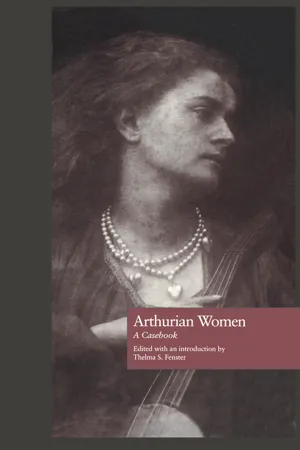
Featuring three original and 14 classic essays, this volume examines literary representations of women in Arthuriana and how women artists have viewed them. The essays discuss the female characters in Arthurian legend, medieval and modern readers of the legend, modern critics and the modern women writers who have recast the Arthurian inheritance, and finally women visual artists who have used the material of the Arthurian story. All the essays concentrate interpretation on a female creator and the work. This collection contains a useful bibliography of material devoted to female characters in Arthurian literature.
Information
LOVE, HONOR, AND THE EXCHANGE OF WOMEN IN YVAIN
SOME REMARKS ON THE FEMALE READER
AUTHOR’S PREFACE
This article about Chrétien de Troyes’ Yvain, or The Knight of the Lion, first published in 1985, was the beginning of what ultimately became a book-length study of Old French courtly romance and its female audience. Women Readers and the Ideology of Gender in Old French Verse Romance (Cambridge University Press, 1993) analyzes the problem of female reception of courtly ideology in selected verse narratives from Chrétien de Troyes to Christine de Pizan. It argues that many romances present a surface that is more complex than the simple promotion or devalorization of women: they simultaneously invite women readers’ complicity with and resistance to the texts’ idealized constructions of gender.
Since “Love, Honor; and the Exchange of Women” was published, a lively debate in feminist criticism has questioned the very notions of a “female subject” or “female reader, Some critics have cautioned against drawing a necessary link between a reader’s gender and a particular mode of identification or subjectivity; but others have warned of the dangers of erasing the different voices of historical women. The terms of this debate inform Women Readers and the Ideology of Gender in Old French Verse Romance. In it I reject the notion of an “essentially” feminine way of reading but I also argue that to overlook the problematic position of women readers of medieval romance (a genre written for a mixed audience of knights and ladies) contributes to women’s effacement in history. If courtly women did not have essentially different ways of reading, nonetheless they occupied a different position with respect to textual production and performance, traditionally male domains. European medieval women were normally displaced from the subject position in writing; so, too, the apparently privileged fictional women within French medieval romances were usually displaced as objects within the masculine chivalric plot.
As the author of the first full-length Arthurian romances, Chrétien de Troyes in fact inscribes the female audience’s displacement at the genre’s inception. But, as I show here and in an analysis of a companion romance, Le Chevalier de la Charrete,* which together form Chapter 2, The Question of Women in Yvain and Le Chevalier de la charrete,” of Women Readers, Chrétien’s romances invite his readers to question the processes by which women are marginalized. He inscribes female characters and female readers as a problem. He creates complex female characters (Laudine in Yvain, Guenevere in the Charrete,) who do not accede instantly to the knight’s desire. He further explicitly presents courtly women as a problematic audience for chivalric stories of love and honor; both in the Prologues and Epilogues to each work and in each text’s depiction of women as readers, listeners and spectators. Chrétien’s romances may eventually have done more than inculcate gender identities in their aristocratic audience: they may have challenged their readers to question their own identification with courtly fictions.
Yvain’s marriage quest and the Chevalier de la Charrete’s adulterous love quest set the stage for the continuation, imitation, adaptation, and translation of the Arthurian legend throughout the Middle Ages. The story of the Knight of the Lion became a prototype for Arthurian romances that recount the adventures of an individual knight who increases his status through combat and marriage; the fictional adultery between Lancelot and Guenevere forms the core of the immense recasting of Arthurian legend in the thirteenth-century Prose Lancelot. In both types of quest narrative, the women’s subjective autonomy is subsumed within the masculine adventure. But if Chrétien’s narratives lay the groundwork for women’s subsequent displacement in Arthurian fiction, so, too, do they create a discursive space where courtly ideology can be examined and questioned. Yvain and Le Chevalier de la Charrete inaugurate a tradition of debate about gender roles, a debate catalyzed by the displacement of the female reader.
Roberta L. Krueger
LOVE, HONOR, AND THE EXCHANGE OF WOMEN IN YVAIN: SOME REMARKS ON THE FEMALE READER
If Old French courtly romances were addressed to audiences of men and women, and if a text’s ideological function depends upon the relationship it establishes with its readers, how does the sens of a romance differ when the implied reader is a woman? The hypothesis of the female reader1 focuses our attention on the problem of gender in romance and reveals sexual tensions which qualify the ideology of chivalry. Such an approach draws its theoretical justification from the critical perspective of a modern female reader, from the historic conditions of romances’ reception, and, preeminently, from the problematic inscription of women as readers and as characters in particular texts.
The debate about the promotion of women in courtly literature2 finds much fuel to feed its fires in Chrétien de Troyes’ Yvain,3 where a profound ambivalence about woman’s position in court life is established in the first lines of the Prologue. The narrator’s invocation of Arthur’s prowess for “our” instruction—“la cui proesce nos enseigne” (2)—appeals to an implied audience of knights. But the fictional knights assembled at Arthur’s court on Pentecost have gathered where the ladies have called them—“cil chevalier s’atropelerent / la ou dames les apelerent / ou dameiseles ou puceles” (9-11)—and they discuss not honor but Love (12-17). Arthur’s negligent absence from the court at Pentecost because the Queen has detained him in bed—“que la re’ine Íe detint” (50)—bespeaks the power of feminine wiles to influence court life for better or worse. Then, when Guenevere sneaks in, “tot a celee” (64), to listen to the story that Calogrenant recounts before an exclusively male audience (as described in 53-60), her appearance occasions a display of courtoisie which degenerates into uncourtly bickering among the knights (69-130). From the perspective of the knights, the intrusion of the feminine threatens to ruin the ambiance of the male gathering, as Keu warns: “Dame, se nos n’ i gaeignons, / fet Kex, an vostre conpaignie, / gardez que nos n’ i perdiens mie” (“Lady, says Kay, if we do not gain by your company, be careful that we do not lose because of it,” 92-94).
Guenevere’s presence is a troublesome influence, but her power to act is sanctioned by the knights’ approval. Although she commands Calogrenant to resume his storytelling, after he has begged that she leave him “an pes” (“in peace,” 120) and that she “s’an teise” (“be quiet,” 121), her command is reinforced by Keu. The seneschal invokes the faith she owes the King “Íe vostre seignor et Íe mien” (“your lord and mine,” 129) to entreat her to order Calogrenant, “comandez li, si feroiz bien” (“command him, you would do well,” 130). By making her love conditional upon the knight’s recounting of his adventures, “se de m’amor volez joïr” (“if you wish to have my love,” 140), Guenevere appears to act as the sovereign patron of Calogrenant’s tale. But Calogrenant’s principal destinataires are the Arthurian knights, whose reputation for honor rests upon their successful vindication of his shame. If the Queen enjoys a privileged position where she influences court life, she is no less subordinate to the action of knights vying for honor.
Chrétien’s presentation of fictional woman’s problematic status in court life may be in keeping with historians’ differing conceptions of noblewomen’s power in medieval France.4 But Chrétien’s work does more than “reflect” an historical paradox. In the subsequent adventures of Yvain, the narrator explores the process by which the tensions between men and women become masked by an ideology of love and honor. This embellishment or “mystification” of sexual division is a textual strategy which Chrétien simultaneously adopts and debunks. As will be shown in an analysis of three episodes—Yvain’s lovesickness and marriage with Laudine, Yvain’s exploits at Pesme Aventure, and Yvain’s return to the Fountain and “reconciliation” with Laudine—the narrator calls our attention to the romance’s mystification of woman’s place at the same time that he reveals the underlying reality of her status as an object of exchange. Chrétien’s dialectical presentation produces a romance with a double vision which calls forth several possible responses among the women who heard or read it. If one woman reader or listener may have admired an idealized image of chivalry, another may have perceived the narrator’s critical analysis of a system which constrains both sexes.
A paradigm for the dynamics of sexual exchange can be found in the costume (“custom”) of the immodest damsel in Yvain’s companion romance, Le Chevalier de la Charrete.5 A nameless maiden who has staged a mock rape the previous night in order to attract Lancelot’s attention requests that Lancelot allow her to accompany him and that he protect her, according to a costume which seems perhaps as uncourtly as the damsel’s former behavior (see lines 1302-16). The costume’s two propositions can be restated as follows: 1) A knight will be dishonored in court if he seizes a woman who is alone (1302-10). But, 2) If a knight conquers a woman from another knight in battle, he may do with her as he pleases without incurring shame or blame (1311-16).
From one perspective, the custom is another ruse by which the damsel attempts to secure Lancelot’s affections; it is one of a number of constraints in which the knight finds himself enmeshed. But on a deeper level, the custom—recounted here by the third-person narrator—describes how a system which may seem to protect damsels regulates instead the ascription of honor to knights.
If a knight wishes to be of good reputation he will not dishonor a woman alone: “… ne feist se tote enor non, / s’estre volsist de been renon” (“he should do only what is honorable, if he would like to be of good renown,” 1307-08, emphasis added). As stated, the custom’s first tenet implies the existence of some dishonorable knights who will harm women alone. A resultant corollary is that prudent damsels would be well-advised to seek a strong knight’s protection. But, under the terms of the second proposition, a maiden appended to a knight becomes fair game for any other knight willing to do battle for her: “… sa volente an poist faire / sanz honte et sanz blasme retraire” (“… he might do his will without earning shame or blame,” 1315-16).
The custom thus assures not the protection of a maiden’s autonomy, but her value as a possession or prize for those knights between whom she is the object of dispute. Within the chivalric honor system, the woman becomes an object of exchange.6 The damsel’s custom describes not only Guenevere’s situation with regard to Meleagant and Lancelot in the Charrete; it also describes Laudine’s position with respect to Esclados le Ros and Yvain in Le Chevalier au Lion.7
Yvain’s coup de foudre and marriage to Laudine exemplify how the romance mystifies the exchange of women at the same time that it lays bare the mechanism for our analysis. Yvain’s adventure in Broceliande fulfills what Duby might call a reve de jeunesse: he marries the wife of the knight he has slain in combat. His conquest of his rival’s wife and possession of her domain resembles a marriage by capture in early Germanic society which, if it is antithetical to the doctrine of consent in the twelfth century,8 is not without historic example as late as the eleventh century in Northern France.9 Chretien’s courtly romance transforms the unchivalrous practice of rapt into an artfully negotiated exchange between Lunete and Yvain.
That exchange is further transformed by a narrative presentation which allows the reader to create the fiction of a widow in love with Yvain by her own desire and for her own good. The mystification of the exchange occurs in three steps through a narrative progression from Yvain’s lovesickness, to Lunete’s negotiations, to Laudine’s quick change of heart. In each step, Chretien’s narrative embellishes the marriage by coercion at the same time that it points up the constraints of the custom imposed on Laudine.
For some critics, the courtly manner in which Yvain falls in love, while peering from his hiding place through a little window to marvel at the beauty of the bereaved Laudine as the mourning procession for her husband passes beneath, legitimates his desire for his rival’s widow.10 It does so by reversing the terms of the capture: Yvain is the prisoner, the victim of Amors, and Laudine is the unwitting agent of vengeance for her husband’s death: “Bien a vangiee, et si nel set / la dame la mort son seignor” (“The lady has indeed avenged—and doesn’t know it—the death of her lord,” 1366-67...
Table of contents
- Cover Page
- Half Title page
- Series Page
- Title Page
- Copyright Page
- Dedication
- Contents
- Series Editor's Preface
- Foreword Seeking Guinevere
- Acknowledgments
- Introduction
- Select Bibliography
- Resisting Tales
- Story, Gender, and Culture
- Fairies' Tales
- Iseult and Guenevere in the Nineteenth Century
- Another Look
- Revisionary Tales Guenevere and Morgan in the Twentieth Century
Trusted by 375,005 students
Access to over 1.5 million titles for a fair monthly price.
Study more efficiently using our study tools.
Frequently asked questions
Yes, you can cancel anytime from the Subscription tab in your account settings on the Perlego website. Your subscription will stay active until the end of your current billing period. Learn how to cancel your subscription
No, books cannot be downloaded as external files, such as PDFs, for use outside of Perlego. However, you can download books within the Perlego app for offline reading on mobile or tablet. Learn how to download books offline
Perlego offers two plans: Essential and Complete
- Essential is ideal for learners and professionals who enjoy exploring a wide range of subjects. Access the Essential Library with 800,000+ trusted titles and best-sellers across business, personal growth, and the humanities. Includes unlimited reading time and Standard Read Aloud voice.
- Complete: Perfect for advanced learners and researchers needing full, unrestricted access. Unlock 1.5M+ books across hundreds of subjects, including academic and specialized titles. The Complete Plan also includes advanced features like Premium Read Aloud and Research Assistant.
We are an online textbook subscription service, where you can get access to an entire online library for less than the price of a single book per month. With over 1.5 million books across 990+ topics, we’ve got you covered! Learn about our mission
Look out for the read-aloud symbol on your next book to see if you can listen to it. The read-aloud tool reads text aloud for you, highlighting the text as it is being read. You can pause it, speed it up and slow it down. Learn more about Read Aloud
Yes! You can use the Perlego app on both iOS and Android devices to read anytime, anywhere — even offline. Perfect for commutes or when you’re on the go.
Please note we cannot support devices running on iOS 13 and Android 7 or earlier. Learn more about using the app
Please note we cannot support devices running on iOS 13 and Android 7 or earlier. Learn more about using the app
Yes, you can access Arthurian Women by Thelma S. Fenster,Norris J. Lacy in PDF and/or ePUB format, as well as other popular books in Literature & Art General. We have over 1.5 million books available in our catalogue for you to explore.