eBook - ePub
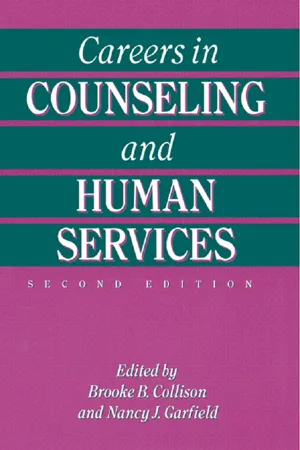
Careers In Counseling And Human Services
- 176 pages
- English
- ePUB (mobile friendly)
- Available on iOS & Android
eBook - ePub
Careers In Counseling And Human Services
About this book
Providing information needed to make choices about different occupations in counselling and human services, the second edition of this text enables readers to examine their own strengths and limitations within these fields.; The opening chapters examine profession and personal issues to be considered in making career choices. Next, chapters present examples of counselling and human services careers in seven different work settings, all written by professionals in that particular area: schools, higher education, business and industry, private practice, federal and state agencies, health care facilities, residential treatment, and community-based support programmes. Also included in the setting chapters is the most up-to-date salary information available. Finally, information is provided about licensure, certification, programme accreditation, and the next steps for further career decision-making. A comprehensive appendix contains current names and addresses of 63 professional associations, organizations, and licensing bodies related to the counselling and human services professions. The index lists 168 occupational titles used throughout the book.; Giving an overview of the field, this book can be used as a supplementary text for courses in counselling and human services preparation programmes, or in high school and university courses that focus on career exploration. It is a valuable resource in any career information library or resource centre.
Information
Publisher
Taylor & FrancisYear
2013Print ISBN
9781560324157
9781138415096
Edition
2eBook ISBN
9781135893675
Chapter 1
AN INTRODUCTION TO THE PROFESSION
Many people would like to have a career in which they help others, but they may not know about the various occupations in the counseling and human services fields, nor do they understand the differences and similarities among those occupations. This book provides information about careers in the counseling and human services fields. Most people know the school guidance counselor who assisted in choosing classes for the next school year, or administered an interest inventory for information about possible career choices. In this book, we provide information about school counselors and many other helping professionals who work with clients to help them solve problems.
This book provides general information about the fields of counseling and human services as well as the qualities of people who enter those fields: What are those people like and who are they? We will also discuss the types of educational programs you must attend to become a helping professional. The first two chapters include a discussion of changes that are taking place in the helping professions and suggest to readers that there are social, economic, and political forces that have an impact on careers in the helping professions.
No two jobs are ever alike, even if they have the same occupational title. You may find that the description of an occupation in one chapter differs from the description of that same occupation in another chapter--that is to be expected. In the same way, salary information may differ from chapter to chapter for the same occupational title. Keep those differences in mind as you read.
In Chapters 3-9 information is provided about seven different settings where helping professionals work. These are not all the work settings, but a representative sample of the major work setting options for counseling and human services professionals. For each chapter the following questions will be answered:
• What are the types of places in which you might work?
• Who would you be helping?
• What job responsibilities would you have in this work setting?
• What personal characteristics do you need to work in this setting?
• As a new professional, what salary might you expect?
• What education and training do you need to enter these jobs?
• What credential or license is required to work in this setting?
WORK SETTINGS
The seven work settings described help you understand the many different places where a helping professional might work.
Chapter 3: Careers in school settings. This chapter discusses the types of activities that school counselors do, such as providing one-to-one and group counseling for students, working with teachers to develop programs to improve the learning environment for students and teachers, teaching classes about subjects such as adjustment to school or career choice, or working with students about dealing with peer pressure. School counselors might work with sensitive issues such as AIDS education or might work with students who have questions about their own sexuality. Other careers in the helping professions that are frequently found in school settings are mentioned in this chapter.
Chapter 4: Careers in higher education settings. Colleges and universities, community colleges, and proprietary schools are all places where persons in the helping professions work. Careers in student services are described, such as orientation director, financial aid officer, residence hall complex coordinator, learning skills counselor, counseling center counselor, or student activities program coordinator. This is a long chapter because higher education is a complex environment where many persons are employed in many different jobs.
Chapter 5: Careers in business and industry. There are a number of different counseling and human services positions in business and industrial settings. A new and growing occupation--employee assistance program (EAP) consultant--is described in this chapter. Outplacement counselor, employment recruiter, training specialist, and substance abuse counselor are occupations included in this chapter. Common to all of these occupations is that the helping professional works in or with a business or industry.
Chapter 6: Careers in private practice. This chapter examines what type of person is well suited for a career as a private practitioner. It addresses private practice activities, including one-to-one and group counseling, consulting, and teaching-training opportunities for private practitioners who are counselors, psychologists, and social workers. Private practitioners work for themselves or with a small group of other professionals. It is a small business.
Chapter 7: Careers in federal and state agencies. Agencies that are organized or funded by states or the federal government are described in this chapter. The kinds of careers discussed in this chapter include counselors in the employment service, the military, or detention or correction facilities. Other counseling and human services careers in state and federal agencies include youth counselor, parole officer, vocational rehabilitation counselor, and correction psychologist. State and federal agencies employ persons in many different occupations.
Chapter 8: Careers in health care facilities. Nearly every community has some kind of health care facility. You will find many counseling and human services careers in the various health care facilities, including counselor, psychologist, health or wellness counselor, social worker, music or art therapist, nurse, or aides. This chapter describes many of those careers.
Chapter 9: Careers in residential treatment centers. Residential treatment centers are places where clients live during treatment. The many different residential treatment centers have opportunities for persons with education in counseling and human services. Recreation or physical therapist, rehabilitation counselor, speech-language therapist, psychologist, and case manager are a few of the occupational titles described in this chapter.
Chapter 10: Accreditation and credentialing. This chapter presents information about how preparation programs are accredited and what accreditation means to you as a prospective student. This chapter includes information about certification and licensure of helping professionals. This is important information as you examine different schools you might want to attend. Professionals in counseling and human services are frequently licensed, registered, or certified.
Chapter 11: What next? This chapter makes suggestions about the next steps that you might take in pursuing a career in counseling or human services. Some reflective exercises that will help in deciding about a career in one of these fields.
Appendix: The Appendix of this book contains names and addresses of organizations and associations related to the professions discussed in each of the chapters. At the end of most chapters will be a suggestion for “Additional Information and Resources.” If you want to pursue one of the career topics, the addresses in the Appendix will be very helpful.
PREPARING TO READ THIS BOOK
Careers in the counseling and human services professions can be rewarding and exciting. They can also be frustrating and discouraging. These occupations provide many opportunities for the professional to help others grow and change throughout their life span. Human services professionals are expected to be in demand in the future. Particular demand areas include work with adults and aging people, consulting, work with outplacement and career changes, and many facets of mental health counseling. Emerging careers in the helping professions deal with new and changing social issues--working with people with AIDS, intervention programs with gang members, or counseling programs for persons who are contending with issues related to sexuality concerns.
TERMINOLOGY
In this first chapter, we have used the terms counseling and human services and helping professions to describe the fields that include all the different occupations covered in this book. Each of these terms is partially descriptive of the field and each term also limits meaning. It is difficult to find a single inclusive descriptor. Most of the professionals described do some counseling, yet not all are counselors; some, but not all, of the occupations described would be classified as professions, with rigorous preparation and licensing requirements; every occupation described in this book has something to do with people. Because people, human beings, are the focus of every occupation described in this book, we will use the term human services as the general descriptor for the remaining chapters. We will often use the term counselor to refer to a set of human service professionals.
TRENDS AND ISSUES
Several factors influence the fields of counseling and human services. The future of this relatively young field is changing--and it is difficult to predict where the greatest changes will take place. Persons who are considering a profession in one of the counseling or human services fields would be well advised to examine each of the following trends and issues to decide how they might affect their own career choices.
Changes in Health Care
Because many counselors work in systems that are supported by health care revenue, any change in the health care system affects counselors in private practice and in agency settings. In recent years, the structure of health care systems has changed, greatly affecting who is paid for service and how they are paid. States have worked to obtain licensure for counselors [see Chapter 10], only to find that health maintenance organizations (HMOs) or other care systems may change the definition of who can provide service and be paid. Changes in health care have emphasized shorter periods of treatment and treatment only for specified diagnoses. Some of these issues are discussed in Chapter 6--Careers in Private Practice. It is likely that there will be additional changes in health insurance systems as both state and federal legislation include structural reform of Medicare, Medicaid, and other forms of health care.
Demographic Changes
America is becoming a more diverse population. Changes in the population, described by changing demographic studies, indicate that there are increasing proportions of ethnic minority peoples in all urban locations. One statistic that is frequently quoted is that by the year 2010, the White American-European population in the United States will have become a numerical minority. This fact has a significant impact on all the counseling and human services professions. It is obvious that the helping professions must become more culturally diverse in their membership and more culturally sensitive in their professional practice. Other changes in the population, such as an increasing number and proportion of aging persons in the population, indicate that specialties such as gerontological counseling will become more in demand.
School Reform
Many counselors work in schools [see Chapter 3]. Schools are undergoing dramatic changes tied to three different forces: reduced funding, legislated reform, and changing student populations. The trend in educational funding over the last several years has resulted in schools having less money to spend for staff and instructional programs. The result has been reduction in numbers of specialty staff--such as counselors--in several states. This trend is not likely to change quickly, even though Claire Cole Vaught points out in Chapter 3 that there will be a need for school counselors in the future. Educational reform measures have called for changes in the way that schools are operated, with increased demands for accountability and increased emphasis on employability of public school graduates. This means that counselors in schools will have to emphasize career development programs and be involved in school-to-work programs, particularly at the secondary level. The third trend, changing school populations, will place increased demands on counselors in schools--work with youth in gangs, increasingly diverse student populations, and youth who live in a mobile society with less certainty about employment for their parents, all have implications for professionals in schools.
A major change in the way that social services will be delivered in the future is called “integration of services.” This means that social service systems will be located in the school instead of having the clients--student and or family--go to different agencies for assistance. Mental health counselors from community agencies are likely to have offices in the schools, and school counselors are likely to become more involved in the management of different service providers. Schools are becoming a place where it is common to have treatment programs for persons with alcohol and other drug problems. Some of those treatment providers may come from outside the regular school ranks.
Social Issues
In the last decade, issues such as AIDS have permeated nearly every aspect of life and professional practice. Counselors must be aware of the implication of social, political, economic, and cultural issues that affect their clients. There is no area of professional practice that will not be impacted by clients, friends, or families of people with AIDS. Similarly, counselors must be prepared to work with people who are homeless, people struggling with sexual orientation issues, clients dealing with emotional or sexual abuse, and those who planned a long career in a secure job only to find that they are unemployed and near the end of their work life. A growing trend in the counseling and human services fields is to be more of a...
Table of contents
- Cover
- Halftitle
- Title
- Copyright
- Dedication
- Contents
- Preface
- Contributors
- Chapter 1: An Introduction to the Profession
- Chapter 2: So You Think You Want a Career in the Human Services
- Chapter 3: Careers in School Settings
- Chapter 4: Student Affairs and Related Careers in Higher Education
- Chapter 5: Careers in Business and Industry
- Chapter 6: Careers in Private Practice
- Chapter 7: Careers in Federal and State Agencies
- Chapter 8: Careers in Health Care Facilities
- Chapter 9: Careers in Residential Treatment and Community-Based Support Programs
- Chapter 10: Accreditation and Credentialing
- Chapter 11: What Next?
- Appendix A: Organizations and Associations
- Appendix B: Matrix of Occupational Titles and Work Settings
- Index
Trusted by 375,005 students
Access to over 1.5 million titles for a fair monthly price.
Study more efficiently using our study tools.
Frequently asked questions
Yes, you can cancel anytime from the Subscription tab in your account settings on the Perlego website. Your subscription will stay active until the end of your current billing period. Learn how to cancel your subscription
No, books cannot be downloaded as external files, such as PDFs, for use outside of Perlego. However, you can download books within the Perlego app for offline reading on mobile or tablet. Learn how to download books offline
Perlego offers two plans: Essential and Complete
- Essential is ideal for learners and professionals who enjoy exploring a wide range of subjects. Access the Essential Library with 800,000+ trusted titles and best-sellers across business, personal growth, and the humanities. Includes unlimited reading time and Standard Read Aloud voice.
- Complete: Perfect for advanced learners and researchers needing full, unrestricted access. Unlock 1.5M+ books across hundreds of subjects, including academic and specialized titles. The Complete Plan also includes advanced features like Premium Read Aloud and Research Assistant.
We are an online textbook subscription service, where you can get access to an entire online library for less than the price of a single book per month. With over 1.5 million books across 990+ topics, we’ve got you covered! Learn about our mission
Look out for the read-aloud symbol on your next book to see if you can listen to it. The read-aloud tool reads text aloud for you, highlighting the text as it is being read. You can pause it, speed it up and slow it down. Learn more about Read Aloud
Yes! You can use the Perlego app on both iOS and Android devices to read anytime, anywhere — even offline. Perfect for commutes or when you’re on the go.
Please note we cannot support devices running on iOS 13 and Android 7 or earlier. Learn more about using the app
Please note we cannot support devices running on iOS 13 and Android 7 or earlier. Learn more about using the app
Yes, you can access Careers In Counseling And Human Services by Brooke B. Collison, Nancy J. Garfield, Brooke B. Collison,Nancy J. Garfield in PDF and/or ePUB format, as well as other popular books in Psychology & Mental Health in Psychology. We have over 1.5 million books available in our catalogue for you to explore.