eBook - ePub
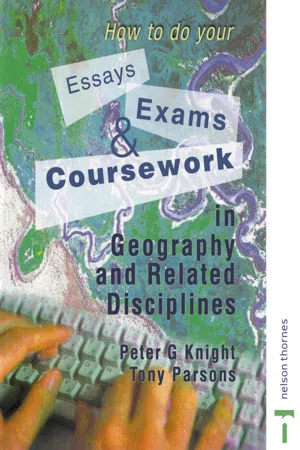
How to do your Essays, Exams and Coursework in Geography and Related Disciplines
- 220 pages
- English
- ePUB (mobile friendly)
- Available on iOS & Android
eBook - ePub
How to do your Essays, Exams and Coursework in Geography and Related Disciplines
About this book
Written for students who need help doing their coursework and exams, this book focuses mainly on the skills and techniques that apply to essay writing, but also covers other types of assignment such as posters, talks, PowerPoint^DTM presentations and web pages. Its basis is that all of these different types of work are centred on clear communication of well-supported responses to the questions or tasks that have been set.
1
What is this book for, and how should I use it?
Chapter summary
The aim of this book is to help you to write better essays and to get better marks. It is designed to help you with both your coursework and your exams, and also to help you with other types of presentation, like posters, talks and web pages. Using this book will develop your skills and improve your confidence, leading to better work and better grades. When you first use the book, look quickly through it to see what kinds of things it covers and to gather the general principles it puts forward. Then use it as a step-by-step guide for your next few pieces of work. Afterwards, use it as a reference guide whenever you have problems with specific assignments, and as a revision and preparation aid before exams.
What is this book for?
The aim of this book is to help students in geography and related disciplines to write better essays and to get better marks. The book also covers other types of assignment like posters, talks and web pages, and it deals with both coursework and exams. If you are doing a course where you have to write essays, put together talks or posters, or make any other kind of structured presentation, then this book is written specifically to help you.
We’ve written this book because most students don’t do as well as they could do with their assignments. Most students could do much better work, and get much higher marks, if they just followed a few simple guidelines.
We want you to do the best work you can, so we’ve written this book to help.
Some courses require students to do most of their coursework in the form of essays, while others require you to produce a variety of essays, posters, talks, web pages and other forms of work. The basic principles behind all these types of work are the same, and as well as explaining the ins and outs of writing essays, this book will also explain how to transfer your essay-writing skills to other types of presentation. We will also deal with the differences between the kind of work you can do when you have a whole semester to produce a report and the kind of work you can do when you have just a couple of hours in an examination room. Again, the same principles apply to both situations, but you have to learn to adapt your skills to get the most out of both types of test. This book will show you how.
How should I use this book?
You will have noticed by now that we’ve arranged the book in the form of a series of answers to the specific questions that we think you will be asking as you read it.
The book is a bit like a workshop manual or a recipe book.
You can dip into it to look up answers to specific questions, or you can work through it section by section as you tackle your coursework projects. We have written it with the expectation that you will do a little bit of both.
We suggest that you should start off by taking a quick skim through the book (especially the contents page and the chapter summaries) just to see what kinds of things we talk about. This will give you a clue as to when you might want to come back to it in moments of panic (no, don’t panic yet). Next, if you are a wise and right-thinking student you will at some point early in your career (before things become urgent) read the book carefully from cover to cover. Trust us, it will stand you in good stead. After you’ve done that, we suggest that you take the book for a serious test drive by using it step by step as you do your next piece of coursework. When your assignment is first set, use Chapters 5 and 6. As you start to assemble your materials and plan the work, use Chapters 7 and 8, and so on until just before you submit the work, when you should look at Chapter 15. Of course, different sections might be more or less appropriate to specific assignments that you do, but once you know your way around the book you will quickly be able to choose which bits offer most relief in times of pain.
The reader we’ve had in mind while writing this book is a student wanting help with an essay. It’s written for you, not for your tutors or for your granny. Therefore we’ve written in a way that is intended to make the book as easy as possible for you to use. We’ve written in a pretty informal style, but we should point out right away that the style we’ve used to write this book is not the style you should normally use to write your essays! You always have to choose a style appropriate to your particular piece of work. We’ll go into that in more detail later (Chapter 8).
Of course, this book is not your only source of advice and assistance. Your institution will almost certainly produce a set of guidelines of its own that explain to you the regulations governing your coursework and the nuts and bolts of what your tutors expect of you. In the end it is they, not we, who will be marking your essays, so you should always seek their advice. If their advice seems to conflict with ours, do what you think best. It is you, not we, who will have to defend your work in a tutorial or in a post-exam viva.
Always begin by reading your institution’s guidelines and your tutor’s instructions.
What types of assignment are (and are not) covered in this book?
This book specifically covers essays, talks, posters, professional reports, newspaper articles, press releases, abstracts and computer-based presentations such as web pages. The book does not cover laboratory classes, short-answer exercises or problem sheets, and it does not cover dissertations or project reports.
We have chosen to cover those particular types of assignment because they form the core of the independent work that most geography students are asked to submit as coursework and in exams, but there are not many books available that provide specific advice on how to do them—at least, not friendly books like this one. We are able to cover all these types of assignment in one book because the same basic principles apply to all of them. For example, if you learn how to do a good essay, it is easy to transfer that skill to giving talks or preparing posters and web pages. These are all structured presentations that follow the same basic rules, but the different media used to convey the material affect how you apply those rules. We don’t cover lab-class reports or problem sheets because they follow different rules, and we don’t cover dissertations because we have already written another book about dissertations (How to Do Your Dissertation in Geography and Related Disciplines), which will be much more use to you than this one will if doing a dissertation is your immediate problem.
Our friend Eric
Whenever you’re struggling with a piece of work it’s useful to have a friend to bounce ideas off, to share problems with, and maybe even enlist to read through a rough draft to see how it sounds. It’s useful to have somebody to give an alternative point of view. In this book, when we need someone like that, we use our friend Eric. Eric can be a good friend to have around. He can suggest alternative ways of doing things, he can get you out of bed in the afternoon when your 5 o’clock deadline is approaching and, when he has something really important to say, he can send you a note:
Eric says:
You need all the help you can get, but in the end you have to make up your own mind and do your own work.
Conclusion to Chapter 1
- This book will help you to do better essays, exams and other coursework.
- You can use it either for reference or as a step-by-step workshop manual.
- You should use it alongside your tutor’s instructions and advice.
2
Why are there so many different types of assignment?
Chapter summary
Assessments of your work are intended to allow you, your tutors, and potential employers to judge your progress and achievements. Different types of assignment allow you to demonstrate different skills and abilities, and geography students can expect to be given a range of types of work to do. Although your assignments will involve different skills, they are all based on similar fundamental principles. This book will help you to identify those principles and to recognize how they should be applied to different tasks.
Why have assessment at all?
Assessment serves several different purposes. First, it lets you know how you are getting on throughout your studies. The marks you get week by week, or semester by semester, are a barometer of your progress that you can use to steer your way towards your final grade. Second, assessment tells your tutors how you are getting on. This is useful to them as they try to give you the most constructive and helpful advice that they can, and it also provides evidence that can, and usually will, be chalked up against your name as part of some final course grade. Third, assessment, especially the cumulative final score or degree result, provides a label that will be attached to you and will follow you out of university and into the big bad world of job-hunting, or whatever you choose to do next. To your dying day it will tell you, and everyone else, how well you did at university.
Eric says:
You ought to try to do the best you can. You’ll regret it later if you don’t.
What does assessment actually measure?
The marks that you get for your work are supposed to indicate how well you have done. Tutors, examiners and potential future employers look at them as a measure of your achievement. It is important for you, and for them, to realize what is actually being assessed. This has been made easier by the production of precise formal guidelines that describe exactly what is expected of students graduating with different levels of qualification. These guidelines have been produced by the Quality Assurance Agency for Higher Education (QAA) within a document called ‘Framework for Higher Education Qualifications in England, Wales and Northern Ireland’. For students graduating at the level of a bachelor’s degree with honours, the QAA identify a number of things that students should be able to do. We’ve put a version of this list in Box 2.1 so that you can refer back to it when you need to be reminded what you are trying to convince your examiners of.
Study this list. This is what is expected of you. This is what your examiners will be looking for. This is what is being assessed.
BOX 2.1
WHAT CAN BE EXPECTED OF A GRADUATE
WHAT CAN BE EXPECTED OF A GRADUATE
Based on the descriptor for the qualification of bachelor’s degree with honours, from the Framework for Higher Education Qualifications in England, Wales and Northern Ireland produced by the Quality Assurance Agency for Higher Education.
Students should be able to:
- evaluate evidence, arguments and assumptions, to reach sound judgements, and to communicate effectively;
- devise and sustain arguments, and/or to solve problems, using ideas and techniques, some of which are at the forefront of a discipline;
- describe and comment upon particular aspects of current research, or equivalent advanced scholarship, in the discipline;
- apply the methods and techniques that they have learned to review, consolidate, extend and apply their knowledge and understanding; and to carry out projects;
- critically evaluate arguments, assumptions, abstract concepts and data (that may be incomplete); to formulate judgements, and to frame appropriate questions to achieve a solution—or identify a range of solutions—to a problem;
- communicate information, ideas, problems and solutions to both specialist and non-specialist audiences.
Why use different types of assessment?
Whichever institution you study at, if you do a degree in geography or a similar discipline you can expect to encounter many different types of assessment. From your point of view, this is actually a good thing. It means if there is a particular type of assignment that you don’t like you can be sure that your final mark won’t depend on that type of work alone. This is one of the reasons that you are given different types of assignment, but there is more to it than that.
Geography is a broad subject, not only in terms of the range of topics that you will be expected to study, but also in terms of the types of skills or abilities that you will be expected to learn. That was clear from Box 2.1 These skills include some that are expected to be of value to you long after you have finished your geography degree. Box 2.2 is an extract from the ‘Benchmark Statement’ for geography published by the Quality Assurance Agency for Higher Education in 2000, and it shows how much importance is given to the issue of skills training in modern geography.
BOX 2.2
STUDENT SKILLS
STUDENT SKILLS
EXTRACT FROM SECTION 4 ‘STUDENT SKILLS, ABILITIES AND ATTRIBUTES’ OF THE QUALITY ASSURANCE AGENCY BENCHMARK STATEMENT FOR GEOGRAPHY, 2000.
‘Many geography degree programmes are now at the forefront of policies to furnish students with skills that are valued in the world of work and provide the basis for lifelong learning. Students therefore learn “through” geography in addition to learning “about” geography. The attention given to skills, both discipline-specific and generic, is intended to improve students’ academic performance, enhance their career prospects, enable them as citizens to make a full contribution to the wider community and give them the flexibility required to adapt to new developments and opportunities in a rapidly changing world.’
The main reason that you find yourself having to do all sorts of different types of coursework and exams is that you are being taught, and being tested in, all sorts of different skills. Different types of assignment allow you to demonstrate your competence in different areas. Or, to see it from another perspective, it allows your examiners to see how good you are at doing different things.
In the past, most geography courses employed a wide range of assessment types as a matter of course because it was clearly good practice. Recently this good practice has been formalized and to some extent standardized by the production of a ‘Benchmark Statement’ by the QAA. This Benchmark describes the sort of things that a geography programme should be expected to offer and achieve, and within it is a description of the type of assessments that will usually be included as part of the programme. We’ve put (a version of) this description here, in Box 2.3 It should help to explain why your tutors keep asking you to do so many different things.
BOX 2.3
ASSESSMENT IN GEOGRAPHY
ASSESSMENT IN GEOGRAPHY
From the Subject Benchmark Statement for Geography, produced by the Quality Assurance Agency for Higher Education.
Students should be permitted to demonstrate their full range of abilities and skills, with institutions providing a mix of assessment methods that are, overall, equally accessible to students from varying educational backgrounds and in different learning situations. Students of geography are therefore likely to encounter most of the following assessment methods in their degree: unseen examinations with a range of types of questions/tasks; dissertations and projects (and proposals for these); practical work (in the field, scientific laboratories, specialist C&IT work and quantitative and qualitative analyses); essays of varying lengths; ...
Table of contents
- Cover Page
- Title Page
- Copyright Page
- Acknowledgements
- Preface
- 1 What is this book for, and how should I use it?
- 2 Why are there so many different types of assignment?
- 3 What are essays, and why do I have to write them?
- 4 What will the examiners be looking for when they mark my essay?
- 5 How do I choose which essay to attempt?
- 6 How do I get started on my essay?
- 7 How do I make sure I have a well-structured essay?
- 8 How do I produce a well-written essay?
- 9 What goes at the beginning of the essay? The introduction
- 10 What goes in the middle of the essay?
- 11 What goes at the end of the essay? The conclusion
- 12 How do I use references and write a reference list?
- 13 How do I use diagrams and other illustrations?
- 14 How much do things like layout, neatness and English matter?
- 15 How can I perfect my essay before I hand it in?
- 16 How should I handle exam essays?
- 17 How do I prepare a poster presentation?
- 18 How do I prepare and deliver a verbal presentation?
- 19 How do I prepare web pages and other types of presentation?
- 20 How do I work as part of a group?
- 21 Help! It’s all going wrong, what can I do?
- 22 A final word
Trusted by 375,005 students
Access to over 1.5 million titles for a fair monthly price.
Study more efficiently using our study tools.
Frequently asked questions
Yes, you can cancel anytime from the Subscription tab in your account settings on the Perlego website. Your subscription will stay active until the end of your current billing period. Learn how to cancel your subscription
No, books cannot be downloaded as external files, such as PDFs, for use outside of Perlego. However, you can download books within the Perlego app for offline reading on mobile or tablet. Learn how to download books offline
Perlego offers two plans: Essential and Complete
- Essential is ideal for learners and professionals who enjoy exploring a wide range of subjects. Access the Essential Library with 800,000+ trusted titles and best-sellers across business, personal growth, and the humanities. Includes unlimited reading time and Standard Read Aloud voice.
- Complete: Perfect for advanced learners and researchers needing full, unrestricted access. Unlock 1.5M+ books across hundreds of subjects, including academic and specialized titles. The Complete Plan also includes advanced features like Premium Read Aloud and Research Assistant.
We are an online textbook subscription service, where you can get access to an entire online library for less than the price of a single book per month. With over 1.5 million books across 990+ topics, we’ve got you covered! Learn about our mission
Look out for the read-aloud symbol on your next book to see if you can listen to it. The read-aloud tool reads text aloud for you, highlighting the text as it is being read. You can pause it, speed it up and slow it down. Learn more about Read Aloud
Yes! You can use the Perlego app on both iOS and Android devices to read anytime, anywhere — even offline. Perfect for commutes or when you’re on the go.
Please note we cannot support devices running on iOS 13 and Android 7 or earlier. Learn more about using the app
Please note we cannot support devices running on iOS 13 and Android 7 or earlier. Learn more about using the app
Yes, you can access How to do your Essays, Exams and Coursework in Geography and Related Disciplines by Peter Knight,Tony Parsons in PDF and/or ePUB format, as well as other popular books in Study Aids & Geography. We have over 1.5 million books available in our catalogue for you to explore.