Geometric Dimensioning and Tolerancing: Workbook and Answerbook offers a host of effective examples that utilize the concepts discussed in the reference/text--covering all facets of geometric dimensioning and tolerancing, measurement, inspection, and gauging applicable in any on-the-job situation. The Workbook and Answerbook is a companion to Geometric Dimensioning and Tolerancing: Applications for use in Design, Manufacturing, and Inspection (ISBN: 0-8247-9309-9) and follows the reference text chapter by chapter.
9. Do both holes meet their geometric requirements?
99. Do both holes meet their geometric requirements?
100. Do both holes meet their geometric requirements?
Chapter 1: Introduction
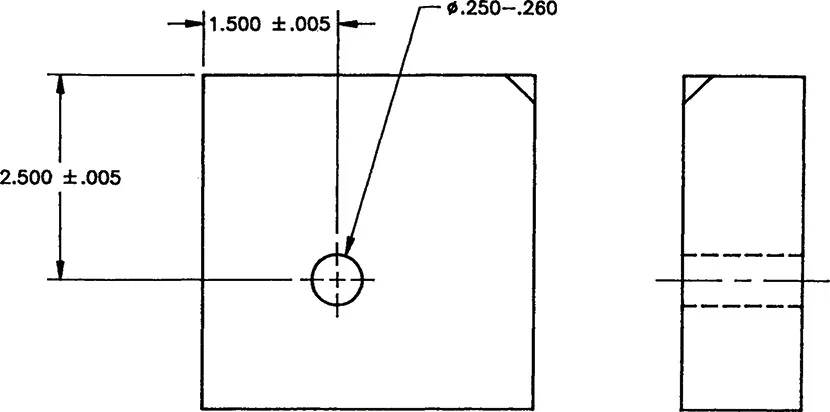
1. Convert this drawing from plus and minus tolerancing to true position tolerancing. The mating shaft shown below has a size tolerance of Ø.220-.230.
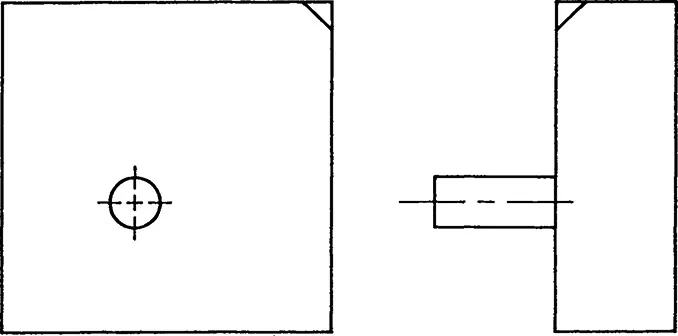
Once the part containing the hole is converted, dimension and tolerance the part containing the shaft using datums, basic dimensions and position tolerance so it is compatible with the first part. Geometric tolerance may be divided between the parts in any appropriate combination.
[Circle as many answers as are correct]
2. Datums are:
real.
simulated.
perfect.
irregular and flawed.
derived from datum features.
3. Features are:
real.
surfaces.
perfect.
always measurable for size.
sometimes measurable for size.
4. Datum features are:
never measurable.
real.
perfect.
sometimes size features.
surfaces.
5. Surfaces are:
features.
datums.
real.
perfect.
flawed.
sometimes chosen to serve as datum features.
6. Datum features should be chosen based on:
function.
smoothness as produced.
repeatability.
accessibility.
representation of mating features.
the part itself with no consideration for mating features.
7. List five common datum feature simulators:
In FIG. 1-5 of the textbook (questions 8-15):
8. The 1.000 is called:
basic size.
basic dimension.
plus and minus tolerance.
limit dimension.
9. The
is called a:
datum feature symbol.
tolerance.
allowance.
geometric characteristic symbol.
10. What kind of tolerance is .500 ±.010?
Limit dimensioning.
Location tolerance.
Bilateral plus and minus tolerancing.
Unilateral plus and minus tolerancing.
11. The
is called a:
datum identification symbol.
zone descriptor.
basic size.
material condition symbol.
12. The C in the feature control frame is called the:
primary datum.
tertiary datum.
perpendicularity datum.
modifier.
13. The ⌖ is called a:
geometric characteristic symbol.
datum feature symbol.
tolerance.
material condition symbol.
14. The Ø.020 in the feature control frame is:
the hole size.
the size tolerance.
basic size.
the diameter of the locational tolerance zone.
15. List at least three more components you feel are needed to accurately define this part.
16. A clearance fit implies the mating features, when produced within size limits,
will always encounter material interference.
will sometimes encounter material interference.
will never encounter material interference.
17. An interference fit implies the mating features, when produced within size limits,
will always encounter material interference.
will sometimes encounter material interference.
will never encounter material interference.
18. Allowance is
the difference between the least material conditions of mating features.
the difference between the maximum material conditions of mating features.
the difference between the shaft MMC and the hole LMC.
the difference between the shaft LMC and the hole MMC.
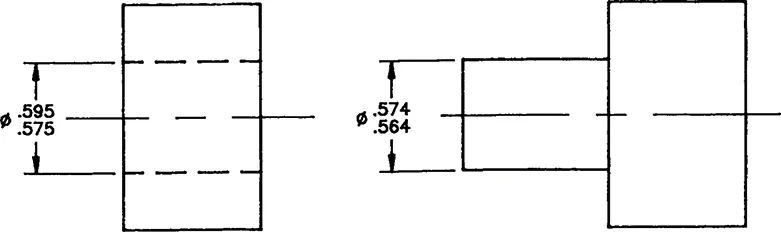
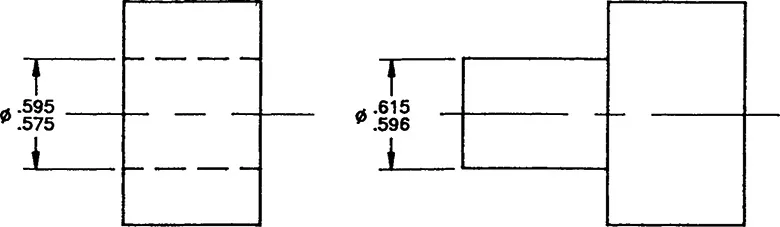
19. In the drawing below, what type of fit would the shaft and hole be classified as?
Fit:____________
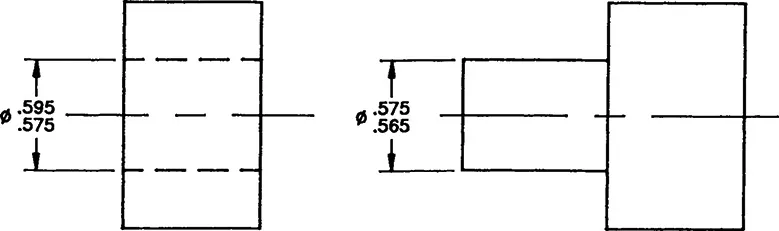
20. Classify the type of fit for the shaft and hole in the drawing below.
Fit:____________
21. Classify the shaft and hole (mating features) fit below.
Fit:____________
22. Show an example of:
a bilateral tolerance ____________
a unilateral tolerance ____________
23. Calculate the mean dimen...
Table of contents
Cover
Half Title
Title Page
Copyright Page
Table of Contents
Preface
Workbook
Answerbook
Trusted by 375,005 students
Access to over 1.5 million titles for a fair monthly price.
Study more efficiently using our study tools.
Frequently asked questions
Yes, you can cancel anytime from the Subscription tab in your account settings on the Perlego website. Your subscription will stay active until the end of your current billing period. Learn how to cancel your subscription
No, books cannot be downloaded as external files, such as PDFs, for use outside of Perlego. However, you can download books within the Perlego app for offline reading on mobile or tablet. Learn how to download books offline
Perlego offers two plans: Essential and Complete
Essential is ideal for learners and professionals who enjoy exploring a wide range of subjects. Access the Essential Library with 800,000+ trusted titles and best-sellers across business, personal growth, and the humanities. Includes unlimited reading time and Standard Read Aloud voice.
Complete: Perfect for advanced learners and researchers needing full, unrestricted access. Unlock 1.5M+ books across hundreds of subjects, including academic and specialized titles. The Complete Plan also includes advanced features like Premium Read Aloud and Research Assistant.
Both plans are available with monthly, semester, or annual billing cycles.
We are an online textbook subscription service, where you can get access to an entire online library for less than the price of a single book per month. With over 1.5 million books across 990+ topics, we’ve got you covered! Learn about our mission
Look out for the read-aloud symbol on your next book to see if you can listen to it. The read-aloud tool reads text aloud for you, highlighting the text as it is being read. You can pause it, speed it up and slow it down. Learn more about Read Aloud
Yes! You can use the Perlego app on both iOS and Android devices to read anytime, anywhere — even offline. Perfect for commutes or when you’re on the go. Please note we cannot support devices running on iOS 13 and Android 7 or earlier. Learn more about using the app
Yes, you can access Geometric Dimensioning and Tolerancing by James D. Meadows in PDF and/or ePUB format, as well as other popular books in Technology & Engineering & Industrial Design. We have over 1.5 million books available in our catalogue for you to explore.