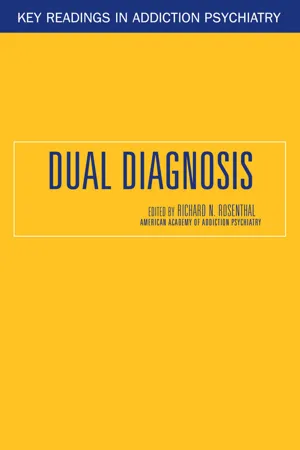
Dual Diagnosis, the second volume in the Key Readings in Addiction Psychiatry Series, broadly illuminates the nature, presentation, evaluation and treatment of persons with co-occurring mental and substance use disorders. Selected from high quality, peer-reviewed journals, the presented articles are authored by some of the most eminent researchers in their respective fields. The reader will come away with up-to-date, evidence-based information on identification and intervention regarding comorbidity of substance use and mood, anxiety, personality and severe mental disorders such as schizophrenia and bipolar disorder.
- 192 pages
- English
- ePUB (mobile friendly)
- Available on iOS & Android
eBook - ePub
Dual Diagnosis
About this book
Information
Chapter 1
Illicit Psychoactive Substance Use, Heavy Use, Abuse, and Dependence in a U.S. Population-Based Sample of Male Twins
Kenneth S. Kendler, M.D.
Laura M. Karkowski, Ph.D.
Michael C. Neale, Ph.D.
Carol A. Prescott, Ph.D.
Laura M. Karkowski, Ph.D.
Michael C. Neale, Ph.D.
Carol A. Prescott, Ph.D.
Illicit psychoactive substance use, abuse, and dependence are major public health problems. To develop informed approaches to prevention and treatment, we need to understand the sources of individual differences in risk. Substantial evidence suggests that the liability to psychoactive substance use disorder (PSUD) aggregates in families.1-6 Both twin7-10 and adoption11-13 studies suggest that part of this familial aggregation is due to genetic factors.
In the first phase of a comprehensive study of PSUD in a U.S. population-based twin population, we examined cannabis, cocaine, hallucinogen, opiate, sedative, and stimulant use. abuse, and dependence in personally interviewed members of more than 800 female-female twin pairs.14-16 In a separate and recently completed study, we have interviewed personally, with the same assessment instrument, both members of 1,193 male-male (MM) pairs ascertained from the same twin registry. In this chapter, therefore, we examine the results for the use, heavy use, and abuse of and dependence on these categories of psychoactive substances in these MM pairs.
Subjects and Methods
Subjects
This report is based on data collected in the second wave of interviews in a new study of adult twins from the Virginia Twin Registry (now part of the Mid-Atlantic Twin Registry). The Virginia registry was formed by a systematic search of all Virginia birth certificates since 1918. Subjects from multiple births are matched by names and birth dates from state records to obtain addresses and telephone numbers. Twins were eligible for participation in this study if one or both twins were successfully matched, were members of a multiple birth that included at least 1 male, were white, and were born between 1940 and 1974. Of 9,417 individuals eligible for the first wave, 6,814 (72.4%) had completed interviews, 1,163 (12.4%) refused, 33 (0.4%) had incomplete interviews, 388 (4,1%) did not agree within the study time limit, 862 (9.1%) could not be located, and 157 (1.7%) were deceased or too ill to be interviewed. At least 1 year after the completion of the first-wave interview (performed by telephone in most instances), we contacted the twins again and attempted to schedule a second-wave interview. The number of subjects eligible for wave-2 interviews included the 6,814 with complete wave-1 interviews as well as 3 subjects interviewed at wave 2 who were eligible at wave 1 but from whom completed wave-1 interviews were not obtained. Whenever possible, this interview was completed face-to-face (79.4% of sample). Of the 6,817 individuals eligible for the wave-2 interview, 5,629 (82.6%) were successfully interviewed while 852 (12.5%) refused, 22 (0.3%) had incomplete interviews, 237 (3.5%) did not agree within the study time limit, 51 (0.7%) could not be located, and 26 (0.4%) were deceased or too ill to be interviewed. To assess the test-retest reliability of our assessments, 131 members of MM twins were reinterviewed 4.4 ±1.1 months (mean ± SEM) after their initial interview.
The current report is based on 1,198 MM pairs with complete data on PSUD from the wave-2 interview. There were 1,184 male-male twins, with 12 pairs from 4 all-male triplet births and 1 pair each from a male-male-female triplet birth and a male-male-female-female quadruplet birth. In addition, this sample includes 534 subjects whose cotwins did not complete a wave-2 interview, of whom 247 came from monozygotic (MZ) and 287 from dizygotic (DZ) pairs.
At the time of second-wave interviews (1994-1998), subjects were 20 to 58 years old (mean [SD], 36.8 [9.1]) and had a mean of 13.4 years of education (SD, 2.6). Interviewers had a master's degree in a mental health-related field or a bachelor's degree in this area plus 2 years of clinical experience. They received 40 hours of classroom training plus regular individual and group review sessions. Two senior staff reviewed each interview for completeness and consistency, Members of a twin pair were interviewed by different interviewers who were blind to clinical information about the cotwin.
Zygosity Diagnosis
We began assessing zygosity by genotyping 227 twin pairs with 8 or more highly polymorphic DNA markers. Using these pairs, we developed a Fisher discriminant function with PROC DISCRIM in SAS17 using height, weight, six standard zygosity questions, and the twins' history of any blood tests. Using this discriminant function, we could confidently assign zygosity to all of the remaining sample (operationalized as an estimated probability of monozygosity of ≤ 10% or ≥ 90%) except for 97 pairs. Of these, we had usable DNA from both members of 65 pairs, from which we obtained zygosities. All available information on the remaining 32 cases, including photographs, was reviewed by two of us (K.S.K. and C.A.P.), who assigned final zygosities. Assignment of zygosity for twins without an interviewed cotwin was done using the discriminant function analysis. These analyses were based on 708 complete MZ pairs and 490 complete DZ pairs.
Measures
Lifetime use, heavy use, abuse, and dependence were assessed separately for seven categories of substances using an adaptation of the Structured Clinical Interview for DSM-III-R.18 With illustrative specific forms, these categories were cannabis (marijuana and hashish); sedatives (quaalude, Seconal, and Valium); stimulants (speed, ecstasy, and Ritalin); cocaine (intranasal, freebase, and crack); opiates (heroin. Demerol [meperidine hydrochloride], and morphine); hallucinogens (lysergic acid diethylamide, mescaline, and phencyclidine); and "other," including inhalants (glue and nitrous oxide), over-the-counter medications (diet and sleeping pills), and miscellaneous (steroids and poppers). For those substances that could be legally obtained, we told respondents that we were interested solely in nonmedical use, defined as use (1) without a physician's prescription; (2) in greater amounts than prescribed; (3) more often than prescribed; or (4) for any other reason than that a physician said they should be taken. Heavy use was defined as ever using the substance more than 10 times per month.
Drug abuse and dependence were diagnosed using DSM-IV criteria,19 except that we ignored criterion B for substance abuse, which rules out abuse in the presence of dependence. Thus, we diagnosed abuse and dependence nonhierarchically. Use and misuse of the other category were too rare to usefully analyze separately, but the other category was added to the category of any PSUD.
Statistical Analysis
We assess twin resemblance in three ways. First, proband concordance is the proportion of affected individuals among cotwins of affected twins. This statistic ignores information from pairs in which both twins are unaffected. Second, the odds ratio (OR) reflects the risk of being affected (or using a substance) among cotwins of affected twins compared with the risk of being affected among cotwins of unaffected twins.
Third, we use a liability threshold model to estimate the genetic and environmental contributions to twin resemblance for substance use, abuse, and dependence. For categorical characteristics, such as lifetime use or dependence, the estimates reflect resemblance in twins pairs for their liability to develop the disorder.20 Liability is assumed to be continuous and normally distributed in the population, with individuals who exceed a theoretical threshold expressing the disorder.
Individual differences in liability are assumed to arise from three sources: (1) additive genetic (A), from genes with allelic effects that combine additively; (2) common environment (C), which includes all sources shared by members of a twin pair, including family environment, social class, and schools; and (3) specific environment (E), which includes all remaining environmental factors not shared within a twin pair plus measurement error. Monozygotic twins within a pair resemble one another because they share all of their A and C components, while DZ pairs share (on average) half of their A and all of their C components. It is possible to include nonadditive genetic effects, such as dominance or epistasis, but these have not been implicated in prior studies of PSUD and their inclusion did not improve the fit of our models, so we did not consider them further.
Our model also assumes independence and additivity of the three components and the equality of shared environmental effects. The equal environment assumption requires that MZ and DZ pairs be equally similar in the etiologically relevant aspects of their shared environments. To test this assumption, we assessed twin similarity for environmental exposure in childhood using standard questions.21 Similarity of their adult environment is assessed by measures of current frequency of contact. We examine whether, when controlling for zygosity, pairs with greater environmental similarity are more similar for substance use, heavy use, abuse, or dependence.
Since drug use, abuse, and dependence are correlate...
Table of contents
- Cover
- Title
- Copyright
- Contents
- Introduction to the Key Readings in Addiction Psychiatry Series
- Introduction
- 1. Illicit Psychoactive Substance Use, Heavy Use, Abuse, and Dependence in a U.S. Population-Based Sample of Male Twins
- 2. Diagnostic Subgroups within a Sample of Comorbid Substance Abusers: Correlates and Characteristics
- 3. Psychiatric Disorders Among Drug-Dependent Subjects: Are They Primary or Secondary?
- 4. Reliability and Validity of Screening Instruments for Drug and Alcohol Abuse in Adults Seeking Evaluation for Attention-Deficit/Hyperactivity Disorder
- 5. Implementing Dual-Diagnosis Services for Clients with Severe Mental Illness
- 6. Motivational Interviewing With Psychiatrically Ill Substance-Abusing Patients
- 7. Current Concepts in the Treatment of Depression in Alcohol-Dependent Patients
- 8. Utilization of Psychosocial Treatments by Patients Diagnosed with Bipolar Disorder and Substance Dependence
- 9. Screening and Diagnosis of Anxiety and Mood Disorders in Substance Abuse Patients
- 10. Substance Use Disorders in Patients with Posttraumatic Stress Disorder: A Review of the Literature
- 11. Social Functioning, Psychopathology, and Medication Side Effects in Relation to Substance Use and Abuse in Schizophrenia
- 12. Personality and Substance Use Disorders: A Prospective Study
- Permission Acknowledgments
- About the American Academy of Addiction Psychiatry
- Index
Trusted by 375,005 students
Access to over 1.5 million titles for a fair monthly price.
Study more efficiently using our study tools.
Frequently asked questions
Yes, you can cancel anytime from the Subscription tab in your account settings on the Perlego website. Your subscription will stay active until the end of your current billing period. Learn how to cancel your subscription
No, books cannot be downloaded as external files, such as PDFs, for use outside of Perlego. However, you can download books within the Perlego app for offline reading on mobile or tablet. Learn how to download books offline
Perlego offers two plans: Essential and Complete
- Essential is ideal for learners and professionals who enjoy exploring a wide range of subjects. Access the Essential Library with 800,000+ trusted titles and best-sellers across business, personal growth, and the humanities. Includes unlimited reading time and Standard Read Aloud voice.
- Complete: Perfect for advanced learners and researchers needing full, unrestricted access. Unlock 1.5M+ books across hundreds of subjects, including academic and specialized titles. The Complete Plan also includes advanced features like Premium Read Aloud and Research Assistant.
We are an online textbook subscription service, where you can get access to an entire online library for less than the price of a single book per month. With over 1.5 million books across 990+ topics, we’ve got you covered! Learn about our mission
Look out for the read-aloud symbol on your next book to see if you can listen to it. The read-aloud tool reads text aloud for you, highlighting the text as it is being read. You can pause it, speed it up and slow it down. Learn more about Read Aloud
Yes! You can use the Perlego app on both iOS and Android devices to read anytime, anywhere — even offline. Perfect for commutes or when you’re on the go.
Please note we cannot support devices running on iOS 13 and Android 7 or earlier. Learn more about using the app
Please note we cannot support devices running on iOS 13 and Android 7 or earlier. Learn more about using the app
Yes, you can access Dual Diagnosis by Richard N. Rosenthal in PDF and/or ePUB format, as well as other popular books in Psicologia & Dipendenze in psicologia. We have over 1.5 million books available in our catalogue for you to explore.