- 172 pages
- English
- ePUB (mobile friendly)
- Available on iOS & Android
eBook - ePub
About this book
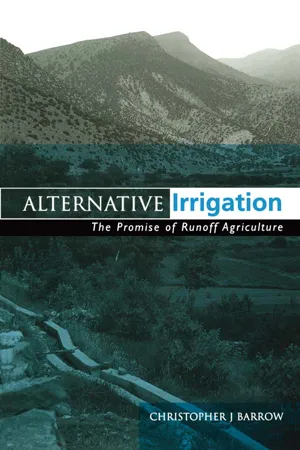
An introduction to runoff agriculture - a form of agricultural irrigation - this text describes how the use of surface and subsurface water, often overlooked and wasted, enables both small farmers and commercial agriculturists to improve yields and the security of harvest, even in harsh and remote environments. The text introduces the techniques and strategies, as well as the challenges and the potential of the crucial approach, which can contribute so much to reducing land degradation and improving conservation and sustainability.
Information
1 | INTRODUCTION |
It is clear that a few years from the start of the 21st century, the world’s agriculture, in spite of impressive achievements over the last century, faces serious challenges (see Box 1.1). Population growth is one of these – between AD 1900 and 1992 the world’s human population grew from roughly 1.6 billion to over 5.0 billion, and it is unlikely to stabilize before reaching 11 billion and may reach 15 billion by AD 2050. Irrigated land increased roughly five-fold to around 235 million hectares between 1900 and 1992, so that by the early 1990s about 16 per cent of total cropland was ‘irrigated’ and gave approximately 36 per cent of total harvest. More than half of increased food production since 1970 has come from irrigated land (rough estimate) (Postel, 1992, p49; Srivastava et al, 1993, pl3). Irrigation is particularly important in Asia where it provides about two-thirds of all food supplies although it comprises less than half of the cultivated land area (Le Moigne et al, 1989, pvii). For some areas of the world, increasing agricultural output through irrigation supplied by river diversion or groundwater will be impractical; however, agricultural improvement may well be possible through better runoff management. Roughly 84 per cent of the world’s agricultural land is rain-fed and either needs improvement or has potential for improvement.
It is important to find alternatives to mainstream irrigation development (mainstream implies large scale and high tech), not only because many localities are unsuitable for it and because of growing competition for available freshwater supplies, but also to reduce pollution and other impacts often associated with established irrigation approaches. These impacts should not be underestimated; there are too many examples of large numbers of people who have suffered socio-economic and health problems, of land degraded and biodiversity destroyed. For example, the Aral Sea bears testimony to ill-conceived irrigation development. In 1961 the Aral Sea was the world’s fourth largest inland waterbody, with rich fisheries and flourishing communities around it; by 1990 its volume had shrunk by 69 per cent and the water was badly contaminated by salts, pesticides and fertilizer from the return flows of cotton and rice irrigation in the southern Commonwealth of Independent States (CIS, former USSR). Today the fisheries have virtually disappeared, settlements have withered, wildlife has suffered badly, and many people are ill from the effects of pollution. Worse, the irrigation that has caused these impacts may not be sustainable in the long-term or even reasonably profitable in the short-term (Adams, 1992; Jones, 1997, p217; Kobori and Glantz, 1998).
Box 1.1 CHALLENGES FACED BY AGRICULTURE IN THE LATE 20TH CENTURY
Challenges include:
• growing population;
• soil degradation;
• breakdown of established social controls and obligations affecting agriculture practices which leads to environmental degradation and rural-urban migration;
• growing competition for water supplies;
• risk of global environmental change;
• pollution of various kinds affecting agriculture (for instance, acid deposition);
• risk of further stratospheric ozone depletion raising UV-radiation damage;
• failure to invest enough in improving the agriculture of poor smallfarmers, especially those in harsh (marginal) environments;
• loss of access to common resources;
• rising costs of establishing new large scale agriculture (especially irrigation);
• low market prices and marketing difficulties for smallfarmers;
• escalating costs of rehabilitating failed agricultural development;
• outmigration from rural areas causing labour shortages;
• environmental harmful agrochemicals (pesticides, herbicides, artificial fertilizers).
Although mainstream irrigation has contributed a great deal since the 1950s to feeding people and providing agricultural commodities, this must be weighed against the fact that, since the turn of the century, a large proportion of expenditure on agricultural research and much of the total investment in agriculture has been directed towards it. At the time of writing, over 60 per cent of all agrochemicals were used by the irrigation sector, which includes most larger-scale producers. The success of irrigation is thus hardly surprising and begs the question: what would similar investment yield if directed at runoff or rain-fed agriculture and smallfarmers?
The reality is that the runoff and rain-fed agriculture sectors are neglected and, unless attitudes change, efforts to upgrade (to intensify) agriculture will be based on expensive mainstream irrigation which is often poorly adapted to local environments and the needs of many rural people (notably the production of locally available food and the generation of employment) and is seldom sustainable (Hilly, 1990). It is not cost effective to extend mainstream irrigation to some parts of the world. For example, it has been estimated that only 5 per cent of sub-Saharan agricultural land is under mainstream irrigation, and with costs rising fast, cheaper and more accessible alternative ways of boosting yields, improving security of harvest and sustaining agriculture are needed.
Total water use (for example, for agriculture, domestic supply and industry) has increased five-fold since AD 1900 (Uitto and Schneider, 1997, p5). In preparation for the Rio Earth Summit of 1992, the International Conference on Water and Environment met in Dublin to discuss water availability and its constraints. Irrigation plays a very important role in world food production and uses roughly 65 per cent of total available freshwater; that use is projected to fall to roughly 60 per cent by AD 2000 as demand for domestic supplies and industry increases (Agnew and Anderson, 1992; Pearce, 1992; Hillel, 1994, p34). As water availability is falling, world population is increasing: by AD 2040 there will probably be over nine billion people to feed (compared with the present estimated 5.5 billion) and less water for irrigation. According to Pereira et al (1996) world food production must double in the next few decades. Postel (1992, p58) warned: ‘With some 95 million people being added to the planet each year in the nineties, new strategies will be needed to prevent the many irrigation constraints from leading to food shortages.’ The struggle to find enough water for cities and to feed growing populations is already a threat to well-being for some regions and countries.
Large irrigation schemes often leak water from their supply channels and crop land; it is not unusual for 80 per cent of the water diverted from a river or pumped from groundwater to fail to be absorbed by crops (Barrow, 1987, p209). More efficient agricultural use of water and alternative sources must be urgently pursued. Before the late 1970s irrigation expanded fast enough to keep pace with population growth, but recently there has been a per capita decline in irrigated land area and food security is falling as a consequence (Postel, 1992, p51). Governments and development agencies have mainly supported large scale, commercially oriented mainstream irrigation development projects which rely on considerable quantities of water diverted from rivers or groundwater and suitable land. Both these resources are becoming more difficult to find. Given the commercial support and government favour it enjoys, mainstream irrigation will continue to be implemented. At least there are signs that the mainstream irrigation sector is paying more attention to rehabilitating degraded schemes and to developing water conservation technology, especially low-cost (but still too expensive for many agriculturalists), low-volume drip, bubble and trickle water application techniques (Barrow, 1987; Lambert and Faulkner, 1989; Le Moigne et al, 1989). As well as improving mainstream irrigation it is important to develop and promote accessible, sustainable , effective, and water-conserving alternatives, and runoff agriculture offers some of the most promising strategies for doing that.
In rich and poor nations irrigation development has too often resulted in unwanted consequences: groundwater supplies have been depleted and sometimes fail permanently; agrochemical-charged return flows contaminate groundwater, lakes, rivers and seas (such as the Aral Sea); wetlands are damaged and coral reefs may suffer; soils may be salinized and ruined; debts are incurred; people may be relocated without adequate compensation; and water-related illnesses may increase. Many large irrigation schemes fail to adequately repay investment and often degenerate, sometimes necessitating abandonment so that much agriculturally productive land is lost. Where large scale irrigation produces export crops or foodgrains for urban areas, small farmers may find that market prices fall. They then neglect or abandon production to the detriment of their livelihoods and national food security.
Low rewards for smallholder agricultural production can prompt rural folk to migrate to cities, where they usually join the ranks of the unemployed. Thus, the benefits of investment in large-scale commercial irrigation may be overshadowed and the impacts may marginalize other off-site agriculturalists, enough to cause urban migration and widespread environmental degradation. For example, in Morocco the government has invested in large irrigation schemes mainly in the north-western lowlands. The impact of the cheap crops these produce, including grain purchased from abroad with the profits of export crops, together with the lack of investment in traditional farming, has led to overgrazing of common land, narcotics cultivation and neglect of traditional arable farming in the Rif and Atlas Mountains. Consequent land degradation has helped to silt up dams and channels and has reduced groundwater recharge, threatening some of the large scale lowland irrigation schemes and urban water supplies. These are high prices to pay for irrigation development that generally offers limited employment generation and often vulnerable and unsustainable production and increased dependency (for instance on pump parts, agrochemicals and fuel).
The problems associated with large scale irrigation are well known and funding agencies and irrigation experts call for better engineering and management and for rehabilitation of schemes which have failed (perhaps as much as two-thirds of the world total). However, as easier-access water supplies and the best land are used, costs of large scale irrigation spiral up; by 1992 a big scheme in Africa often exceeded US$ 20,000 per hectare to establish (Postel, 1992, p52). In spite of the costs and risks nations still plan to develop large irrigation; for example, Egypt has been reviewing proposals to divert up to 10 per cent of Nile flows to irrigate the Western Desert. The expense would probably be well over UK£1.2 billion (at 1997 prices) and the development could be environmentally and socially damaging and unsustainable (Pearce, 1997, p5). Commercial interests still see potential for profit if they invest in mainstream irrigation – there are pumps, water distribution equipment and agrochemicals to be sold; runoff agriculture does not offer such opportunities for gain and so will probably have to be supported by non-commercial means.
The opportunities for opening up new land for rain-fed agriculture are decreasing – although the development of drought-and salt-tolerant crops may help, and there are regions of Africa where underpopulation and communal landholding may prevent the intensification of agriculture (Tiffen et al, 1994). Outside the humid tropics, and even within some humid tropical localities, rain-fed agriculture runs the risk of ‘uncertain rain’ (Adams, 1992); to improve security of harvest (as well as to boost crops and perhaps allow diversification) some way of improving moisture availability is required. In many parts of the world that will have to be through runoff agriculture because there are no suitable groundwater or river irrigation water supplies, or they are too distant, or some company or city has appropriated them.
Growing human populations are more likely to be fed through intensification rather than expansion of farming. As already discussed, intensification in recent decades has mainly occurred through promoting large scale irrigation. However, the number of water-scarce regions and countries is growing: Postel (1992, p29) estimated that at least 232 million people were already affected. Some countries are relying on finite groundwater supplies and have few or no rivers as an irrigation supply alternative when underground supplies run out; for ...
Table of contents
- Cover
- Half Title
- Title Page
- Copyright Page
- Table of Contents
- List of Figures, Boxes and Tables
- List of Photographs
- List of Acronyms and Abbreviations
- Preface
- Acknowledgements
- 1 Introduction
- 2 Soil and Water Conservation (SWC)
- 3 Runoff Harvesting and Storage
- 4 Ephemeral and Variable Streamflow: Spate, Wetlands and Flood Agriculture
- 5 Indigenous Runoff Agriculture: Challenges and Breakdown
- 6 Expanding, Upgrading and Rehabilitating Runoff Agriculture
- 7 The Future for Runoff Agriculture
- Glossary
- References
- Further Reading
- Index
Trusted by 375,005 students
Access to over 1.5 million titles for a fair monthly price.
Study more efficiently using our study tools.
Frequently asked questions
Yes, you can cancel anytime from the Subscription tab in your account settings on the Perlego website. Your subscription will stay active until the end of your current billing period. Learn how to cancel your subscription
No, books cannot be downloaded as external files, such as PDFs, for use outside of Perlego. However, you can download books within the Perlego app for offline reading on mobile or tablet. Learn how to download books offline
Perlego offers two plans: Essential and Complete
- Essential is ideal for learners and professionals who enjoy exploring a wide range of subjects. Access the Essential Library with 800,000+ trusted titles and best-sellers across business, personal growth, and the humanities. Includes unlimited reading time and Standard Read Aloud voice.
- Complete: Perfect for advanced learners and researchers needing full, unrestricted access. Unlock 1.5M+ books across hundreds of subjects, including academic and specialized titles. The Complete Plan also includes advanced features like Premium Read Aloud and Research Assistant.
We are an online textbook subscription service, where you can get access to an entire online library for less than the price of a single book per month. With over 1.5 million books across 990+ topics, we’ve got you covered! Learn about our mission
Look out for the read-aloud symbol on your next book to see if you can listen to it. The read-aloud tool reads text aloud for you, highlighting the text as it is being read. You can pause it, speed it up and slow it down. Learn more about Read Aloud
Yes! You can use the Perlego app on both iOS and Android devices to read anytime, anywhere — even offline. Perfect for commutes or when you’re on the go.
Please note we cannot support devices running on iOS 13 and Android 7 or earlier. Learn more about using the app
Please note we cannot support devices running on iOS 13 and Android 7 or earlier. Learn more about using the app
Yes, you can access Alternative Irrigation by Christopher J Barrow in PDF and/or ePUB format, as well as other popular books in Technology & Engineering & Agriculture. We have over 1.5 million books available in our catalogue for you to explore.