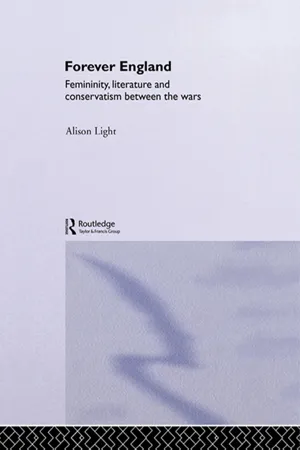
Most studies of the interwar years have focussed upon literary elites, rendering that past and its literature in almost exclusively male terms. In Forever England Alison Light argues that we cannot make sense of Englishness in the period, or understand the changes within literary culture, unless we recognise the extent to which the female population represented the nation between the wars.
From the traumatic aftermath of the First World War, Forever England traces the making of a conservative national temperament which could be defensive and protective, yet modernising in outlook. In a series of literary anaylses, the author suggests some of the tones and accents of this new version of Englishness; in particular she looks at new kinds of readership and fiction, at the historical and emotional significance of the `whodunit', the burgeoning of historical romance, and the creation of a middlebrow culture in the period.
Forever England evokes a powerful sense of period and of the pleasures of reading, providing an intimate picture of interwar life from inside the English middle classes. As a feminist inquiry, it argues from a different kind of social and political history; one which makes connections between the interior structures of private life and their more public national forms. Controversially, it also urges that feminism deal with conservative, as well as radical, desires and their place in women's lives.
- 312 pages
- English
- ePUB (mobile friendly)
- Available on iOS & Android
eBook - ePub
About this book
Information
Chapter 1
The demon in the house: the novels of I. Compton-Burnett
A WOMAN OUT OF PLACE
(Angus to his mother): ‘You might be a figure in history, corrupted by power. It is what you are, except that you are not in history.’(The Last and the First, p. 87)1
‘I've read your book’, Ivy Compton-Burnett remarked to Rosamund Lehmann on first meeting her at a publishing party for The Echoing Grove, ‘and I've decided that one of us cannot be a woman.’2 Nothing could be less feminine than the fictions of ‘I. Compton-Burnett’, a literary phenomenon whose defiant and contrary voice compelled readers' attention for nearly fifty years. Born in 1884, she published her first novel (which she later disclaimed) in 1911, and went on to write nineteen novels at roughly two-year intervals from Pastors and Masters in 1925 until The Last and the First, published in 1971, two years after her death. This resilient authorship, which brought her many literary and public honours including a Dameship in 1968, is perhaps less interesting than the one striking fact about the novels themselves: with very minor exceptions they are all pretty much the same. It is as if nearly half a century of social change has not happened, although time does not so much stand still in her work as simply repeat itself. Yet these are not popular fictions, bestsellers whose pleasures reside unashamedly in the formulaic and in the re-evocation of well-loved and savoured certainties of plot and genre. If Compton-Burnett's prose performs a ritual then it is more an exhausting and inward exorcism, a purging of demons who even after all those years continued to possess her.
Her novels really are peculiar. The fictions are all but relentlessly uniform in conjuring up the lives of the well-to-do, an imagined petty aristocracy and a propertied but usually impoverished upper middle class in their country places and small mansions, locked into the late Victorian years, the period in which Compton-Burnett herself grew up. Their bizarre quality resides, however, in these doings being rendered primarily as ‘sayings’: each novel consists entirely of highly-wrought, stylised conversations between family groupings in a mannered Victorianese which is the unchanging vernacular from 1925 to 1969. There are next to no passages of description. Enormous, often criminal events (infants murdered in their cradles, unsuspecting relatives lured into gaping ravines) do happen but they happen in parenthesis, as it were, whilst the minute recording of everyday exchanges between the self-conscious members of the same family constitutes the real dramatic interest. With very little authorial intervention readers are left to make what they can of the sketched-in characters (the shape of whose hands or brows must usually suffice) and to fend for themselves in a narrow echo-chamber of voices. The emotional temperature varies very little from novel to novel: it is always chilly, and for the uninitiated it is possible to wander through whole paragraphs in the dark, beset by ‘the tumult of voices’3 or deciding, as Dame Ivy herself wryly suggested, that ‘if you once pick up a Compton-Burnett, it is difficult not to put it down again.’4
No doubt it is partly the ‘monotonous obstinacy’5 of Compton-Burnett's novels which has had the power to daunt and disarm her critics. Her work upsets many of literary criticism's dearest discriminations: it does not ‘develop’; it awkwardly refuses to belong to any one decade, and stylistically it straddles a no-man's land between the extreme edge of realism and a grotesque, quirky modernism. The literary critical division between novels which document and are ‘sociological’ and novels of personal sensibility, or between realism and modernism, is never more clearly revealed as a false and unhelpful opposition than in the work of Compton-Burnett, whose novels are obviously neither and yet somehow both.6 For many it is a project which simply defeats placing and is best relegated to that well-worn category of English eccentricity.7 Both Compton-Burnett's virtues and failings are taken to be purely idiosyncratic: hers is an ‘aggressively original and distinctive talent,’8 but the accumulative effect of such praise has been to situate the work outside history, beyond the mainstream of English cultural life, in a curious backwater of its own.
This apparent marginality is belied, however, by the monotonous obstinacy of Compton-Burnett's readers here and in North America who keep her reprinted every year. For if not a bestselling author, she seems to have a continuous following with, as one of her biographers remarks, ‘ardent followers in every walk of life’.9 Compton-Burnett appears regularly in Penguin paperback as well as in the more avant-garde lists of Allison & Busby. Manservant and Maidservant is one of Oxford University Press's ‘Best Novels of Our Time’, whilst outside the usual literary circles, she has appealed to enthusiasts as far apart as Nathalie Sarraute (a high priestess of the nouveau roman) and Studs Terkel, the Chicago oral historian and radical.10 A considerable social and cultural presence in her time, holding court to a younger generation which included Elizabeth Taylor, Olivia Manning and Rosamund Lehmann, Compton-Burnett has always been a ‘writer's writer’ but also one of the very few female authors to get more than a nodding mention in standard critical histories of modern literature.11
Nevertheless if Compton-Burnett has become a literary curiosity, she seems hardly less outré as a ‘woman's novelist’ and has indeed proved to be one of the blind spots of feminist literary criticism. This absence of discussion might at first seem surprising given the imaginative centre of her novels, which for all of her long life had the force of a magnificent obsession: the family and domestic existence. Yet she offers us no confessions of a suffering heroine to identify with, indeed no ‘I’ at all; no consoling narratives of escape from the prisons of home and relationships; no routes either into a private space of feeling or emotionality eschewing, as she does, the novel's special prerogatives of interior monologues and reflective commentary. There are no narratorial words of wisdom to wrap around ourselves nor do the characters connect their lives with a more public sphere or with avowedly social issues. If by ‘woman writer’ we expect someone who makes ‘female experience’ and especially heterosexual love the impulse of her narrative, Compton-Burnett is disappointingly uninterested in either courtship or marriage. No one could be less moved by romantic longings, whether personal, sexual or social: the reader, like the writer, does not so much explore as dissect feelings, is encouraged not to be a co-participant in the action so much as a voyeur, an observer not an actor in the charades of family life.
In the tentative literary histories so far of British women's writing this century, Compton-Burnett seems a woman out of place. She cannot sensibly be grouped with other inter-war writers, that second generation of suffragists and realists like Vera Brittain or Winifred Holtby, nor with committed experimentalists like Dorothy Richardson and Virginia Woolf; as someone who continued writing into the 1950s and '60s she seems to have even less in common as a literary dowager with a Doris Lessing or a Sylvia Plath. In other words, she cannot be read to illustrate the forward march of women's consciousness or be assimilated to any mapping of feminist or proto-feminist protest in a reading of novels which wants them to be the straightforward social history of our times. Neither is she, on the other hand, a novelist of the inward self, analysing or proposing a proclaimedly feminine subjectivity. Not surprisingly, those critics who have broached her work have again stressed its waywardness: she is a writer who fails to ‘fit in’12 and whose fiction constitutes ‘the oddest exhibit which women's literature has to offer’.13
Yet it is often the oddest exhibit which tells us most about the museum, its classifications and its processes of selection. It is precisely Compton-Burnett's intractability as a ‘woman writer’ which might make us reconsider the terms of the definition. If women's writing is a house of many mansions, could it be that we have been reluctant to investigate its darkest corners, to move from its well-lit rooms down into the shadowy cellars? Compton-Burnett's novels reveal a welter of ugly imaginings about the more perverse and tormented sides of the self, about the capacity to hurt and maim within the ‘safe’ confines of home. It is a capacity which the novels deem as clearly feminine as any other and which at least one female critic has found ‘repellent’ and unwomanly.14 One of her best-loved ‘comedies’ (for they are also humorous novels), The Present and the Past, opens upon a group of children watching a sick hen being pecked to death by its fellows; none of them is for the squeamish and all aim to scrutinise with gimlet eyes ‘the below-stairs of family relationships’.15 For Ivy Compton-Burnett is the most unflinching of guides to what she sees as the misery of a domestic life in which women are as likely to be manipulative and peevish despots as benign chatelaines. Her work forces us to contemplate a full repertoire of feminine desires, of feelings and behaviours we might prefer to disown.
If one of the insights of feminism is to suggest that we can best understand our inward life of thought and emotion as the life too of a particular culture and a particular social life, then it is part of my purpose here to argue that what structures Compton-Burnett's fictional universe can be recognised as social and historical impulses. I begin in this chapter, therefore, with a rereading of her early life so powerfully evoked in Hilary Spurling's imaginative biography,16 not in order to impress the reader yet again (as even the best biography will do), with its unique nature, but to see where it touches on a common history and representative concerns. Compton-Burnett's life was in many ways typical of that pre-war generation whose needs and anxieties were shaped in the crucible of late Victorian and Edwardian domestic privacy, under — to use the phrase of one of her contemporaries — ‘the tyranny of the private house’.17 Her relation to that past, from which she was abruptly and completely severed after 1918, was to dominate her writing career. I suggest that her fiction needs to be read as a response to a loss which, though it took individual and personal shape, nevertheless was part of a significantly shared experience marked by the social cataclysm of the Great War. Not that the life and the fiction can ever be made to fit (or ought to be so manipulated): Compton-Burnett's novels occupy their own fantastic territory beyond the bounds of the feasible or plausible. This does not mean, however, that their imaginative devices, the contours and the features of their symbolic landscape, are outside time and place, arbitrary or random.
Rather than being outside the mainstream of cultural life, Compton-Burnett was left tragically well-placed in the 1920s to understand something of the traumatic upheavals which were the post-war legacy. Violently evacuated from the pre-war world into a modernity she had not chosen and which in many ways she refused, Compton-Burnett's formation as a writer embodies a complex response to the experience of personal and historical disjuncture, at once holding on to the past and compulsively repeating it, whilst at the same time enjoying a distance from its moral authority and seeking to loosen its emotional grip. I see her fiction as speaking directly to the reshaping of English cultural life after the war, able to confront the explosion of ideals about domestic life and family, sentiments which had been as dramatically undermined by 1918 as the nation's ideals of manhood. It is usual to think of literary modernism as shaped by the experience of exiles, either those who literally put a distance between themselves and their country or who signal imaginatively their sense of being outside any continuous cultural inheritance or stable history of belonging. Such a model is archetypally a masculine one, dependent as it is on certain freedoms of movement, on notions of social mobility and sexual autonomy, as well as on the assumption of economic independence. Compton-Burnett's fiction, on the other hand, suggests another history of modernism, one bound up tightly with the history of femininity. Her novels are also concerned with exile and with modernity but explore their meanings much closer to home, dwelling on an expulsion from childhood, from the values and expectations of the pre-war world, in the most intimate spheres of private and subjective life.
A MORBID GROWTH
‘We can only hide our heads at home. Home causes the shame, but it also provides a hiding-place for it, and we have to take one thing with another.’‘You would hardly think homes would be so fair,’ said Clemence.(Two Worlds and Their Ways, p. 310)
One of the most convincing fabrications Ivy Compton-Burnett ever produced was that of her own family past. Refusing to speak directly about that past — there was no biography, she told one friend18 — the few details which she gave out, ‘I was educated with my brothers in the country as a child’,19 were powerfully misleading. One could indeed be forgiven, as Hilary Spurling writes, for believing her ‘the daughter of an impoverished squire’: many of her nearest friends most certainly did,20 and new acquaintances could be entirely taken in: ‘The family, to use her word, was “raised” on an estate, and one appreciated the truth of this in her fiction.’21 Even if she was unaware of just how unillustrious her forebears actually were (numbering farm labourers, grocers and straw-bonnet makers amongst them), Compton-Burnett was nevertheless quite happy to claim a vague descent from the renowned Bishop Burnet (the seventeenth-century historian) whose portrait graced her walls, and to allow rumours of a family ‘place’ in the country to circulate, when it is unlikely that she had even so much as visited a country hou...
Table of contents
- Cover
- Half Title
- Full Title
- Copyright
- Dedication
- Contents
- Preface
- Introduction
- 1 The demon in the house: the novels of I. Compton-Burnett
- 2 Agatha Christie and conservative modernity
- 3 ‘Peace in our time’: Mrs. Miniver
- 4 Daphne du Maurier's romance with the past
- Afterword
- Appendix: Mrs. Miniver writes to The Times
- Notes
- Bibliography
- Index
Trusted by 375,005 students
Access to over 1.5 million titles for a fair monthly price.
Study more efficiently using our study tools.
Frequently asked questions
Yes, you can cancel anytime from the Subscription tab in your account settings on the Perlego website. Your subscription will stay active until the end of your current billing period. Learn how to cancel your subscription
No, books cannot be downloaded as external files, such as PDFs, for use outside of Perlego. However, you can download books within the Perlego app for offline reading on mobile or tablet. Learn how to download books offline
Perlego offers two plans: Essential and Complete
- Essential is ideal for learners and professionals who enjoy exploring a wide range of subjects. Access the Essential Library with 800,000+ trusted titles and best-sellers across business, personal growth, and the humanities. Includes unlimited reading time and Standard Read Aloud voice.
- Complete: Perfect for advanced learners and researchers needing full, unrestricted access. Unlock 1.5M+ books across hundreds of subjects, including academic and specialized titles. The Complete Plan also includes advanced features like Premium Read Aloud and Research Assistant.
We are an online textbook subscription service, where you can get access to an entire online library for less than the price of a single book per month. With over 1.5 million books across 990+ topics, we’ve got you covered! Learn about our mission
Look out for the read-aloud symbol on your next book to see if you can listen to it. The read-aloud tool reads text aloud for you, highlighting the text as it is being read. You can pause it, speed it up and slow it down. Learn more about Read Aloud
Yes! You can use the Perlego app on both iOS and Android devices to read anytime, anywhere — even offline. Perfect for commutes or when you’re on the go.
Please note we cannot support devices running on iOS 13 and Android 7 or earlier. Learn more about using the app
Please note we cannot support devices running on iOS 13 and Android 7 or earlier. Learn more about using the app
Yes, you can access Forever England by Alison Light in PDF and/or ePUB format, as well as other popular books in Literature & Modern British History. We have over 1.5 million books available in our catalogue for you to explore.