- 432 pages
- English
- ePUB (mobile friendly)
- Available on iOS & Android
eBook - ePub
Integrated Management of Insects in Stored Products
About this book
This work offers a comprehensive presentation of the identification, biology, ecology and sampling of insect pests in stored foods, and provides a balanced ciew of the biological, physical and chemical control methods used in pest management. It furnishes step-by-step procedures for creating individually tailored integrated pest management programmes. Every available method of control is covered.
Information
Subtopic
BiologyIndex
Biological Sciences1
Coleoptera
The order Coleoptera (beetles) comprises some 250,000 known species, many of which are able to exploit human-made and human-modified habitats and, in doing so, are now important pests. Members of some 40 families of beetles have been recorded in stores worldwide (Halstead 1986). However, almost all the species of major importance as storage pests belong to one of seven families: Bostrichidae, Bruchidae, Cucujidae, Curculionidae, Dermestidae, Silvanidae, and Tenebrionidae.
The Coleoptera undergo complete metamorphosis. Adults are typically heavily sclerotized and can be easily recognized by the presence of elytra, or highly modified hardened front wings. These conceal the usually functional hind wings, the dorsal, or upper, surface of the metathorax, and most of the dorsal surface of the mesothorax. In most species the elytra also conceal all or most of the dorsal surface of the abdomen (Fig. 1). The head of most species projects directly forwards but in some, notably the bostrichids, it is deflexed (projects downwards) under the prothorax.
Larvae, which have well-developed biting mouthparts, vary in form (Fig. 1a–d). They all lack the prolegs or false legs found on most lepidopteran larvae. Campodeiform larvae are elongate active creatures with well-developed legs and antennae. These are often obligate or facultative carnivores, for example, larvae of the Carabidae, Histeridae, and Tenebrionidae. Most secondary pests have larvae of this type whereas larvae of primary pests are usually scarabaeiform. Scarabaeiform larvae are typically herbivores and spend all or most of their life within a seed or solid food. They are crescent-shaped and have less well developed legs and antennae than campodeiform larvae. Examples include larvae of the Anobiidae, Bostrichidae, Bruchidae, Curculionidae, and Ptinidae. Larvae of the Curculionidae are apodous (legless) and spend all their life within grain kernels.
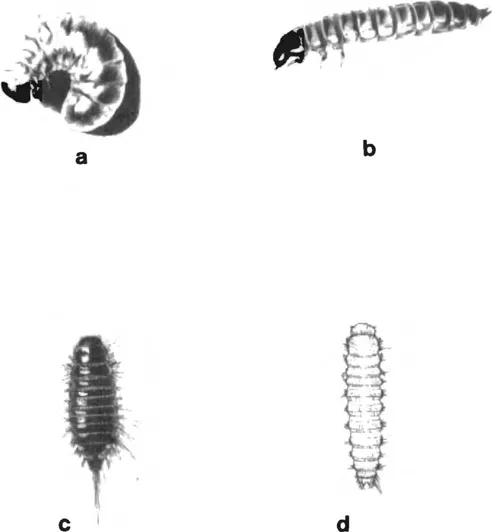
Figure 1 (a) Larva of Ptinus tectus (Ptinidae) (MAFF/CSL). (b) Larva of Tribolium castaneum (Tenebrionidae) (MAFF/CSL). (c) Larva of Trogoderma granarium (Dermestidae) (MAFF/CSL). (d) Larva of Dermestes maculatus (Dermestidae) (NRI).
Nearly all ecological niches found in stores are exploited by beetles. Members of the Bostrichidae, Bruchidae, and Curculionidae can attack undamaged pulse and cereal grains as primary pests. Damage caused makes the grain much more susceptible to attack by other insects, the secondary pests, which are not generally capable of breeding rapidly or at all on intact grains. These species can, nevertheless, cause heavy additional damage to previously attacked material and can also attack processed commodities such as flour and milled rice and material damaged by processing, bad handling, threshing, drying, or other processes. Most of these species belong to the Cucujidae, Silvanidae, and Tenebrionidae.
Several families, notably the Cleridae and Dermestidae, contain species that attack material of animal origin such as dried skins, dried fish, and fishmeal.
Many beetles of the families Cryptophagidae, Mycetophagidae, and Ptinidae are mold feeders or scavengers. Others, for example, many nitidulids and some members of the Bruchidae, are frequent inhabitants of ripening crops but can only persist in storage on poorly dried commodities.
Wood-feeding members of the Bostrichidae, Lyctidae, and Scolytidae can damage wooden storage structures. Other beetles, including the Trogossitidae and some Dermestidae, will feed elsewhere but their larvae will often burrow into wood, soft plaster, and other materials in search of a site to pupate. Several families of predaceous beetles occur in stores, notably the Carabidae, Histeridae, and Staphylinidae. While most are casual strays from the local fauna and are of little consequence, some, notably several histerids, are strongly associated with the particular storage pests on which they prey.
Of all of the beetle species known, probably fewer than 100 could be called regular inhabitants of food stores. Many of these, while rare or little known in nature, have been associated with human activities since at least the time of ancient Egypt, Greece, or Rome (Buckland 1981; Panagiotakopulu and Buckland 1991). As a result of millennia of trade, most important species have a cosmopolitan or a pantropical distribution. However some, such as the dermestid Trogoderma granarium Everts and most notably the bostrichid Prostephanus truncatus (Horn), appear to have colonized only a proportion of their potential range and are still spreading. There also remains the possibility of new species adapting to the storage environment and becoming pests or of known storage pests developing a taste for new commodities.
A number of publications provide identification of storage Coleoptera in more detail than is possible here. These include works by Collier (1981a), Gorham (1987), Mound (1989), Haines (1991), Halstead (1986), and Kingsolver (1987a), and keys for larvae by Anderson (1987) and Collier (1981b). Other works give additional information on the distribution and biology of pest species together with data on environmental requirements. These include works by Aitken (1975), Evans (1981), Haines (1974, 1981, 1991), and Gorham (1991).
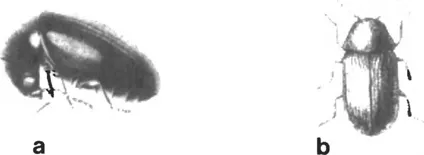
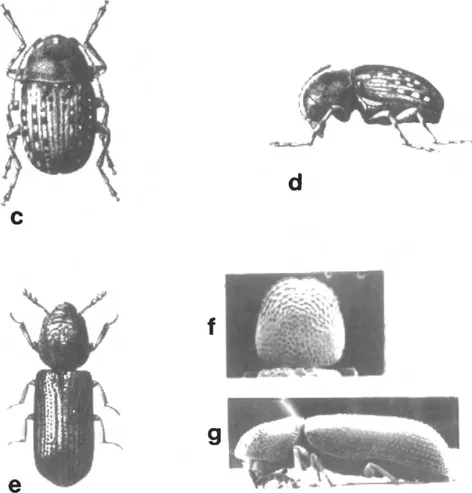
Figure 2 (a) Lasioderma serricorne (Anobiidae): lateral view (2–2.5 mm) (MAFF/ CSL). (b) Stegobium paniceum (Anobiidae): dorsal view (2–3 mm) (MAFF/CSL). (c) Araecerus fasciculatus (Anthribiidae): dorsal view (3–5 mm) (R. E. White). (d) Araecerus fasciculatus: lateral view (R. E. White). (e) Rhyzopertha dominica (Bostrichidae): dorsal view (2–3 mm) (MAFF/CSL). (f) Rhyzopertha dominica: dorsal view of prothorax (NRI). (g) Rhyzopertha dominica: lateral view shows gently convex declivity of elytra (NRI).
I ECOLOGY, DISTRIBUTION, AND IDENTIFICATION
1. Anobiidae
Description
The Anobiidae are small oval or cylindrical beetles with the head strongly deflexed under the prothorax. Most species are wood borers and some of these will attack wooden storage structures. Only two species are important as pests of stored products: Lasioderma serricorne (F.) (Fig. 2a) and Stegobium paniceum (L.) (Fig. 2b). L. serricorne is an oval beetle 2–3 mm long and light brown. The elytra are smooth and covered with fine hairs. The antennae of L. serricorne are serrate (sawlike); those of S. paniceum have a loose club formed from the last three segments. The elytra of S. paniceum have longitudinal striae, or grooves, which are not present in L. serricorne.
Life Cycle
Eggs are laid loosely on the commodity. On hatching, the scarabaeiform larvae burrow into the commodity, feeding as they go. After four to six instars, the larva pupates in a cell made out of fragments of food bound up with silk. The adults, which do not feed, live for 2–6 weeks. They are active and strong fliers and can be attracted to light. Development takes place most rapidly for both species at 30°C, 60–80% relative humidity (RH) and is possible at 20–37°C and 13–34°C for L. serricorne and S. paniceum, respectively. Biological data on L. serricorne have been published by Howe (1957) and for S. paniceum by Lefkovitch (1967).
Distribution and Habitat
Both species are cosmopolitan; in temperate areas S. paniceum is more common. Both attack a wide range of commodities, from cereal grains to processed foods, and are most serious as pests when they attack high-value processed commodities, for example, tobacco products, chocolate, herbs, and spices.
2. Anthicidae
Adults of this family bear a passing resemblance to ants. Their larvae typically feed on decaying vegetation. Members of the genus Anthicus have been recorded from a wide range of stored products. They are cosmopolitan in distribution but are not important as pests. Storage species can be identified by the key provided by Mound (1989).
3. Anthribidae
Members of the Anthribidae are typically found on fungi and dead wood. Only one species, Araecerus fasciculatus (Degeer), is of economic importance on stored products. The adult, 3–5 mm long, resembles a bruchid. The elytra, which are mottled in appearance, leave the last abdominal segment exposed. The last three segments of the relatively long antennae form a loose club (Fig. 2c,d).
A. fasciculatus is found throughout the tropics and subtropics. It is best known as a pest of stored coffee and cocoa beans. It is also a serious pest of drying cassava and will attack other commodities, for example, maize, nuts, spices, and roots. Mphuru (1974) has reviewed the literature on this species.
4. Apionidae
This family is closely related to the Curculionidae and its members are similar in appearance. Many apionids attack growing crops but are not often found in stored commodities. Piezotrachelus spp, which infest the ripening pods of Vigna spp (cowpeas and grams), sometimes emerge in large numbers from the recently stored seeds of these pulses.
5. Bostrichidae
Description
The Bostrichidae are principally wood-borers. However, three genera, Rhyzopertha, Prostephanus, and Dinoderus, are very important as primary pests of cereal grains and dried cassava. Many wood-boring species, especially in the tropics, attack wooden storage structures. Adult bostrichids are cylindrical (circular in cross-section) with a large pronotum and deflexed head. Both the pronotum and the apical end of the elytra (often called the declivity) are often adorned with horns, hooks, and spikes, although in the storage species these are modest or absent.
Adu...
Table of contents
- Cover
- Half Title
- Title Page
- Copyright Page
- Dedication
- Preface
- Table of Contents
- Contributors
- 1 Coleoptera
- 2 Lepidoptera and Psocoptera
- 3 Ecology
- 4 Sampling
- 5 Physical Control
- 6 Biological Control
- 7 Chemical Control
- 8 Resistance Measurement and Management
- 9 Integrated Pest Management
- Index
Trusted by 375,005 students
Access to over 1.5 million titles for a fair monthly price.
Study more efficiently using our study tools.
Frequently asked questions
Yes, you can cancel anytime from the Subscription tab in your account settings on the Perlego website. Your subscription will stay active until the end of your current billing period. Learn how to cancel your subscription
No, books cannot be downloaded as external files, such as PDFs, for use outside of Perlego. However, you can download books within the Perlego app for offline reading on mobile or tablet. Learn how to download books offline
Perlego offers two plans: Essential and Complete
- Essential is ideal for learners and professionals who enjoy exploring a wide range of subjects. Access the Essential Library with 800,000+ trusted titles and best-sellers across business, personal growth, and the humanities. Includes unlimited reading time and Standard Read Aloud voice.
- Complete: Perfect for advanced learners and researchers needing full, unrestricted access. Unlock 1.5M+ books across hundreds of subjects, including academic and specialized titles. The Complete Plan also includes advanced features like Premium Read Aloud and Research Assistant.
We are an online textbook subscription service, where you can get access to an entire online library for less than the price of a single book per month. With over 1.5 million books across 990+ topics, we’ve got you covered! Learn about our mission
Look out for the read-aloud symbol on your next book to see if you can listen to it. The read-aloud tool reads text aloud for you, highlighting the text as it is being read. You can pause it, speed it up and slow it down. Learn more about Read Aloud
Yes! You can use the Perlego app on both iOS and Android devices to read anytime, anywhere — even offline. Perfect for commutes or when you’re on the go.
Please note we cannot support devices running on iOS 13 and Android 7 or earlier. Learn more about using the app
Please note we cannot support devices running on iOS 13 and Android 7 or earlier. Learn more about using the app
Yes, you can access Integrated Management of Insects in Stored Products by Bhadriraju Subramanyam in PDF and/or ePUB format, as well as other popular books in Biological Sciences & Biology. We have over 1.5 million books available in our catalogue for you to explore.