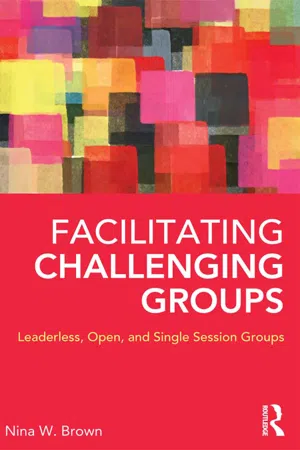
Groups—like the people in them—come in all forms, and often they don't fit a standard mold. Single-session, leaderless, and open groups are three of the most common kinds of nonstandard groups, but participants and facilitators of these kinds of groups have few, if any, resources at their disposal when they try to confront the unique challenges that their group structures present. Facilitating Challenging Groups confronts these challenges head on and offers activities, tools, tips, and techniques vital to everyone from the smallest self-help group to the largest human-relations training session. Readers will come away from this book with a deep understanding of each group's unique needs, the leader's role where applicable, and concrete strategies for developing the two traits most important to any successful group: universality and hope.
eBook - ePub
Facilitating Challenging Groups
Leaderless, Open, and Single-Session Groups
- 216 pages
- English
- ePUB (mobile friendly)
- Available on iOS & Android
eBook - ePub
About this book
Information
1

Facilitating Challenging Groups: Leaderless, Open, and Single Session Groups
The reality of leading a group can be very different from the leader’s educational and training experiences. Group leaders can encounter many unanticipated and sometimes difficult events and situations with their groups. Many preparation courses and programs are geared to providing the knowledge, skills, and techniques for facilitating a particular type of group, usually a closed group with consistent membership and a limited number of sessions. The reality of practice may be that even when the group is closed, the leader is unprepared to cope effectively with sporadic or inconsistent attendance by one or more group members; a member terminating his or her participation without notice; life events for members that affect their ability to attend a group session; the leader’s inability to screen out or terminate inappropriate members (e.g., for non-attendance) because of policies that are in place; and so on.
In addition, there is little information presented in preparation programs about leaderless, open, and single session groups. An examination of six textbooks and other leading books on group facilitation has shown that most do not present any information on leaderless and single session groups, and while all do have some information on open groups, that information is limited (Corey, 2008; Coyne, Crowill, & Newmeyer, 2008; Forsyth, 1999; Jacobs, Masson, & Harvill, 2009; Posthuma, 2002; Yalom & Leszcz, 2005). There are many of these challenging groups in the field, and this book is intended to fill these gaps. It is intended to provide guidance for entry-level and untrained group leaders who are called on to facilitate these challenging groups, and for trained group leaders who may be leading one or more of these groups for the first time.
Chapter 1 provides descriptions and definitions for three types of challenging groups, a rationale for some perceptual shifts leaders need to make, ethical considerations, and an overview of the remaining chapters. To get oriented, let’s begin with defining and describing challenging groups.
Open Groups
Open groups are not easily defined but can be conceptualized as groups organized around a common theme or purpose, the duration for the group is open-ended, members are added or terminated along the life of the group on an as needed basis, and these groups call for a high level of leader flexibility to accommodate the ever changing group membership (Gruner, 1984). Examples of groups that fit this category include some support and self-help groups, some substance abuse treatment groups, and peer supervision groups for mental health professionals. Some of these examples will also be classified with the leaderless groups.
Other characteristics of open groups include the following:

Leaderless Groups
Leaderless groups can be found in many venues, such as training groups for mental health professionals, self-help and support groups, and some treatment groups such as the long term leaderless women’s group described by Counselman (1991) that has some therapy aspects. Leaderless groups usually do not have a professional leader or facilitator who is responsible for the group and its functioning, although when the group is composed of mental health professionals there can be one or more members who alternate responsibility for facilitating group sessions. The term leaderless, in this discussion, refers to the absence of a formal group leader who is not a group member but is responsible for the group’s functioning. These groups have their own benefits, concerns, and challenges that revolve around or are associated with the lack of a formal leader. Some major characteristics for these groups are as follows:
Single Session
Two types of single sessions groups are discussed; the planned single session group, and the unplanned single session group. The planned single session group has a specified time frame where all members attend or are expected to attend the full session. Unplanned single session groups refer to planned multisession groups where one or more members will terminate prematurely, usually without notice, after the first session.
Single session groups are just what the title describes—one session. It can be frustrating to have to lead a group where the time constraints do not permit the learning, the dawning of awareness and insight, the unfolding of process and group development, or many of the group factors that have been shown to be helpful but that also need time to develop. Leaders can wonder about the usefulness of conducting a single session, but there can be also be positive outcomes when the leader understands the possibilities for effective use of the available time. Further, it may be that several sessions are planned, but one or more members attend a single session. The discussion will address how to make this limited participation positive for both the leader and the group member(s).
There is another use for a single session group perspective. It could be helpful to organize a multisession group so that each session is self-contained (Brown, 2011), so that even inconsistent attendance, such as what can happen when the group is open, allows members to receive some benefits from the sessions that they do attend.
Other characteristics of single session groups include the following:
Perceptual Shifts
The perceptual shifts that are needed for many group processes are very important for group leaders, especially trained group leaders, because these can differ for challenging groups as opposed to the usual closed group. For example, the planning process is a part of the preparation and training for group leaders (Corey, 2008; Yalom & Leszcz, 2005). This planning process will be very different for some challenging groups, however, and while some planning is recommended for all types of groups, some leaderless and self-help groups may not use it because of the lack of a trained leader, or because of leader absence or leader turnover. The trained group leader may need to make some perceptual shifts, but an untrained or temporary leader can be...
Table of contents
- Cover
- Half Title
- Title Page
- Copyright Page
- Dedication
- Table of Contents
- Acknowledgments
- 1 Facilitating Challenging Groups: Leaderless, Open, and Single Session Groups
- 2 General Group Factors
- 3 Developing a Therapeutic Alliance: Leader–Member Relationships
- 4 Open Groups: Challenges and Benefits
- 5 Open Groups: Issues, Concerns, and Possible Strategies
- 6 Open Groups: Facilitative Skills and Techniques
- 7 Leaderless Groups: Challenges, Benefits, and Self-Help Groups
- 8 Leaderless Groups: Guidelines for Facilitation
- 9 Single Session Groups: Challenges and Benefits
- 10 Single Session Groups: Planned or Unplanned Groups, Managing Premature Termination
- 11 Activities: Guidelines, Introductions, and Ice Breakers
- 12 Activities: Self-Reflection and Expressing Emotions
- 13 Activities: Communications and Closure
- References
- Index
Trusted by 375,005 students
Access to over 1.5 million titles for a fair monthly price.
Study more efficiently using our study tools.
Frequently asked questions
Yes, you can cancel anytime from the Subscription tab in your account settings on the Perlego website. Your subscription will stay active until the end of your current billing period. Learn how to cancel your subscription
No, books cannot be downloaded as external files, such as PDFs, for use outside of Perlego. However, you can download books within the Perlego app for offline reading on mobile or tablet. Learn how to download books offline
Perlego offers two plans: Essential and Complete
- Essential is ideal for learners and professionals who enjoy exploring a wide range of subjects. Access the Essential Library with 800,000+ trusted titles and best-sellers across business, personal growth, and the humanities. Includes unlimited reading time and Standard Read Aloud voice.
- Complete: Perfect for advanced learners and researchers needing full, unrestricted access. Unlock 1.5M+ books across hundreds of subjects, including academic and specialized titles. The Complete Plan also includes advanced features like Premium Read Aloud and Research Assistant.
We are an online textbook subscription service, where you can get access to an entire online library for less than the price of a single book per month. With over 1.5 million books across 990+ topics, we’ve got you covered! Learn about our mission
Look out for the read-aloud symbol on your next book to see if you can listen to it. The read-aloud tool reads text aloud for you, highlighting the text as it is being read. You can pause it, speed it up and slow it down. Learn more about Read Aloud
Yes! You can use the Perlego app on both iOS and Android devices to read anytime, anywhere — even offline. Perfect for commutes or when you’re on the go.
Please note we cannot support devices running on iOS 13 and Android 7 or earlier. Learn more about using the app
Please note we cannot support devices running on iOS 13 and Android 7 or earlier. Learn more about using the app
Yes, you can access Facilitating Challenging Groups by Nina W. Brown in PDF and/or ePUB format, as well as other popular books in Psychology & Mental Health in Psychology. We have over 1.5 million books available in our catalogue for you to explore.